
Home » College SAT Score Ranges, Costs, and Programs by Major and State » Engineering Colleges by State: SAT Scores, ACT Scores, Costs, and ABET Programs » Engineering Colleges in Mississippi: ACT Scores, SAT Scores, Costs, and Programs
By Glyn Caddell, BSME · Author of Digital SAT Math Secrets · Tutoring since 2008 — Updated October 24, 2026
Four Mississippi universities offer ABET-accredited engineering degrees, and this page lists what they cost and the test scores of the students they admit.
The two flagships report the same ACT range, and the number that separates them for a Mississippi student is the ACT Math score each one asks for before calculus, two points apart, a difference worked out below the table.
The table is sorted by ACT because every Mississippi public-school junior takes it, and it carries an ACT Math column that the other pages in this series do not, because the finding on this page is in that column.
Table of Contents
- Mississippi Engineering Colleges by ACT and SAT Score
- What ACT Math Score Do You Need to Start Calculus at Ole Miss or Mississippi State?
- Which Mississippi Universities Have ABET-Accredited Engineering Schools?
- What If Your Score Is Below the Line You Want?
Mississippi Engineering Colleges by ACT and SAT Score
The four universities below are the ones in Mississippi that hold an ABET-accredited bachelor’s degree in an engineering discipline. They are sorted by the midpoint of the ACT composite range, so the order can be checked from the table itself.
| College | ACT composite | ACT Math | SAT Reading & Writing | SAT Math | Cost of attendance | Undergraduates | Admit rate |
|---|---|---|---|---|---|---|---|
| Mississippi State University | 21 to 29 | 19 to 27 | 560 to 670 | 540 to 680 | $29,267 | 18,397 | 78% |
| University of Mississippi | 21 to 29 | 19 to 27 | 510 to 610 | 490 to 590 | $28,660 | 21,473 | 97% |
| University of Southern Mississippi | 20 to 29 | 17 to 25 | Does not report SAT data | Does not report SAT data | $26,566 | 10,075 | 99% |
| Jackson State University | 15 to 20 | 15 to 18 | 430 to 550 | 390 to 520 | $32,415 | 4,600 | 93% |
Each range covers the middle 50% of admitted students who submitted that test. A quarter scored below the lower number, and the top quarter scored at or above the upper one. Being under the lower number does not rule a student out, and being just above it is not as safe as it looks.
Mississippi State and Ole Miss share an ACT range, and Mississippi State is listed first on the SAT Math midpoint. The ACT Math column is added on this page because both flagships place students into calculus by that score. Only universities with an ABET-accredited engineering bachelor’s degree are listed. Southern Miss reports an ACT range and no SAT range.
Three things about that table are worth pausing on.
Mississippi State and Ole Miss report the same ACT composite range, 21 to 29, and the same ACT Math range, 19 to 27, and on the SAT they are 90 points apart at the Math ceiling, 680 to 590. A Mississippi student holding an ACT cannot tell the two apart from the table. A New York student holding an SAT can, and the next section is about which of them is seeing the real difference.
Southern Miss and Jackson State both charge a student from outside Mississippi less than $12,000 a year, $11,998 and $11,965. After McNeese State’s $9,989 on the Louisiana page and St. Cloud State’s $10,245 on the Minnesota page, those are the next two lowest out-of-state tuitions at public engineering schools in this series, and they are $33 apart.
Jackson State has the highest cost of attendance on the page, $32,415, and the lowest in-state tuition, $8,965. The $23,450 between them is housing, food, books and the university’s estimate of everything else, and it is the widest such gap on the page by $4,400.
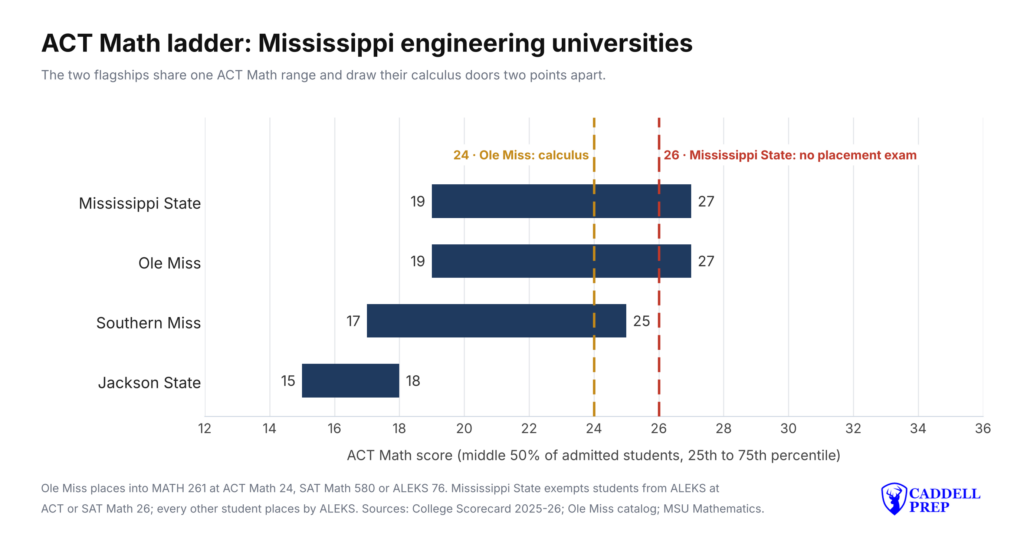
A student can see where his ACT Math score sits against the two calculus lines in the image above.
Want to Know What 5 Topics Will Improve Your SAT Score the Most?
Sample Feedback from our Diagnostic Test:

Mississippi State University
Mississippi State University’s Bagley College of Engineering in Starkville holds ABET accreditation in disciplines including aerospace, biological, biomedical, chemical, civil, computer, electrical, industrial, mechanical, petroleum and software engineering, and Mississippi State exempts a student from its math placement exam at an ACT Math score of 26.
ACT composite 21 to 29, ACT Math 19 to 27. Reading & Writing 560 to 670, Math 540 to 680. The top quarter of admitted students scored at or above 29 on the ACT and 680 on SAT Math. Cost of attendance $29,267, with tuition and fees at $10,202 in state and $27,637 out of state. 18,397 undergraduates, 78% admitted.
Mississippi State is the most selective school on the page by admit rate and holds the most accredited disciplines, eleven. Its SAT Math ceiling of 680 is 90 points above Ole Miss’s on an identical ACT range.
University of Mississippi
The University of Mississippi’s School of Engineering in Oxford holds ABET accreditation in biomedical, chemical, civil, computer, electrical, geological and mechanical engineering, and Ole Miss starts a student in Calculus I on an ACT Math score of 24.
ACT composite 21 to 29, ACT Math 19 to 27. Reading & Writing 510 to 610, Math 490 to 590. The top quarter of admitted students scored at or above 29 on the ACT and 590 on SAT Math. Cost of attendance $28,660, with tuition and fees at $9,772 in state and $28,600 out of state. 21,473 undergraduates, 97% admitted.
Ole Miss is the largest school on the page, admits 97% of applicants, and charges the highest out-of-state tuition on the page, $963 above Mississippi State’s. Its SAT Math ceiling of 590 is the lowest of the three reporting schools other than Jackson State.
University of Southern Mississippi
The University of Southern Mississippi in Hattiesburg holds ABET accreditation in polymer science and engineering, computer engineering and ocean engineering, and Southern Miss charges a student from outside Mississippi $11,998.
ACT composite 20 to 29, ACT Math 17 to 25. Southern Miss reports no SAT range. The top quarter of admitted students scored at or above 29 on the ACT and 25 on ACT Math. Cost of attendance $26,566, with tuition and fees at $9,998 in state and $11,998 out of state. 10,075 undergraduates, 99% admitted.
Southern Miss is the least selective school on the page, the cheapest by total cost, and the holder of one of two accredited ocean engineering degrees in this series. Its ACT Math ceiling of 25 is a point above Ole Miss’s calculus line and a point below Mississippi State’s exemption line.
Jackson State University
Jackson State University’s College of Science, Engineering and Technology holds ABET accreditation in civil, computer and electrical engineering, and Jackson State has the lowest range on the page on every test.
ACT composite 15 to 20, ACT Math 15 to 18. Reading & Writing 430 to 550, Math 390 to 520. The top quarter of admitted students scored at or above 20 on the ACT and 520 on SAT Math. Cost of attendance $32,415, with tuition and fees at $8,965 in state and $11,965 out of state. 4,600 undergraduates, 93% admitted.
Jackson State is the only historically Black university on the page, the smallest school, and the cheapest for a resident and for a non-resident. Its ACT Math ceiling of 18 is six points below Ole Miss’s calculus line and eight below Mississippi State’s exemption line, so a Jackson State student in the top quarter of his class on Math would sit a placement exam at either flagship.
Four ranges say who got in, and two of them are the same range. The next section is about the number that tells those two apart.
What ACT Math Score Do You Need to Start Calculus at Ole Miss or Mississippi State?
Ole Miss starts a student in Calculus I on an ACT Math score of 24 or an SAT Math score of 580, and Mississippi State exempts a student from its placement exam at an ACT or SAT Math score of 26 and otherwise places him into Calculus I on an ALEKS score of 76 or higher.
The two rules are written differently and the difference matters. Ole Miss’s Fall 2026 catalog lists the prerequisites for MATH 261, Unified Calculus and Analytic Geometry I, as any one of three: a minimum ACT mathematics score of 24, with SAT 560 or SAT 580 on the current scale as the equivalents, or a B in both MATH 121 and MATH 123 or a B in MATH 125, the precalculus sequence, or an ALEKS PPL score of 76. Mississippi State’s Department of Mathematics and Statistics does not publish an ACT line for MA 1713, Calculus I. It says that a student with a 26 or higher on the math portion of the ACT or SAT does not need to take the ALEKS PPL test and can register for the course his curriculum requires, and that every other student takes ALEKS, where a 76 or higher places into MA 1713, 61 to 75 into trigonometry, and 46 to 60 into college algebra, with three proctored attempts.
Now set both against the range they share. The ACT Math range at both universities is 19 to 27. The 24 sits approximately five eighths of the way up it. The 26 sits approximately seven eighths of the way up. So at Ole Miss, approximately the top third of admitted students start calculus on their score and the rest start it on a placement exam or a B in precalculus. At Mississippi State, approximately the top eighth skip the exam and everyone else takes it. Two universities, one admitted range, and the direct door into the first engineering math course two points apart.
The table’s SAT columns tell a different story, and it is the one a New York student will see first. Mississippi State’s SAT Math range is 540 to 680 and Ole Miss’s is 490 to 590, 90 points apart at the ceiling. But the SAT is the test a minority of Mississippi applicants submit, and the two schools’ SAT equivalents for the calculus door are 580 at Ole Miss and, by Mississippi State’s own phrasing, whatever a 26 on the ACT converts to. The Mississippi student is not choosing between a 590 school and a 680 school. He is choosing between a 24 door and a 26 door on a range of 19 to 27.
Admission itself does none of this work in Mississippi, and the reason is worth one paragraph. The IHL board’s Policy 602 sets a statewide full-admission standard for every public university: a 3.20 GPA on the college preparatory curriculum with no test score, or a 2.50 GPA or top-half class rank with an ACT composite of 16, or a 2.00 GPA with an ACT composite of 18. A 16 and an 18 are the lowest admission test lines on any page in this series, and they explain why Ole Miss admits 97% and Southern Miss 99%. The ACT does no admission work at either flagship. It does all of its work at the math door, where a 16 is eight points under the lower line.
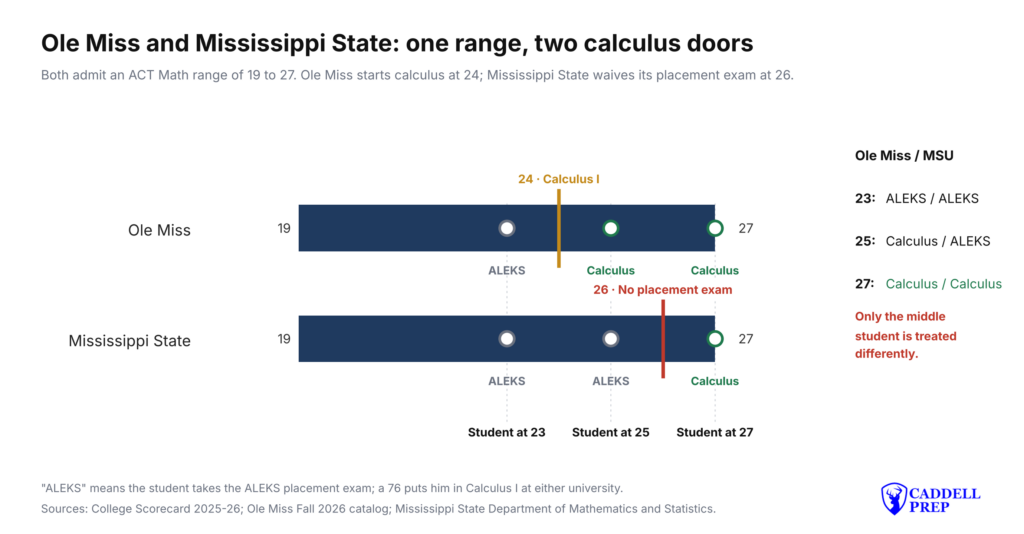
The image above shows the same range at both universities, two points apart at the door.
Take three students with ACT Math scores of 23, 25 and 27. The student at 23 is below both lines, and both universities send him to the ALEKS exam, where a 76 puts him in calculus at either one and a lower score puts him in precalculus. The student at 25 is above Ole Miss’s line and below Mississippi State’s, so he registers for MATH 261 in Oxford on his score and sits the ALEKS exam in Starkville, where the same 76 does the same thing. The student at 27 is above both lines and starts calculus at either one on the score. The composite range cannot tell the three apart. The Math subscore and the two lines can, and only the middle student is treated differently by the two schools.
The other two schools on the page sit below both lines. Southern Miss’s ACT Math range is 17 to 25, so its top quarter reaches Ole Miss’s line and not Mississippi State’s, and it holds three accredited degrees a student will not find in Oxford or Starkville: polymer science and engineering, accredited since 2019, computer engineering, and ocean engineering, accredited in 2023. Jackson State’s ACT Math range is 15 to 18, six points under the lower line at the ceiling. Both charge a non-resident under $12,000. On our page on engineering colleges in Louisiana, LSU places into calculus by ALEKS alone and says a high ACT is not sufficient. Mississippi’s two flagships each accept the ACT at the door, and the only question is which number.
The honest version is that a placement line is not a wall. A student below 24 at Ole Miss or below 26 at Mississippi State takes an exam, and a 76 on that exam puts him in the same calculus section as the student who skipped it. Ole Miss also admits a student into MATH 261 on a B in precalculus with no score at all. Both universities’ admitted ranges describe the students who submitted a test, and under the IHL standard a student with a 3.20 need not have submitted one. Iowa’s two universities also shared an ACT range, on our page on engineering colleges in Iowa, and were separated on the SAT. Mississippi’s cannot be separated that way for the student the page is written for, and the two calculus lines are what separates them instead.
Families reading the two placement pages frequently ask about the score that falls between the lines.
Does a 25 on ACT Math Put You in Calculus at Both Flagships?
A 25 on ACT Math puts a student in Calculus I at Ole Miss on his score and does not put him there at Mississippi State on his score. Ole Miss’s line is 24. Mississippi State’s exemption line is 26, so a 25 takes the ALEKS exam, and a 76 on it places him into MA 1713.
The same student, the same score, and one placement exam between the two campuses. He is in the top third of the admitted range at both universities, and at one of them that is enough.
The two lines are the universities’ own. The degrees are what the next section lists.
Which Mississippi Universities Have ABET-Accredited Engineering Schools?
Four Mississippi universities hold ABET-accredited engineering bachelor’s degrees, all four public, and all four are in the table above.
In Starkville, Mississippi State’s Bagley College of Engineering holds eleven disciplines, the most in the state, with the Nissan plant in Canton and the aerospace cluster around Columbus and the Golden Triangle the nearest large employers. In Oxford, Ole Miss’s School of Engineering holds seven, including the state’s only geological engineering degree. In Hattiesburg, Southern Miss holds polymer science and engineering, computer engineering and ocean engineering, an hour from Ingalls Shipbuilding in Pascagoula and the Stennis Space Center. In Jackson, Jackson State’s College of Science, Engineering and Technology holds civil, computer and electrical engineering.
Accreditation matters for a reason that is easy to miss at seventeen. Licensure as a professional engineer normally requires a degree from an ABET-accredited engineering program. Mississippi Christian, Belhaven, William Carey, Mississippi University for Women, Delta State, Alcorn State, Mississippi Valley State, Rust and Tougaloo award no engineering degree, and Millsaps routes students to one through a three-two arrangement that finishes at another university.
Nothing on this page ranks the four. The table’s order is a stated, verifiable number, and the choice among accredited programs comes down to cost, discipline and where a student’s score places him.
What If Your Scores Are Below the Range You Want?
In Mississippi admission is not the question at any of the four universities, and the math door is. A student at 23 on ACT Math is one point from Ole Miss’s line and three from Mississippi State’s, and the difference between a 23 and a 24 on that section is one or two questions on a test he has already taken once in school.
The ACT Math section rewards the same algebra, functions and geometry at every administration, and a student who knows which of them he is missing can move two points in a summer. A student who would rather not retest has the ALEKS route at both universities, and the topics ALEKS asks about are the same ones. A New York student has three ranges and out-of-state tuition from $11,965 at Jackson State to $28,600 at Ole Miss.
The first step is finding out where the score actually is, section by section. A free diagnostic SAT gives a Math score that can be set against the SAT columns in the table and converted to the two ACT lines.
The Math section rewards the same handful of topics on every test date, and a student who knows which of them he is missing can close a gap of 50 to 100 points in weeks rather than months. The method is on our page on improving your SAT Math score, and the same topics carry the ACT Math section and the ALEKS exam.
How to Read These Score Ranges
Every range on this page covers the middle 50% of admitted students who submitted that test. The lower number is the 25th percentile and the upper number is the 75th, so a quarter of admitted students scored at or above it.
Two universities with one range are not the same university. The range says who they admitted, and the lines each one draws inside the range say what they ask of him once he arrives, and on this page those lines are where the two flagships differ.
Because most colleges are now test-optional, the ranges that are published describe only the students who chose to submit at all. Students with strong scores submit and students with weak ones don’t, so a published range sits higher than the range for everyone who was actually admitted. More on what SAT score you need for college and on test-optional colleges.
Should You Take the SAT Instead?
Mississippi is an ACT state. Every public-school junior takes the ACT, thirteen Mississippi institutions report an ACT range against eight for the SAT, and the IHL admission standard is written in ACT composite points.
That is why the table on this page carries ACT columns and is sorted by them. Both flagships write an SAT equivalent into their calculus rules, 580 at Ole Miss and a 26 “on the math portion of the ACT/SAT” at Mississippi State, and a student from outside Mississippi who holds an SAT should read the SAT columns and submit the test he scores higher on.
Engineering Programs in Nearby States
Mississippi borders Alabama, Louisiana, Tennessee and Arkansas, and Mississippi students apply across those lines in numbers even with four accredited programs at home.
See engineering colleges in Alabama, engineering colleges in Louisiana, and engineering colleges in Tennessee.
Engineering Colleges in Other States
We publish the same breakdown for engineering programs in every state.
See engineering colleges by state for the full list.

Glyn Caddell
Glyn Caddell holds a BS in Mechanical Engineering from NJIT and has been tutoring New York City students since 2008. He founded Caddell Prep in 2012 and is the author of Digital SAT Math Secrets: Lessons & Tricks to Quickly Improve to a Perfect 800 on the Math Test, which contains over 900 practice problems and is used in Caddell Prep’s SAT math classes. He is founding president of the Staten Island Technical High School alumni association and teaches every lesson on this site personally.
Finally, an SAT course that students actually understand
Every question has a video explanation. Not most — every one.
The on-demand Digital SAT course covers all 17 math topics and 15 reading and writing topics, with 5 full-length practice tests and a 100-point score increase guarantee. Keep access for the rest of high school. No subscription.
Want to Know What 5 Topics Will Improve Your SAT Score the Most?
Sample Feedback from our Diagnostic Test: