
Home » College SAT Score Ranges, Costs, and Programs by Major and State » Engineering Colleges by State: SAT Scores, ACT Scores, Costs, and ABET Programs » Engineering Colleges in Delaware: SAT Scores, Costs, and Programs
By Glyn Caddell, BSME · Author of Digital SAT Math Secrets · Tutoring since 2008 — Updated October 22, 2026
One Delaware university, the University of Delaware, holds ABET-accredited engineering degrees, nine of them, and this page lists what it costs and the SAT scores of the students it admits.
UD considers an applicant for an engineering major only if he passed precalculus in high school, and once he is in, it places him into calculus by an assessment the SAT does not touch. Both rules are covered below. Because the state has one engineering school, the second half of the page is the engineering schools across its three borders, where most Delaware applicants also apply.
Table of Contents
- What Does the University of Delaware’s Engineering College Admit and Cost?
- What Does It Take to Get Into Engineering at the University of Delaware?
- What SAT Range Does the University of Delaware Publish?
- Why Is the University of Delaware the Only Engineering School on This Page?
- What If You Want an Engineering School Outside Delaware?
What Does the University of Delaware's Engineering College Admit and Cost?
The University of Delaware’s College of Engineering in Newark admits students with a middle-50% SAT Reading & Writing of 600 to 690 and Math of 590 to 680, at a cost of attendance of $30,952 for a Delaware resident.
The top quarter of admitted students scored at or above 690 on Reading & Writing and 680 on Math. The ACT composite range is 28 to 32, with ACT Math at 26 to 32. Tuition and fees are $16,810 in-state and $41,400 out-of-state, so an out-of-state student’s cost of attendance comes to approximately $55,500 once the higher tuition is substituted. UD has 19,071 undergraduates and admits 71% of applicants.
The nine accredited degrees are biomedical, chemical, civil, computer, construction engineering and management, electrical, environmental, materials science, and mechanical engineering. A tenth, cybersecurity engineering, is seeking its initial accreditation in the 2026-27 cycle and is not counted.
| University of Delaware | |
|---|---|
| SAT Reading & Writing, middle 50% | 600 to 690 |
| SAT Math, middle 50% | 590 to 680 |
| ACT composite, middle 50% | 28 to 32 |
| Cost of attendance, in-state | $30,952 |
| Tuition and fees, in-state / out-of-state | $16,810 / $41,400 |
| Undergraduates | 19,071 |
| Admit rate | 71% |
| ABET-accredited engineering degrees | 9 |
Each range covers the middle 50% of enrolled students who submitted that test. A quarter scored below the lower number, and the top quarter scored at or above the upper one. Figures are university-wide, from the 2025-26 College Scorecard.
Two things about those figures are worth pausing on.
Out-of-state tuition is approximately two and a half times in-state. A New Jersey or New York student pays $24,590 a year more than a Delaware student for the same seat, and the state line is forty minutes from the campus.
UD admits 71% of applicants, and that figure is for the university. Its engineering majors sit behind a rule that the admit rate does not show, and that rule is the reason this page exists.
What Does It Take to Get Into Engineering at the University of Delaware?
A student is considered for an engineering major at the University of Delaware only if he has taken and passed precalculus in high school, and once admitted he is placed into calculus by UD’s ALEKS assessment at a score of 75, and the SAT decides neither.
The first gate is a course. UD’s first-year requirements page says that some majors require at least precalculus to have been taken and passed in high school by graduation, lists the College of Engineering’s majors among them, and states that applicants to those majors will not be considered for the major unless the prerequisite has been met. A student whose high school does not offer precalculus can apply to University Studies, UD’s undeclared program, and transfer into engineering later after meeting its requirements. The same page says that an applicant may be admitted to University Studies if space no longer remains in the major he chose.
The second gate is an assessment. Every UD student is placed into his first math course by ALEKS, and the placement goal for engineering majors is MATH 241, Analytic Geometry and Calculus A, at a score of 75 or above. Precalculus for Scientists and Engineers sits at 57 and Precalculus at 40. A student may take the assessment three times, at least 48 hours apart, and his highest score counts. For fall 2026 it opened on April 1 and closes for registration purposes on June 20. The mathematics department’s placement rules say nothing about the SAT or the ACT, because neither is used.
The department’s own words for an engineering student who scores below 75 are that he may need to attend winter or summer sessions to get back on track with his math sequence, and that failing to do so may extend the time it takes to complete the degree.
Take a student with a 1380 SAT, inside UD’s published admitted range, who took a course called trigonometry in his senior year rather than one called precalculus. He is not considered for mechanical engineering. A student with a 1250 who passed precalculus is. In April both take ALEKS. The one who scores 74 starts in precalculus again in the fall, and the one who scores 75 starts in calculus. The SAT appeared in neither decision.
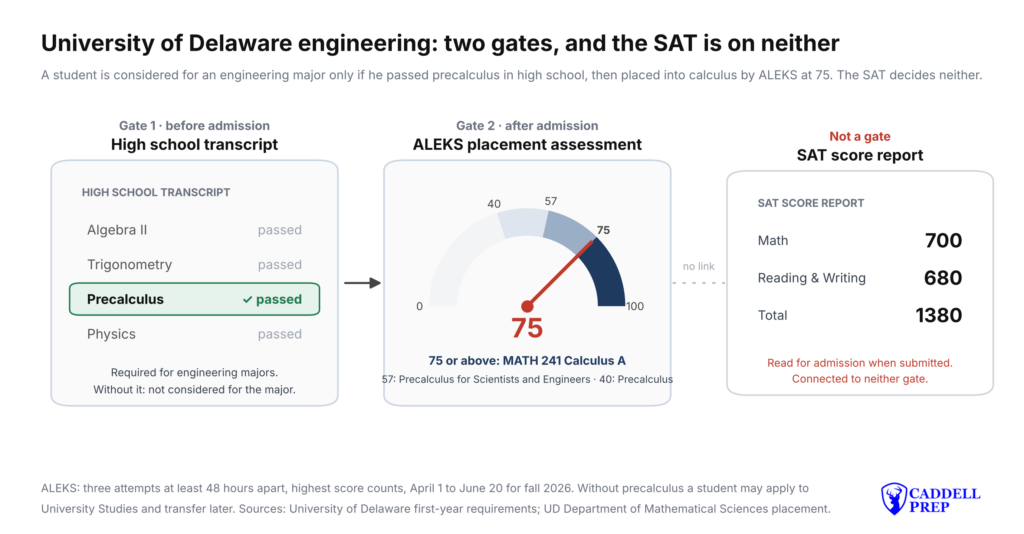
The image above shows two gates, and the SAT is on neither.
The SAT is not nothing at UD. It is read when an applicant submits it, UD is test-optional and leaves that choice to him, and a submitted score is set against the ranges in the next section. What it does not do is open the engineering major or decide the first math course, and a student who has been told the score is the thing to work on should know which decisions it reaches.
Families who have seen the ALEKS line frequently ask whether a strong Math score can stand in for it.
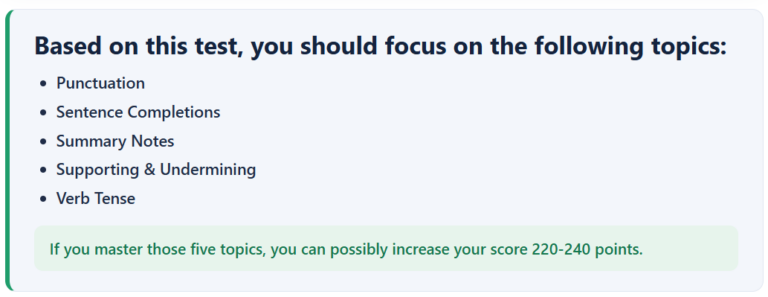
Want to Know What 5 Topics Will Improve Your SAT Score the Most?
Sample Feedback from our Diagnostic Test:
Does the University of Delaware Use the SAT for Math Placement?
The University of Delaware does not use the SAT or the ACT for math placement. Every incoming student takes the ALEKS assessment, a score of 75 places into Calculus A, and a student has three attempts to reach it before June 20.
An engineering student who finishes below 75 starts in a precalculus course that is not on his degree plan, and the department says he may need winter or summer sessions to catch up. The algebra, functions and trigonometry ALEKS tests are the same topics the SAT Math section tests, so the preparation overlaps, and a student who has worked through them for one will find the other familiar. The method for the SAT side is on our page on how to improve your SAT score.
The score’s one job at UD is the admitted range, and UD publishes two of them.
What SAT Range Does the University of Delaware Publish?
The University of Delaware publishes a middle-50% SAT of 1240 to 1390 for general admits and 1350 to 1460 for Honors College admits, and no separate range for its engineering college.
General admits also show a weighted GPA of 3.68 to 4.22 and an ACT of 28 to 32. Honors College admits show a GPA of 4.24 to 4.51 and an ACT of 30 to 34. UD notes that the SAT and GPA figures are self-reported at the time of publication, and because UD is test-optional, the score ranges describe only the students who chose to submit.
| Range | SAT total, middle 50% | Who it describes |
|---|---|---|
| College Scorecard, 2025-26 | approximately 1190 to 1370 | Enrolled students, whole university, sections summed |
| UD general admits | 1240 to 1390 | Admitted students, whole university, self-reported |
| UD Honors College admits | 1350 to 1460 | Admitted to the Honors College, self-reported |
The Scorecard sum adds the 25th percentiles of the two sections and the 75th percentiles, which is not how a total range is built, so it is approximate. UD does not publish a range for the College of Engineering.
The three ranges describe three groups, and none of them is engineering applicants. The Scorecard figure is everyone enrolled. UD’s general figure is everyone admitted who reported a score. The Honors figure is the top of that. At the University of Colorado Boulder, which does publish an engineering-college range, it sat 70 points above the university’s, and a UD engineering applicant should assume the same direction without knowing the size.
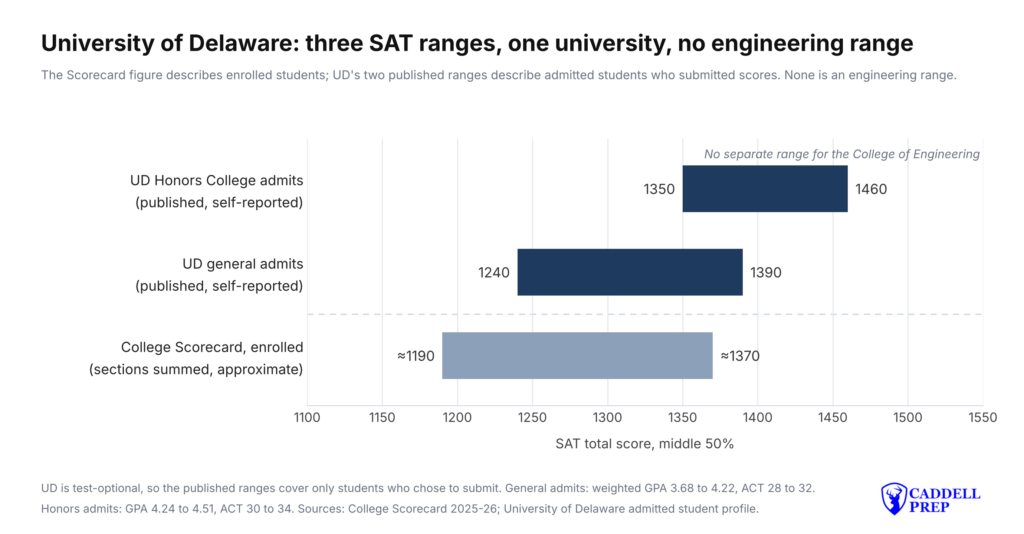
The image above shows three ranges, one university, no engineering range.
Delaware administers the SAT to every public high school junior as its state assessment, so a Delaware applicant has a score whether or not he sends it. The ranges on this page belong to one university because the state has one engineering school, and the next section says why.
Why Is the University of Delaware the Only Engineering School on This Page?
The University of Delaware is the only institution in Delaware that holds an ABET-accredited engineering bachelor’s degree.
Delaware State University in Dover is the state’s historically Black land-grant university. It admits 47% of applicants with a Math range of 380 to 500, costs $27,939 with tuition of $10,670 in-state, and offers an engineering physics degree rather than an accredited engineering one. Wilmington University and Goldey-Beacom College offer no engineering, and Delaware Technical Community College is a two-year institution.
Accreditation is the criterion for a reason that is easy to miss at seventeen. Licensure as a professional engineer normally requires a degree from an ABET-accredited engineering program, and a page about engineering colleges that listed programs without one would be listing a different thing.
So a Delaware engineering applicant has one in-state option, and most of them apply across the border too.
What If You Want an Engineering School Outside Delaware?
Most Delaware engineering applicants apply to at least one school across the state line, and at every one of them the SAT is read against a published range the way it is on every other page in this series.
Pennsylvania is twenty minutes north of the UD campus and holds Penn State, Drexel, Villanova, Lehigh and Temple, all with accredited engineering degrees, listed on our page on engineering colleges in Pennsylvania. New Jersey holds Rutgers, NJIT, Rowan, Stevens and Princeton, on the engineering colleges in New Jersey page. Maryland holds the University of Maryland and Johns Hopkins, on the engineering colleges in Maryland page.
For a Delaware student the comparison is what the flagships charge him as an outsider. Penn State’s out-of-state tuition and fees are $41,790, Rutgers New Brunswick’s $37,441 and Maryland’s $41,186, against UD’s own $16,810 in-state, so the in-state seat is approximately $21,000 to $25,000 a year cheaper than any of the three. For a New Jersey, New York or Pennsylvania student the comparison runs the other way: UD’s $41,400 sits in the same band as the other three flagships’ out-of-state figures, and the choice among them is not a cost choice.
The first step for any of those applications is finding out where the score actually is, section by section. A free diagnostic SAT gives a Math and a Reading & Writing score that can be set against UD’s published range and against every range on the three state pages above.
The Math section rewards the same handful of topics on every test date, and a student who knows which of them he is missing can close a gap of 50 to 100 points in weeks rather than months. The method is on our page on improving your SAT score, and the topics are the ones ALEKS will ask him about in April.
How to Read These Score Ranges
The Scorecard range on this page covers the middle 50% of enrolled students who submitted the SAT, with the lower number at the 25th percentile and the upper at the 75th, so a quarter of students scored at or above it.
UD’s own ranges are different in two ways. They describe admitted students rather than enrolled ones, and they are self-reported. Neither range, and not the Scorecard’s, is specific to the College of Engineering.
Because most colleges are now test-optional, the ranges that are published describe only the students who chose to submit at all. Students with strong scores submit and students with weak ones don’t, so a published range sits higher than the range for everyone who was actually admitted. More on what SAT score you need for college and on test-optional colleges.
Should You Take the ACT Instead?
Delaware is an SAT state. The state gives every public high school junior the SAT, and UD accepts either test and reports both.
A student who scores higher on the ACT should submit it. A student whose state-administered SAT is already inside the range he wants does not need a second test, and neither test moves the precalculus gate or the ALEKS line.
Engineering Colleges in Other States
Delaware borders Pennsylvania, New Jersey and Maryland, and the three pages are linked above.
See engineering colleges in Pennsylvania, engineering colleges in New Jersey, and engineering colleges in Maryland.
Engineering Colleges in Other States
We publish the same breakdown for pre-med programs in every state.
See pre-med colleges by state for the full list.
Add Your Heading Text Here

Glyn Caddell
Glyn Caddell holds a BS in Mechanical Engineering from NJIT and has been tutoring New York City students since 2008. He founded Caddell Prep in 2012 and is the author of Digital SAT Math Secrets: Lessons & Tricks to Quickly Improve to a Perfect 800 on the Math Test, which contains over 900 practice problems and is used in Caddell Prep’s SAT math classes. He is founding president of the Staten Island Technical High School alumni association and teaches every lesson on this site personally.
Finally, an SAT course that students actually understand
Every question has a video explanation. Not most — every one.
The on-demand Digital SAT course covers all 17 math topics and 15 reading and writing topics, with 5 full-length practice tests and a 100-point score increase guarantee. Keep access for the rest of high school. No subscription.
Want to Know What 5 Topics Will Improve Your SAT Score the Most?
Sample Feedback from our Diagnostic Test: