
Home » College SAT Score Ranges, Costs, and Programs by Major and State » Best Pre-Med Colleges » Pre-Med Colleges in Wyoming: ACT Scores, Costs, and Programs
By Glyn Caddell, BSME · Author of Digital SAT Math Secrets · Tutoring since 2008 — Updated October 19, 2026
Wyoming has one four-year university, and this page covers what it costs, what the ACT is worth to a Wyoming student, and how the state’s medical school arrangement works.
The University of Wyoming admits 97% of applicants and publishes no admitted test scores, so the ACT decides nothing about getting in, and it decides up to $18,880 through the Hathaway Scholarship.
This page looks different from the other state pages in this series, and the reason is simple. There is no score table to build, because Wyoming has one four-year institution and it publishes no ranges, so the page gives the regional comparison a Wyoming student actually needs instead.
Two abbreviations matter later on this page. MD is the degree awarded by most medical schools in the United States. DO is the degree awarded by colleges of osteopathic medicine, and DO holders are licensed physicians with the same practice rights. Wyoming has neither kind of school and reaches both by buying seats at other states’ institutions.
Table of Contents
- How Many Four-Year Colleges Does Wyoming Have?
- What ACT Score Does the Hathaway Scholarship Require?
- How Does a Wyoming Student Get Into Medical School?
- Should a Wyoming Student Leave the State?
- What If Your Scores Are Below the Range You Want?
How Many Four-Year Colleges Does Wyoming Have?
Wyoming has one. The table below covers four-year public and non-profit institutions in the state awarding bachelor’s degrees or higher, with at least 1,000 undergraduates, that report an admit rate or admitted test scores, and that rule returns a single institution.
The reason is worth stating, because a reader will otherwise assume the page is incomplete. Wyoming’s other public institutions are community colleges, which these pages do not cover, and the remaining institutions are for-profit. Laramie County Community College, Casper College, Northern Wyoming Community College District, Western Wyoming Community College, Central Wyoming College, Northwest College and Eastern Wyoming College are all predominantly associate-degree institutions.
That makes Wyoming unusual in a way worth measuring. Computed across the whole dataset, Wyoming is the only state with just one public or non-profit institution of 1,000 or more undergraduates that predominantly awards bachelor’s degrees. Guam and the United States Virgin Islands each have one as well and are territories rather than states. Alaska has two, and Delaware and Nevada have three each.
| College | Reading & Writing | Math | Cost of attendance | Undergraduates | Admit rate |
|---|---|---|---|---|---|
| University of Wyoming | Does not report SAT data | Does not report SAT data | $24,818 | 7,944 | 97% |
The University of Wyoming publishes no admitted score ranges, so there is no in-state figure to compare a score against. It reports no ACT composite either. The sections below cover what a test score does decide in Wyoming, and it is a good deal more than this table suggests.
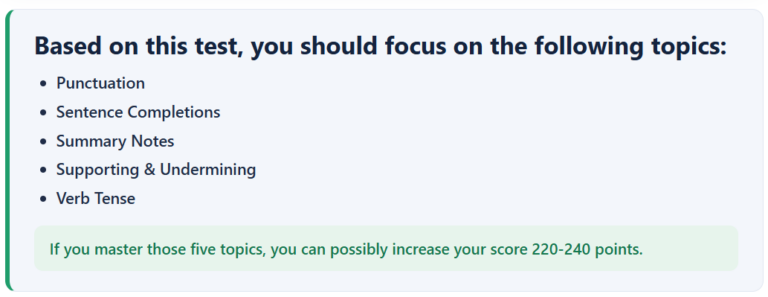
Want to Know What 5 Topics Will Improve Your SAT Score the Most?
Sample Feedback from our Diagnostic Test:
University of Wyoming
The University of Wyoming is the state’s only four-year university, a public land-grant institution in Laramie with 7,944 undergraduates. It admits 97% of applicants and publishes no admitted score ranges for either test.
Cost of attendance is $24,818. In-state tuition and fees are $7,768 against $24,178 for non-residents, a gap of $16,410. That $7,768 resident rate is the lowest charged by any public university in Wyoming or in any of its six bordering states, and the regional comparison later on this page sets out the alternatives.
The university also matters to a pre-med student for a reason that has nothing to do with its undergraduate figures. Students admitted to Wyoming’s medical school arrangement spend eighteen months on the University of Wyoming campus in Laramie before moving into clinical training, so the one university in this table is also where Wyoming’s medical students begin.
What ACT Score Does the Hathaway Scholarship Require?
The Hathaway Scholarship sets four tiers, each with a grade point average and an ACT score. Honors requires a 3.5 average and an ACT of 25 and pays $2,360 a semester. Performance requires a 3.0 and a 21 and pays $1,770. Opportunity requires a 2.5 and a 19 and pays $1,180. Provisional Opportunity requires a 2.5 and a 17, or a WorkKeys score of 12, and pays $1,180.
The first three run for up to eight full-time semesters. Provisional Opportunity runs for four and must be used first at a Wyoming community college, and a provisional student who earns an associate degree can extend for four more semesters at the University of Wyoming. The amounts apply to courses beginning on or after 1 July 2026. The award is usable at the University of Wyoming or any Wyoming community college and does not travel out of state.
A success curriculum applies alongside the score, and a student can clear the ACT threshold and still fall short on coursework. The top three tiers require four years of language arts, four years of mathematics including Algebra I, Algebra II and Geometry plus additional mathematics in grades nine through twelve, three years of social studies, four years of science, and four years of fine arts, career and technical education or world language with two years sequenced. Provisional requirements are lower.
One gap in the published requirements deserves a student’s attention. Both the Hathaway program’s own requirements page and the Wyoming Department of Education’s 2026 requirements document name the ACT, and the provisional tier also accepts WorkKeys, and neither mentions the SAT anywhere. That is an absence rather than a stated exclusion, so this page does not claim the SAT is refused. A Wyoming student who has taken only the SAT should confirm with the Hathaway program directly before assuming it counts, because the published materials give him no reason to think it does.
What Six ACT Points Are Worth in Wyoming
In annual terms the Hathaway tiers pay $4,720 for Honors, $3,540 for Performance and $2,360 for Opportunity. Over eight semesters they come to $18,880, $14,160 and $9,440, and Provisional Opportunity pays $4,720 across its four semesters.
Set against tuition, those figures are substantial. The University of Wyoming charges residents $7,768 a year, so Honors covers approximately 61% of in-state tuition, Performance approximately 46% and Opportunity approximately 30%. Against the full cost of attendance of $24,818, Honors covers approximately 19%. Both comparisons are worth knowing, because tuition is what the award is for and cost of attendance is what a family actually pays.
In-article image 1 Shows: the four Hathaway tiers as steps against the ACT scale at 17, 19, 21 and 25, with each tier’s annual award and the University of Wyoming’s resident tuition drawn across them Alt text: Hathaway Scholarship tiers by required ACT score with annual awards against University of Wyoming resident tuition File name: hathaway-act-tiers-against-tuition Size: 2760×1440
Drawn as steps, six ACT points separate the bottom tier from the top one. Moving from Opportunity to Honors means going from a 19 to a 25, and it is worth $9,440 over eight semesters, more than a full year of resident tuition. That averages approximately $1,573 for each ACT point.
Each individual step is worth $1,180 a year and $4,720 over eight semesters, whether the step is 19 to 21 or 21 to 25.
The grade point requirement is the second gate and it should not be glossed over. The tiers ask for a 3.5, a 3.0 and a 2.5, and a student who already has the average still needs the score. What makes the score the interesting half is that it is the part he can move in a few months, where a grade point average is the accumulated result of four years.
Every Wyoming Junior Takes the ACT at School
The Wyoming State Board of Education lists the ACT as the state’s grade 11 assessment, taken by all grade 11 students in English, mathematics, reading, writing and science. WY-TOPP covers grades three through ten and is a different test.
So a Wyoming student gets one ACT attempt at no cost as a matter of state policy, and that attempt is what sorts him into a Hathaway tier.
The retake route is real and matters because of the ladder. The Wyoming Department of Education published a notice in November 2025 covering ACT fee waivers for national test date registration fees, with eligibility for eleventh and twelfth graders described as criteria-based including demonstrated financial need. Under the waiver a student can test at no cost up to two times, and the notice also lists free online test preparation access, unlimited additional score reports and college application fee waivers. A student planning around that should confirm with his counselor that the waiver is still running, since the notice carries a date.
That combination is unusual and it is the reason the closing section of this page makes a stronger case for preparation than most pages in this series. A Wyoming student gets a free state administration, a published tier ladder where one band is worth $4,720 a year, and up to two further free attempts if he qualifies.
How Does a Wyoming Student Get Into Medical School?
Wyoming has no medical school, so it buys up to twenty seats a year at the University of Washington School of Medicine through a regional program called WWAMI.
WWAMI covers Washington, Wyoming, Alaska, Montana and Idaho, and the letters are those five states. Wyoming’s allocation rose from the original ten seats when the state legislature approved the increase in 2011.
Accepted students spend eighteen months on the University of Wyoming campus in Laramie, then move into years three and four as rotations at selected clinical sites across the WWAMI region, with the University of Washington giving a rotation in Powell as one Wyoming example. That is the strongest reason a Wyoming pre-med student has to care about the University of Wyoming specifically, because the one university in the table above is where his medical training would begin.
The published acceptance rates are where the arrangement becomes visible. The University of Washington publishes three-year averages by group, and Wyoming’s is 46.5%, the highest of the five WWAMI states. Montana is 30.3%, Idaho 27.6%, Washington 13.4%, Alaska 8%, and out-of-region 0.5%.
In-article image 2 Shows: Wyoming’s purchased professional seats with WWAMI’s twenty medical seats, WYDENT’s four dental seats and the WICHE fields, with the practice obligation marked on each Alt text: Wyoming purchased professional school seats by field with the state practice obligation marked File name: wyoming-purchased-professional-seats Size: 2760×1440
A Wyoming resident’s published acceptance rate is approximately ninety times an out-of-region applicant’s, and it is the most favorable published figure on any page in this series. The state with the fewest colleges in the country gives its residents the best published odds into a medical school anywhere in this grid.
One caution carries over from the Washington page in this series. The University of Washington’s published applications and interviews table contains Wyoming figures that do not reconcile, showing 43 applicants against 136 interviews, and a school cannot interview more applicants than applied to it. This page therefore uses the three-year average acceptance rates, internally consistent figures, and does not reproduce that table. A reader who goes looking for the funnel should know the numbers there do not add up.
Selection works through Wyoming before it reaches Seattle. Applicants are certified as Wyoming residents first, after which the University of Wyoming’s preprofessional advising office forwards names to the University of Washington’s admissions office. Two members of its executive committee review each file independently and anonymously, with a third resolving disagreements. Interviews run thirty to forty minutes before a three-person panel during one week in January or February, and Wyoming panels include one or two members of the Wyoming WWAMI Admissions Committee, made up of four Wyoming physicians or medical educators. The panel chair has full access to the file and the other members see everything except grades and MCAT scores.
The Seat Comes With a Contract
Before starting medical school, a Wyoming WWAMI student signs one of two options. He either reimburses the University of Wyoming for his educational costs plus interest, or he returns to Wyoming after residency and practices medicine in the state for three years.
The money moves through the state rather than directly. Wyoming pays the educational costs to the University of Washington, and the student makes contract payments to the University of Wyoming across the four years of medical school.
The University of Washington states that approximately 70% of Wyoming WWAMI graduates return to the state to practice. That figure is the university’s own and is reported here as such, and it is higher than the contract alone would require, which suggests the obligation is not the only thing bringing graduates back. What else is doing the work is not established here.
What a student should take from it is a straightforward trade. A Wyoming WWAMI seat is the best published route into medicine on this page and it is not a free one. A student confident he wants to practice in Wyoming is being offered a very good deal. A student who is not should price the reimbursement option before signing anything, because the alternative to three years of practice is repaying the state with interest.
Wyoming Buys Seats in Seven Other Fields Too
Wyoming has no medical, dental, veterinary, optometry or osteopathic school, and it reaches all of them by buying seats at other states’ institutions.
The WICHE Professional Student Exchange covers dentistry, occupational therapy, optometry, osteopathic medicine, podiatric medicine, physical therapy, physician assistant studies and veterinary medicine. Support is competitive, admission is at the out-of-state school, and supported students pay reduced tuition based on that institution’s costs. The same three-year return-to-Wyoming practice commitment applies, or repayment of state funds plus interest, with one exception. Veterinary medicine carries no contract and no payback requirement, and it is the one field where the state asks nothing back.
WYDENT buys up to two seats each at the University of Nebraska College of Dentistry and Creighton University School of Dentistry, so up to four in total, on the same terms as WWAMI.
Looked at together, every purchased seat but one comes with three years of Wyoming practice attached.
That has a direct consequence for a reader of this page. The DO route in Wyoming runs through WICHE rather than through any Wyoming institution, because the state has no osteopathic school. A student who wants the DO is applying out of state, and he may be able to do it on a purchased seat with the same three-year commitment attached.
No dollar amounts are published for any of the three programs in the materials consulted, so none appear here. All of it is administered through the University of Wyoming’s preprofessional advising office, and that is where a student should start.
No Other State in This Series Buys Its Medical School Seats
Wyoming is the only state covered in this series with no medical school of its own, and the only one that attaches a practice contract to every seat it funds. That makes its position on residency different in kind from the other states rather than different in degree.
Pennsylvania has more medical schools than any other state here, most of them private, so residency carries comparatively little published weight. Alabama’s two public schools publish no resident share in their own admissions materials, and Wisconsin publishes almost nothing. West Virginia has two public MD schools running opposite rules, with Marshall stating that other non-residents are not considered. Washington reserves approximately 95% of 280 seats for five states and admits out-of-region applicants at a three-year average of 0.5%. Texas caps non-residents at 10% of every public class by statute. Utah publishes a 132-seat table reserving 90 for residents. North Carolina’s Brody School of Medicine bars applicants who are neither residents nor recent UNC System graduates. Tennessee’s UTHSC caps out-of-state admissions at approximately 10%. Oregon’s OHSU writes four criteria into a numbered policy. South Dakota’s Sanford grants residents an interview. North Dakota’s UND ranks a state degree inside a preference order. Vermont’s published policy governs tuition rather than admission.
Two findings hold across all of them. Residency matters more than almost anything a student controls, and no two states express it the same way. Some publish a number, some publish a rule, some publish nothing, and Wyoming buys seats in another state and asks for three years back. A student should look up his own state rather than reason from a national average, because there is no national average to reason from.
Should a Wyoming Student Leave the State?
For most Wyoming students the arithmetic favors staying, and the figures below are the reason rather than the conclusion.
The table that follows compares the nearest public universities across Wyoming’s six bordering states, drawn from the same College Scorecard release as the table at the top of this page. These are not Wyoming colleges. It is sorted by out-of-state tuition, because that is what a Wyoming student would pay at any of them.
| University | State | Out-of-state tuition | In-state tuition | Cost of attendance | Admit rate | ACT composite |
|---|---|---|---|---|---|---|
| South Dakota State University | SD | $12,809 | $9,299 | $24,636 | 98% | 19 to 25 |
| University of South Dakota | SD | $12,942 | $9,432 | $24,422 | 99% | 19 to 25 |
| University of Wyoming | WY | $24,178 | $7,768 | $24,818 | 97% | Not reported |
| Utah State University | UT | $24,802 | $9,228 | $21,654 | 92% | 20 to 28 |
| Boise State University | ID | $27,788 | $9,048 | $28,224 | 87% | Not reported |
| University of Idaho | ID | $28,320 | $9,084 | $23,738 | 76% | 20 to 26 |
| University of Nebraska-Lincoln | NE | $28,584 | $10,434 | $26,697 | 87% | 22 to 28 |
| University of Utah | UT | $30,860 | $9,620 | $25,557 | 86% | 22 to 29 |
| Montana State University | MT | $33,287 | $8,460 | $25,905 | 82% | 21 to 27 |
| Colorado State University-Fort Collins | CO | $34,783 | $13,373 | $31,642 | 89% | Not reported |
| University of Colorado Boulder | CO | $44,918 | $15,666 | $37,684 | 78% | 29 to 33 |
Each ACT range covers the middle 50% of admitted students who submitted scores. A quarter scored below the lower number, and the top quarter scored at or above the upper one. Being under the lower number does not rule a student out, and being just above it is not as safe as it looks. These are out-of-state institutions, so a Wyoming student would pay the non-resident rate shown.
Five things in that comparison are worth stating.
The University of Wyoming’s in-state tuition of $7,768 is the lowest of any public university in Wyoming or any of its six bordering states.
In-article image 3 Shows: the eleven regional public universities by out-of-state tuition with the University of Wyoming’s resident rate marked separately Alt text: Public universities bordering Wyoming compared by out-of-state tuition against Wyoming resident tuition File name: wyoming-regional-tuition-comparison Size: 2760×1440
Set out that way, the cheapest way out of Wyoming costs about what the top scholarship tier pays. South Dakota State charges non-residents $12,809, or $5,041 a year more than a Wyoming resident pays at home, and the Hathaway Honors award is $4,720 a year and does not travel. For an Honors student the award almost exactly offsets the premium of leaving for South Dakota.
At the other end, Colorado Boulder charges non-residents $44,918, approximately 5.8 times the University of Wyoming’s resident rate, and at a 78% admit rate with an ACT range of 29 to 33 it is the only genuinely selective option among the neighbors.
Three of the eleven report no admitted scores of any kind. Those are the University of Wyoming, Boise State and Colorado State, so a student comparing himself against a range has eight of eleven to work with.
And the two South Dakota universities are the outliers on cost in the other direction, charging non-residents less than half what Montana State or Colorado State charge them, while admitting 98% and 99% of applicants.
What If Your Scores Are Below the Range You Want?
A Wyoming student whose score sits below the range he wants is in an unusual position, because in this state the score does not decide whether he goes to university. The University of Wyoming admits 97% of applicants and publishes no admitted ranges, so there is no in-state figure to clear.
What the score decides is money, and it decides a precise amount of it.
A student at an ACT of 19 holds Opportunity at $2,360 a year. At 21 he holds Performance at $3,540. At 25 he holds Honors at $4,720. Six points is worth $9,440 over eight semesters, more than a full year of resident tuition, and each individual tier step is worth $4,720 across the same period.
The mechanics favor a Wyoming student more than they favor students in most states. He sits the ACT free at school in grade eleven as the state assessment, so he has a real score rather than an estimate, and he knows exactly which tier he landed in and exactly how far the next one is. If he qualifies on the Department of Education’s criteria he may be able to retake at no cost up to two times.
Our students since 2008 have normally needed approximately 40 hours of focused work to move a score meaningfully and approximately 80 hours for a larger jump. An ACT point is worth approximately 25 to 30 SAT points, so those hours convert between the tests.
Three other situations put the score back in play.
Out-of-state applications are the first, and Wyoming’s arrangements do not travel. Eight of the eleven universities in the regional comparison above report admitted ranges, and the receiving college’s rules apply rather than Wyoming’s.
Colorado Boulder at 78% with an ACT range of 29 to 33 is the second, and the one genuinely selective option within reach of a Wyoming student who stays in the region.
Medical school later is the third, and the test changes. The MCAT rather than the ACT is what decides a WWAMI seat, and what a student is competing for is one of twenty places with a three-year practice contract attached.
A Wyoming student weighing which test to prepare should put the hours into the ACT. It is the state assessment, it is the Hathaway currency, and the published scholarship requirements do not mention the SAT at all.
The closing point for Wyoming is the plainest in this series. A test score here does not decide whether a student goes to university. It decides how much he pays for it, in bands a family can look up and count. That is a better reason to prepare than most states can offer, and it is worth saying exactly that way round.
A student who wants to know where he stands before committing those hours should sit a full timed test first. Take a free diagnostic and work from a real score rather than an impression of one. Our guide on how to improve your ACT score sets out the method, and the conversion above makes it apply to the SAT.
Should a Wyoming Student Take the SAT or the ACT?
A Wyoming student should plan around the ACT, and the reasons here are the strongest in this series.
The state gives the ACT to every grade eleven student as its summative assessment, so he has a score by default and would have to arrange an SAT himself. The Hathaway Scholarship’s published tiers are set in ACT points. Neither the Hathaway program’s requirements nor the Department of Education’s requirements document mentions the SAT. And the University of Wyoming reports neither test, so there is no in-state admission reason to prefer one over the other.
That is also why the table at the top of this page carries no score columns worth sorting and no ACT column. Wyoming’s one four-year institution publishes neither.
The case for the SAT is narrow and specific. An application to a college in a state where the SAT dominates is the clearest one. Several states covered in this series test every junior on the SAT instead, so a Wyoming student applying east has a reason to sit it.
How to Read These Score Ranges
The University of Wyoming publishes no admitted score ranges, so there is nothing on this page to read in the usual way. The ranges that do appear belong to out-of-state universities in the regional comparison above.
For those, each range covers the middle 50% of admitted students who submitted that score. A quarter scored below the lower number, and the top quarter scored at or above the upper one. A score below the lower number does not rule a student out, because a quarter of the admitted class was there, and a score just above it is weaker than it looks, because it sits at the bottom of the middle half rather than in the middle of it.
Two cautions apply to this page in particular.
An ACT point is a wide unit, worth approximately 25 to 30 SAT points, so two institutions one ACT point apart are further apart than they look. That matters twice over in Wyoming, because the Hathaway tiers are also set in ACT points and a single point can move a student a whole tier and $4,720.
Three of the eleven universities in the comparison report no scores at all, so for the University of Wyoming, Boise State and Colorado State there is no published figure of any kind.
The standard test-optional caution applies to the eight that do report, where students with stronger scores tend to submit and students with weaker ones often do not. It is weaker for Wyoming students specifically, because they sit the ACT whether or not they choose to.
Pre-Med Programs in Nearby States
Wyoming borders Montana, South Dakota, Nebraska, Colorado, Utah and Idaho. That is six states, more than almost any other state in this series.
The WWAMI connections give this section its substance. Montana and Idaho are fellow WWAMI states, holding thirty and forty seats against Wyoming’s twenty, so three neighboring states send students to the same medical school under the same regional arrangement.
One comparison is worth making explicitly. Idaho holds forty WWAMI seats at the University of Washington and also holds ten contracted seats at the University of Utah under Idaho House Bill 718, with a four-year Idaho practice requirement attached. Wyoming buys twenty seats with a three-year requirement. So two neighboring states both buy medical school seats in other states and both attach practice obligations, at four years and three.
Utah matters a second way. Its published 132-seat table reserves ten seats for non-residents who did their undergraduate degree in Utah, which rewards where a student studied rather than where he lives. Wyoming’s arrangement does the opposite and turns almost entirely on residency.
Leaving Wyoming has a cost attached. The Hathaway Scholarship is usable only at the University of Wyoming or a Wyoming community college, so a student who earns Honors and enrolls out of state forfeits $4,720 a year. The regional comparison above prices the alternative.
Our pages for Montana, South Dakota, Nebraska, Colorado, Utah and Idaho cover the colleges, costs and medical school rules in each.
Pre-Med Colleges in Other States
Every state page in this series follows the same format, with admitted score ranges, costs, admit rates and each state’s own medical school and scholarship rules. Our pre-med colleges by state index lists all fifty.

Glyn Caddell
Glyn Caddell holds a BS in Mechanical Engineering from NJIT and has been tutoring New York City students since 2008. He founded Caddell Prep in 2012 and is the author of Digital SAT Math Secrets: Lessons & Tricks to Quickly Improve to a Perfect 800 on the Math Test, which contains over 900 practice problems and is used in Caddell Prep’s SAT math classes. He is founding president of the Staten Island Technical High School alumni association and teaches every lesson on this site personally.
Finally, an SAT course that students actually understand
Every question has a video explanation. Not most — every one.
The on-demand Digital SAT course covers all 17 math topics and 15 reading and writing topics, with 5 full-length practice tests and a 100-point score increase guarantee. Keep access for the rest of high school. No subscription.
Want to Know What 5 Topics Will Improve Your SAT Score the Most?
Sample Feedback from our Diagnostic Test: