
Home » College SAT Score Ranges, Costs, and Programs by Major and State » Best Pre-Med Colleges » Pre-Med Colleges in New Jersey: SAT Ranges, Costs, and Programs
By Glyn Caddell, BSME · Author of Digital SAT Math Secrets · Tutoring since 2008 — Updated September 29, 2026
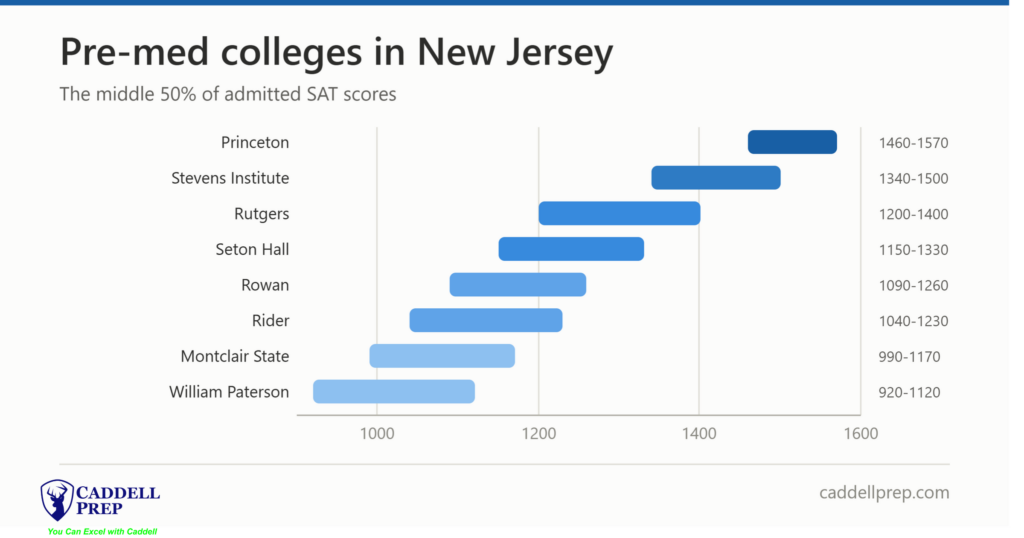
Eight New Jersey colleges with pre-med programs, what they cost, and the SAT scores of the students they admit.
They’re listed by SAT range, highest first, so you can find your own score on the list rather than reading all eight entries to work out where you fit.
One thing to know before you start. A published SAT range is the middle 50% of admitted students, not a minimum. A quarter of the students at every school below scored under the lower number, and a quarter scored over the upper one. More on what a published SAT range means.
Table of Contents
New Jersey Pre-Med Colleges by SAT Range
| College | Reading & Writing | Math | Cost of attendance | Undergraduates | Admit rate |
|---|---|---|---|---|---|
| Princeton University | 740 to 780 | 770 to 800 | $84,040 | 5,709 | 5% |
| Stevens Institute of Technology | 670 to 735 | 710 to 770 | $79,790 | 4,222 | 48% |
| Rutgers University, New Brunswick | 650 to 730 | 660 to 770 | $36,993 | 37,751 | 58% |
| Seton Hall University | 620 to 700 | 600 to 690 | $68,263 | 6,036 | 73% |
| Rider University | 550 to 670 | 550 to 650 | $55,967 | 3,106 | 79% |
| Rowan University | 560 to 660 | 550 to 650 | $35,842 | 15,841 | 78% |
| Montclair State University | 480 to 620 | 430 to 590 | $28,305 | 18,376 | 88% |
| William Paterson University | Does not report SAT data | Does not report SAT data | $28,476 | 6,614 | 90% |
Each range covers the middle 50% of admitted students who submitted scores. A quarter scored below the lower number, and the top quarter scored at or above the upper one. Being under the lower number does not rule a student out, and being just above it is not as safe as it looks.
Two things about that table are worth pausing on.
Cost of attendance is the full figure, including tuition, fees, room and board, before any financial aid. It’s not the tuition price, and at the private schools it’s a long way from what most families actually pay. The public universities also charge different tuition to in-state and out-of-state students, which is noted in each entry below.
William Paterson doesn’t report SAT data, which is increasingly common. It means the score carries less weight there than at a school that does report, and it also means there’s no range to compare yourself against. More on test-optional colleges and what that changes.
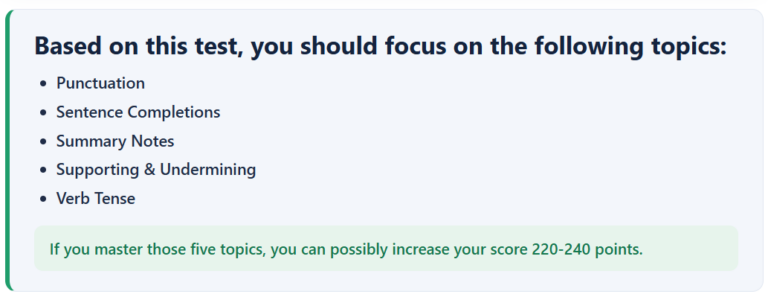
Want to Know What 5 Topics Will Improve Your SAT Score the Most?
Sample Feedback from our Diagnostic Test:
Princeton University
Princeton’s pre-med program combines rigorous coursework with research and internship opportunities, and the school provides comprehensive advising for students preparing for medical school.
Reading & Writing 740 to 780, Math 770 to 800. The top quarter of admitted students scored at or above 780 and 800. Average total score 1553. Cost of attendance $84,040, with tuition and fees at $62,688 and substantial need-based aid available. 5,709 undergraduates, 5% admitted.
Stevens Institute of Technology
Stevens offers a pre-med program that combines a science foundation with an emphasis on technology, which suits students interested in the technical side of medicine.
Reading & Writing 670 to 735, Math 710 to 770. The top quarter scored at or above 735 and 770. Average total score 1446. Cost of attendance $79,790, with tuition and fees at $63,462. 4,222 undergraduates, 48% admitted.
Note the gap between the two sections here. Stevens admits students whose Math scores sit well above their Reading & Writing scores, which is what you’d expect at a technology institute and which a single total score would hide.
Rutgers University, New Brunswick
Rutgers offers a pre-med program with a strong science foundation and opportunities for research and community service, along with extensive advising for students heading to medical school.
Reading & Writing 650 to 730, Math 660 to 770. The top quarter scored at or above 730 and 770. Average total score 1410. Cost of attendance $36,993, with tuition and fees at $17,929 in-state and $37,441 out-of-state. 37,751 undergraduates, 58% admitted.
This is the largest school on the list and the cheapest of the ones with scores in this range, by a wide margin for in-state students.
Seton Hall University
Seton Hall’s pre-med program combines academics with research and internship opportunities, with an emphasis on critical thinking and problem-solving.
Reading & Writing 620 to 700, Math 600 to 690. The top quarter scored at or above 700 and 690. Average total score 1322. Cost of attendance $68,263, with tuition and fees at $53,170. 6,036 undergraduates, 73% admitted.
Rowan University
Rowan emphasizes a strong science foundation, research experience, and clinical exposure, with individualized advising for students navigating the path to medical school.
Reading & Writing 560 to 660, Math 550 to 650. The top quarter scored at or above 660 and 650. Average total score 1212. Cost of attendance $35,842, with tuition and fees at $16,574 in-state and $26,932 out-of-state. 15,841 undergraduates, 78% admitted.
Rowan and Rider admit students with almost identical score ranges. The cost of attendance differs by approximately $20,000 a year.
Rider University
Rider’s pre-med program offers a science foundation, practical experience through research and internships, and individualized advising.
Reading & Writing 550 to 670, Math 550 to 650. The top quarter scored at or above 670 and 650. Average total score 1227. Cost of attendance $55,967, with tuition and fees at $41,120. 3,106 undergraduates, 79% admitted.
Montclair State University
Montclair’s pre-med program runs through its College of Science and Mathematics, providing a science foundation along with research and internship opportunities.
Reading & Writing 480 to 620, Math 430 to 590. The top quarter scored at or above 620 and 590. Average total score 1070. Cost of attendance $28,305, with tuition and fees at $15,912 in-state and $26,022 out-of-state. 18,376 undergraduates, 88% admitted.
William Paterson University
William Paterson offers a pre-med program built on the biological and physical sciences, in a collaborative learning environment.
The university does not report SAT score data. Cost of attendance $28,476, with tuition and fees at $15,704 in-state and $25,344 out-of-state. 6,614 undergraduates, 90% admitted.
What If Your Score Is Below the Range You Want?
Being below a school’s published range doesn’t disqualify anyone. A quarter of the students admitted to every school on this list scored below its lower number.
It does mean the score isn’t helping the application, and at a selective school that matters more than at a less selective one. The number worth aiming for is the top of a school’s range rather than the middle, and the reasoning behind that is on what SAT score you need for college.
The useful part is that the gap is measurable. So is the work to close it. A 70 to 130 point improvement takes approximately 40 hours of effective studying, based on the students we’ve worked with since 2008, and a 130 to 250 point improvement takes approximately 80.
Whether that’s available to you depends on how much time is left before your applications are due. How to improve your SAT score covers the method, including how to work out which topics are actually costing you points.
If you don’t have a recent score to compare against this list, a free diagnostic SAT gives you one, plus a breakdown of where the points are going.
Pre-Med Programs in Nearby States
Students applying to pre-med programs in this region normally look across state lines, particularly along the corridor between Philadelphia and New York.
We cover each of those states separately, with the same figures and the same ordering: pre-med colleges in New York, pre-med colleges in Pennsylvania, and pre-med colleges in Delaware.
How to Read a College's SAT Range
Every range on this page is the middle 50% of admitted students. The lower number is the 25th percentile and the upper number is the 75th.
That means a score at the bottom of a range is not a typical admitted score, it’s a bottom-quarter one. And the bottom quarter includes recruited athletes and legacy applicants, so a regular applicant sitting there is in a weaker position than the number suggests.
See what SAT score you need for college for how to turn a score into a realistic list.
Pre-Med Colleges in Other States
We publish the same breakdown for pre-med programs in every state.
See pre-med colleges by state for the full list.

Glyn Caddell
Glyn Caddell holds a BS in Mechanical Engineering from NJIT and has been tutoring New York City students since 2008. He founded Caddell Prep in 2012 and is the author of Digital SAT Math Secrets: Lessons & Tricks to Quickly Improve to a Perfect 800 on the Math Test, which contains over 900 practice problems and is used in Caddell Prep’s SAT math classes. He is founding president of the Staten Island Technical High School alumni association and teaches every lesson on this site personally.
Finally, an SAT course that students actually understand
Every question has a video explanation. Not most — every one.
The on-demand Digital SAT course covers all 17 math topics and 15 reading and writing topics, with 5 full-length practice tests and a 100-point score increase guarantee. Keep access for the rest of high school. No subscription.
Want to Know What 5 Topics Will Improve Your SAT Score the Most?
Sample Feedback from our Diagnostic Test: