
Home » College SAT Score Ranges, Costs, and Programs by Major and State » Best Pre-Med Colleges » Pre-Med Colleges in Maryland: SAT Scores, Costs, and Programs
By Glyn Caddell, BSME · Author of Digital SAT Math Secrets · Tutoring since 2008 — Updated October 9, 2026
Twelve Maryland colleges with pre-med programs, what they cost, and the SAT scores of the students they admit.
Maryland has three medical schools. One of them charges no tuition and pays its students a salary, and that comes after the table.
Scores are given by section rather than as a single total, because a student at 680 Reading & Writing and 590 Math is in a different position from a student at 590 and 680.
Table of Contents
- Maryland Pre-Med Colleges by SAT Score
- Maryland Has a Medical School That Pays Its Students
- Maryland’s Other Two Medical Schools
- What If Your Scores Are Below the Range You Want?
Maryland Pre-Med Colleges by SAT Score
| College | Reading & Writing | Math | Cost of attendance | Undergraduates | Admit rate |
|---|---|---|---|---|---|
| Johns Hopkins University | 740 to 770 | 780 to 800 | $85,947 | 5,693 | 6% |
| University of Maryland, College Park | 690 to 750 | 710 to 780 | $29,299 | 30,760 | 45% |
| University of Maryland, Baltimore County | 630 to 700 | 610 to 720 | $28,576 | 10,701 | 72% |
| Loyola University Maryland | 620 to 690 | 580 to 680 | $74,055 | 3,869 | 75% |
| United States Naval Academy | 610 to 700 | 600 to 710 | No tuition | 4,474 | 9% |
| Salisbury University | 600 to 670 | 580 to 650 | $28,310 | 6,057 | 87% |
| St. Mary’s College of Maryland | 590 to 690 | 553 to 650 | $31,865 | 1,603 | 69% |
| Mount St. Mary’s University | 543 to 660 | 503 to 620 | $63,731 | 1,768 | 74% |
| Towson University | 490 to 635 | 460 to 600 | $28,535 | 16,136 | 82% |
| Coppin State University | 460 to 510 | 420 to 510 | $23,748 | 1,844 | 46% |
| Morgan State University | 400 to 520 | 440 to 550 | $25,413 | 9,019 | 82% |
| Bowie State University | Does not report | Does not report | $25,220 | 5,043 | 72% |
Each range covers the middle 50% of admitted students who submitted scores. A quarter scored below the lower number, and the top quarter scored at or above the upper one. Being under the lower number does not rule a student out, and being just above it is not as safe as it looks.
Three things in that table deserve attention.
Johns Hopkins reports a Math range of 780 to 800. That is the highest Math range anywhere in this series, and it means at least a quarter of admitted students earned a perfect Math score. Its 25th percentile of 780 matches the 75th percentile at the University of Maryland, College Park and sits above every other school on this page.
Maryland is top-heavy and then opens up quickly. Hopkins admits 6% and the Naval Academy admits 9%. After those two the next most selective are College Park at 45% and Coppin State at 46%, and most of the rest of the state admits over 70%.
Coppin State is the clearest case in this series of admit rate and score range pointing in opposite directions. It admits 46% of applicants, more selectively than every Maryland school on this page except Hopkins, the Naval Academy and College Park, while reporting the lowest ranges here.
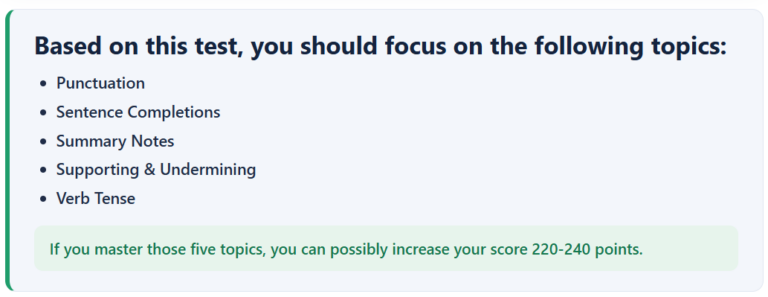
Want to Know What 5 Topics Will Improve Your SAT Score the Most?
Sample Feedback from our Diagnostic Test:
Johns Hopkins University
Johns Hopkins University is a private research university in Baltimore with 5,693 undergraduates, and it runs one of the best-known medical schools in the country.
Reading & Writing 740 to 770, Math 780 to 800. The top quarter of admitted students scored at or above 770 and 800. Cost of attendance $85,947, with tuition and fees at $65,230 and need-based aid that meets full demonstrated need. 5,693 undergraduates, 6% admitted.
University of Maryland, College Park
The University of Maryland at College Park is the state flagship with 30,760 undergraduates, the largest school on this page.
Reading & Writing 690 to 750, Math 710 to 780. The top quarter scored at or above 750 and 780. Cost of attendance $29,299, with tuition and fees at $11,809 in-state and $41,186 out-of-state. 30,760 undergraduates, 45% admitted.
The in-state and out-of-state tuition gap here is approximately $29,400, among the widest in this series.
University of Maryland, Baltimore County
The University of Maryland, Baltimore County has 10,701 undergraduates and a strong reputation in the sciences, particularly in producing students who go on to doctoral and medical programmes.
Reading & Writing 630 to 700, Math 610 to 720. The top quarter scored at or above 700 and 720. Cost of attendance $28,576, with tuition and fees at $13,256 in-state and $31,275 out-of-state. 10,701 undergraduates, 72% admitted.
Loyola University Maryland
Loyola University Maryland is a Jesuit university in Baltimore with 3,869 undergraduates.
Reading & Writing 620 to 690, Math 580 to 680. The top quarter scored at or above 690 and 680. Cost of attendance $74,055, with tuition and fees at $57,150. 3,869 undergraduates, 75% admitted.
United States Naval Academy
The United States Naval Academy is in Annapolis with 4,474 undergraduates, and it charges no tuition.
Reading & Writing 610 to 700, Math 600 to 710. The top quarter scored at or above 700 and 710. 4,474 undergraduates, 9% admitted.
It is not free college. Midshipmen are on active duty while enrolled and commit to serve as officers after graduation, normally five years. The route from a service academy into medicine runs through military channels, including the Uniformed Services University covered below. Check the Academy’s current requirements directly.
Salisbury University
Salisbury University is on the Eastern Shore with 6,057 undergraduates.
Reading & Writing 600 to 670, Math 580 to 650. The top quarter scored at or above 670 and 650. Cost of attendance $28,310, with tuition and fees at $11,084 in-state and $22,174 out-of-state. 6,057 undergraduates, 87% admitted.
St. Mary's College of Maryland
St. Mary’s College of Maryland is the state’s designated public honors college, with 1,603 undergraduates, the smallest school on this page.
Reading & Writing 590 to 690, Math 553 to 650. The top quarter scored at or above 690 and 650. Cost of attendance $31,865, with tuition and fees at $15,298 in-state and $31,374 out-of-state. 1,603 undergraduates, 69% admitted.
Mount St. Mary's University
Mount St. Mary’s University is a Catholic university in Emmitsburg with 1,768 undergraduates.
Reading & Writing 543 to 660, Math 503 to 620. The top quarter scored at or above 660 and 620. Cost of attendance $63,731, with tuition and fees at $48,630. 1,768 undergraduates, 74% admitted.
Towson University
Towson University has 16,136 undergraduates, the second largest on this page, in the Baltimore suburbs.
Reading & Writing 490 to 635, Math 460 to 600. The top quarter scored at or above 635 and 600. Cost of attendance $28,535, with tuition and fees at $11,728 in-state and $29,820 out-of-state. 16,136 undergraduates, 82% admitted.
Coppin State University
Coppin State University is a historically Black university in Baltimore with 1,844 undergraduates, and it admits 46% of applicants.
Reading & Writing 460 to 510, Math 420 to 510. The top quarter scored at or above 510 in both sections. Cost of attendance $23,748, with tuition and fees at $7,100 in-state and $14,024 out-of-state. 1,844 undergraduates, 46% admitted.
This is the least expensive school on the page, and its in-state tuition of $7,100 is the lowest figure here by a wide margin.
Morgan State University
Morgan State University is a historically Black university in Baltimore with 9,019 undergraduates, the largest HBCU in Maryland.
Reading & Writing 400 to 520, Math 440 to 550. The top quarter scored at or above 520 and 550. Cost of attendance $25,413, with tuition and fees at $8,229 in-state and $19,124 out-of-state. 9,019 undergraduates, 82% admitted.
Bowie State University
Bowie State University is a historically Black university with 5,043 undergraduates, and the oldest HBCU in Maryland.
The university does not report SAT score data. Cost of attendance $25,220, with tuition and fees at $9,218 in-state and $19,938 out-of-state. 5,043 undergraduates, 72% admitted.
Maryland Has a Medical School That Pays Its Students
The Uniformed Services University of the Health Sciences in Bethesda is the only federal medical school in the United States. Congress established it in 1972, and its F. Edward Hébert School of Medicine trains physicians for the uniformed services.
Students pay no tuition and no fees. They are commissioned as officers before classes begin, and draw full active-duty pay, reported at approximately $57,000 to $60,000 a year, along with housing and subsistence allowances and military medical and dental care. No prior military service is required to apply.
The commitment is the other half of the arrangement, and it is substantial. Graduates serve seven years of active duty after completing residency for the Army, Navy and Air Force, or ten years for the Public Health Service. Students are on active duty throughout medical school itself, not only afterwards.
So the accurate way to describe it is not free medical school. It is the beginning of a military medical career that happens to carry no tuition. A student who reads the first half of that and stops has misunderstood the second half, and the second half is a decade of his working life.
Maryland Is the Only State Where Both Ends Are Tuition-Free
Put the Naval Academy and the Uniformed Services University next to each other and Maryland looks different from every other state we cover.
A student can do an undergraduate degree at Annapolis without paying tuition, and then a medical degree at Bethesda without paying tuition, and be paid throughout both. The two institutions are approximately thirty miles apart.
What that costs is service, at both stages. Five years as a commissioned officer after Annapolis, then seven more after medical residency. Neither commitment is small and the two do not run concurrently.
For a student who wants a military career and medicine, that path exists in Maryland in a way it does not anywhere else. For a student who wants medicine and is attracted by the absence of tuition, the commitment is the thing to think hardest about rather than the saving.
Confirm current pay, service obligations and admissions requirements at the Uniformed Services University and at the Naval Academy directly. Military pay scales and service commitments both change.
Maryland's Other Two Medical Schools
Maryland’s other two MD programmes are both in Baltimore and both sit at universities in the table above.
- Johns Hopkins University School of Medicine, Baltimore
- University of Maryland School of Medicine, Baltimore
Maryland has no osteopathic programme, so the MD and DO distinction that comes up on other state pages does not arise here.
One figure is worth knowing if you are a Maryland resident. Third-party admissions guides report the University of Maryland School of Medicine’s entering class as approximately 75% Maryland residents. Public medical schools normally favour in-state applicants, and if that figure is accurate it is a meaningful advantage. Verify it with the school before planning around it.
None of this decides where to do an undergraduate degree. Medical school applications are national, and a student at Salisbury or Towson is not disadvantaged against a student at Hopkins when both apply. What proximity changes is how easily you can arrange shadowing and research while you are still an undergraduate, and Baltimore has a density of teaching hospitals that few cities match.
What If Your Scores Are Below the Range You Want?
Being below a school’s published range doesn’t disqualify anyone. A quarter of the students admitted to every school on this list that reports a range scored below its lower number.
Maryland is top-heavy in an unusual way. Johns Hopkins at 6% and the Naval Academy at 9% are among the most selective institutions in the country. After those two the state opens up quickly, and most Maryland colleges admit more than 70% of applicants.
So a score here decides whether the top two are realistic. It does not decide whether Maryland has options, because it plainly does.
The number worth aiming for is the upper end of a school’s range, the one the top quarter cleared, rather than the middle. The reasoning behind that is on what SAT score you need for college.
The gap is measurable and so is the work to close it. A 70 to 130 point improvement takes approximately 40 hours of effective studying, based on the students we’ve worked with since 2008, and a 130 to 250 point improvement takes approximately 80.
How to improve your SAT score covers the method, including how to work out which topics are actually costing you points. If you don’t have a recent score to compare against this list, a free diagnostic SAT gives you one, broken down by section and by topic.
How to Read These Score Ranges
Every range on this page covers the middle 50% of admitted students who submitted scores. The lower number is the 25th percentile and the upper number is the 75th, which means a quarter of admitted students scored at or above it.
Coppin State is the entry worth studying. It admits 46% of applicants while reporting the lowest ranges on this page. A low admit rate measures how many people applied relative to the places available. A score range measures who enrolled. They answer different questions and they often disagree.
Seven Maryland institutions over 1,000 undergraduates report neither SAT nor ACT data, including the University of Maryland Global Campus, which has 49,664 undergraduates and is not in the table because it is an online institution.
Because most colleges are now test-optional, the ranges that are published describe only the students who chose to submit. Students with strong scores submit and students with weak ones don’t, so a published range sits higher than the range for everyone who was actually admitted. More on test-optional colleges.
Pre-Med Programs in Nearby States
Maryland borders Delaware, Pennsylvania, Virginia and West Virginia, and Washington is immediately across the line from several Maryland campuses.
See pre-med colleges in Delaware, pre-med colleges in Pennsylvania, and pre-med colleges in Virginia.
Pre-Med Colleges in Other States
We publish the same breakdown for pre-med programs in every state.
See pre-med colleges by state for the full list.

Glyn Caddell
Glyn Caddell holds a BS in Mechanical Engineering from NJIT and has been tutoring New York City students since 2008. He founded Caddell Prep in 2012 and is the author of Digital SAT Math Secrets: Lessons & Tricks to Quickly Improve to a Perfect 800 on the Math Test, which contains over 900 practice problems and is used in Caddell Prep’s SAT math classes. He is founding president of the Staten Island Technical High School alumni association and teaches every lesson on this site personally.
Finally, an SAT course that students actually understand
Every question has a video explanation. Not most — every one.
The on-demand Digital SAT course covers all 17 math topics and 15 reading and writing topics, with 5 full-length practice tests and a 100-point score increase guarantee. Keep access for the rest of high school. No subscription.
Want to Know What 5 Topics Will Improve Your SAT Score the Most?
Sample Feedback from our Diagnostic Test: