
Home » College SAT Score Ranges, Costs, and Programs by Major and State » Best Pre-Med Colleges » Pre-Med Colleges in Kansas: SAT Scores, ACT Scores, Costs, and Programs
By Glyn Caddell, BSME · Author of Digital SAT Math Secrets · Tutoring since 2008 — Updated October 9, 2026
Eight Kansas colleges with pre-med programs, what they cost, and the test scores of the students they admit.
One of them, Wichita State, has an agreement with a Kansas medical school that admits students without the MCAT and shortens the whole path to seven years. It needs an ACT composite of 28, and it comes after the table.
The table shows ACT alongside SAT because more Kansas colleges report ACT data. Two publish an ACT range and no SAT range at all.
Table of Contents
- Kansas Pre-Med Colleges by Test Score
- A Wichita State Route Into Medical School Without the MCAT
- Kansas Has Two Medical Schools and One Runs Three Campuses
- What If Your Scores Are Below the Range You Want?
Kansas Pre-Med Colleges by Test Score
| College | SAT Reading & Writing | SAT Math | ACT composite | Cost of attendance | Undergraduates | Admit rate |
|---|---|---|---|---|---|---|
| Benedictine College | 570 to 690 | 570 to 690 | 22 to 29 | $52,206 | 2,272 | 98% |
| University of Kansas | 540 to 650 | 530 to 650 | 20 to 28 | $26,751 | 21,217 | 93% |
| Kansas State University | 550 to 640 | 510 to 620 | 20 to 27 | $27,402 | 15,142 | 82% |
| Fort Hays State University | 500 to 580 | 470 to 560 | 18 to 24 | $19,909 | 9,733 | 90% |
| Emporia State University | Not reported | Not reported | 18 to 24 | $21,967 | 2,239 | 98% |
| Friends University | 500 to 530 | 460 to 560 | 15 to 28 | $50,482 | 1,048 | 55% |
| Pittsburg State University | Not reported | Not reported | 17 to 24 | $22,099 | 4,210 | 89% |
| Wichita State University | 470 to 610 | 435 to 630 | 17 to 25 | $21,780 | 10,780 | 94% |
Each range covers the middle 50% of admitted students who submitted that test. A quarter scored below the lower number, and the top quarter scored at or above the upper one. Being under the lower number does not rule a student out, and being just above it is not as safe as it looks.
Sorted by ACT composite, because more Kansas colleges report it. The College Board and ACT publish an official concordance for comparing a score across the two tests.
Three things in that table deserve attention.
Kansas is inexpensive. Fort Hays State is $19,909, Wichita State $21,780, Emporia State $21,967 and Pittsburg State $22,099. Four public universities under $23,000 for full cost of attendance including room and board is the cheapest cluster of any state in this series.
Admission is not the constraint. Benedictine and Emporia State both admit 98% of applicants, Wichita State 94%, Kansas 93%, Fort Hays State 90%. Only Friends University, at 55%, turns away a significant share.
Benedictine College admits 98% while reporting the highest scores in the state. That combination appears in most states and it means the same thing each time: a college with a specific character draws applicants who already fit it, so it admits nearly everyone who applies and still enrolls a strong class. The Illinois page explains the effect in full using Wheaton College.
Friends University reports an ACT range of 15 to 28, which is thirteen points wide. Nothing else on this page comes close, and a range that wide means the college admits across a very broad band of preparation.
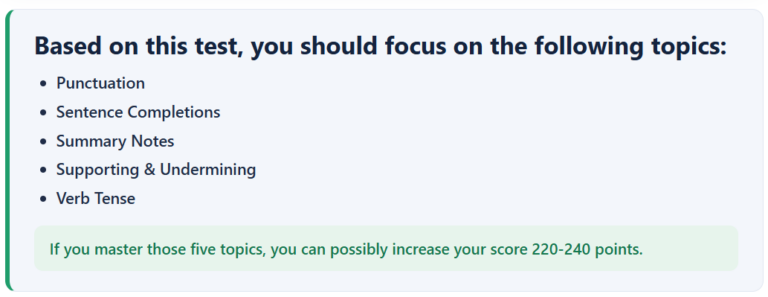
Want to Know What 5 Topics Will Improve Your SAT Score the Most?
Sample Feedback from our Diagnostic Test:
Benedictine College
Benedictine College is a private Catholic liberal arts college in Atchison with 2,272 undergraduates, and it reports the highest test ranges in Kansas.
SAT Reading & Writing 570 to 690, SAT Math 570 to 690, ACT composite 22 to 29. The top quarter of admitted students scored at or above 690 in both SAT sections and 29 on the ACT. Cost of attendance $52,206, with tuition and fees at $36,350. 2,272 undergraduates, 98% admitted.
University of Kansas
The University of Kansas is the state flagship, in Lawrence, with 21,217 undergraduates. Its School of Medicine is covered below.
SAT Reading & Writing 540 to 650, SAT Math 530 to 650, ACT composite 20 to 28. The top quarter scored at or above 650 in both SAT sections and 28 on the ACT. Cost of attendance $26,751, with tuition and fees at $12,102 in-state and $30,432 out-of-state. 21,217 undergraduates, 93% admitted.
Kansas State University
Kansas State University is in Manhattan with 15,142 undergraduates and a strong agriculture and veterinary medicine presence.
SAT Reading & Writing 550 to 640, SAT Math 510 to 620, ACT composite 20 to 27. The top quarter scored at or above 640, 620 and 27. Cost of attendance $27,402, with tuition and fees at $11,221 in-state and $28,568 out-of-state. 15,142 undergraduates, 82% admitted.
Fort Hays State University
Fort Hays State University is in Hays with 9,733 undergraduates and the lowest cost of attendance in Kansas.
SAT Reading & Writing 500 to 580, SAT Math 470 to 560, ACT composite 18 to 24. The top quarter scored at or above 580, 560 and 24. Cost of attendance $19,909, with tuition and fees at $5,923 in-state and $17,741 out-of-state. 9,733 undergraduates, 90% admitted.
In-state tuition here is $5,923, the lowest figure on this page by a wide margin.
Emporia State University
Emporia State University is in Emporia with 2,239 undergraduates.
The university does not report SAT data. ACT composite 18 to 24, with the top quarter at or above 24. Cost of attendance $21,967, with tuition and fees at $7,106 in-state and $15,419 out-of-state. 2,239 undergraduates, 98% admitted.
Its out-of-state tuition of $15,419 is lower than several Kansas universities charge their own residents elsewhere in the region.
Friends University
Friends University is a private university in Wichita with 1,048 undergraduates, the smallest school on this page and the most selective by admit rate.
SAT Reading & Writing 500 to 530, SAT Math 460 to 560, ACT composite 15 to 28. The top quarter scored at or above 530, 560 and 28. Cost of attendance $50,482, with tuition and fees at $34,192. 1,048 undergraduates, 55% admitted.
Pittsburg State University
Pittsburg State University is in Pittsburg with 4,210 undergraduates.
The university does not report SAT data. ACT composite 17 to 24, with the top quarter at or above 24. Cost of attendance $22,099, with tuition and fees at $8,400 in-state and $19,744 out-of-state. 4,210 undergraduates, 89% admitted.
Wichita State University
Wichita State University is in Wichita with 10,780 undergraduates, and it is the one college on this page with a named agreement into a Kansas medical school.
SAT Reading & Writing 470 to 610, SAT Math 435 to 630, ACT composite 17 to 25. The top quarter scored at or above 610, 630 and 25. Cost of attendance $21,780, with tuition and fees at $9,684 in-state and $19,869 out-of-state. 10,780 undergraduates, 94% admitted.
Note the gap between its published ACT range and the score its medical school agreement requires. That is covered next.
A Wichita State Route Into Medical School Without the MCAT
Wichita State has an admissions partnership with the Kansas College of Osteopathic Medicine, the state’s osteopathic medical school in downtown Wichita. It is called the KansasCOM Early Acceptance Partners Program.
Students admitted to it begin their first year of medical school during their senior year of undergraduate study. After completing that year they receive their bachelor’s degree from Wichita State, which means the bachelor’s degree and the medical degree together take seven years rather than eight.
What the program requires:
- An ACT composite score of 28
- A cumulative undergraduate GPA of at least 3.25
- A science GPA of at least 3.5
- Completion of prerequisite coursework and at least 90 credit hours before matriculating
- Community service, and demonstrated knowledge of and commitment to osteopathic medicine
- The MCAT is not required
Two things about that list are worth sitting with.
The ACT 28 is a published, specific number, which is rare. Most of what this series covers is percentile ranges that describe who enrolled. This is a threshold that decides whether a door is open.
It is also well above Wichita State’s own admitted range. The university’s published ACT composite runs 17 to 25, so a student clearing 28 is above the top quarter of the people admitted alongside him. Getting into Wichita State and qualifying for this program are different problems.
On the SAT. The published requirement names an ACT composite and does not mention an SAT equivalent. We sell SAT preparation and that is still what the page says. If you are planning around this program, ask Wichita State directly whether an SAT score is accepted and at what level, rather than assuming a concordance applies.
Confirm current requirements with Wichita State’s pre-med advising before building a plan around any of this.
Kansas Has Two Medical Schools and One Runs Three Campuses
Kansas had one medical school until 2022, when a second opened.
The University of Kansas School of Medicine is the state’s MD programme and it operates three campuses, each with a stated focus.
Kansas City is an urban academic medical centre. Wichita, running since 1971, is community-based, with teaching spread across partner hospitals and more than a thousand volunteer faculty. Salina, opened in 2011, focuses on rural and secondary care.
The Salina campus admits eight students a year. They train in local clinics, rural physicians’ offices and Salina Regional Health Center while joining classes on the other two campuses by video. KU describes the student it suits as self-motivated, comfortable working with a small group for four years, and intending to practise primary care in rural Kansas.
Eight places is the narrowest route described anywhere in this series. For a student from a rural Kansas county who already knows he wants to go back, it is also one of the most direct.
KU states that nearly 80% of its first-year medical students are from Kansas.
The Kansas College of Osteopathic Medicine opened in Wichita in 2022 as the state’s first osteopathic medical school, under Kansas Health Science University. Its inaugural class enrolled 85 students with a stated goal of 170 a year.
One thing a prospective student should check rather than assume. KansasCOM holds pre-accreditation status from the Commission on Osteopathic College Accreditation rather than full accreditation. The school’s own disclosures note that if full accreditation is granted in 2026, the decision would apply retroactively to its first graduating class. Graduation from a fully accredited college of osteopathic medicine is a requirement for licensure in all fifty states, so the accreditation timeline is worth understanding before committing eight years to a route that depends on it.
None of this decides where to do an undergraduate degree. Medical school applications are national, and a student at a Kansas college without a medical school nearby is not disadvantaged applying to one. What proximity changes is access to shadowing and research while you are still an undergraduate, and in Wichita’s case it changes rather more than that.
What If Your Scores Are Below the Range You Want?
Being below a school’s published range doesn’t disqualify anyone. A quarter of the students admitted to every school on this list that reports a range scored below its lower number.
Kansas is a state where that matters less than usual for admission. Benedictine and Emporia State admit 98%, Wichita State 94%, Kansas 93%. The score is not what stands between most Kansas students and a Kansas college.
Where it does work is the Wichita State medical school agreement, institutional merit aid, and out-of-state applications. The first of those is the sharpest example in this series of a score opening a specific door: ACT 28 or the programme is closed, regardless of how the rest of the application looks.
The number worth aiming for is the upper end of a school’s range, the one the top quarter cleared, rather than the middle. The reasoning behind that is on what SAT score you need for college.
The gap is measurable and so is the work to close it. A 70 to 130 point improvement takes approximately 40 hours of effective studying, based on the students we’ve worked with since 2008, and a 130 to 250 point improvement takes approximately 80.
How to improve your SAT score covers the method, including how to work out which topics are actually costing you points. If you don’t have a recent score to compare against this list, a free diagnostic SAT gives you one, broken down by section and by topic.
Should You Take the ACT Instead?
Kansas reports more ACT data than SAT data, and in one case the question has a concrete answer.
Of the ten four-year Kansas colleges with more than 1,000 undergraduates, eight report an ACT composite and six report SAT sections. Two publish ACT and no SAT.
The Wichita State medical school agreement names an ACT composite of 28 and does not mention the SAT. If that programme is part of your plan, the ACT is the test the published requirement is written in, and you should confirm with the university whether an SAT score is accepted at all.
For everything else, both tests are accepted. If your list is all Kansas colleges, the ACT is the more common submission here. If it reaches outside the region, the SAT is the more common currency.
How to Read These Score Ranges
Every range on this page covers the middle 50% of admitted students who submitted that test. The lower number is the 25th percentile and the upper number is the 75th, which means a quarter of admitted students scored at or above it.
Two Kansas colleges on this page report SAT ranges and ACT ranges that sit differently against each other, and Friends University is the clearest case. Its SAT Reading & Writing range is narrow at 500 to 530 while its ACT composite runs 15 to 28. When very few students submit one of the two tests, that test’s published range describes a small group and should be read as such.
Because most colleges are now test-optional, these ranges describe only the students who chose to submit at all. Students with strong scores submit and students with weak ones don’t, so a published range sits higher than the range for everyone who was actually admitted. More on test-optional colleges.
Pre-Med Programs in Nearby States
Kansas borders Missouri, Nebraska, Oklahoma and Colorado, and Kansas students apply across those lines in numbers.
See pre-med colleges in Colorado, pre-med colleges in Missouri, and pre-med colleges in Nebraska.
Pre-Med Colleges in Other States
We publish the same breakdown for pre-med programs in every state.
See pre-med colleges by state for the full list.

Glyn Caddell
Glyn Caddell holds a BS in Mechanical Engineering from NJIT and has been tutoring New York City students since 2008. He founded Caddell Prep in 2012 and is the author of Digital SAT Math Secrets: Lessons & Tricks to Quickly Improve to a Perfect 800 on the Math Test, which contains over 900 practice problems and is used in Caddell Prep’s SAT math classes. He is founding president of the Staten Island Technical High School alumni association and teaches every lesson on this site personally.
Finally, an SAT course that students actually understand
Every question has a video explanation. Not most — every one.
The on-demand Digital SAT course covers all 17 math topics and 15 reading and writing topics, with 5 full-length practice tests and a 100-point score increase guarantee. Keep access for the rest of high school. No subscription.
Want to Know What 5 Topics Will Improve Your SAT Score the Most?
Sample Feedback from our Diagnostic Test: