
Home » College SAT Score Ranges, Costs, and Programs by Major and State » Best Pre-Med Colleges » Pre-Med Colleges in California: Where Your SAT Score Counts and Where It Doesn’t
By Glyn Caddell, BSME · Author of Digital SAT Math Secrets · Tutoring since 2008 — Updated October 1, 2026
Every University of California and California State University campus is test-blind. They will not look at an SAT score, even if you send one, and they will not use it when awarding scholarships.
That covers UCLA, Berkeley, UC San Diego, UC Davis, UC Irvine, San Diego State, Cal State Long Beach, and every other campus in both systems. It is most of where California pre-med students go.
California’s private colleges do consider scores. They are also among the most expensive in the country. This page covers both groups, what the policy actually means, and why nearly 139,000 California students took the SAT last year anyway.
Table of Contents
- Why UC and CSU Won’t Look at Your SAT Score
- Where an SAT Score Still Counts in California
- So Why Did 139,000 California Students Take the SAT?
- Getting Into UC and CSU Without a Score
- The California Community College Route
- Is the SAT Worth Taking if You’re in California?
Why UC and CSU Won't Look at Your SAT Score
There’s a difference between test-optional and test-blind, and California is the second one.
Test-optional means a school will consider a score if you send one and won’t penalize you if you don’t. Most of the country works this way.
Test-blind, sometimes called test-free, means the school doesn’t look at the score at all. Sending it changes nothing because nobody reads it.
The University of California’s own application language states that it will not consider SAT or ACT test scores when making admissions decisions or awarding scholarships. Both UC and CSU eliminated their testing requirements in 2020 and have since ended SAT and ACT admissions testing permanently.
That applies to all nine UC undergraduate campuses and the entire CSU system. Here’s what that covers for a pre-med student.
| Campus | Cost of attendance | In-state tuition | Undergraduates | Admit rate |
|---|---|---|---|---|
| UCLA | $38,614 | $15,203 | 33,475 | 9% |
| UC Berkeley | $45,619 | $16,347 | 33,068 | 11% |
| UC San Diego | $38,701 | $16,758 | 34,948 | 27% |
| UC Irvine | $38,632 | $15,722 | 30,197 | 29% |
| UC Davis | $41,238 | $16,774 | 32,253 | 42% |
| San Diego State | $27,780 | $8,728 | 35,377 | 36% |
| Cal State Long Beach | $22,679 | $7,350 | 35,924 | 46% |
No SAT ranges appear in that table because these campuses do not collect scores for admissions. This is not missing data.
There’s one exception worth knowing. Both systems still use scores for course placement after a student enrolls, and a score can satisfy UC’s A-G English requirement, which is a course prerequisite rather than part of the admissions review. Neither of those affects whether you get in.
Where an SAT Score Still Counts in California
The private colleges. All of them consider scores, and all of them report ranges.
| College | Reading & Writing | Math | Cost of attendance | Undergraduates | Admit rate |
|---|---|---|---|---|---|
| Stanford University | 740 to 780 | 770 to 800 | $87,833 | 7,554 | 4% |
| University of Southern California | 710 to 760 | 740 to 790 | $90,300 | 20,443 | 10% |
| Santa Clara University | 670 to 730 | 680 to 760 | $82,026 | 6,552 | 48% |
| Pepperdine University | 650 to 710 | 640 to 740 | $93,512 | 3,553 | 63% |
| Loyola Marymount University | 640 to 720 | 620 to 710 | $83,943 | 7,094 | 45% |
| Chapman University | 630 to 720 | 630 to 720 | $83,146 | 7,478 | 65% |
| University of San Francisco | 610 to 700 | 580 to 690 | $80,141 | 5,287 | 62% |
| University of the Pacific | 590 to 710 | 593 to 770 | $71,515 | 3,204 | 71% |
Each range covers the middle 50% of admitted students who submitted scores. A quarter scored below the lower number, and the top quarter scored at or above the upper one. Being under the lower number does not rule a student out, and being just above it is not as safe as it looks.
Put the two tables next to each other and the California situation becomes clear.
Every school where your score counts costs more than $71,000 a year. Six of the eight are above $80,000, and Pepperdine is $93,512. Those are the highest costs of attendance anywhere in this series.
Every school where your score doesn’t count is cheaper. UCLA is $38,614 and in-state tuition is $15,203. Cal State Long Beach is $22,679 with $7,350 in tuition. UCLA admits 9% of applicants, which is more selective than every private college on this page except Stanford, and it does it without looking at a single test score.
That’s an unusual position for a state to be in, and it’s the opposite of what most families assume.
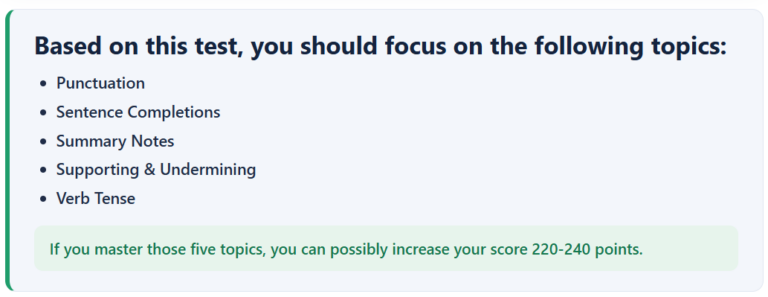
Want to Know What 5 Topics Will Improve Your SAT Score the Most?
Sample Feedback from our Diagnostic Test:
Stanford University
Stanford University is in Palo Alto and is the most selective institution in California, admitting 4% of applicants.
Reading & Writing 740 to 780, Math 770 to 800. The top quarter of admitted students scored at or above 780 and 800, which means at least a quarter earned a perfect Math score. Cost of attendance $87,833, with tuition and fees at $65,910 and substantial need-based aid. 7,554 undergraduates, 4% admitted.
University of Southern California
The University of Southern California is in Los Angeles and runs the Keck School of Medicine, which puts an undergraduate on a campus connected to a medical school.
Reading & Writing 710 to 760, Math 740 to 790. The top quarter scored at or above 760 and 790. Cost of attendance $90,300, with tuition and fees at $72,097. 20,443 undergraduates, 10% admitted.
USC has the Keck School of Medicine, which puts an undergraduate on a campus connected to a medical school.
Santa Clara University
Santa Clara University is a Jesuit university in Silicon Valley with 6,552 undergraduates.
Reading & Writing 670 to 730, Math 680 to 760. The top quarter scored at or above 730 and 760. Cost of attendance $82,026, with tuition and fees at $61,293. 6,552 undergraduates, 48% admitted.
Pepperdine University
Pepperdine University is in Malibu and is the most expensive school on this page, at over $93,000 a year before aid.
Reading & Writing 650 to 710, Math 640 to 740. The top quarter scored at or above 710 and 740. Cost of attendance $93,512, with tuition and fees at $69,918. 3,553 undergraduates, 63% admitted.
This is the most expensive school on the page, at over $93,000 a year before aid.
Loyola Marymount University
Loyola Marymount University is a Jesuit university in Los Angeles with 7,094 undergraduates.
Reading & Writing 640 to 720, Math 620 to 710. The top quarter scored at or above 720 and 710. Cost of attendance $83,943, with tuition and fees at $62,357. 7,094 undergraduates, 45% admitted.
Chapman University
Chapman University is in Orange, south of Los Angeles, with 7,478 undergraduates.
Reading & Writing 630 to 720, Math 630 to 720. The top quarter scored at or above 720 in both sections. Cost of attendance $83,146, with tuition and fees at $64,984. 7,478 undergraduates, 65% admitted.
University of San Francisco
The University of San Francisco is a Jesuit university in the city itself, with 5,287 undergraduates.
Reading & Writing 610 to 700, Math 580 to 690. The top quarter scored at or above 700 and 690. Cost of attendance $80,141, with tuition and fees at $60,492. 5,287 undergraduates, 62% admitted.
University of the Pacific
The University of the Pacific is in Stockton and is the least expensive private college on this page.
Reading & Writing 590 to 710, Math 593 to 770. The top quarter scored at or above 710 and 770. Cost of attendance $71,515, with tuition and fees at $57,080. 3,204 undergraduates, 71% admitted.
Pacific has the widest Math range on this page, running from 593 to 770, and it’s the least expensive of the private colleges here.
So Why Did 139,000 California Students Take the SAT?
If the state’s public universities ignore the score, that’s the obvious question.
138,763 California seniors in the class of 2026 took the SAT, a 12.6% increase on the previous class and the largest one-year rise in three years, according to College Board data reported by the Los Angeles Times. They did that while UC and CSU were refusing to look at the results.
Four reasons, and together they explain most of it.
Private California colleges consider scores. Every school in the second table above.
Colleges outside California consider scores. A California student applying to schools in other states is applying under normal rules, and plenty do.
Merit scholarships use scores. Not at UC or CSU, which excluded them from scholarship decisions too. But at private colleges and at out-of-state universities, scores commonly factor into merit aid, and merit thresholds normally sit above admission thresholds.
Course placement. Both systems still use scores to place enrolled students into courses, and a score can satisfy UC’s A-G English requirement.
So the honest summary is not that the SAT doesn’t matter in California. It’s that it doesn’t matter at two systems, and matters everywhere else a California student might apply.
Getting Into UC and CSU Without a Score
If scores aren’t considered, something else is.
UC uses a comprehensive review that looks at GPA in the A-G course sequence, the rigor of the courses taken, performance relative to what was available at your school, personal insight questions, and activities outside the classroom. CSU uses a multi-factor evaluation built around GPA and coursework.
What that means practically is worth saying plainly, even on a site that sells test preparation.
If you’re applying only to UC and CSU campuses, your hours are better spent on coursework and the application than on SAT preparation. The A-G grades are what the review reads. The personal insight questions are what distinguishes two students with the same transcript. Neither improves because you studied for a test nobody will see.
That’s the honest answer, and it’s the answer we’d give a student who called and asked.
Is the SAT Worth Taking if You're in California?
It depends entirely on your school list, and for most students the list isn’t limited to UC and CSU.
If you are applying only to UC and CSU campuses, the answer is no for admissions purposes. If there is any chance you’ll apply to a private California college, to a school in another state, or for merit scholarships, the answer is yes, and the 139,000 students above worked that out already.
Is UC Going to Bring the SAT Back?
There’s a discussion happening and nothing has changed.
UC’s admissions board minutes from March 2026 outlined a possible two-track structure: California residents would satisfy a testing requirement through the state’s Smarter Balanced assessments, already given to eleventh graders, while nonresident and international applicants would submit SAT or ACT scores.
That is a proposal under discussion, not a policy. Nothing changes for current applicants, and we have no way of knowing whether it will be adopted.
We sell SAT preparation, so treat any prediction from us about the SAT returning with appropriate suspicion. What we can tell you is what the minutes say and what the policy is today.
What If You're Applying Outside California?
Then normal rules apply, and published score ranges mean what they mean elsewhere.
A range covers the middle 50% of admitted students who submitted scores. The number worth aiming for is the upper end, the one the top quarter cleared, rather than the middle.
See what SAT score you need for college for how to turn a score into a realistic list, and test-optional colleges for how to decide whether to submit one.
How to Improve Your SAT Score
If you’re applying to private California colleges, out of state, or for merit scholarships, the score does work and the gap is measurable.
A 70 to 130 point improvement takes approximately 40 hours of effective studying, based on the students we’ve worked with since 2008, and a 130 to 250 point improvement takes approximately 80.
How to improve your SAT score covers the method. A free diagnostic SAT gives you a starting score broken down by section and topic.
How to Read These Score Ranges
This page has two kinds of entry, and a blank is not the same as a low number.
For the private colleges, every range covers the middle 50% of admitted students who submitted scores. The lower number is the 25th percentile and the upper number is the 75th, which means a quarter of admitted students scored at or above it. That upper number is the one to aim for.
Because those colleges are test-optional rather than test-required, the ranges describe only the students who chose to submit. Students with strong scores submit and students with weak ones don’t, so a published range sits higher than the range for everyone who was actually admitted.
For the UC and CSU campuses there is no range at all, and that means something different. It isn’t that scores there are low or unreported. It’s that the score is not part of the decision. A student comparing himself to UCLA has nothing to compare against, because UCLA is not looking.
More on what SAT score you need for college and on test-optional colleges, which covers how to decide whether to submit a score where submitting is a choice.
Pre-Med Programs in Nearby States
California has more colleges than any other state, and plenty of California students apply outside it anyway.
That’s worth saying because the in-state options being good doesn’t settle the question. A student may want a smaller campus, a different climate, a school with a medical school attached, or simply a fresh start somewhere else. And at the neighbouring state universities, unlike at UC and CSU, an SAT score is part of the application again.
See pre-med colleges in Oregon, pre-med colleges in Nevada, and pre-med colleges in Arizona.
Pre-Med Colleges in Other States
We publish the same breakdown for pre-med programs in every state.
See pre-med colleges by state for the full list.

Glyn Caddell
Glyn Caddell holds a BS in Mechanical Engineering from NJIT and has been tutoring New York City students since 2008. He founded Caddell Prep in 2012 and is the author of Digital SAT Math Secrets: Lessons & Tricks to Quickly Improve to a Perfect 800 on the Math Test, which contains over 900 practice problems and is used in Caddell Prep’s SAT math classes. He is founding president of the Staten Island Technical High School alumni association and teaches every lesson on this site personally.
Finally, an SAT course that students actually understand
Every question has a video explanation. Not most — every one.
The on-demand Digital SAT course covers all 17 math topics and 15 reading and writing topics, with 5 full-length practice tests and a 100-point score increase guarantee. Keep access for the rest of high school. No subscription.
Want to Know What 5 Topics Will Improve Your SAT Score the Most?
Sample Feedback from our Diagnostic Test: