
Home » College SAT Score Ranges, Costs, and Programs by Major and State » Engineering Colleges by State: SAT Scores, ACT Scores, Costs, and ABET Programs » Engineering Colleges in Rhode Island: SAT Scores, Costs, and Programs
By Glyn Caddell, BSME · Author of Digital SAT Math Secrets · Tutoring since 2008 — Updated October 25, 2026
Three Rhode Island universities offer ABET-accredited engineering degrees, and this page lists what they cost and the test scores of the students they admit.
At one of them, the state university, the engineering degree can be two degrees, a B.S. in engineering and a B.A. in a language, earned in five years with a full year abroad in the fourth.
SAT scores are given by section rather than as a total, because a student at 650 Reading & Writing and 550 Math is in a different position from a student at 550 and 650.
Table of Contents
- Rhode Island Engineering Colleges by SAT Score
- How Does the University of Rhode Island Give Engineering Students Two Degrees in Five Years?
- Which Rhode Island Universities Have ABET-Accredited Engineering Schools?
- What If Your Score Is Below the Range You Want?
Rhode Island Engineering Colleges by SAT Score
The three universities below are the ones in Rhode Island that hold an ABET-accredited bachelor’s degree in an engineering discipline. They are sorted by the midpoint of the SAT Math range, so the order can be checked from the table itself, and there are no ties.
| College | SAT Reading & Writing | SAT Math | Cost of attendance | Undergraduates | Admit rate |
|---|---|---|---|---|---|
| Brown University | 740 to 780 | 770 to 800 | $87,648 | 7,226 | 5% |
| Roger Williams University | 580 to 660 | 560 to 650 | $61,950 | 3,946 | 88% |
| University of Rhode Island | 520 to 650 | 500 to 630 | $34,321 | 13,381 | 72% |
Each range covers the middle 50% of admitted students who submitted that test. A quarter scored below the lower number, and the top quarter scored at or above the upper one. Being under the lower number does not rule a student out, and being just above it is not as safe as it looks.
Only universities with an ABET-accredited engineering bachelor’s degree are listed. Rhode Island has no engineering technology programs to note. All three universities report an SAT range.
Three things about that table are worth pausing on.
Rhode Island’s engineering degree can be two degrees. The state university’s International Engineering Program adds a B.A. in a language and a year abroad to the B.S., in five years. The next section is about it.
Brown reports a Math range of 770 to 800, so the top quarter of admitted students scored a perfect 800, the same range Penn and Carnegie Mellon report on our page on engineering colleges in Pennsylvania, and Brown admits 5%, one applicant in twenty.
Roger Williams charges every student $44,418, $7,272 more than a New Yorker pays Rhode Island and $27,476 more than a Rhode Islander does, on a Math range 60 points higher at the floor and 20 higher at the ceiling. Rhode Island is the largest school on the page by a factor of three over Roger Williams.
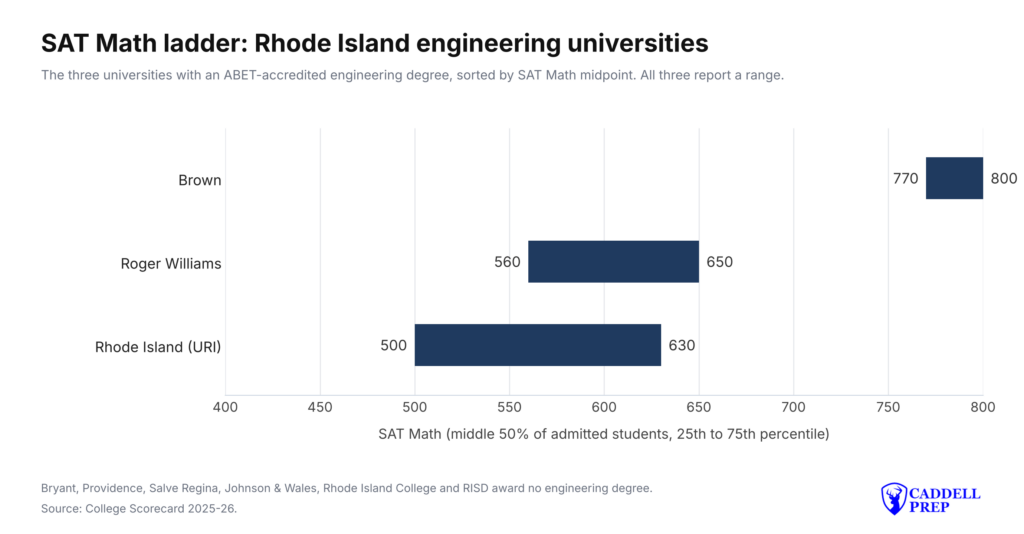
A student can see where his Math score sits on this list in the image above.
Want to Know What 5 Topics Will Improve Your SAT Score the Most?
Sample Feedback from our Diagnostic Test:
Brown University
Brown University’s School of Engineering in Providence holds ABET accreditation for its Sc.B. degrees in biomedical, chemical, computer, electrical, materials and mechanical engineering [VERIFY list on abet.org], and Brown is the most selective school on the page by a wide margin.
Reading & Writing 740 to 780, Math 770 to 800. The top quarter of admitted students scored 800 on Math. Cost of attendance $87,648, with tuition and fees at $71,412 for all students. 7,226 undergraduates, 5% admitted.
Brown’s engineering program dates to 1847 and is the oldest in the Ivy League [VERIFY on brown.edu]. Its Math floor of 770 is 120 points above Roger Williams’ ceiling, and its cost of attendance is the highest on the page by $25,698.
Roger Williams University
Roger Williams University’s School of Engineering, Computing and Construction Management in Bristol holds ABET accreditation for its Bachelor of Science in Engineering [VERIFY degree name and concentrations on abet.org], and Roger Williams is the least selective school on the page.
Reading & Writing 580 to 660, Math 560 to 650. The top quarter of admitted students scored at or above 650 on Math. Cost of attendance $61,950, with tuition and fees at $44,418 for all students. 3,946 undergraduates, 88% admitted.
Roger Williams admits 88% of applicants on a Math range that sits above Rhode Island’s at both ends, and it charges every student the same $44,418. Its campus is on Mount Hope Bay, across the water from Fall River.
University of Rhode Island
The University of Rhode Island’s College of Engineering in Kingston holds ABET accreditation in biomedical, chemical, civil, computer, electrical, industrial and systems, mechanical and ocean engineering [VERIFY list on abet.org], and Rhode Island is the one university on the page whose engineering degree can be paired with a second degree in a language.
Reading & Writing 520 to 650, Math 500 to 630. The top quarter of admitted students scored at or above 630 on Math. Cost of attendance $34,321, with tuition and fees at $16,942 in state and $37,146 out of state. 13,381 undergraduates, 72% admitted.
Rhode Island is the only public on the page, the largest school on it, and the cheapest for a New York student by $7,272. Its Math range of 500 to 630 is the lowest on the page, and its International Engineering Program and ocean engineering degree are described in the next section.
Three ranges say who got in. At one of the three the degree comes with a second one, and the next section is about how.
How Does the University of Rhode Island Give Engineering Students Two Degrees in Five Years?
The University of Rhode Island gives engineering students two degrees in five years through its International Engineering Program, in which, in the university’s words, students “earn two degrees simultaneously: a B.S. in an engineering discipline and a B.A. in Chinese, French, German, Italian, Spanish, or Global Language Area Studies with a concentration in Japanese.”
The structure is published. The program takes five years. Students spend “a full calendar year studying and interning abroad,” and the university’s program page describes that year as “a semester of study with one of our partner institutions” followed by “a six-month internship at a global company or research lab.” The engineering degree is one of the College of Engineering’s accredited disciplines, and the language degree is earned alongside it from the first year, not after it. The IEP is a program within the college, not a separate admission.
The university publishes the result. Its IEP page says that 100% of IEP graduates study abroad for one year, “compared to .1% undergraduate students nationally,” and that approximately 950 students have been placed in internships abroad to date. Elsewhere in this series the five-year engineering degree is one degree with co-op terms inside it, at Cincinnati on our page on engineering colleges in Ohio, at Drexel, at Northeastern and Kettering. Rhode Island’s is two degrees with a year abroad inside it, at a public university that admits 72% on a Math range of 500 to 630.
| University | SAT Math | Tuition for an out-of-state student | Years | Degrees |
|---|---|---|---|---|
| Brown University | 770 to 800 | $71,412 | 4 | 1 |
| Roger Williams University | 560 to 650 | $44,418 | 4 | 1 |
| University of Rhode Island | 500 to 630 | $37,146 | 4 | 1 |
| University of Rhode Island, International Engineering Program | 500 to 630 | $37,146 | 5 | 2 |
The fifth year is the price, and this page can only partly state it. The university’s public pages do not say what a student is charged during the year abroad or whether the six-month internship is paid [VERIFY both on the IEP FAQ, along with the program’s founding year and current enrollment]. What the pages do say is that the year abroad is a full calendar year, that the engineering degree is the same accredited degree, and that the second degree is a B.A. in one of six languages. A New York student who took three years of Spanish is in a different position from one who took none [VERIFY the language placement requirement at entry].
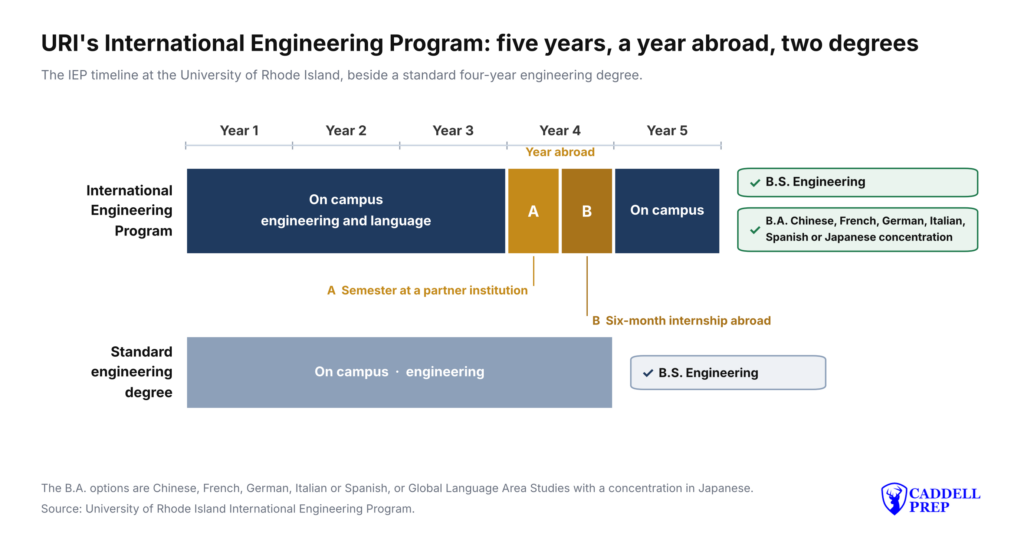
The image above lays the five IEP years beside a standard four-year degree.
Take a New York student with a 600 on SAT Math. At Brown he is 170 points below the floor of 770 to 800 and would pay $71,412. At Roger Williams he is just below the middle of 560 to 650 and pays $44,418. At Rhode Island he is in the upper half of 500 to 630 and pays $37,146, and if he enters the International Engineering Program with a language, he spends five years and leaves with two degrees. The spread between his two realistic options is $7,272 a year, and the one that costs less is the one with the second degree.
Rhode Island’s second number is a body of water. The university’s ocean engineering degree “is accredited by the Engineering Accreditation Commission of ABET” and is, in the university’s words, “one of only a handful of accredited programs in the United States.” It is taught at the Narragansett Bay Campus with a 30-foot wave tank and a 42-foot research vessel. The only other ocean engineering degree on these pages is the Naval Academy’s, on our page on engineering colleges in Maryland, and that one comes with a commission.
Brown’s number is the one at the top of the table. Brown’s engineering program dates to 1847 [VERIFY], its Sc.B. degrees are ABET-accredited in six disciplines [VERIFY], and it reports a Math range of 770 to 800 and admits 5%. It is the third school in this series to report a Math floor of 770, after Penn and Carnegie Mellon, and it is on this page as the top row, not as the subject of it.
The honest version is that the extra year of the IEP is an extra year of tuition and living costs, and until the FAQ is read this page cannot say what the year abroad costs or whether the internship pays for part of it. The IEP requires a language, and the program does not publish its own admitted range, so the 500 to 630 in the table is the university’s and not the program’s. Roger Williams admits 88% and Brown 5%, and the page does not pretend the three are peers on anything but the accredited degree they award. A student reading the five-year line should read the two-degree line beside it, and then ask the university the questions in brackets.
Families looking at Rhode Island’s price frequently ask whether the second degree costs a fifth year.
Does the International Engineering Program Take Five Years?
The International Engineering Program takes five years. The fourth is spent abroad, as a semester at a partner institution and a six-month internship at a company or research lab, and the student returns for a fifth year on campus and graduates with a B.S. in engineering and a B.A. in the language.
A student who wants the engineering degree alone takes it in four years at the same university. The fifth year buys the second degree and the year abroad, and the university’s pages say that every IEP graduate has taken it.
The program is Rhode Island’s. The degrees are what the next section lists.
Which Rhode Island Universities Have ABET-Accredited Engineering Schools?
Three Rhode Island universities hold ABET-accredited engineering bachelor’s degrees, one public and two private, and all three are in the table above.
In Providence, Brown’s School of Engineering is on College Hill. In Kingston, the University of Rhode Island’s College of Engineering is on the main campus, with its ocean engineering program at the Narragansett Bay Campus six miles away. In Bristol, Roger Williams’ School of Engineering, Computing and Construction Management is on Mount Hope Bay. The three are within forty minutes of one another in a state that can be crossed in an hour.
Accreditation matters for a reason that is easy to miss at seventeen. Licensure as a professional engineer normally requires a degree from an ABET-accredited engineering program, and all three programs on this page hold it. Bryant, Providence College, Salve Regina, Johnson & Wales, Rhode Island College and the Rhode Island School of Design award no engineering degree.
Nothing on this page ranks the three. The table’s order is a stated, verifiable number, and the choice among accredited programs comes down to cost, discipline and where a student’s score places him.
What If Your Scores Are Below the Range You Want?
In Rhode Island three schools cover Math ranges from a 500 floor to an 800 ceiling, one of them is public, and a New York student’s price runs from $37,146 to $71,412. The score decides Brown or not. Below Brown the question is price, and at the state university it is also a language.
The gap from a 600 to the upper half at Roger Williams is five points of SAT Math, less than a question, and the student who closes it is in the upper half at both of his realistic options. The gap from a 600 to Brown’s floor is 170 points and a different page.
The first step is finding out where the score actually is, section by section. A free diagnostic SAT gives a score that can be set against the Math column in the table.
The Math section rewards the same handful of topics on every test date, and a student who knows which of them he is missing can close a gap of 50 to 100 points in weeks rather than months. The method is on our page on improving your SAT Math score.
How to Read These Score Ranges
Every range on this page covers the middle 50% of admitted students who submitted that test. The lower number is the 25th percentile and the upper number is the 75th, so a quarter of admitted students scored at or above it. At Brown the upper number is 800, so the top quarter scored exactly 800.
A program’s length is a cost the range does not show. Rhode Island’s 500 to 630 describes who got in, and the five-year line describes what one program inside the university costs in time. A student should read both.
Because most colleges are now test-optional, the ranges that are published describe only the students who chose to submit at all. Students with strong scores submit and students with weak ones don’t, so a published range sits higher than the range for everyone who was actually admitted. More on what SAT score you need for college and on test-optional colleges.
Should You Take the ACT Instead?
Rhode Island gives the SAT to its public school juniors as the state test [VERIFY with the Rhode Island Department of Education], and all three universities on this page report an SAT range. Rhode Island reports no ACT range.
That is why the table carries SAT columns and is sorted by Math. All three universities accept either test, and a student who holds an ACT should convert it and read the same columns.
Engineering Programs in Nearby States
Rhode Island borders Massachusetts and Connecticut, and New York is across the Sound, so Rhode Island students have more accredited engineering programs within two hours than most states hold in total.
See engineering colleges in Massachusetts, engineering colleges in Connecticut, and engineering colleges in New York.
Engineering Colleges in Other States
We publish the same breakdown for engineering programs in every state.
See engineering colleges by state for the full list.

Glyn Caddell
Glyn Caddell holds a BS in Mechanical Engineering from NJIT and has been tutoring New York City students since 2008. He founded Caddell Prep in 2012 and is the author of Digital SAT Math Secrets: Lessons & Tricks to Quickly Improve to a Perfect 800 on the Math Test, which contains over 900 practice problems and is used in Caddell Prep’s SAT math classes. He is founding president of the Staten Island Technical High School alumni association and teaches every lesson on this site personally.
Finally, an SAT course that students actually understand
Every question has a video explanation. Not most — every one.
The on-demand Digital SAT course covers all 17 math topics and 15 reading and writing topics, with 5 full-length practice tests and a 100-point score increase guarantee. Keep access for the rest of high school. No subscription.
Want to Know What 5 Topics Will Improve Your SAT Score the Most?
Sample Feedback from our Diagnostic Test: