
Home » College SAT Score Ranges, Costs, and Programs by Major and State » Engineering Colleges by State: SAT Scores, ACT Scores, Costs, and ABET Programs » Engineering Colleges in New Hampshire: SAT Scores, Costs, and Programs
By Glyn Caddell, BSME · Author of Digital SAT Math Secrets · Tutoring since 2008 — Updated October 24, 2026
Two New Hampshire colleges offer ABET-accredited engineering degrees, and this page lists what they cost and the SAT scores of the students they admit.
At one of them the accredited degree is a second degree, earned after or alongside the four-year one and normally in a fifth year, a structure covered below the table.
Scores are given by section and the table is sorted by Math, because that is the section engineering programs use.
Table of Contents
- New Hampshire Engineering Colleges by SAT Math Score
- Does Dartmouth’s Four-Year Engineering Degree Count as an Accredited Engineering Degree?
- Which New Hampshire Colleges Have ABET-Accredited Engineering Programs?
- What If Your Score Is Below the Range You Want?
New Hampshire Engineering Colleges by SAT Math Score
The two colleges below are the ones in New Hampshire that hold an ABET-accredited bachelor’s degree in an engineering discipline. They are sorted by the midpoint of the SAT Math range, so the order can be checked from the table itself.
| College | SAT Reading & Writing | SAT Math | Cost of attendance | Undergraduates | Admit rate |
|---|---|---|---|---|---|
| Dartmouth College | 740 to 780 | 760 to 790 | $87,793 | 4,541 | 5% |
| University of New Hampshire | 550 to 670 | 540 to 660 | $35,537 | 11,261 | 88% |
Each range covers the middle 50% of admitted students who submitted the SAT. A quarter scored below the lower number, and the top quarter scored at or above the upper one. Being under the lower number does not rule a student out, and being just above it is not as safe as it looks.
Only colleges with an ABET-accredited engineering bachelor’s degree are listed. Dartmouth’s accredited engineering degree is the Bachelor of Engineering, described below the table. UNH Manchester’s engineering technology programs are accredited under a separate ABET commission and do not qualify it for the list.
Three things about that table are worth pausing on.
Dartmouth’s ABET-accredited engineering degree is its Bachelor of Engineering, a degree its engineering school describes as one to three terms of study beyond the four-year AB, and most students who earn it add a fifth year. The four-year degree most Dartmouth engineering students leave with is not the one that puts Dartmouth on this list, and the next section is about that.
UNH’s in-state tuition, $19,202, is the second-highest resident charge at any public university in this series, behind Colorado School of Mines and ahead of UMass Amherst. A New Hampshire family pays more for its flagship than a Michigan family pays for Ann Arbor or a Maryland family for College Park.
Dartmouth’s Math floor of 760 is 100 points above UNH’s ceiling of 660. The bottom quarter of one admitted class and the top quarter of the other have no score in common.
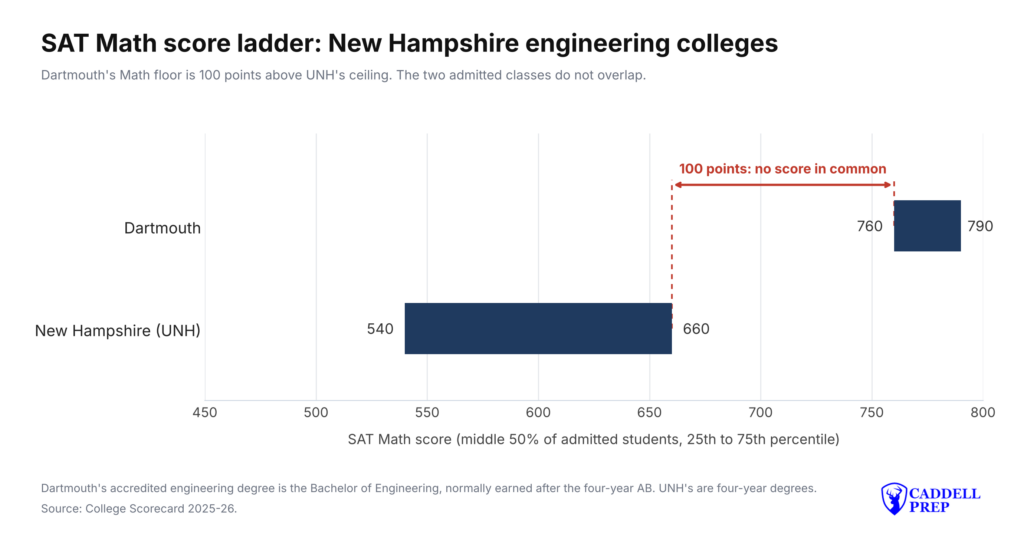
A student can see where his Math score sits on this list in the image above.
Want to Know What 5 Topics Will Improve Your SAT Score the Most?
Sample Feedback from our Diagnostic Test:

Dartmouth College
Dartmouth College’s Thayer School of Engineering in Hanover holds ABET accreditation for its Bachelor of Engineering, a second undergraduate degree that students earn after or alongside the four-year AB in Engineering Sciences, and Dartmouth has the highest range on the page.
Reading & Writing 740 to 780, Math 760 to 790. The top quarter of admitted students scored at or above 790 on Math. Cost of attendance $87,793, with tuition and fees at $68,268 for all students. 4,541 undergraduates, 5.4% admitted.
Dartmouth is the only private college on the page, the most selective by a factor of sixteen, and the most expensive by $52,256 in total cost. Its accredited engineering degree normally takes a fifth year, and the structure and the aid for it are the subject of the next section.
University of New Hampshire
The University of New Hampshire’s College of Engineering and Physical Sciences in Durham holds ABET accreditation in chemical, civil, computer, electrical, environmental, mechanical and ocean engineering, and UNH awards each of them as a four-year bachelor’s degree.
Reading & Writing 550 to 670, Math 540 to 660. The top quarter of admitted students scored at or above 660 on Math. Cost of attendance $35,537, with tuition and fees at $19,202 in state and $39,852 out of state. 11,261 undergraduates, 88% admitted.
UNH is the only public university on the page, the larger of the two by 6,700 students, and the holder of the state’s only ocean engineering degree. Its in-state tuition is the second-highest public resident charge in this series, and its out-of-state tuition is 2.1 times in-state, the narrowest ratio among the flagship universities in this series.
Two ranges say who got in. At one of the two colleges, getting in does not say which degree a student will leave with, and the next section is about that.
Does Dartmouth's Four-Year Engineering Degree Count as an Accredited Engineering Degree?
Dartmouth’s ABET-accredited engineering degree is the Bachelor of Engineering, which the Thayer School describes as one to three terms of study beyond the four-year AB in Engineering Sciences, and Thayer’s page for the AB says nothing about accreditation.
Thayer awards two undergraduate engineering degrees. The AB in Engineering Sciences is Dartmouth’s four-year liberal arts degree in engineering. The Bachelor of Engineering, the BE, is “accredited by the Engineering Accreditation Commission of ABET” under the General Criteria, and Thayer’s page for it says the BE takes “one to three terms” after the AB depending on the courses a student took in his first four years, that most students add a fifth year, that advanced standing can shorten it, and that a student “may also plan ahead to finish a combined AB-BE in four years.” The AB page puts it the other way around: “Many earn both the AB and BE degrees in four years, while others opt to add a fifth year of study.” A BE application and a program plan approved by a faculty advisor and the department are due by mid-January of senior year.
So the one college in New Hampshire with a Math range of 760 to 790 and a 5.4% admit rate is on this page through a degree that is not the one in its four-year catalog. Every other school in this series so far places on its state’s list with a four-year bachelor’s degree. Dartmouth is the first whose accredited engineering degree is structured as a second degree, and the question for a student who wants it is not the 760. It is the fifth year.
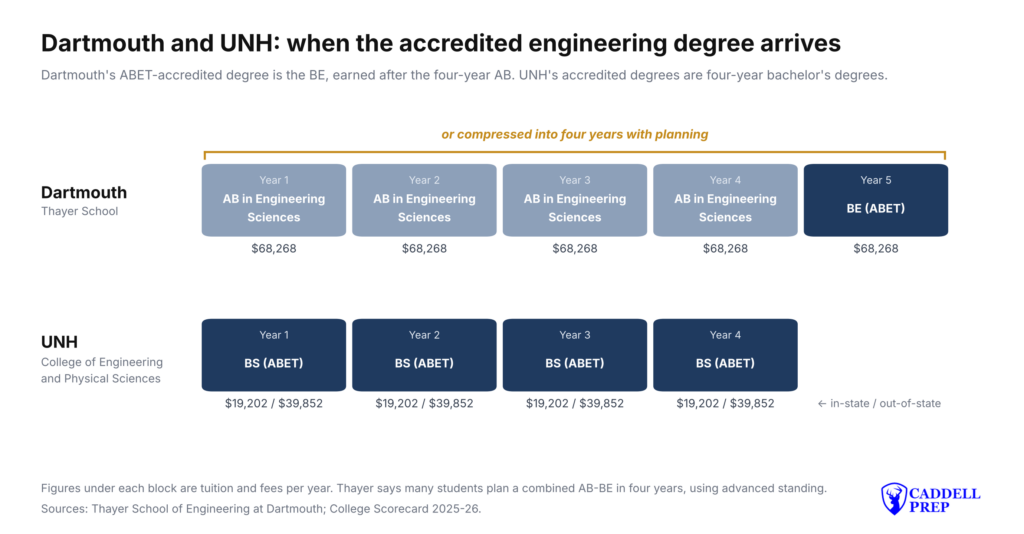
The image above shows one degree in four years, or two degrees in four or five.
The fifth year has a price and, as of this writing, a published gap in the aid for it. Full-time BE students are eligible for partial-tuition scholarships, hourly employment, fellowships and loans, and scholarship recipients may be asked to work as paid teaching assistants. On December 16, 2025, Dartmouth announced a $35 million endowed-scholarship goal for fifth-year engineering students, with $10 million committed, and said in the announcement that “Thayer currently cannot fully meet the demonstrated need of most fifth-year BE students.” The announcement described the choices facing a student without the resources for the fifth year: take on loan debt, compress both degrees into four years, or skip the BE. That is the college’s own account, and this page adds nothing to it.
Take a New York student with a 780 on Math. At Dartmouth he is in the upper half of the admitted range and admitted at 5.4% if he is admitted at all, and then he plans one of two things: a four-year AB-BE with advanced standing and a schedule that has no slack, or an AB in four years and a BE in a fifth, at $68,268 a year in tuition with partial aid. At UNH he is 120 points above the Math ceiling, admitted at 88%, and finishes an accredited BS in four years at $39,852. The two paths end in the same credential, an ABET-accredited engineering bachelor’s. One is one degree in four years. The other is two degrees in four or five.
UNH’s own number is its price. Its in-state tuition of $19,202 is behind only Colorado School of Mines among the public universities in this series and ahead of UMass Amherst’s $17,772, so a New Hampshire resident pays more for Durham than a Michigan resident pays for Ann Arbor ($17,736) or a Maryland resident for College Park ($11,809). Its out-of-state tuition of $39,852 is 2.1 times its in-state figure, the narrowest ratio among the flagships in this series. UNH charges its own residents a larger share of the non-resident price than any other flagship on a drafted page. On our page on engineering colleges in Maine, the flagship next door matches a New Hampshire student’s UNH price for him in Orono.
The honest version is that Thayer does not call the AB unaccredited. Its AB page says nothing about accreditation and its BE page says the BE is accredited, and this page states it that way. Many Dartmouth students finish both degrees in four years, in Thayer’s words, and this page does not estimate how many take the fifth. A student who leaves Dartmouth with the AB alone has a Dartmouth engineering degree, and for most careers that is what matters. What he does not have is the credential that licensure as a professional engineer normally requires, and that is the one this page lists. Olin, on our page on engineering colleges in Massachusetts, was the other school in this series with a structure no one else uses, and in both cases the structure is the thing to read before the range.
Families reading Thayer’s two pages frequently ask whether the fifth year is avoidable.
Can You Finish Dartmouth's AB and BE in Four Years?
A student can finish Dartmouth’s AB and BE in four years. Thayer says a student “may also plan ahead to finish a combined AB-BE in four years,” that many do, and that advanced standing shortens the BE.
What it takes is advanced standing from AP or equivalent credit, a program plan approved by a faculty advisor and the department by mid-January of senior year, and a schedule with no slack in it from the first term. A student without the advanced standing, or who changes direction in his second year, is the student who adds the fifth year, and Dartmouth’s December 2025 announcement is about him.
Dartmouth’s structure is its own. The degrees are what the next section lists.
Which New Hampshire Colleges Have ABET-Accredited Engineering Programs?
Two New Hampshire colleges hold ABET-accredited engineering bachelor’s degrees, one private and one public, and both are in the table above.
In Hanover, Dartmouth’s Thayer School awards the BE, a general engineering degree accredited under ABET’s General Criteria, after or alongside the AB. In Durham, UNH’s College of Engineering and Physical Sciences holds seven disciplines, including the state’s ocean engineering degree and the Chase Ocean Engineering Laboratory that supports it, with BAE Systems in Nashua and the Portsmouth Naval Shipyard the largest engineering employers in the state.
Accreditation matters for a reason that is easy to miss at seventeen. Licensure as a professional engineer normally requires a degree from an ABET-accredited engineering program, and that is why Dartmouth’s BE and not its AB is the degree counted here, and why UNH Manchester’s engineering technology programs do not put that campus on the list. Southern New Hampshire University, Keene State, Plymouth State, Saint Anselm, Franklin Pierce, Rivier, Colby-Sawyer and New England College award no engineering degree.
Nothing on this page ranks the two. The table’s order is a stated, verifiable number, and the choice between two accredited programs comes down to cost, discipline and the number of years.
What If Your Score Is Below the Range You Want?
In New Hampshire the two ranges do not touch, and the 100 points between UNH’s ceiling and Dartmouth’s floor are closed by the questions almost everyone misses, not the ones most students miss. A student at 660 who wants Hanover is working on two or three questions a test, and a student at 600 who wants Durham is already in the upper half.
At UNH admission is 88% and the question after it is placement. At Dartmouth the question after admission is whether the accredited degree takes four years or five, and the answer depends on what the student arrives with. A New York student has two ranges, $68,268 a year at Dartmouth with a possible fifth year of it, and $39,852 at UNH.
The first step is finding out where the score actually is, section by section. A free diagnostic SAT gives a Math score that can be set against the table.
The Math section rewards the same handful of topics on every test date, and a student who knows which of them he is missing can close a gap of 50 to 100 points in weeks rather than months. The method is on our page on improving your SAT Math score, and the last 40 points are their own chapter of it.
How to Read These Score Ranges
Every range on this page covers the middle 50% of admitted students who submitted the SAT. The lower number is the 25th percentile and the upper number is the 75th, so a quarter of admitted students scored at or above it.
A range describes who got in, and an accreditation describes which degree a school awards. A school can have the highest range on a page and award the accredited degree in its fifth year, and the range says nothing about that.
Because most colleges are now test-optional, the ranges that are published describe only the students who chose to submit at all. Students with strong scores submit and students with weak ones don’t, so a published range sits higher than the range for everyone who was actually admitted. More on what SAT score you need for college and on test-optional colleges.
Should You Take the ACT Instead?
New Hampshire administers the SAT to every public-school junior, and six New Hampshire institutions report an SAT range against three for the ACT, so most New Hampshire applicants already hold an SAT score.
Both colleges on this page accept either test, and a student should take whichever he scores higher on.
Engineering Programs in Nearby States
New Hampshire borders Massachusetts, Maine and Vermont, and New Hampshire students apply across those lines in numbers, because two accredited programs at home is one of the shortest lists in the country.
See engineering colleges in Massachusetts, engineering colleges in Maine, and engineering colleges in Vermont.
Engineering Colleges in Other States
We publish the same breakdown for engineering programs in every state.
See engineering colleges by state for the full list.

Glyn Caddell
Glyn Caddell holds a BS in Mechanical Engineering from NJIT and has been tutoring New York City students since 2008. He founded Caddell Prep in 2012 and is the author of Digital SAT Math Secrets: Lessons & Tricks to Quickly Improve to a Perfect 800 on the Math Test, which contains over 900 practice problems and is used in Caddell Prep’s SAT math classes. He is founding president of the Staten Island Technical High School alumni association and teaches every lesson on this site personally.
Finally, an SAT course that students actually understand
Every question has a video explanation. Not most — every one.
The on-demand Digital SAT course covers all 17 math topics and 15 reading and writing topics, with 5 full-length practice tests and a 100-point score increase guarantee. Keep access for the rest of high school. No subscription.
Want to Know What 5 Topics Will Improve Your SAT Score the Most?
Sample Feedback from our Diagnostic Test: