
Home » College SAT Score Ranges, Costs, and Programs by Major and State » Best Business Colleges » Business Colleges in Illinois: SAT Scores, ACT Scores, Costs, and Programs
By Glyn Caddell, BSME · Author of Digital SAT Math Secrets · Tutoring since 2008 — Updated November 9, 2026
Eighteen Illinois universities hold AACSB-accredited business schools, from the Gies College of Business at Urbana-Champaign to Governors State, and this page lists the SAT and ACT scores of the students they admit, what each costs a New York student, and what it takes to enter Gies after the university says yes.
Twelve report an SAT range and eleven an ACT range, so the table leads with the SAT.
At Urbana-Champaign a student is admitted to Gies as a freshman or applies once, the next spring, to a pool that takes about a third and does not read the SAT.
Table of Contents
- Illinois Business Colleges by SAT and ACT Score
- What Does It Take to Enter the Gies College of Business?
- Which Illinois Universities Have AACSB-Accredited Business Schools?
- What If Your Score Is Below the Range You Want?
Illinois Business Colleges by SAT and ACT Score
Illinois’s eighteen AACSB-accredited business schools run from the Gies College of Business at the University of Illinois Urbana-Champaign, with a Math range of 660 to 780, to six universities that report no range at all, and the table below lists each with its SAT and ACT ranges where reported, cost of attendance, enrollment and admit rate. Eleven are public and seven private, twelve report an SAT range, and the rows are sorted by the midpoint of the SAT Math range, with ties broken on the ACT composite midpoint and the six non-reporters following in order of enrollment, so the order can be checked from the table itself.
| College | SAT Reading & Writing | SAT Math | ACT composite | Business school | Cost of attendance | Undergraduates | Admit rate |
|---|---|---|---|---|---|---|---|
| University of Illinois Urbana-Champaign | 650 to 740 | 660 to 780 | 30 to 34 | Gies College of Business | $33,642 | 36,258 | 42% |
| Illinois Institute of Technology | 590 to 720 | 590 to 720 | 26 to 32 | Stuart School of Business | $68,164 | 2,833 | 55% |
| Loyola University Chicago | 600 to 690 | 570 to 670 | 27 to 32 | Quinlan School of Business | $67,408 | 11,737 | 82% |
| University of Illinois Chicago | 570 to 670 | 560 to 680 | 25 to 31 | College of Business Administration | $27,521 | 22,170 | 77% |
| DePaul University | 580 to 670 | 560 to 660 | 25 to 31 | Driehaus College of Business | $63,052 | 14,090 | 76% |
| North Central College | 530 to 650 | 525 to 660 | 24 to 29 | School of Business and Entrepreneurship | $57,219 | 2,428 | 77% |
| Illinois State University | 500 to 620 | 490 to 590 | 21 to 27 | College of Business | $34,309 | 19,057 | 88% |
| University of Illinois Springfield | 480 to 610 | 460 to 590 | 21 to 27 | College of Business and Management | $25,521 | 2,263 | 86% |
| Southern Illinois University Edwardsville | 490 to 600 | 460 to 590 | 20 to 27 | School of Business | $28,919 | 8,750 | 98% |
| Southern Illinois University-Carbondale | 470 to 590 | 430 to 570 | 18 to 25 | College of Business and Analytics | $28,329 | 8,494 | 87% |
| Dominican University | 460 to 560 | 420 to 540 | 16 to 26 | Brennan School of Business | $43,891 | 2,561 | 90% |
| Eastern Illinois University | 460 to 560 | 420 to 530 | not reported | Lumpkin College of Business and Technology | $26,996 | 4,188 | 65% |
| Northern Illinois University | not reported | not reported | not reported | College of Business | $28,851 | 11,301 | 70% |
| Western Illinois University | not reported | not reported | not reported | College of Business and Technology | $28,254 | 4,410 | 71% |
| Northeastern Illinois University | not reported | not reported | not reported | College of Business and Management | $26,960 | 3,982 | 75% |
| Bradley University | not reported | not reported | not reported | Foster College of Business | $54,730 | 3,574 | 77% |
| Saint Xavier University | not reported | not reported | not reported | Graham School of Management | $43,244 | 3,096 | 84% |
| Governors State University | not reported | not reported | not rep |
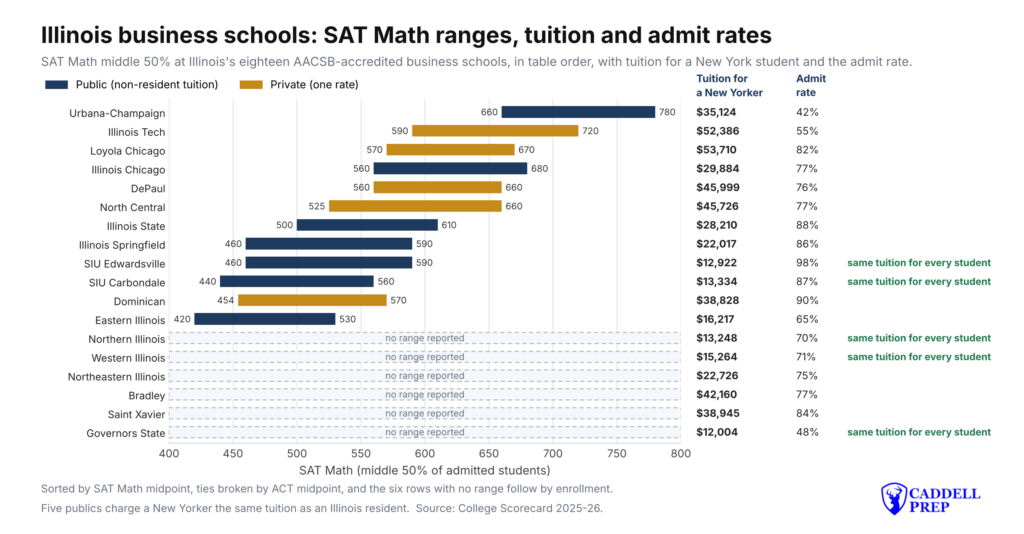
A student can see where his Math score sits on this ladder in the image above.
University of Illinois Urbana-Champaign
The University of Illinois Urbana-Champaign awards its business degrees through the Gies College of Business, and Urbana-Champaign reports the highest Math range on this page, 660 to 780, admits 42% of applicants to the university and charges a New Yorker $35,124.
Reading & Writing 650 to 740, Math 660 to 780. ACT composite 30 to 34. The top quarter of admitted students scored at or above 780 on Math and 34 on the ACT. Cost of attendance $33,642, with tuition and fees at $16,004 in-state and $35,124 out-of-state. 36,258 undergraduates, 42% admitted.
Urbana-Champaign’s 660 floor is 70 points above IIT’s 590 and 20 below UIC’s 680 ceiling, and its 30 to 34 on the ACT is the only range on the page that starts at 30. The 42% is the university’s rate, and the Scorecard does not separate Gies’s own, the subject of the next section. The cost of attendance in the table is a resident’s. A non-resident’s comes to approximately $52,762 once the higher tuition is substituted, and the $35,124 that drives it is $952 above what the University of Alabama charges a New Yorker and $8,588 below UConn’s figure.
Illinois Institute of Technology
The Illinois Institute of Technology in Chicago awards its business degrees through the Stuart School of Business, and IIT reports the second highest Math range on the page, 590 to 720, on 2,833 undergraduates, the smallest campus among the top five rows.
Reading & Writing 590 to 720, Math 590 to 720. ACT composite 26 to 32. The top quarter of admitted students scored at or above 720 on Math and 32 on the ACT. Cost of attendance $68,164, with tuition and fees at $52,386 for all students. 2,833 undergraduates, 55% admitted.
IIT’s $52,386 is the second highest tuition on the page after Loyola’s, and its $68,164 cost of attendance is the highest. Its 720 Math ceiling is 60 points under Urbana-Champaign’s, and it admits 55%, the third lowest rate on the page after Urbana-Champaign’s and Governors State’s.
Loyola University Chicago
Loyola University Chicago awards its business degrees through the Quinlan School of Business, and Loyola reports a Math range of 570 to 670, the same 620 midpoint as the University of Illinois Chicago, and sits above it in the table on its ACT midpoint alone.
Reading & Writing 600 to 690, Math 570 to 670. ACT composite 27 to 32. The top quarter of admitted students scored at or above 670 on Math and 32 on the ACT. Cost of attendance $67,408, with tuition and fees at $53,710 for all students. 11,737 undergraduates, 82% admitted.
Loyola’s $53,710 is the highest tuition on the page, and its 27 to 32 on the ACT is the second highest range after Urbana-Champaign’s. Loyola admits 82% of applicants to UIC’s 77%, and a student with the same middle score pays $95,304 more over four years to attend it.
University of Illinois Chicago
The University of Illinois Chicago awards its business degrees through its College of Business Administration, and UIC reports a Math range of 560 to 680, matches Loyola at the midpoint, and charges a New Yorker $23,826 a year less.
Reading & Writing 570 to 670, Math 560 to 680. ACT composite 25 to 31. The top quarter of admitted students scored at or above 680 on Math and 31 on the ACT. Cost of attendance $27,521, with tuition and fees at $14,338 in-state and $29,884 out-of-state. 22,170 undergraduates, 77% admitted.
UIC’s 680 Math ceiling is the second highest on the page, and its 22,170 undergraduates make it the second largest campus after Urbana-Champaign. The cost of attendance in the table is a resident’s. A non-resident’s comes to approximately $43,067 with the higher tuition substituted, and the $29,884 that drives it is $5,240 below Urbana-Champaign’s, with a premium of $15,546 over a resident.
DePaul University
DePaul University in Chicago awards its business degrees through the Driehaus College of Business, and DePaul is the largest private university on the page, with 14,090 undergraduates, and reports a Math range of 560 to 660.
Reading & Writing 580 to 670, Math 560 to 660. ACT composite 25 to 31. The top quarter of admitted students scored at or above 660 on Math and 31 on the ACT. Cost of attendance $63,052, with tuition and fees at $45,999 for all students. 14,090 undergraduates, 76% admitted.
DePaul’s $45,999 is $7,711 below Loyola’s on a Math range 10 points lower at both ends, and it admits 76%. Its 660 ceiling matches North Central’s, two rows down, on a floor 35 points higher.
North Central College
North Central College in Naperville awards its business degrees through its School of Business and Entrepreneurship, AACSB-accredited since April 2026 and the newest accreditation in this series, and North Central reports a Math range of 525 to 660.
Reading & Writing 530 to 650, Math 525 to 660. ACT composite 24 to 29. The top quarter of admitted students scored at or above 660 on Math and 29 on the ACT. Cost of attendance $57,219, with tuition and fees at $45,726 for all students. 2,428 undergraduates, 77% admitted.
North Central’s Math range reaches the same 660 ceiling as DePaul’s from a floor of 525, and its $45,726 is $273 below DePaul’s. It admits 77%, with 2,428 undergraduates, and its accreditation is seven months old as this page is written [VERIFY on the AACSB directory].
Illinois State University
Illinois State University in Normal awards its business degrees through its College of Business, and Illinois State is the third largest public on the page, with 19,057 undergraduates, admits 88% and charges a New Yorker $28,210.
Reading & Writing 500 to 620, Math 490 to 590. ACT composite 21 to 27. The top quarter of admitted students scored at or above 590 on Math and 27 on the ACT. Cost of attendance $34,309, with tuition and fees at $16,144 in-state and $28,210 out-of-state. 19,057 undergraduates, 88% admitted.
Illinois State’s 590 Math ceiling matches Springfield’s and SIUE’s, and its 490 floor is 30 points above both. The cost of attendance in the table is a resident’s. A non-resident’s comes to approximately $46,375 with the higher tuition substituted, and the $28,210 that drives it is $110 below what the University of Idaho charges a New Yorker, with a premium of $12,066 over a resident.
University of Illinois Springfield
The University of Illinois Springfield awards its business degrees through its College of Business and Management, and Springfield reports the same Math range as SIU Edwardsville, 460 to 590, and sits above it in the table on its ACT midpoint alone.
Reading & Writing 480 to 610, Math 460 to 590. ACT composite 21 to 27. The top quarter of admitted students scored at or above 590 on Math and 27 on the ACT. Cost of attendance $25,521, with tuition and fees at $12,252 in-state and $22,017 out-of-state. 2,263 undergraduates, 86% admitted.
Springfield is the smallest public on the page, with 2,263 undergraduates, and admits 86%. Its $22,017 for a New Yorker is $9,765 above its resident figure, and the non-resident cost of attendance comes to approximately $35,286 with the higher tuition substituted.
Southern Illinois University Edwardsville
Southern Illinois University Edwardsville awards its business degrees through its School of Business, and SIUE admits 98% of applicants, the highest rate on the page, and charges every student the same $12,922 whether he lives in Edwardsville or Brooklyn.
Reading & Writing 490 to 600, Math 460 to 590. ACT composite 20 to 27. The top quarter of admitted students scored at or above 590 on Math and 27 on the ACT. Cost of attendance $28,919, with tuition and fees at $12,922 for every student, resident or not. 8,750 undergraduates, 98% admitted.
SIUE’s 98% is 8 points above Dominican’s, the next highest rate, and its 460 to 590 on Math matches Springfield’s. Four years of tuition is $51,688, less than two years at Loyola.
Southern Illinois University-Carbondale
Southern Illinois University-Carbondale awards its business degrees through its College of Business and Analytics, and Carbondale charges every student $13,334, the same figure for a resident and a New Yorker.
Reading & Writing 470 to 590, Math 430 to 570. ACT composite 18 to 25. The top quarter of admitted students scored at or above 570 on Math and 25 on the ACT. Cost of attendance $28,329, with tuition and fees at $13,334 for every student, resident or not. 8,494 undergraduates, 87% admitted.
Carbondale’s 430 Math floor is 30 points under SIUE’s, and its 87% admit rate is 11 points under it. Four years of tuition is $53,336, $87,160 less than four years at Urbana-Champaign for a New Yorker.
Dominican University
Dominican University in River Forest awards its business degrees through the Brennan School of Business, and Dominican admits 90% of applicants.
Reading & Writing 460 to 560, Math 420 to 540. ACT composite 16 to 26. The top quarter of admitted students scored at or above 540 on Math and 26 on the ACT. Cost of attendance $43,891, with tuition and fees at $38,978 for all students. 2,561 undergraduates, 90% admitted.
Eastern Illinois University
Eastern Illinois University in Charleston awards its business degrees through the Lumpkin College of Business and Technology, and Eastern Illinois is the one row on the page that reports an SAT range and no ACT range.
Reading & Writing 460 to 560, Math 420 to 530. Eastern Illinois reports no ACT range. The top quarter of admitted students scored at or above 530 on Math. Cost of attendance $26,996, with tuition and fees at $13,679 in-state and $16,217 out-of-state. 4,188 undergraduates, 65% admitted.
Eastern Illinois’s $16,217 for a New Yorker is $2,538 above its resident figure, the smallest premium on the page among the publics that charge one, and the second smallest in this series after Henderson State’s $2,376. Its 420 to 530 on Math is the lowest reported range on the page, and it admits 65%.
Northern Illinois University
Northern Illinois University in DeKalb awards its business degrees through its College of Business, and NIU is the largest row that reports no score range, with 11,301 undergraduates, and has charged every U.S. student the same tuition since its board dropped the out-of-state premium in 2017, $13,248 this year.
Score ranges not reported. Cost of attendance $28,851, with tuition and fees at $13,248 for every student, resident or not. 11,301 undergraduates, 70% admitted.
NIU’s board dropped the out-of-state premium for U.S. residents in October 2017, and the Scorecard’s resident and non-resident figures have matched since [VERIFY the current NIU tuition page]. Four years of tuition is $52,992, and NIU admits 70%.
Western Illinois University
Western Illinois University in Macomb awards its business degrees through its College of Business and Technology, and Western Illinois admits 71% of applicants, reports no score range and charges every student $15,264.
Score ranges not reported. Cost of attendance $28,254, with tuition and fees at $15,264 for every student, resident or not. 4,410 undergraduates, 71% admitted. Four years of tuition is $61,056 for a New Yorker, the same as for a resident.
Northeastern Illinois University
Northeastern Illinois University in Chicago awards its business degrees through its College of Business and Management, and Northeastern Illinois admits 75% of applicants and reports no score range.
Score ranges not reported. Cost of attendance $26,960, with tuition and fees at $12,383 in-state and $22,726 out-of-state. 3,982 undergraduates, 75% admitted. Northeastern Illinois charges a New Yorker $22,726, with a premium of $10,343 over its resident tuition.
Bradley University
Bradley University in Peoria awards its business degrees through the Foster College of Business, and Bradley admits 77% of applicants and reports no score range.
Score ranges not reported. Cost of attendance $54,730, with tuition and fees at $42,160 for all students. 3,574 undergraduates, 77% admitted.
Saint Xavier University
Saint Xavier University in Chicago awards its business degrees through the Graham School of Management, and Saint Xavier admits 84% of applicants and reports no score range.
Score ranges not reported. Cost of attendance $43,244, with tuition and fees at $37,940 for all students. 3,096 undergraduates, 84% admitted.
Governors State University
Governors State University in University Park awards its business degrees through its College of Business, and Governors State charges every student $12,004, the lowest tuition on the page, and admits 48%, the lowest rate after Urbana-Champaign’s.
Score ranges not reported. Cost of attendance $24,227, with tuition and fees at $12,004 for every student, resident or not. 2,556 undergraduates, 48% admitted.
Governors State’s $12,004 is $918 below SIUE’s, the next lowest on the page, and $23,120 below Urbana-Champaign’s. Four years of tuition is $48,016. The admit rate sits on no reported range, so the 48% says how many were turned away and not what scores the admitted students carried.
Eighteen rows say who got into the university. The next section is about the one spring in which an Urbana-Champaign student who is not already in Gies gets to ask.
What Does It Take to Enter the Gies College of Business?
A University of Illinois Urbana-Champaign student enters the Gies College of Business as a freshman admitted directly to the college or through Intercollegiate Transfer in the spring of his first year, with 24 graded hours, four named courses and priority at a 3.0, into a pool that admits about 35% of those who apply.
The Gies Intercollegiate Transfer page, ICT for short, sets the terms for a student already enrolled at Illinois in another college. He must have “completed at least 24 graded credit hours at Illinois by the end of your first spring semester.” By the end of that same spring he must have finished Composition I, ECON 102 (ACE 100 substitutes), ECON 103 and one of MATH 115, 220, 221, 231, 234 or STAT 100, taken at Illinois, elsewhere, or earned through AP or IB credit. Three levels of a language other than English, CMN 101 and CS 105 are recommended, and the page gives priority to a student with the three language levels or a passed proficiency exam. A student with “an overall 3.0 GPA or above” at the end of spring receives priority admission [VERIFY every item on the Gies ICT page for the current cycle].
Priority is the page’s word, and the next sentence takes most of it back. Admission is not guaranteed “due to space limitations and the strength of the applicant pool each year,” and about 35% of ICT applicants are admitted in a normal year. The fall 2026 deadline was May 20, 2026, decisions come in late June, and a Gies program must then be finished within nine full-time semesters. The application carries several essays and a holistic review.
The university’s own ICT process page adds four sentences that matter more to a New York family than the course list. “A competitive application process is used to admit students.” “Students apply for ICT during the spring semester their freshman year.” “Only college-level coursework and grades will be considered for academic review.” And: “High school grades and ACT/SAT/TOEFL scores are not factors.” A student who has completed more than two semesters at Illinois cannot apply, and neither can a student who entered as an off-campus transfer. The window is one spring.
The wide door is the freshman application. Gies admits most of its students directly from high school, through the university application with Gies as the first-choice college, and the Scorecard does not separate the college’s admit rate from the university’s 42% [VERIFY on the Gies freshman admission page and quote any profile or share it gives]. UIC’s College of Business Administration and Illinois State’s College of Business admit business majors on the university application, and neither catalog was read for this page for a later gate [VERIFY both].
Set against the earlier pages, Gies’s second door is a different kind of door. On our page on business colleges in Georgia, Terry reads a student’s SAT or ACT a second time when he applies to his major. On our page on business colleges in Idaho, Boise State’s gate is a 2.5 across nine courses and nothing else, and the FAQ says it cannot be waived, so a student who hits it is in. Gies does neither. It does not read the score, and hitting the 3.0 earns a place in line, not a seat. Two of three applicants in that line are turned away.
| Door | Who | What Gies asks | Odds |
|---|---|---|---|
| Freshman admission | A high school senior naming Gies on the university application | The university application with Gies as first choice [VERIFY any stated profile] | Gies’s own rate is not separated from the university’s 42% in the Scorecard [VERIFY] |
| Intercollegiate Transfer | A first-year Illinois student in another college, once, in spring | 24 graded hours at Illinois, Composition I, ECON 102 and 103, one calculus or statistics course, essays, by the May deadline. Language levels I to III, CMN 101 and CS 105 recommended |
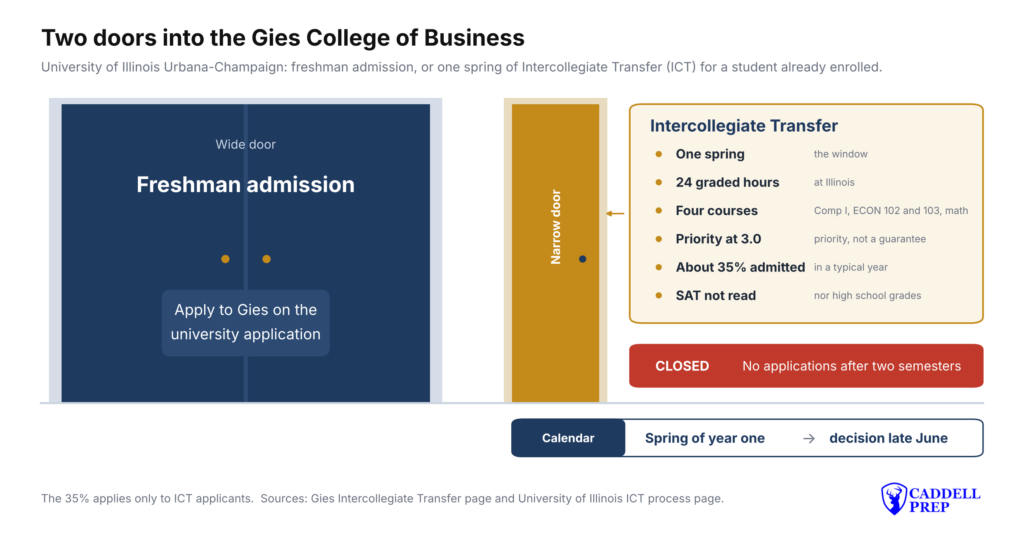
The image above shows the two doors into Gies and how far each one opens.
Does a 3.0 Guarantee Admission to Gies Through ICT?
No, a 3.0 does not guarantee admission to the Gies College of Business through Intercollegiate Transfer, because the Gies page gives a 3.0 priority and says admission is not guaranteed due to space limitations and the strength of the applicant pool, and about 35% of applicants are admitted.
The test score does not help either. The university’s ICT page says high school grades and ACT and SAT scores are not factors, so the 1500 that opened the first door is not read at the second. The application is open for one spring, closed after two semesters, and decided in late June on college grades, four courses and essays [VERIFY].
One spring, a 3.0 for priority, one in three. Which schools hold the accreditation is the next section.
Which Illinois Universities Have AACSB-Accredited Business Schools?
Eighteen Illinois universities hold business accreditation from AACSB International, eleven public and seven private, and the list below names each with its city and the school that awards the business degree [VERIFY all eighteen on the AACSB directory before publishing].
- University of Illinois Urbana-Champaign in Champaign awards its business degrees through the AACSB-accredited Gies College of Business.
- University of Illinois Chicago in Chicago awards its business degrees through its AACSB-accredited College of Business Administration.
- Illinois State University in Normal awards its business degrees through its AACSB-accredited College of Business.
- University of Illinois Springfield in Springfield awards its business degrees through its AACSB-accredited College of Business and Management.
- Southern Illinois University Edwardsville in Edwardsville awards its business degrees through its AACSB-accredited School of Business.
- Southern Illinois University-Carbondale in Carbondale awards its business degrees through its AACSB-accredited College of Business and Analytics.
- Eastern Illinois University in Charleston awards its business degrees through the AACSB-accredited Lumpkin College of Business and Technology.
- Northern Illinois University in DeKalb awards its business degrees through its AACSB-accredited College of Business.
- Western Illinois University in Macomb awards its business degrees through its AACSB-accredited College of Business and Technology.
- Northeastern Illinois University in Chicago awards its business degrees through its AACSB-accredited College of Business and Management.
- Governors State University in University Park awards its business degrees through its AACSB-accredited College of Business.
- Illinois Institute of Technology in Chicago awards its business degrees through the AACSB-accredited Stuart School of Business.
- Loyola University Chicago in Chicago awards its business degrees through the AACSB-accredited Quinlan School of Business.
- DePaul University in Chicago awards its business degrees through the AACSB-accredited Driehaus College of Business.
- North Central College in Naperville awards its business degrees through its AACSB-accredited School of Business and Entrepreneurship (accredited April 2026).
- Dominican University in River Forest awards its business degrees through the AACSB-accredited Brennan School of Business.
- Bradley University in Peoria awards its business degrees through the AACSB-accredited Foster College of Business.
- Saint Xavier University in Chicago awards its business degrees through the AACSB-accredited Graham School of Management.
Accreditation matters for a reason that is easy to miss at seventeen. Business itself is not a licensed profession, and the one business degree that leads to a license, accounting, leads to it through the state board rather than through the school. A CPA in Illinois normally needs 150 semester hours, the Uniform CPA Examination, an ethics exam and a year of experience until January 1, 2027, and after that date one of three pathways that trade a master’s degree, a second year of experience or 30 extra hours against one another [VERIFY on the board’s page]. AACSB status matters on the way there because business schools use it to decide whose courses they will accept in transfer.
Two Illinois business schools a New York family names first are not rows. Northwestern University’s Kellogg School of Management in Evanston and the University of Chicago’s Booth School of Business hold AACSB accreditation for graduate schools that award no undergraduate business degree, and this series leaves graduate-only schools off the table, as it did Yale, UCLA Anderson and the Stanford GSB. Northwestern reports a Math range of 770 to 800, admits 8% and charges every student $68,322, and the bachelor’s degrees the Scorecard files under business at Northwestern come from a school other than Kellogg [VERIFY which program]. Chicago State University in Chicago holds business accreditation from the ACBSP, charges every student $12,754 and admits 43%, and Roosevelt University holds ACBSP accreditation, charges $21,315 and admits 97%. Illinois Wesleyan, Millikin, Lewis, Elmhurst, Olivet Nazarene and Aurora award business degrees under the ACBSP or no business accreditor [VERIFY each]. None of the ten is a row.
Nothing on this page ranks the eighteen. They are eleven public universities and seven private with the same accreditor, one pool at Gies, five prices that do not change at the state line and thirteen that do, and the pages for business colleges in Wisconsin, business colleges in Indiana and business colleges in Missouri carry the schools a student looking at Illinois is likely comparing.
What If Your Scores Are Below the Range You Want?
In Illinois the flagship’s floors are 660 on Math and 30 on the ACT, IIT’s are 590 and 26, UIC’s 560 and 25, and six rows publish none. A student under the floor he wants is not ruled out, because a quarter of admitted students were there too. He is in the quarter that needs the rest of the application to carry more.
The first step is finding out where the score actually is, section by section. A free diagnostic SAT gives a Math score that can be set directly against UIC’s 560 floor and Urbana-Champaign’s 660.
The Math section rewards the same handful of topics on every test date, and a student who knows which of them he is missing can close a gap of 50 to 100 points in weeks rather than months. The method is on our page on improving your SAT Math score, and at Urbana-Champaign the same algebra fills the calculus or statistics course, MATH 115, 220, 221, 231, 234 or STAT 100, that Gies asks a student to finish before the ICT application.
How to Read These Score Ranges
Each range in the table covers the middle 50% of admitted students who submitted that test, so a quarter of admitted students were below the lower number and a quarter were at or above the upper one.
A range describes the students who chose to submit at all. Where a school is test-optional, the range describes the submitters, and the submitters are the students whose scores helped them. A row marked not reported means the Scorecard has no range for that university, and a student should read the university’s own admissions page for the score it expects. More on what SAT score you need for college and on test-optional colleges.
Should You Take the ACT Instead?
Illinois gives the SAT to its public school juniors as the state test [VERIFY current Illinois statewide testing], and eleven of the twelve reporting rows report both tests.
A New York student who holds an SAT should send it everywhere in Illinois and leave the ACT alone unless a school elsewhere asks for it. Nothing at Gies’s second door reads either test.
Business Programs in Nearby States
Illinois borders five states, and each has its own page in this series.
See business colleges in Wisconsin, business colleges in Iowa, business colleges in Missouri, business colleges in Kentucky and business colleges in Indiana.
Business Colleges in Other States
We publish the same breakdown for business programs in every state.
See business colleges by state for the full list.

Glyn Caddell
Glyn Caddell holds a BS in Mechanical Engineering from NJIT and has been tutoring New York City students since 2008. He founded Caddell Prep in 2012 and is the author of Digital SAT Math Secrets: Lessons & Tricks to Quickly Improve to a Perfect 800 on the Math Test, which contains over 900 practice problems and is used in Caddell Prep’s SAT math classes. He is founding president of the Staten Island Technical High School alumni association and teaches every lesson on this site personally.
Finally, an SAT course that students actually understand
Every question has a video explanation. Not most — every one.
The on-demand Digital SAT course covers all 17 math topics and 15 reading and writing topics, with 5 full-length practice tests and a 100-point score increase guarantee. Keep access for the rest of high school. No subscription.
Want to Know What 5 Topics Will Improve Your SAT Score the Most?
Sample Feedback from our Diagnostic Test: