
Home » College SAT Score Ranges, Costs, and Programs by Major and State » Best Business Colleges » Business Colleges in Indiana: SAT Scores, ACT Scores, Costs, and Programs
By Glyn Caddell, BSME · Author of Digital SAT Math Secrets · Tutoring since 2008 — Updated November 10, 2026
Sixteen Indiana universities hold AACSB-accredited business schools, from the Mendoza College of Business at Notre Dame to the four Indiana University regional campuses, and this page lists the SAT and ACT scores of the students they admit, what each costs a New York student, and what the Kelley School of Business asks of a student Indiana University admits without admitting him to Kelley.
Fourteen report both tests, a tie, so the table leads with the SAT.
At Bloomington a pre-business student is admitted to Kelley automatically with an A- or better in every course on the first attempt, and anything less sends him to a review decided as space allows.
Table of Contents
- Indiana Business Colleges by SAT and ACT Score
- What Does It Take to Enter the Kelley School of Business as a Pre-Business Student?
- Which Indiana Universities Have AACSB-Accredited Business Schools?
- What If Your Score Is Below the Range You Want?
Indiana Business Colleges by SAT and ACT Score
Indiana’s sixteen AACSB-accredited business schools run from the Mendoza College of Business at the University of Notre Dame, with a Math range of 735 to 790, to two universities that report no range, and the table below lists each with its SAT and ACT ranges where reported, cost of attendance, enrollment and admit rate. Twelve are public and four private, fourteen report an SAT range, and the rows are sorted by the midpoint of the SAT Math range, with a tie broken on the ACT composite midpoint and the two non-reporters following in order of enrollment, so the order can be checked from the table itself.
| College | SAT Reading & Writing | SAT Math | ACT composite | Business school | Cost of attendance | Undergraduates | Admit rate |
|---|---|---|---|---|---|---|---|
| University of Notre Dame | 720 to 770 | 735 to 790 | 33 to 35 | Mendoza College of Business | $83,271 | 8,818 | 11% |
| Purdue University | 600 to 720 | 600 to 760 | 27 to 34 | Mitchell E. Daniels, Jr. School of Business | $24,591 | 44,503 | 50% |
| Indiana University-Bloomington | 590 to 690 | 580 to 710 | 27 to 33 | Kelley School of Business | $28,801 | 37,806 | 78% |
| Butler University | 590 to 680 | 570 to 670 | 26 to 31 | Lacy School of Business | $65,970 | 4,317 | 85% |
| Valparaiso University | 540 to 640 | 520 to 640 | 23 to 31 | College of Business | $58,437 | 2,083 | 89% |
| Ball State University | 550 to 640 | 530 to 620 | 20 to 24 | Miller College of Business | $26,146 | 13,988 | 86% |
| University of Southern Indiana | 520 to 620 | 510 to 620 | 21 to 27 | Romain College of Business | $22,383 | 5,292 | 96% |
| Indiana University-Indianapolis | 520 to 630 | 510 to 610 | 21 to 29 | Kelley School of Business Indianapolis | $23,316 | 13,830 | 76% |
| Purdue University Fort Wayne | 490 to 610 | 480 to 610 | 22 to 29 | Doermer School of Business | $22,183 | 5,484 | 84% |
| Indiana University-Southeast | 490 to 610 | 480 to 570 | 20 to 25 | School of Business | $16,411 | 3,170 | 84% |
| Indiana University-South Bend | 480 to 610 | 470 to 580 | 21 to 23 | Judd Leighton School of Business and Economics | $17,364 | 3,933 | 84% |
| Indiana University-Kokomo | 490 to 580 | 470 to 570 | 21 to 27 | School of Business | $11,837 | 2,352 | 86% |
| Indiana University-Northwest | 460 to 600 | 450 to 580 | 18 to 26 | School of Business and Economics | $13,989 | 2,661 | 73% |
| Purdue University Northwest | 450 to 570 | 440 to 570 | 16 to 24 | College of Business | $15,571 | 5,671 | 72% |
| Indiana State University | not reported | not reported | not reported | Scott College of Business | $24,535 | 6,188 | 81% |
| University of Evansville | not reported | not reported | not report |
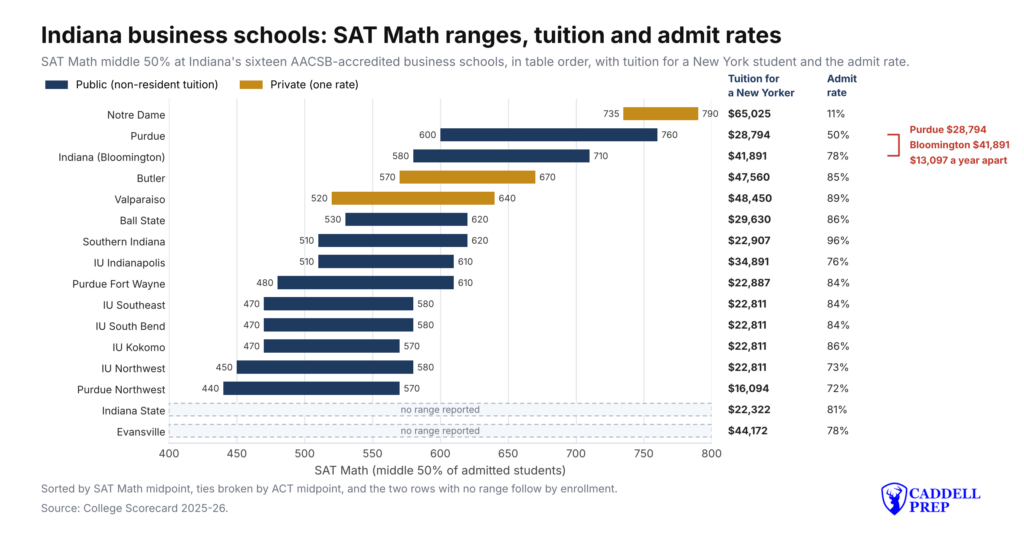
A student can see where his Math score sits on this ladder in the image above.
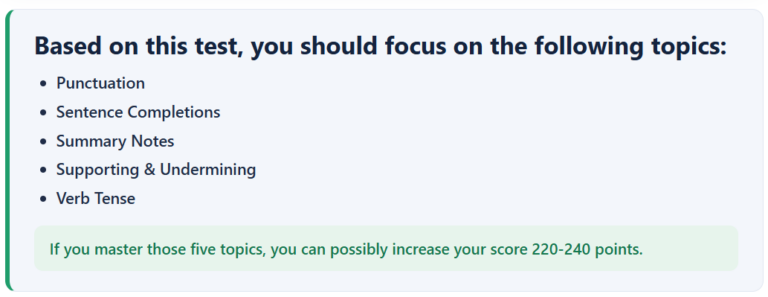
Want to Know What 5 Topics Will Improve Your SAT Score the Most?
Sample Feedback from our Diagnostic Test:
University of Notre Dame
The University of Notre Dame awards its business degrees through the Mendoza College of Business, and Notre Dame reports a Math range of 735 to 790, the second highest floor in this series after Emory’s, and admits 11% of applicants, the lowest rate on the page.
Reading & Writing 720 to 770, Math 735 to 790. ACT composite 33 to 35. The top quarter of admitted students scored at or above 790 on Math and 35 on the ACT. Cost of attendance $83,271, with tuition and fees at $65,025 for all students. 8,818 undergraduates, 11% admitted.
Notre Dame’s 735 floor is 135 points above Purdue’s 600 and its 790 ceiling matches Emory’s, the series high. Its $65,025 is the highest tuition on the page and its $83,271 cost of attendance the highest in the table. A New York student with a 650 on Math is 85 points under the floor.
Purdue University
Purdue University in West Lafayette, listed in the Scorecard as Purdue University-Main Campus, awards its business degrees through the Mitchell E. Daniels, Jr. School of Business, and Purdue reports a Math range of 600 to 760, the highest of any public on the page, and charges a New Yorker $28,794.
Reading & Writing 600 to 720, Math 600 to 760. ACT composite 27 to 34. The top quarter of admitted students scored at or above 760 on Math and 34 on the ACT. Cost of attendance $24,591, with tuition and fees at $9,992 in-state and $28,794 out-of-state. 44,503 undergraduates, 50% admitted.
Purdue’s 600 floor is 20 points above Bloomington’s 580 and its 760 ceiling 50 above Bloomington’s 710, and it charges a New Yorker $13,097 a year less, $52,388 over four years. Purdue has held its tuition at the same figure since the 2012-13 year [VERIFY the freeze’s status on Purdue’s tuition page]. The cost of attendance in the table is a resident’s. A non-resident’s comes to approximately $43,393 once the higher tuition is substituted, and the $28,794 that drives it is $474 above what the University of Idaho charges a New Yorker. Purdue admits 50%, the second lowest rate on the page.
Indiana University-Bloomington
Indiana University-Bloomington awards its business degrees through the Kelley School of Business, and Bloomington admits 78% of applicants to the university, charges a New Yorker $41,891, the highest non-resident tuition among the publics on the page, and decides who enters Kelley separately, the subject of the next section.
Reading & Writing 590 to 690, Math 580 to 710. ACT composite 27 to 33. The top quarter of admitted students scored at or above 710 on Math and 33 on the ACT. Cost of attendance $28,801, with tuition and fees at $12,144 in-state and $41,891 out-of-state. 37,806 undergraduates, 78% admitted.
Bloomington’s Math range of 580 to 710 sits 20 points under Purdue’s at the floor and 50 under it at the top, and its 27 to 33 on the ACT matches Purdue’s at the floor. The cost of attendance in the table is a resident’s. A non-resident’s comes to approximately $58,548 with the higher tuition substituted, and the $41,891 that drives it is $6,767 above Urbana-Champaign’s and $1,821 below UConn’s, with a premium of $29,747 over a resident, the largest on the page.
Butler University
Butler University in Indianapolis awards its business degrees through the Lacy School of Business, and Butler reports a Math range of 570 to 670, the highest private range on the page after Notre Dame’s, and admits 85%.
Reading & Writing 590 to 680, Math 570 to 670. ACT composite 26 to 31. The top quarter of admitted students scored at or above 670 on Math and 31 on the ACT. Cost of attendance $65,970, with tuition and fees at $47,560 for all students. 4,317 undergraduates, 85% admitted.
Butler’s $47,560 is $17,465 below Notre Dame’s and $1,561 above Evansville’s, and its 26 to 31 on the ACT is the fourth highest range on the page. Its 570 floor is 10 points under Bloomington’s.
Valparaiso University
Valparaiso University awards its business degrees through its College of Business, and Valparaiso reports a Math range of 520 to 640, a midpoint 5 points above Ball State’s, and admits 89%.
Reading & Writing 540 to 640, Math 520 to 640. ACT composite 23 to 31. The top quarter of admitted students scored at or above 640 on Math and 31 on the ACT. Cost of attendance $58,437, with tuition and fees at $48,450 for all students. 2,083 undergraduates, 89% admitted.
Valparaiso’s $48,450 is $890 above Butler’s on a Math floor 50 points lower, and its 23 to 31 on the ACT reaches the same 31 ceiling as Butler’s. It admits 89%, with 2,083 undergraduates.
Ball State University
Ball State University in Muncie awards its business degrees through the Miller College of Business, and Ball State charges a New Yorker $29,630, $836 more than Purdue on a Math floor 70 points lower.
Reading & Writing 550 to 640, Math 530 to 620. ACT composite 20 to 24. The top quarter of admitted students scored at or above 620 on Math and 24 on the ACT. Cost of attendance $26,146, with tuition and fees at $11,082 in-state and $29,630 out-of-state. 13,988 undergraduates, 86% admitted.
Ball State’s 530 to 620 on Math reaches a 620 ceiling that matches Southern Indiana’s, and its 20 to 24 on the ACT is the second narrowest range on the page after IU South Bend’s. The cost of attendance in the table is a resident’s. A non-resident’s comes to approximately $44,694 with the higher tuition substituted, and the $29,630 that drives it carries a premium of $18,548 over a resident.
University of Southern Indiana
The University of Southern Indiana in Evansville awards its business degrees through the Romain College of Business, and Southern Indiana admits 96% of applicants, the highest rate on the page, on a Math range of 510 to 620.
Reading & Writing 520 to 620, Math 510 to 620. ACT composite 21 to 27. The top quarter of admitted students scored at or above 620 on Math and 27 on the ACT. Cost of attendance $22,383, with tuition and fees at $10,066 in-state and $22,907 out-of-state. 5,292 undergraduates, 96% admitted.
Southern Indiana charges a New Yorker $22,907, $96 above the four regionals, with a premium of $12,841 over a resident. The Scorecard files the university as predominantly certificate-awarding this year [VERIFY], and it stays a row because Romain is AACSB-accredited and awards the bachelor’s.
Indiana University-Indianapolis
Indiana University-Indianapolis awards its business degrees through the Kelley School of Business Indianapolis, and IU Indianapolis charges a New Yorker $34,891, exactly $7,000 less than Bloomington, on a Math range of 510 to 610.
Reading & Writing 520 to 630, Math 510 to 610. ACT composite 21 to 29. The top quarter of admitted students scored at or above 610 on Math and 29 on the ACT. Cost of attendance $23,316, with tuition and fees at $10,762 in-state and $34,891 out-of-state. 13,830 undergraduates, 76% admitted.
IU Indianapolis admits 76% and is the fourth largest campus on the page, with 13,830 undergraduates, 158 fewer than Ball State. The cost of attendance in the table is a resident’s. A non-resident’s comes to approximately $47,445 with the higher tuition substituted, and the $34,891 that drives it carries a premium of $24,129 over a resident, second on the page to Bloomington’s.
Purdue University Fort Wayne
Purdue University Fort Wayne awards its business degrees through the Doermer School of Business, and Purdue Fort Wayne charges a New Yorker $22,887, $76 above the four Indiana University regional campuses, on a Math range of 480 to 610.
Reading & Writing 490 to 610, Math 480 to 610. ACT composite 22 to 29. The top quarter of admitted students scored at or above 610 on Math and 29 on the ACT. Cost of attendance $22,183, with tuition and fees at $9,532 in-state and $22,887 out-of-state. 5,484 undergraduates, 84% admitted.
Purdue Fort Wayne admits 84% and its 22 to 29 on the ACT is the highest range among the publics below IU Indianapolis in the table. Its premium over a resident is $13,355, and the non-resident cost of attendance comes to approximately $35,538 with the higher tuition substituted.
Indiana University-Southeast
Indiana University-Southeast in New Albany awards its business degrees through its School of Business, and IU Southeast is the first of four Indiana University regional campuses on this page that charge a New Yorker the same $22,811.
Reading & Writing 490 to 610, Math 480 to 570. ACT composite 20 to 25. The top quarter of admitted students scored at or above 570 on Math and 25 on the ACT. Cost of attendance $16,411, with tuition and fees at $8,424 in-state and $22,811 out-of-state. 3,170 undergraduates, 84% admitted.
The four regionals, IU Southeast, IU South Bend, IU Kokomo and IU Northwest, charge a resident $8,424 and a New Yorker $22,811, a premium of $14,387, and report Math midpoints within 10 points of one another, 515 to 525. IU Southeast’s non-resident cost of attendance comes to approximately $30,798 with the higher tuition substituted.
Indiana University-South Bend
Indiana University-South Bend awards its business degrees through the Judd Leighton School of Business and Economics, and IU South Bend shares a 525 Math midpoint with IU Southeast and sits below it in the table on the ACT midpoint alone, 22 to 22.5.
Reading & Writing 480 to 610, Math 470 to 580. ACT composite 21 to 23. The top quarter of admitted students scored at or above 580 on Math and 23 on the ACT. Cost of attendance $17,364, with tuition and fees at $8,424 in-state and $22,811 out-of-state. 3,933 undergraduates, 84% admitted.
IU South Bend’s 21 to 23 on the ACT is the narrowest ACT range on the page, and its 470 to 580 on Math ties IU Northwest for the highest ceiling among the four regionals. Its non-resident cost of attendance comes to approximately $31,751 with the higher tuition substituted.
Indiana University-Kokomo
Indiana University-Kokomo awards its business degrees through its School of Business, and IU Kokomo reports the lowest cost of attendance on the page, $11,837 for a resident, and admits 86%.
Reading & Writing 490 to 580, Math 470 to 570. ACT composite 21 to 27. The top quarter of admitted students scored at or above 570 on Math and 27 on the ACT. Cost of attendance $11,837, with tuition and fees at $8,424 in-state and $22,811 out-of-state. 2,352 undergraduates, 86% admitted.
IU Kokomo’s 470 to 570 on Math matches IU Southeast’s at the floor and sits 10 points under IU South Bend’s at the top, and its 21 to 27 on the ACT is the highest ceiling among the four regionals. Its non-resident cost of attendance comes to approximately $26,224 with the higher tuition substituted, the lowest on the page.
Indiana University-Northwest
Indiana University-Northwest in Gary awards its business degrees through its School of Business and Economics, and IU Northwest is the last of the four regional campuses at $22,811 and the one with the widest Math range among them, 450 to 580.
Reading & Writing 460 to 600, Math 450 to 580. ACT composite 18 to 26. The top quarter of admitted students scored at or above 580 on Math and 26 on the ACT. Cost of attendance $13,989, with tuition and fees at $8,424 in-state and $22,811 out-of-state. 2,661 undergraduates, 73% admitted.
IU Northwest admits 73%, the lowest rate among the four regionals, and its 2,661 undergraduates make it the second smallest of them. Its non-resident cost of attendance comes to approximately $28,376 with the higher tuition substituted.
Purdue University Northwest
Purdue University Northwest in Hammond awards its business degrees through its College of Business, and Purdue Northwest charges a New Yorker $16,094, the lowest non-resident tuition on the page, on the lowest reported Math range, 440 to 570.
Reading & Writing 450 to 570, Math 440 to 570. ACT composite 16 to 24. The top quarter of admitted students scored at or above 570 on Math and 24 on the ACT. Cost of attendance $15,571, with tuition and fees at $8,675 in-state and $16,094 out-of-state. 5,671 undergraduates, 72% admitted.
Purdue Northwest’s $16,094 is $6,717 below the regionals’ $22,811 and $12,700 below Purdue’s, with a premium of $7,419 over a resident, the smallest on the page. Its 16 to 24 on the ACT reaches the same 24 ceiling as Ball State’s from a floor four points lower, and the non-resident cost of attendance comes to approximately $22,990 with the higher tuition substituted.
Indiana State University
Indiana State University in Terre Haute awards its business degrees through the Scott College of Business, and Indiana State is the larger of the two rows on the page that report no score range, with 6,188 undergraduates.
Score ranges not reported. Cost of attendance $24,535, with tuition and fees at $10,258 in-state and $22,322 out-of-state. 6,188 undergraduates, 81% admitted.
Indiana State charges a New Yorker $22,322, $489 below the regionals, with a premium of $12,064 over a resident, and admits 81%. The non-resident cost of attendance comes to approximately $36,599 with the higher tuition substituted.
University of Evansville
The University of Evansville awards its business degrees through the Schroeder School of Business, and Evansville is the smallest row on the page, with 1,539 undergraduates, and reports no score range.
Score ranges not reported. Cost of attendance $57,451, with tuition and fees at $44,172 for all students. 1,539 undergraduates, 78% admitted.
Evansville’s $44,172 is $3,388 below Butler’s and $20,853 below Notre Dame’s, and it admits 78%. The Scorecard has no range for it, so a student should read the university’s own admissions page for the score it expects.
Sixteen rows say who got into the university. The next section is about the one at which getting in is not the same as getting into the business school, and what the business school asks in the first semester.
What Does It Take to Enter the Kelley School of Business as a Pre-Business Student?
An Indiana University-Bloomington student the university admits without admitting him to the Kelley School of Business is labeled pre-business and applies for standard admission in his second semester, and for the cohort entering in 2026-27 he is admitted automatically with an A- or better in every IU Bloomington course on the first attempt, or reviewed as space allows with anything less.
Kelley’s criteria page for students entering summer 2026 through spring 2027 asks for three things before it reads a grade. The student must have at least 30 credit hours of college coursework by the end of the semester he applies, with AP, IB, dual-enrollment and test credit counting. He must be enrolled full-time at Bloomington, 12 hours or more, in that semester. And he must have completed the seven I-Core prerequisites, 17.5 hours in all: BUS-A 100 Basic Accounting (1), BUS-C 104 or C 106 Business Presentations (3), BUS-K 201 or K 204 Foundations of Business Information Systems and Decision-Making (3), BUS-T 175 Compass 1 (1.5), ENG-W 131 English Composition (3) or one of three equivalents, ECON-B 251 Fundamentals of Economics for Business I (3) and MATH-B 110 Mathematics for Business and Public Affairs (3) [VERIFY the list and hours on the criteria page].
The window is one semester wide. The page tells a pre-business student to “Submit your application for admission to Kelley in the second semester,” and then: “Applications submitted after two semesters will not be considered.” The application opens February 1 and closes April 1 for a fall start, and opens September 1 and closes November 1 for a spring start.
Then the page reads the grades, and the automatic path is narrow. A student with an A- or better in every IU Bloomington course on the first attempt is admitted. Everyone else goes to a comprehensive review that the page says is decided “as space allows.” Two rules can end it early. A student is ineligible after his first semester if he has three or more grades below A-, with a W, an I or an X counting as one, or any D or F. And two unsuccessful attempts at a single prerequisite, a grade below C, a withdrawal, an incomplete or an X, is an automatic denial.
The rule has moved three times. The Indiana Daily Student reported in August 2025 that the automatic threshold for standard admission was a B in every class for students who enrolled through spring 2025, a B+ for students entering from fall 2025 through spring 2026, and an A- for students entering from fall 2026. The same report says that automatic direct admission from high school, formerly a 3.8 GPA with a 1370 SAT or a 30 ACT, ended for students entering fall 2026, and that the Kelley Admissions Committee now reviews a Kelley Prospective Inventory for “high school rigor, academic performance, academic achievements, and the potential for success at Kelley” [VERIFY every item on Kelley’s direct admission page and quote it from there].
Purdue’s door is a different shape. A Purdue student in another college changes into the Daniels School through a CODO, Change of Degree Objective, and the Daniels page sends him to the catalog for his entry year for the GPA and course list, allows one conditional CODO while the last courses are in progress at West Lafayette, and makes the change effective at once if the request is filed in the first two weeks of a semester [VERIFY the Daniels GPA and courses in the 2026-27 catalog’s Major Change requirements]. Whether a freshman is admitted to Daniels directly on the application is not on the CODO page [VERIFY].
Set against the earlier pages, Kelley’s gate is the first in this grid that is a ceiling rather than a floor. On our page on business colleges in Idaho, Boise State’s 2.5 across nine courses opens the door to anyone who reaches it. On our page on business colleges in Illinois, Gies runs a pool that reads college grades and takes about a third. Kelley’s automatic line is an A- in every course, the review beneath it is as space allows, and the three-grades rule can close the door in December, before the application opens in February.
| Door | Who | What Kelley asks | What happens |
|---|---|---|---|
| Direct admission | A high school senior applying to IU with Kelley | The Kelley Prospective Inventory, reviewed for rigor, performance, achievements and potential. The former 3.8 GPA with a 1370 SAT or 30 ACT no longer admits by itself [VERIFY] | Admitted to Kelley, or admitted to IU as pre-business |
| Standard admission, automatic | A pre-business student in his second semester with 30 hours, the seven I-Core prerequisites and an A- or better in every IU Bloomington course on the first attempt | The application between February 1 and April 1, or September 1 and November 1 | Admitted |
| Standard admission, review | A pre-business student with the hours and prerequisites and one or two grades below A- | The same application, read in comprehensive review | Decided as space allows |
| Closed | Three or more grades below A- (W, I and X count) or any D or F after the first semester. Two failed attempts at one prerequisite. Any application after two semesters | Nothing |
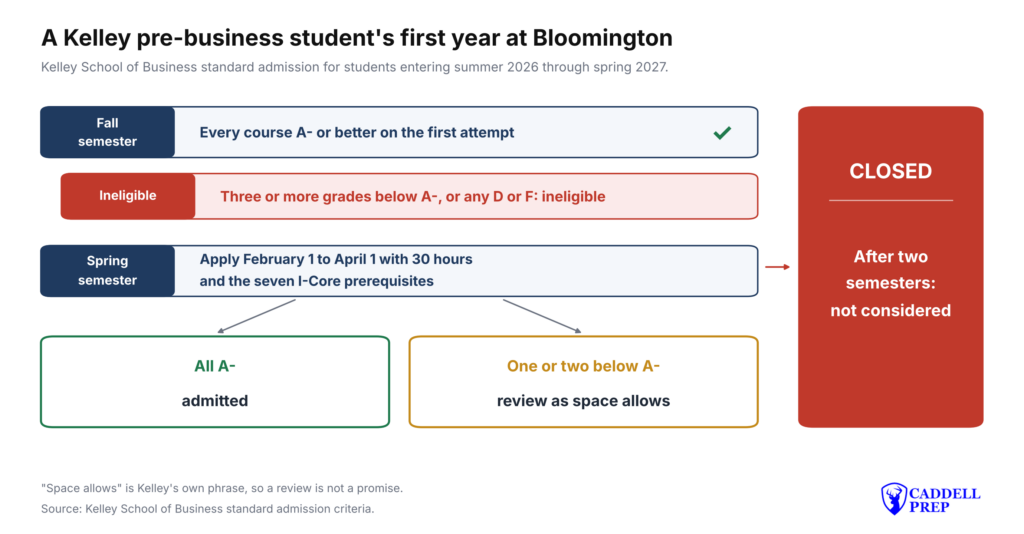
The image above shows a pre-business student’s first year at Bloomington and where the Kelley door opens or closes.
Does a 3.8 GPA and a 1370 SAT Still Admit a Student Directly to Kelley?
No, a 3.8 GPA with a 1370 SAT no longer admits a student directly to the Kelley School of Business, because Kelley ended automatic direct admission on that line for students entering in fall 2026 and reviews a Kelley Prospective Inventory instead [VERIFY on Kelley’s direct admission page].
The committee reads high school rigor, academic performance, academic achievements and the potential for success at Kelley, in the report’s words, and the test score is one input among them rather than a line that admits by itself. A student IU admits without Kelley is pre-business the day he arrives, and the first semester decides whether the automatic path is still open to him in the spring.
An A- in every course, one spring to apply, a review beneath it. Which schools hold the accreditation is the next section.
Which Indiana Universities Have AACSB-Accredited Business Schools?
Sixteen Indiana universities hold business accreditation from AACSB International, twelve public and four private, and the list below names each with its city and the school that awards the business degree [VERIFY all sixteen on the AACSB directory before publishing].
- Purdue University in West Lafayette awards its business degrees through the AACSB-accredited Mitchell E. Daniels, Jr. School of Business.
- Indiana University-Bloomington in Bloomington awards its business degrees through the AACSB-accredited Kelley School of Business.
- Ball State University in Muncie awards its business degrees through the AACSB-accredited Miller College of Business.
- University of Southern Indiana in Evansville awards its business degrees through the AACSB-accredited Romain College of Business.
- Indiana University-Indianapolis in Indianapolis awards its business degrees through the AACSB-accredited Kelley School of Business Indianapolis.
- Purdue University Fort Wayne in Fort Wayne awards its business degrees through the AACSB-accredited Doermer School of Business.
- Indiana University-Southeast in New Albany awards its business degrees through its AACSB-accredited School of Business.
- Indiana University-South Bend in South Bend awards its business degrees through the AACSB-accredited Judd Leighton School of Business and Economics.
- Indiana University-Kokomo in Kokomo awards its business degrees through its AACSB-accredited School of Business.
- Indiana University-Northwest in Gary awards its business degrees through its AACSB-accredited School of Business and Economics.
- Purdue University Northwest in Hammond awards its business degrees through its AACSB-accredited College of Business.
- Indiana State University in Terre Haute awards its business degrees through the AACSB-accredited Scott College of Business.
- University of Notre Dame in Notre Dame awards its business degrees through the AACSB-accredited Mendoza College of Business.
- Butler University in Indianapolis awards its business degrees through the AACSB-accredited Lacy School of Business.
- Valparaiso University in Valparaiso awards its business degrees through its AACSB-accredited College of Business.
- University of Evansville in Evansville awards its business degrees through the AACSB-accredited Schroeder School of Business.
Accreditation matters for a reason that is easy to miss at seventeen. Business itself is not a licensed profession, and the one business degree that leads to a license, accounting, leads to it through the state board rather than through the school. A CPA in Indiana normally sits with 120 hours, 24 in accounting and 24 in business and economics, and licenses on 150 hours and two years of experience until January 1, 2027, when a bachelor’s with an accounting concentration and two years becomes a second route [VERIFY on the board’s page]. AACSB status matters on the way there because business schools use it to decide whose courses they will accept in transfer.
DePauw University in Greencastle is the school a New York family asks about first among those left off, because it reports a Math range of 600 to 720, admits 57% and charges every student $59,070, and it has no AACSB-accredited business school [VERIFY]. Indiana University-East in Richmond is listed by AACSB as a non-accredited educational member, reports 470 to 570 on Math, admits 67% and charges a New Yorker the same $22,811 as the four regional rows [VERIFY]. The University of Indianapolis says in its 2026-27 catalog that its School of Business is “nationally accredited by the Accreditation Council for Business Schools and Programs (ACBSP)” and “a member of” AACSB, charges every student $37,200 and admits 67%. Marian University in Indianapolis holds IACBE accreditation, charges $40,664 and admits 95%. Taylor, Trine, Indiana Tech, Indiana Wesleyan, Anderson, Bethel, Huntington, Grace, Franklin, Hanover and Saint Mary’s award business degrees under the ACBSP, the IACBE or no business accreditor [VERIFY each], and Rose-Hulman awards no business bachelor’s. None of them is a row.
Nothing on this page ranks the sixteen. They are twelve public universities and four private with the same accreditor, one ceiling at Kelley, two flagships $13,097 apart, and the pages for business colleges in Illinois, business colleges in Ohio and business colleges in Michigan carry the schools a student looking at Indiana is likely comparing.
What If Your Scores Are Below the Range You Want?
In Indiana Notre Dame’s floors are 735 on Math and 33 on the ACT, Purdue’s are 600 and 27, Bloomington’s 580 and 27, Butler’s 570 and 26, and two rows publish none. A student under the floor he wants is not ruled out, because a quarter of admitted students were there too. He is in the quarter that needs the rest of the application to carry more.
The first step is finding out where the score actually is, section by section. A free diagnostic SAT gives a Math score that can be set directly against Bloomington’s 580 floor and Purdue’s 600.
The Math section rewards the same handful of topics on every test date, and a student who knows which of them he is missing can close a gap of 50 to 100 points in weeks rather than months. The method is on our page on improving your SAT Math score, and at Bloomington the same algebra fills MATH-B 110, one of Kelley’s seven prerequisites and one of the courses that must come back at A- or better for the automatic path.
How to Read These Score Ranges
Each range in the table covers the middle 50% of admitted students who submitted that test, so a quarter of admitted students were below the lower number and a quarter were at or above the upper one.
A range describes the students who chose to submit at all. Where a school is test-optional, the range describes the submitters, and the submitters are the students whose scores helped them. A row marked not reported means the Scorecard has no range for that university, and a student should read the university’s own admissions page for the score it expects. More on what SAT score you need for college and on test-optional colleges.
Should You Take the ACT Instead?
Indiana requires no statewide college-entrance test of its public school juniors [VERIFY], and fourteen of the sixteen rows report both tests.
A New York student who holds an SAT should send it everywhere in Indiana and leave the ACT alone unless a school elsewhere asks for it. Kelley’s old direct-admit line read either test at 1370 or 30, and the inventory that replaced it reads neither by number [VERIFY].
Business Programs in Nearby States
Indiana borders four states, and each has its own page in this series.
See business colleges in Illinois, business colleges in Michigan, business colleges in Ohio and business colleges in Kentucky.
Business Colleges in Other States
We publish the same breakdown for business programs in every state.
See business colleges by state for the full list.

Glyn Caddell
Glyn Caddell holds a BS in Mechanical Engineering from NJIT and has been tutoring New York City students since 2008. He founded Caddell Prep in 2012 and is the author of Digital SAT Math Secrets: Lessons & Tricks to Quickly Improve to a Perfect 800 on the Math Test, which contains over 900 practice problems and is used in Caddell Prep’s SAT math classes. He is founding president of the Staten Island Technical High School alumni association and teaches every lesson on this site personally.
Finally, an SAT course that students actually understand
Every question has a video explanation. Not most — every one.
The on-demand Digital SAT course covers all 17 math topics and 15 reading and writing topics, with 5 full-length practice tests and a 100-point score increase guarantee. Keep access for the rest of high school. No subscription.
Want to Know What 5 Topics Will Improve Your SAT Score the Most?
Sample Feedback from our Diagnostic Test: