
Home » College SAT Score Ranges, Costs, and Programs by Major and State » Best Business Colleges » Business Colleges in Kentucky: SAT Scores, ACT Scores, Costs, and Programs
By Glyn Caddell, BSME · Author of Digital SAT Math Secrets · Tutoring since 2008 — Updated November 11, 2026
Eight Kentucky universities hold AACSB-accredited business schools, seven public and one private, and this page lists the SAT and ACT scores of the students they admit, what each costs a New York student, and what the Gatton College of Business and Economics asks of a premajor before it places him in upper division.
Seven report both tests, a tie, so the table leads with the SAT.
At Kentucky every Gatton freshman is a premajor, and upper division comes with a 3.0 in the premajor courses and a 3.0 cumulative, with no probationary notice before a student misses it.
Table of Contents
- Kentucky Business Colleges by SAT and ACT Score
- What Does It Take to Reach Upper Division at Gatton?
- Which Kentucky Universities Have AACSB-Accredited Business Schools?
- What If Your Score Is Below the Range You Want?
Kentucky Business Colleges by SAT and ACT Score
Kentucky’s eight AACSB-accredited business schools run from the Gatton College of Business and Economics at the University of Kentucky in Lexington, with a Math range of 530 to 640, to Morehead State, with no range reported, and the table below lists each with its SAT and ACT ranges where reported, cost of attendance, enrollment and admit rate. Seven are public and one private, seven report both tests, and the rows are sorted by the midpoint of the SAT Math range, with a tie broken on the ACT composite midpoint and the one non-reporter last, so the order can be checked from the table itself.
| College | SAT Reading & Writing | SAT Math | ACT composite | Business school | Cost of attendance | Undergraduates | Admit rate |
|---|---|---|---|---|---|---|---|
| University of Kentucky | 540 to 650 | 530 to 640 | 21 to 28 | Gatton College of Business and Economics | $34,391 | 24,763 | 93% |
| Bellarmine University | 510 to 630 | 520 to 620 | 23 to 28 | Rubel School of Business | $61,691 | 2,161 | 86% |
| University of Louisville | 530 to 640 | 510 to 630 | 19 to 27 | College of Business | $32,941 | 14,727 | 79% |
| Northern Kentucky University | 473 to 590 | 480 to 560 | 18 to 25 | Haile College of Business | $19,725 | 8,246 | 68% |
| Murray State University | 480 to 600 | 460 to 570 | 19 to 26 | Bauernfeind College of Business | $23,485 | 6,688 | 86% |
| Eastern Kentucky University | 440 to 530 | 440 to 550 | 19 to 25 | College of Business | $23,735 | 12,318 | 78% |
| Western Kentucky University | 420 to 530 | 420 to 520 | 16 to 21 | Gordon Ford College of Business | $24,188 | 12,155 | 94% |
| Morehead State University | not reported | not reported | not reported |
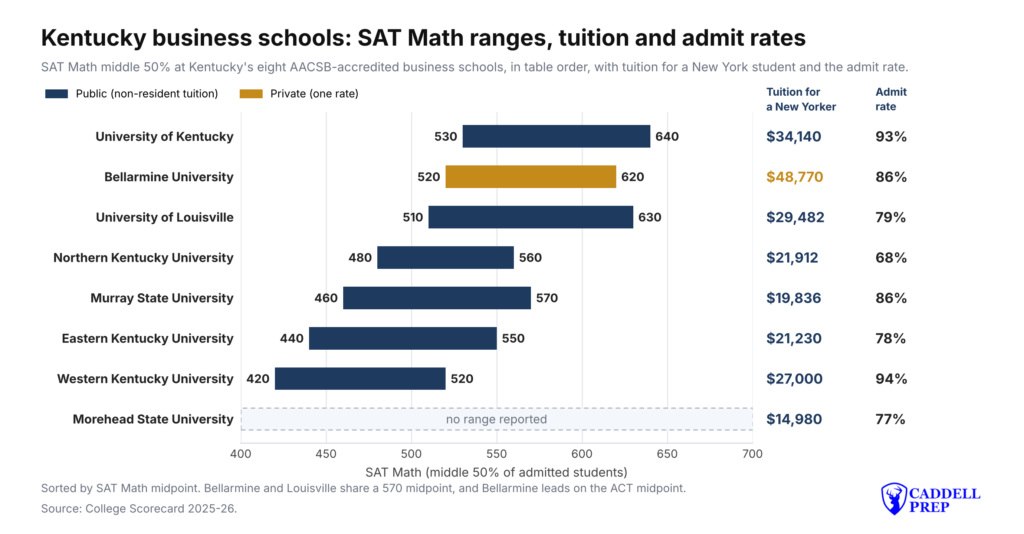
A student can see where his Math score sits on this ladder in the image above.
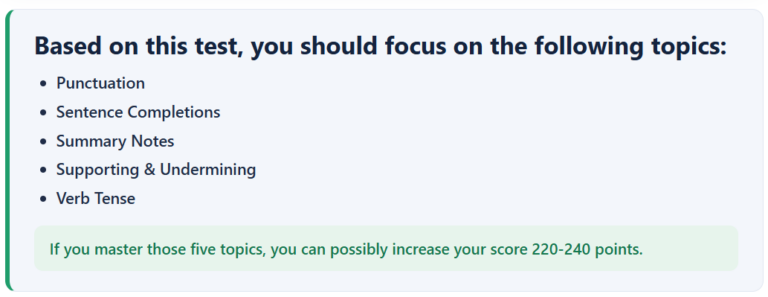
Want to Know What 5 Topics Will Improve Your SAT Score the Most?
Sample Feedback from our Diagnostic Test:
University of Kentucky
The University of Kentucky in Lexington awards its business degrees through the Gatton College of Business and Economics, and Kentucky reports the highest Math range on the page, 530 to 640, admits 93% of applicants to the university and charges a New Yorker $34,140, the most of the seven publics.
Reading & Writing 540 to 650, Math 530 to 640. ACT composite 21 to 28. The top quarter of admitted students scored at or above 640 on Math and 28 on the ACT. Cost of attendance $34,391, with tuition and fees at $13,502 in-state and $34,140 out-of-state. 24,763 undergraduates, 93% admitted.
Kentucky is the largest campus on the page, 10,036 undergraduates ahead of Louisville, and its Math range sits 20 points above Louisville’s at the floor and 10 at the ceiling. Every freshman admitted to Gatton is a premajor, the subject of the next section. The cost of attendance in the table is a resident’s. A non-resident’s comes to approximately $55,029 once the higher tuition is substituted, and the $34,140 that drives it is $32 below what the University of Alabama charges a New Yorker and $3,708 above Kansas’s $30,432, with a premium of $20,638 over a resident, the largest on the page.
Bellarmine University
Bellarmine University in Louisville awards its business degrees through the Rubel School of Business, and Bellarmine is the one private on the page, reports the highest ACT floor, 23, and sits above the University of Louisville in the table on the ACT midpoint alone.
Reading & Writing 510 to 630, Math 520 to 620. ACT composite 23 to 28. The top quarter of admitted students scored at or above 620 on Math and 28 on the ACT. Cost of attendance $61,691, with tuition and fees at $48,770 for all students. 2,161 undergraduates, 86% admitted.
Bellarmine and Louisville share a 570 Math midpoint, and Bellarmine leads on the ACT midpoint, 25.5 to 23, for no other reason. Its $48,770 is $19,288 above what Louisville charges a New Yorker for the same middle Math score, and its $61,691 cost of attendance is the highest on the page. Its 520 Math floor is 10 points above Louisville’s on a ceiling 10 points lower. Four years of tuition is $195,080.
University of Louisville
The University of Louisville awards its business degrees through its College of Business, and Louisville reports the second highest Math ceiling on the page, 630, admits 79% and charges a New Yorker $29,482, $4,658 less than Kentucky.
Reading & Writing 530 to 640, Math 510 to 630. ACT composite 19 to 27. The top quarter of admitted students scored at or above 630 on Math and 27 on the ACT. Cost of attendance $32,941, with tuition and fees at $13,136 in-state and $29,482 out-of-state. 14,727 undergraduates, 79% admitted.
Louisville’s 19 to 27 on the ACT starts two points under Kentucky’s and four under Bellarmine’s. The cost of attendance in the table is a resident’s. A non-resident’s comes to approximately $49,287 with the higher tuition substituted, and the $29,482 that drives it carries a premium of $16,346 over a resident. Whether the College of Business asks anything of a business major after the university admits him was not read for this page [VERIFY].
Northern Kentucky University
Northern Kentucky University in Highland Heights awards its business degrees through the Haile College of Business, and Northern Kentucky admits 68% of applicants, the lowest rate on the page, and reports the lowest resident cost of attendance, $19,725.
Reading & Writing 473 to 590, Math 480 to 560. ACT composite 18 to 25. The top quarter of admitted students scored at or above 560 on Math and 25 on the ACT. Cost of attendance $19,725, with tuition and fees at $11,088 in-state and $21,912 out-of-state. 8,246 undergraduates, 68% admitted.
Northern Kentucky’s 480 Math floor is 20 points above Murray State’s on a ceiling 10 points lower, and its $21,912 is $682 above Eastern Kentucky’s. The cost of attendance in the table is a resident’s. A non-resident’s comes to approximately $30,549 with the higher tuition substituted, and the $21,912 that drives it carries a premium of $10,824 over a resident. Four years of tuition is $87,648.
Murray State University
Murray State University awards its business degrees through the Bauernfeind College of Business, and Murray State charges a New Yorker $19,836, the second lowest tuition on the page, and admits 86%.
Reading & Writing 480 to 600, Math 460 to 570. ACT composite 19 to 26. The top quarter of admitted students scored at or above 570 on Math and 26 on the ACT. Cost of attendance $23,485, with tuition and fees at $9,900 in-state and $19,836 out-of-state. 6,688 undergraduates, 86% admitted.
Murray State’s 26 on the ACT is the highest ceiling on the page after the top three rows’, and its 600 Reading & Writing ceiling is 10 points above Northern Kentucky’s. Its premium over a resident is $9,936. The cost of attendance in the table is a resident’s, and a non-resident’s comes to approximately $33,421 with the higher tuition substituted. Four years of tuition is $79,344.
Eastern Kentucky University
Eastern Kentucky University in Richmond awards its business degrees through its College of Business, and Eastern Kentucky is the third largest campus on the page, with 12,318 undergraduates, 163 ahead of Western Kentucky, and charges a New Yorker $21,230.
Reading & Writing 440 to 530, Math 440 to 550. ACT composite 19 to 25. The top quarter of admitted students scored at or above 550 on Math and 25 on the ACT. Cost of attendance $23,735, with tuition and fees at $10,320 in-state and $21,230 out-of-state. 12,318 undergraduates, 78% admitted.
Eastern Kentucky’s $21,230 is $5,770 below Western Kentucky’s on a Math range 20 points higher at the floor and 30 at the ceiling, with a premium of $10,910 over a resident. The cost of attendance in the table is a resident’s, and a non-resident’s comes to approximately $34,645 with the higher tuition substituted. Four years of tuition is $84,920.
Western Kentucky University
Western Kentucky University in Bowling Green awards its business degrees through the Gordon Ford College of Business, and Western Kentucky admits 94% of applicants, the highest rate on the page, on the lowest reported ranges, 420 to 520 on Math and 16 to 21 on the ACT.
Reading & Writing 420 to 530, Math 420 to 520. ACT composite 16 to 21. The top quarter of admitted students scored at or above 520 on Math and 21 on the ACT. Cost of attendance $24,188, with tuition and fees at $11,652 in-state and $27,000 out-of-state. 12,155 undergraduates, 94% admitted.
Western Kentucky’s $27,000 is the third highest non-resident tuition on the page, $2,482 under Louisville’s, on the lowest range, and its premium over a resident, $15,348, is the third largest. Its 21 ACT ceiling is the floor at Kentucky. The cost of attendance in the table is a resident’s, and a non-resident’s comes to approximately $39,536 with the higher tuition substituted. Four years of tuition is $108,000.
Morehead State University
Morehead State University awards its business degrees through the Elmer R. Smith College of Business and Technology, and Morehead State charges a New Yorker $14,980, the lowest tuition on the page by $4,856, and reports no score range.
Score ranges not reported. Cost of attendance $21,961, with tuition and fees at $10,024 in-state and $14,980 out-of-state. 4,578 undergraduates, 77% admitted.
Morehead State’s premium over a resident is $4,956, the smallest on the page, and its $14,980 is $284 below Western Illinois’s $15,264, the lowest public non-resident tuition in this series since Henderson State’s $10,620 and Dalton State’s $10,656. The Scorecard has no range for it, so a student should read Morehead State’s own admissions page for the score it expects. The cost of attendance in the table is a resident’s, and a non-resident’s comes to approximately $26,917 with the higher tuition substituted, also the lowest on the page. Four years of tuition is $59,920.
Eight rows say who got into the university. The next section is about the one business school on the page whose own answer waits until the end of the first year.
What Does It Take to Reach Upper Division at Gatton?
A University of Kentucky student admitted to the Gatton College of Business and Economics enters as a premajor and reaches upper division with at least a 3.0 in the premajor courses and a 3.0 cumulative GPA, after eleven courses that include two semesters of calculus-track math.
Gatton’s GPA requirements page puts the line in one sentence: “Students should have at least a 3.0 GPA in pre-major courses, and a 3.0 cumulative GPA.” A student who meets both is placed in upper division. The page adds that a Gatton degree takes 120 credit hours, and it adds one more line a family should read twice: “No probationary notice will be given.” A student who misses the line learns it when he misses it [VERIFY every item on the page].
The premajor courses are listed on Gatton’s BSBA page. Composition and Communication I and II, CIS or WRD 110 and 111, or the accelerated 112. ACC 200 Intro to Accounting for Decision Makers or ACC 202, and ACC 201 Financial Accounting. ECO 201 and ECO 202, Principles of Economics I and II. AN 105 Business Applications of Spreadsheets. MA 123 Elementary Calculus and Its Applications, and one of MA 162 Finite Mathematics, MA 113 Calculus I or MA 137. Eleven courses in all, two of them math, and the page’s first condition is about the math: “A student applying for the BSBA must be eligible to take Elementary Calculus (MA 123)” [VERIFY the list].
A student who falls short has a form. Gatton’s FAQ points him to the student forms page and the Appeal for Upper Division Admission. And the first door has its own wording. UK’s admissions site lists Gatton among ten colleges with selective majors and says an applicant to a selective major “may be placed in an alternate major until a final decision is made,” without a GPA or a score for Gatton on that page. The same BSBA page, written for the general business degree and transfer students, gives 2.8 on both GPAs and calls admission “selective in nature,” and the page should be read against the 3.0 page before a family relies on either [VERIFY which figure governs which majors, and whether any freshman is admitted to upper division directly].
Louisville, Western Kentucky, Eastern Kentucky, Northern Kentucky, Murray State, Morehead State and Bellarmine were not read for a gate. As far as this page knows, each admits a business major on the university application, and a family should read each catalog for any rule that follows [VERIFY all seven].
Set against the earlier pages, Gatton’s line is the highest. On our page on business colleges in Kansas, KU admits a freshman on a published index and moves a current student over at a 2.5. On our page on business colleges in Iowa, Tippie guarantees a freshman at a 3.60 and a 1230 and takes a second-year student at a 2.75. Alabama, Boise State and KU sit at 2.5, Tippie at 2.75, Florida State at 2.9. Gatton sits at 3.0, twice, after eleven courses, and publishes no number that lets a freshman skip the year.
| Stage | Who | What Gatton asks | What happens |
|---|---|---|---|
| Admission to UK with Gatton | A high school senior naming a Gatton major | The university application. Gatton is a selective college, and an applicant may be placed in an alternate major until a decision is made [VERIFY any direct-admit line] | Admitted as a Gatton premajor |
| Upper division | A premajor who has completed the eleven premajor courses | At least a 3.0 in the premajor courses and a 3.0 cumulative, with no probationary notice | Placed in upper division |
| Short of 3.0 | The same premajor | The Appeal for Upper Division Admission form | Decided on appeal |
| General business BSBA | A transfer student | A 2.8 cumulative and a 2.8 premajor GPA, eligibility for MA 123, selective [VERIFY] | Admitted or n |
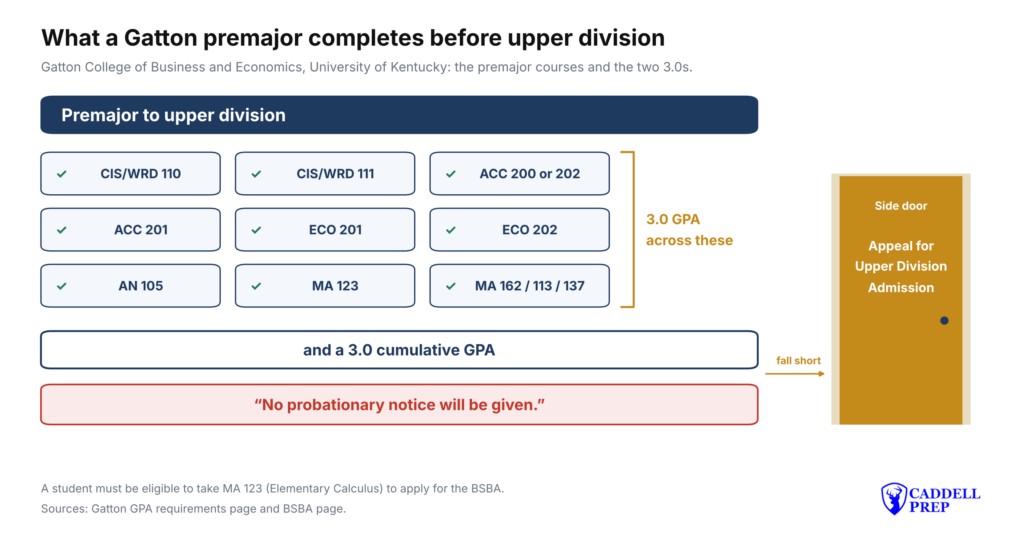
The image above lists the premajor courses a Gatton student completes and the two 3.0s that place him in upper division.
Does a High SAT Admit a Freshman to Upper Division at Gatton?
No, a high SAT does not admit a freshman to upper division at the Gatton College of Business and Economics, because Gatton’s published rule places a student in upper division on a 3.0 in the premajor courses and a 3.0 cumulative GPA, and the pages read for this article show no score or high school GPA that carries a freshman past the premajor year [VERIFY the outcome of Gatton’s 2020 direct-admit proposal].
The SAT opens the university and, with Gatton a selective college, the premajor seat. The eleven courses decide the rest, the two 3.0s are read at the end of them, and the page gives no warning before the line is missed.
Eleven courses, a 3.0 twice, no notice. Which schools hold the accreditation is the next section.
Which Kentucky Universities Have AACSB-Accredited Business Schools?
Eight Kentucky universities hold business accreditation from AACSB International, seven public and one private, and the list below names each with its city and the school that awards the business degree [VERIFY all eight on the AACSB directory before publishing].
- The University of Kentucky in Lexington awards its business degrees through the AACSB-accredited Gatton College of Business and Economics.
- The University of Louisville in Louisville awards its business degrees through its AACSB-accredited College of Business.
- Western Kentucky University in Bowling Green awards its business degrees through the AACSB-accredited Gordon Ford College of Business.
- Eastern Kentucky University in Richmond awards its business degrees through its AACSB-accredited College of Business.
- Northern Kentucky University in Highland Heights awards its business degrees through the AACSB-accredited Haile College of Business.
- Murray State University in Murray awards its business degrees through the AACSB-accredited Bauernfeind College of Business.
- Morehead State University in Morehead awards its business degrees through the AACSB-accredited Elmer R. Smith College of Business and Technology.
- Bellarmine University in Louisville awards its business degrees through the AACSB-accredited Rubel School of Business.
Accreditation matters for a reason that is easy to miss at seventeen. Business itself is not a licensed profession, and the one business degree that leads to a license, accounting, leads to it through the state board rather than through the school. A CPA in Kentucky normally needs 150 hours with 27 in accounting and 12 in business, the four exam sections and a year of experience, and since July 16, 2026 a bachelor’s with two years of experience is a second route [VERIFY on the board’s page]. AACSB status matters on the way there because business schools use it to decide whose courses they will accept in transfer.
Centre College in Danville reports the highest Math range in the state, 570 to 730, admits 54% and charges every student $52,820, and it has no AACSB-accredited business school [VERIFY]. Transylvania University in Lexington reports 540 to 690, admits 87% and charges $46,870 [VERIFY]. Berea College reports 568 to 655 and admits 19%, the lowest rate in the state, and the $51,658 in the Scorecard is a sticker price that Berea covers with a tuition scholarship for every admitted student, so the figure should not be read as a bill [VERIFY on Berea’s page]. Kentucky State University in Frankfort is a public historically Black university, reports 14 to 17 on the ACT, admits 96% and charges a New Yorker $13,658, and its business accreditation is not AACSB [VERIFY the accreditor]. Thomas More University in Crestview Hills reports 520 to 620 and charges $39,800, Georgetown College charges $42,840, Campbellsville University $27,998, and the University of the Cumberlands in Williamsburg charges every student $9,875 and admits 99% on 6,941 undergraduates. Each awards a business degree under the ACBSP, the IACBE or no business accreditor [VERIFY each], and none is a row.
Nothing on this page ranks the eight. They are seven public universities and one private with the same accreditor, one premajor year at Gatton, two prices under $20,000, and the pages for business colleges in Ohio, business colleges in Indiana and business colleges in Tennessee carry the schools a student looking at Kentucky is likely comparing.
What If Your Scores Are Below the Range You Want?
In Kentucky the flagship’s floors are 530 on Math and 21 on the ACT, Louisville’s 510 and 19, Bellarmine’s 520 and 23, Northern Kentucky’s 480 and 18, Murray State’s 460 and 19, Eastern Kentucky’s 440 and 19, and Western Kentucky’s 420 and 16. A student under the floor he wants is not ruled out, because a quarter of admitted students were there too. He is in the quarter that needs the rest of the application to carry more.
The first step is finding out where the score actually is, section by section. A free diagnostic SAT gives a Math score that can be set directly against Kentucky’s 530 floor and Louisville’s 510.
The Math section rewards the same handful of topics on every test date, and a student who knows which of them he is missing can close a gap of 50 to 100 points in weeks rather than months. The method is on our page on improving your SAT Math score, and at Gatton the first condition on the BSBA page is eligibility for MA 123, with two of the eleven premajor courses in math and both of them inside the 3.0.
How to Read These Score Ranges
Each range in the table covers the middle 50% of admitted students who submitted that test, so a quarter of admitted students were below the lower number and a quarter were at or above the upper one.
A range describes the students who chose to submit at all. Where a school is test-optional, the range describes the submitters, and the submitters are the students whose scores helped them. A row marked not reported means the Scorecard has no range for that university, and a student should read the university’s own admissions page for the score it expects. More on what SAT score you need for college and on test-optional colleges.
Should You Take the ACT Instead?
Kentucky gives the ACT to its public school juniors as the state test [VERIFY current Kentucky testing], and seven of the eight rows report both tests.
A New York student who holds an SAT should send it everywhere in Kentucky and leave the ACT alone unless a school elsewhere asks for it. Nothing at Gatton’s upper-division line reads either test.
Business Programs in Nearby States
Kentucky borders seven states, and each has its own page in this series.
See business colleges in Ohio, business colleges in Indiana, business colleges in Illinois, business colleges in Missouri, business colleges in Tennessee, business colleges in Virginia and business colleges in West Virginia.
Business Colleges in Other States
We publish the same breakdown for business programs in every state.
See business colleges by state for the full list.

Glyn Caddell
Glyn Caddell holds a BS in Mechanical Engineering from NJIT and has been tutoring New York City students since 2008. He founded Caddell Prep in 2012 and is the author of Digital SAT Math Secrets: Lessons & Tricks to Quickly Improve to a Perfect 800 on the Math Test, which contains over 900 practice problems and is used in Caddell Prep’s SAT math classes. He is founding president of the Staten Island Technical High School alumni association and teaches every lesson on this site personally.
Finally, an SAT course that students actually understand
Every question has a video explanation. Not most — every one.
The on-demand Digital SAT course covers all 17 math topics and 15 reading and writing topics, with 5 full-length practice tests and a 100-point score increase guarantee. Keep access for the rest of high school. No subscription.
Want to Know What 5 Topics Will Improve Your SAT Score the Most?
Sample Feedback from our Diagnostic Test: