
Home » College SAT Score Ranges, Costs, and Programs by Major and State » Best Business Colleges » Business Colleges in Georgia: ACT Scores, SAT Scores, Costs, and Programs
By Glyn Caddell, BSME · Author of Digital SAT Math Secrets · Tutoring since 2008 — Updated November 9, 2026
Twenty-one Georgia institutions hold AACSB-accredited business schools, and this page lists the ACT and SAT scores of the students they admit, what each costs a New York student, and the second time one of them reads the score.
Seventeen of the twenty-one report an ACT range, so the table leads with the ACT and sorts by it.
At the University of Georgia a student admitted as Intended Business applies to a Terry major in his sophomore year with his SAT or ACT and sub-scores on the application and his college GPA left off it.
Table of Contents
- Georgia Business Colleges by ACT and SAT Score
- Does the Terry College of Business Look at SAT Scores Twice?
- Which Georgia Universities Have AACSB-Accredited Business Schools?
- What If Your Score Is Below the Range You Want?
Georgia Business Colleges by ACT and SAT Score
Georgia’s twenty-one AACSB-accredited business schools run from Emory’s Goizueta, with an ACT range of 32 to 35, to four schools that report no range, and the table below lists each with its ranges, cost of attendance, enrollment and admit rate. Sixteen of the twenty-one are public, and the rows are sorted by the midpoint of the ACT composite range, with ties broken by the ACT Math midpoint and then by enrollment, so the order can be checked from the table itself.
| College | ACT composite | SAT Reading & Writing | SAT Math | Business school | Cost of attendance | Undergraduates | Admit rate |
|---|---|---|---|---|---|---|---|
| Emory University | 32 to 35 | 720 to 760 | 750 to 790 | Goizueta Business School | $83,622 | 7,298 | 11% |
| Georgia Institute of Technology | 30 to 34 | 680 to 750 | 690 to 790 | Scheller College of Business | $28,167 | 18,785 | 14% |
| University of Georgia | 29 to 34 | 640 to 730 | 630 to 750 | Terry College of Business | $27,993 | 32,137 | 38% |
| Mercer University | 25 to 31 | 590 to 680 | 570 to 670 | Stetson-Hatcher School of Business | $58,204 | 4,500 | 69% |
| Berry College | 22 to 28 | 580 to 680 | 545 to 650 | Campbell School of Business | $56,697 | 2,245 | 64% |
| Georgia College & State University | 22 to 26 | 550 to 630 | 520 to 600 | Bunting College of Business and Technology | $30,258 | 5,947 | 78% |
| Kennesaw State University | 19 to 26 | 510 to 620 | 490 to 600 | Coles College of Business | $24,008 | 41,254 | 69% |
| Georgia State University | 19 to 26 | 480 to 590 | 460 to 590 | Robinson College of Business | $28,241 | 26,623 | 55% |
| University of North Georgia | 19 to 25 | 500 to 620 | 480 to 590 | Cottrell College of Business | $18,177 | 16,146 | 68% |
| Augusta University | 18 to 25 | 500 to 590 | 470 to 550 | Hull College of Business | $23,524 | 5,613 | 86% |
| Morehouse College | 18 to 25 | Does not report SAT data | Does not report SAT data | Division of Business Administration and Economics | $51,433 | 2,844 | 44% |
| Georgia Southern University | 18 to 23 | 528 to 583 | 458 to 550 | Parker College of Business | $24,430 | 21,790 | 88% |
| University of West Georgia | 17 to 22 | 490 to 590 | 460 to 550 | Richards College of Business | $21,981 | 7,520 | 52% |
| Columbus State University | 16 to 22 | 440 to 530 | 360 to 530 | Turner College of Business | $21,676 | 5,625 | 99% |
| Valdosta State University | 16 to 22 | 480 to 570 | 440 to 530 | Langdale College of Business Administration | $20,801 | 6,622 | 72% |
| Georgia Southwestern State University | 16 to 22 | 460 to 570 | 430 to 540 | College of Business and Computing | $20,484 | 2,424 | 75% |
| Clayton State University | 15 to 19 | 450 to 558 | 410 to 520 | College of Business | $17,415 | 4,348 | 68% |
| Georgia Gwinnett College | Does not report ACT data | Does not report SAT data | Does not report SAT data | School of Business Administration | $22,547 | 11,344 | 96% |
| Dalton State College | Does not report ACT data | Does not report SAT data | Does not report SAT data | Wright School of Business | $12,719 | 4,553 | Not reported |
| Clark Atlanta University | Does not report ACT data | Does not report SAT data | Does not report SAT data | School of Business | $43,676 | 3,603 | 64% |
| Savannah State University | Does not report ACT data | Does not report SAT data | Does not report SAT data | College of Business Administration | $17,191 | 2,833 | Not reported |
Each range covers the middle 50% of admitted students who submitted that test. A quarter scored below the lower number, and the top quarter scored at or above the upper one. Being under the lower number does not rule a student out, and being just above it is not as safe as it looks. Business school names the AACSB-accredited college or school within the institution that awards the business degree [VERIFY each name on the institution’s site]. The cost of attendance shown for a public institution is a resident’s.
Schools whose business accreditation comes from another body, or from none, are left off this list and named further down, and so are the state colleges without AACSB accreditation and the online institutions.
Three things about that table are worth pausing on.
Twenty-one Georgia institutions hold AACSB business accreditation, and the flagship’s Terry College is the one business school in this series that asks for a student’s SAT or ACT a second time, at the door of the major, and does not read his college GPA there.
Emory reports a Math range of 750 to 790, the highest floor of any business school on these pages, at $64,280 a year, while Georgia reports 630 to 750 at $31,688 for a New Yorker, $2,484 less than the University of Alabama on a higher range.
Seventeen of the twenty-one report an ACT range and sixteen report SAT ranges. Morehouse reports only the ACT and four schools report neither, so a New Yorker with an SAT has sixteen ranges to read in Georgia.
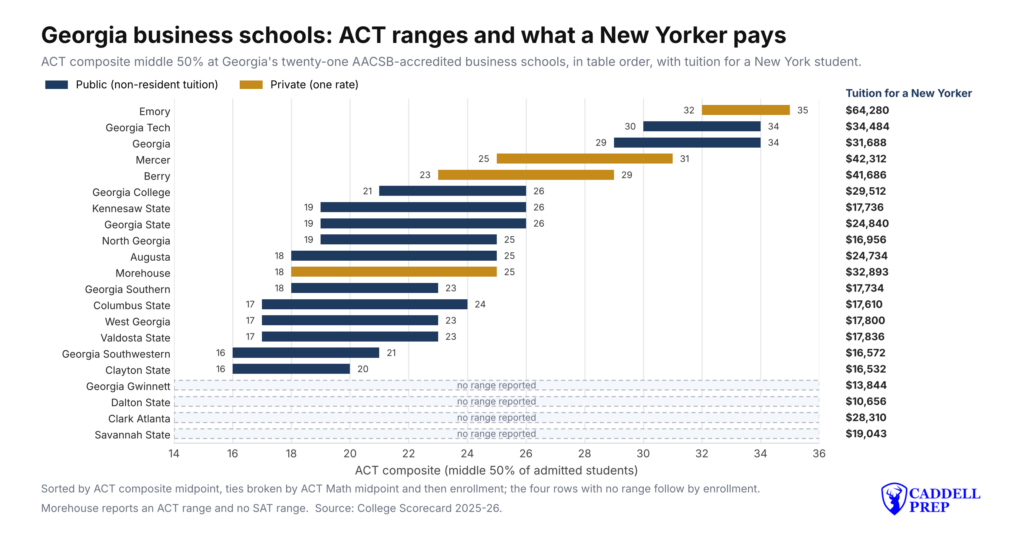
A student can see where his ACT score sits on this ladder in the image above.
Want to Know What 5 Topics Will Improve Your SAT Score the Most?
Sample Feedback from our Diagnostic Test:

Emory University
Emory University in Atlanta awards its business degrees through the Goizueta Business School, and Emory reports a Math range of 750 to 790, the highest floor of any business school in this series, and admits 11% of its applicants.
ACT composite 32 to 35. Reading & Writing 720 to 760, Math 750 to 790. The top quarter of admitted students scored at or above 35 on the ACT and 790 on Math. Cost of attendance $83,622, with tuition and fees at $64,280 for all students. 7,298 undergraduates, 11% admitted.
Emory’s 750 floor is 10 points above USC’s 740, the previous high in this series, and 60 above Georgia Tech’s 690 in the same city. Its $64,280 is the highest tuition on the page, $32,592 above what Georgia charges a New Yorker, and its cost of attendance, $83,622, is the highest in the table. A New York student with a 650 on Math is 100 points under Emory’s floor.
Georgia Institute of Technology
The Georgia Institute of Technology in Atlanta awards its business degrees through the Scheller College of Business, and Georgia Tech reports a Math range of 690 to 790, second in this series only to Emory’s, and admits 14% of its applicants.
ACT composite 30 to 34. Reading & Writing 680 to 750, Math 690 to 790. The top quarter of admitted students scored at or above 34 on the ACT and 790 on Math. Cost of attendance $28,167, with tuition and fees at $12,058 in-state and $34,484 out-of-state. 18,785 undergraduates, 14% admitted.
Georgia Tech’s 690 Math floor is 60 points above Georgia’s 630, and its 790 ceiling matches Emory’s. A student changes into the Scheller BSBA from another Georgia Tech major with a 2.3 after 60 hours, and the college’s page says meeting that does not guarantee a seat. The cost of attendance in the table is a resident’s. A non-resident’s comes to approximately $50,593 once the higher tuition is substituted, and the $34,484 that drives it is $312 above what the University of Alabama charges a New Yorker.
University of Georgia
The University of Georgia in Athens awards its business degrees through the Terry College of Business, and Georgia is the one university in this series whose business school reads a student’s SAT or ACT a second time, when he applies to his major.
ACT composite 29 to 34. Reading & Writing 640 to 730, Math 630 to 750. The top quarter of admitted students scored at or above 34 on the ACT and 750 on Math. Cost of attendance $27,993, with tuition and fees at $11,450 in-state and $31,688 out-of-state. 32,137 undergraduates, 38% admitted.
Georgia admits 38% of applicants and places a business applicant in Intended Business, and the Terry College decides on his major in his sophomore year on his test score, six course grades and an essay, the subject of the next section. The cost of attendance in the table is a resident’s. A non-resident’s comes to approximately $48,231 with the higher tuition substituted, and the $31,688 that drives it is $2,484 below Alabama’s $34,172 on a Math floor 50 points higher.
Mercer University
Mercer University in Macon awards its business degrees through the Stetson-Hatcher School of Business, AACSB-accredited since April 2023, and Mercer reports the fourth highest ACT range on the page, 25 to 31.
ACT composite 25 to 31. Reading & Writing 590 to 680, Math 570 to 670. The top quarter of admitted students scored at or above 31 on the ACT and 670 on Math. Cost of attendance $58,204, with tuition and fees at $42,312 for all students. 4,500 undergraduates, 69% admitted.
Mercer’s Math range of 570 to 670 sits 60 points below Georgia’s at the floor and 80 below it at the top, and its $42,312 is $10,624 more than Georgia charges a New Yorker. It admits 69% of applicants, the same share as Kennesaw State.
Berry College
Berry College in Mount Berry awards its business degrees through the Campbell School of Business, and Berry is the smallest private school on the page, with 2,245 undergraduates, and charges every student $41,686.
ACT composite 22 to 28. Reading & Writing 580 to 680, Math 545 to 650. The top quarter of admitted students scored at or above 28 on the ACT and 650 on Math. Cost of attendance $56,697, with tuition and fees at $41,686 for all students. 2,245 undergraduates, 64% admitted.
Georgia College & State University
Georgia College & State University in Milledgeville awards its business degrees through the Bunting College of Business and Technology, and Georgia College & State University admits 78% of its applicants.
ACT composite 22 to 26. Reading & Writing 550 to 630, Math 520 to 600. The top quarter of admitted students scored at or above 26 on the ACT and 600 on Math. Cost of attendance $30,258, with tuition and fees at $9,186 in-state and $29,512 out-of-state. 5,947 undergraduates, 78% admitted. Georgia College & State University charges a New Yorker $29,512, $4,660 below what the University of Alabama charges, with a non-resident premium of $20,326 over its resident tuition.
Kennesaw State University
Kennesaw State University in Kennesaw awards its business degrees through the Coles College of Business, and Kennesaw State is the largest university on this page, with 41,254 undergraduates, and charges a New Yorker $17,736.
ACT composite 19 to 26. Reading & Writing 510 to 620, Math 490 to 600. The top quarter of admitted students scored at or above 26 on the ACT and 600 on Math. Cost of attendance $24,008, with tuition and fees at $5,808 in-state and $17,736 out-of-state. 41,254 undergraduates, 69% admitted.
Kennesaw State’s $17,736 is $16,436 below Alabama’s non-resident figure and $13,952 below Georgia’s, and its non-resident premium over its own residents is $11,928. Its Math range of 490 to 600 reaches the same 600 ceiling as Georgia College’s on a floor 30 points lower.
Georgia State University
Georgia State University in Atlanta awards its business degrees through the Robinson College of Business, and Georgia State reports the same ACT range as Kennesaw State, 19 to 26, and sits below it in the table on enrollment alone.
ACT composite 19 to 26. Reading & Writing 480 to 590, Math 460 to 590. The top quarter of admitted students scored at or above 26 on the ACT and 590 on Math. Cost of attendance $28,241, with tuition and fees at $8,664 in-state and $24,840 out-of-state. 26,623 undergraduates, 55% admitted.
Georgia State charges a New Yorker $24,840, $7,104 more than Kennesaw State on an identical ACT range, and its Math range of 460 to 590 sits 30 points below Kennesaw’s at the floor. Its 55% admit rate is the sixth lowest on the page.
University of North Georgia
University of North Georgia in Dahlonega awards its business degrees through the Cottrell College of Business, and University of North Georgia admits 68% of its applicants.
ACT composite 19 to 25. Reading & Writing 500 to 620, Math 480 to 590. The top quarter of admitted students scored at or above 25 on the ACT and 590 on Math. Cost of attendance $18,177, with tuition and fees at $5,285 in-state and $16,503 out-of-state. 16,146 undergraduates, 68% admitted. University of North Georgia charges a New Yorker $16,503, $17,669 below what the University of Alabama charges, with a non-resident premium of $11,218 over its resident tuition.
Augusta University
Augusta University in Augusta awards its business degrees through the Hull College of Business, and Augusta University admits 86% of its applicants.
ACT composite 18 to 25. Reading & Writing 500 to 590, Math 470 to 550. The top quarter of admitted students scored at or above 25 on the ACT and 550 on Math. Cost of attendance $23,524, with tuition and fees at $8,414 in-state and $24,734 out-of-state. 5,613 undergraduates, 86% admitted. Augusta University charges a New Yorker $24,734, $9,438 below what the University of Alabama charges, with a non-resident premium of $16,320 over its resident tuition.
Morehouse College
Morehouse College in Atlanta awards its business degrees through its Division of Business Administration and Economics, and Morehouse is a historically Black college that reports an ACT range and no SAT range, the one row on the page to do so.
ACT composite 18 to 25. Morehouse College reports no SAT range. The top quarter of admitted students scored at or above 25 on the ACT. Cost of attendance $51,433, with tuition and fees at $32,893 for all students. 2,844 undergraduates, 44% admitted.
Morehouse’s ACT range of 18 to 25 matches Augusta University’s, and so does its ACT Math midpoint, so the two sit in the table on enrollment, Augusta above. Its $32,893 is $1,205 above what Georgia charges a New Yorker. It admits 44% of applicants, the fourth lowest rate on the page after Emory’s, Georgia Tech’s and Georgia’s.
Georgia Southern University
Georgia Southern University in Statesboro awards its business degrees through the Parker College of Business, and Georgia Southern admits 88% of its applicants and charges a New Yorker $17,734, $2 below Kennesaw State.
ACT composite 18 to 23. Reading & Writing 528 to 583, Math 458 to 550. The top quarter of admitted students scored at or above 23 on the ACT and 550 on Math. Cost of attendance $24,430, with tuition and fees at $6,022 in-state and $17,734 out-of-state. 21,790 undergraduates, 88% admitted.
Georgia Southern’s Math range of 458 to 550 is the only one on the page with a floor ending in an eight, and its 88% admit rate is the third highest on the page. Its $17,734 is $16,438 below Alabama’s non-resident tuition, with a premium of $11,712 over its own residents.
University of West Georgia
University of West Georgia in Carrollton awards its business degrees through the Richards College of Business, and University of West Georgia admits 52% of its applicants.
ACT composite 17 to 22. Reading & Writing 490 to 590, Math 460 to 550. The top quarter of admitted students scored at or above 22 on the ACT and 550 on Math. Cost of attendance $21,981, with tuition and fees at $6,088 in-state and $17,800 out-of-state. 7,520 undergraduates, 52% admitted. University of West Georgia charges a New Yorker $17,800, $16,372 below what the University of Alabama charges, with a non-resident premium of $11,712 over its resident tuition.
Columbus State University
Columbus State University in Columbus awards its business degrees through the Turner College of Business, and Columbus State admits 99% of its applicants, the highest rate on the page, on a Math floor of 360, the lowest.
ACT composite 16 to 22. Reading & Writing 440 to 530, Math 360 to 530. The top quarter of admitted students scored at or above 22 on the ACT and 530 on Math. Cost of attendance $21,676, with tuition and fees at $5,898 in-state and $17,610 out-of-state. 5,625 undergraduates, 99% admitted. Columbus State University charges a New Yorker $17,610, $16,562 below what the University of Alabama charges, with a non-resident premium of $11,712 over its resident tuition.
Valdosta State University
Valdosta State University in Valdosta awards its business degrees through the Langdale College of Business Administration, and Valdosta State University admits 72% of its applicants.
ACT composite 16 to 22. Reading & Writing 480 to 570, Math 440 to 530. The top quarter of admitted students scored at or above 22 on the ACT and 530 on Math. Cost of attendance $20,801, with tuition and fees at $6,124 in-state and $17,836 out-of-state. 6,622 undergraduates, 72% admitted. Valdosta State University charges a New Yorker $17,836, $16,336 below what the University of Alabama charges, with a non-resident premium of $11,712 over its resident tuition.
Georgia Southwestern State University
Georgia Southwestern State University in Americus awards its business degrees through the College of Business and Computing, and Georgia Southwestern State University admits 75% of its applicants.
ACT composite 16 to 22. Reading & Writing 460 to 570, Math 430 to 540. The top quarter of admitted students scored at or above 22 on the ACT and 540 on Math. Cost of attendance $20,484, with tuition and fees at $5,220 in-state and $16,572 out-of-state. 2,424 undergraduates, 75% admitted. Georgia Southwestern State University charges a New Yorker $16,572, $17,600 below what the University of Alabama charges, with a non-resident premium of $11,352 over its resident tuition.
Clayton State University
Clayton State University in Morrow awards its business degrees through the College of Business, and Clayton State University admits 68% of its applicants.
ACT composite 15 to 19. Reading & Writing 450 to 558, Math 410 to 520. The top quarter of admitted students scored at or above 19 on the ACT and 520 on Math. Cost of attendance $17,415, with tuition and fees at $5,180 in-state and $16,532 out-of-state. 4,348 undergraduates, 68% admitted. Clayton State University charges a New Yorker $16,532, $17,640 below what the University of Alabama charges, with a non-resident premium of $11,352 over its resident tuition.
Georgia Gwinnett College
Georgia Gwinnett College in Lawrenceville awards its business degrees through its School of Business Administration, and Georgia Gwinnett admits 96% of its applicants and reports no score range.
Georgia Gwinnett College reports no SAT or ACT range. Cost of attendance $22,547, with tuition and fees at $4,532 in-state and $13,844 out-of-state. 11,344 undergraduates, 96% admitted. Georgia Gwinnett College charges a New Yorker $13,844, $20,328 below what the University of Alabama charges, with a non-resident premium of $9,312 over its resident tuition.
Dalton State College
Dalton State College in Dalton awards its business degrees through the Wright School of Business, and Dalton State charges a New Yorker $10,656, the lowest non-resident tuition on the page and $36 above Henderson State’s, the lowest in this series.
Dalton State College reports no SAT or ACT range. Cost of attendance $12,719, with tuition and fees at $3,336 in-state and $10,656 out-of-state. 4,553 undergraduates. Dalton State College charges a New Yorker $10,656, $23,516 below what the University of Alabama charges, with a non-resident premium of $7,320 over its resident tuition.
Clark Atlanta University
Clark Atlanta University in Atlanta awards its business degrees through its School of Business, and Clark Atlanta is a historically Black university that reports no SAT or ACT range and admits 64% of its applicants.
Clark Atlanta University reports no SAT or ACT range. Cost of attendance $43,676, with tuition and fees at $28,310 for all students. 3,603 undergraduates, 64% admitted.
Savannah State University
Savannah State University in Savannah awards its business degrees through its College of Business Administration, AACSB-accredited and extended in 2026, and Savannah State is a historically Black university that reports no score range and no admit rate to the Scorecard.
Savannah State University reports no SAT or ACT range. Cost of attendance $17,191, with tuition and fees at $5,750 in-state and $19,043 out-of-state. 2,833 undergraduates. Savannah State University charges a New Yorker $19,043, $15,129 below what the University of Alabama charges, with a non-resident premium of $13,293 over its resident tuition.
Twenty-one rows say who got into the institution. The next section is about the one business school that reads the score again two years later.
Does the Terry College of Business Look at SAT Scores Twice?
Yes, the University of Georgia’s Terry College of Business requires a student applying to a business major in his sophomore year to submit his ACT or SAT scores and sub-scores, and it does not consider his UGA or overall GPA in that decision.
The route runs through Intended Business. A freshman who wants a Terry degree is admitted to the university as an Intended Business student, and he applies to a Terry major, normally in his second year, once he has completed MATH 1113 and ACCT 2101, has BUSN 3000 completed or in progress, has ACCT 2102, ECON 2105, ECON 2106, LEGL 2700 and MIST 2090 completed or in progress, has finished or is finishing Areas I to VI of the core or 58 hours, and holds a 2.0 UGA GPA and, in the advising packet’s words, “a 2.6 or higher overall GPA (transfer and UGA coursework combined).” Withdrawing from a required course during the application semester can rescind an offer [VERIFY on the Intended Business advising packet, and find the current deadline on the Terry Admissions Process worksheet].
What Terry reads is printed on its selection-criteria page. “Applicants are required to submit ACT or SAT scores and sub-scores,” and a student without a score takes the E-Proficiency Profile, up to three times while at UGA, with the highest score used. The page reads grades in ACCT 2101 and 2102, ECON 2105 and 2106, MATH 1113 and the calculus courses if taken, BUSN 3000 if completed, the Foundation First courses FINA 3000, MARK 3000 and MGMT 3000 if completed, and the prefix courses of the major applied to, and it reads a Statement of Purpose of 300 to 400 words for each major. Accounting and Finance applicants also sit an Accounting Exam on ACCT 2101 content, up to three times, highest score used. The International Business co-major asks the third level of a language with a B in each course [VERIFY on the selection-criteria page].
What Terry does not read is printed on the same page: “UGA/cumulative GPA, overall GPA” are not considered, eligibility for HOPE or Zell Miller is not, letters of recommendation are not, and where a course was taken is not. The one exception to the whole process is Terry Direct: a Morehead Honors College student in good standing, with a semester of UGA coursework and a 3.40, is guaranteed his first-choice primary major [VERIFY].
Georgia Tech’s second door is a different kind. A student changes into the Scheller College’s BSBA with a 2.3 after 60 earned hours, in good standing and off academic contract, during one window each semester, for spring 2027 from January 18 to January 29, with no required courses, and the college’s page says, “Meeting eligibility requirements does not guarantee acceptance” [VERIFY on the Scheller change-of-major page, and confirm whether first-year applicants are admitted to the BSBA directly].
The shape is new to this series. On our page on business colleges in Alabama, the second door read a college GPA. On our page on business colleges in Connecticut, it read a college GPA and seven courses and published how many got through. On our page on business colleges in Arizona, ASU’s business school read a test score at the first door. Terry reads the test score at the second door and refuses to read the college GPA there.
| School | When the business school admits you to the major | What it reads | What it does not read |
|---|---|---|---|
| Georgia (Terry) | Sophomore year, after MATH 1113, ACCT 2101 and BUSN 3000 | SAT or ACT with sub-scores (or the EPP), grades in six named courses, Foundation First grades, Statement of Purpose, Accounting Exam for Accounting and Finance | UGA GPA, overall GPA, HOPE or Zell Miller eligibility, letters, where courses were taken |
| Georgia (Terry Direct) | After one UGA semester | Honors College standing, 3.40 | Everything else, with the first-choice major guaranteed |
| Georgia Tech (Scheller change of major) | After 60 earned hours, one window a semester | 2.3 GPA, good standing, no academic contract | No required courses, and acceptance not guaranteed |
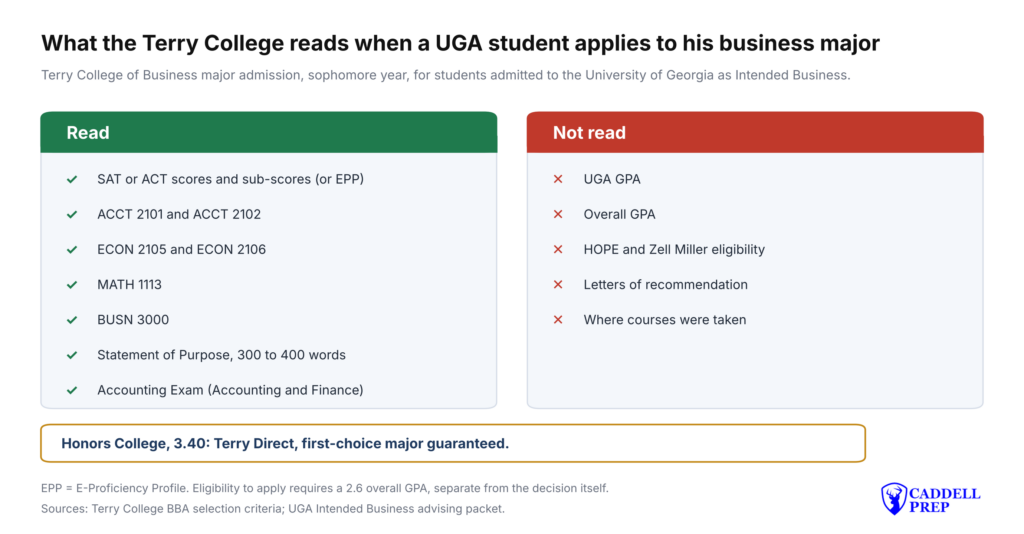
The image above lists what the Terry College reads and does not read when a UGA student applies to a business major.
Whether a score earned after enrollment counts at Terry is a question the page does not answer, and a student who means to retake should ask the Terry admissions office before he registers [VERIFY]. Whether Georgia Tech admits freshmen to the BSBA directly is the question the Scheller page leaves open [VERIFY].
The price runs the other way from the ranges. Georgia charges a New Yorker $31,688 in tuition, $2,484 below the University of Alabama on a Math floor 50 points higher, and Georgia Tech $34,484, $312 above Alabama on a floor 110 points higher. Emory charges $64,280 to every student on the highest floor in this series. Kennesaw State charges $17,736 and Georgia Southern $17,734, Georgia State $24,840, and Dalton State $10,656, $36 above Henderson State’s $10,620, the lowest figure on any business page so far. Four years is $126,752 at Georgia, $137,936 at Georgia Tech, $70,944 at Kennesaw State and $257,120 at Emory. HOPE and Zell Miller are for Georgia residents, and Terry’s page says eligibility for them is not read at the business school’s door either.
The one business degree Georgia licenses is accounting. The Georgia State Board of Accountancy licenses a CPA by three routes. The first is a bachelor’s degree with 150 semester hours, 30 in accounting and 18 to 24 in business, and one year of experience. The second is a master’s in accounting or taxation with 30 accounting hours and 18 business hours and one year. The third is a bachelor’s with an accounting concentration at 120 hours, 30 accounting hours and 18 business hours, and two years of experience. Georgia requires no separate ethics examination for initial licensure [Georgia College’s September 2026 sheet, VERIFY on the board’s page, including the hours required to sit]. Alabama asks 150 hours with 33 in accounting, Florida 150 with 30 and 36 in business, Alaska a bachelor’s and two years from 2026. Georgia’s third route is Alaska’s rule without the repeal.
Take a New York student with a 1300 on the SAT, 650 on each section, and a 3.5 GPA. At Georgia he is inside the 630 to 750 Math range and the 640 to 730 Reading & Writing range, admitted at 38% as Intended Business. In the fall of his sophomore year he applies to a Terry major with the 1300 and its two 650s on the application, his grades in ACCT 2101 and 2102, ECON 2105 and 2106, MATH 1113 and BUSN 3000, and a 300-word statement, and his 3.5 in college is not read. If he wants Finance he sits the Accounting Exam. At Georgia Tech he is 40 points under the 690 Math floor, admitted at 14%, and a change into Scheller later asks a 2.3 at 60 hours and does not guarantee a seat. At Kennesaw State he is above the 490 to 600 Math range entirely, admitted at 69%, at $17,736. At Emory he is 100 under the 750 floor, admitted at 11%. Four years of tuition is $126,752 at Athens, $137,936 at Georgia Tech and $70,944 at Kennesaw. The score decided the first door at all four, and at Athens it is read again at the second.
The honest version is that Terry publishes no admit rate for its majors and no average score or grade of the students it admits, and the application deadline sits on a worksheet this page did not reach. The E-Proficiency Profile means the test-score rule is not an absolute bar. Georgia Tech’s page does not say whether freshmen enter the BSBA directly. The other nineteen schools’ business-school rules were not read for this page and are not described here [VERIFY each]. Four rows report no range and one reports the ACT alone. The page does not say which business school is better. It says who reads the score, how many times, and what each school charges a New Yorker.
Families reading the Terry rule frequently ask what a student does if he never took the test.
Can a UGA Student Without an SAT or ACT Score Apply to a Terry Major?
Yes, a University of Georgia student without an ACT or SAT score may apply to a Terry major by taking the E-Proficiency Profile, up to three times while enrolled, with the highest score used in place of the test.
Accounting and Finance applicants sit a second exam either way, the Accounting Exam on ACCT 2101 content, also up to three times with the highest score used. Both are the business school’s own tests, not the university’s, and both sit beside the course grades and the Statement of Purpose rather than replacing them [VERIFY on the selection-criteria page].
Two tests of Terry’s own, and one of the College Board’s read twice. Which schools hold the accreditation is the next section.
Which Georgia Universities Have AACSB-Accredited Business Schools?
Twenty-one Georgia institutions hold business accreditation from AACSB International, sixteen public and five private, and the list below names each with its city and the school that awards the business degree [VERIFY all twenty-one on the AACSB directory before publishing].
- Georgia Institute of Technology in Atlanta awards its business degrees through the AACSB-accredited Scheller College of Business.
- University of Georgia in Athens awards its business degrees through the AACSB-accredited Terry College of Business.
- Georgia College & State University in Milledgeville awards its business degrees through the AACSB-accredited Bunting College of Business and Technology.
- Kennesaw State University in Kennesaw awards its business degrees through the AACSB-accredited Coles College of Business.
- Georgia State University in Atlanta awards its business degrees through the AACSB-accredited Robinson College of Business.
- University of North Georgia in Dahlonega awards its business degrees through the AACSB-accredited Cottrell College of Business.
- Augusta University in Augusta awards its business degrees through the AACSB-accredited Hull College of Business.
- Georgia Southern University in Statesboro awards its business degrees through the AACSB-accredited Parker College of Business.
- University of West Georgia in Carrollton awards its business degrees through the AACSB-accredited Richards College of Business.
- Columbus State University in Columbus awards its business degrees through the AACSB-accredited Turner College of Business.
- Valdosta State University in Valdosta awards its business degrees through the AACSB-accredited Langdale College of Business Administration.
- Georgia Southwestern State University in Americus awards its business degrees through the AACSB-accredited College of Business and Computing.
- Clayton State University in Morrow awards its business degrees through the AACSB-accredited College of Business.
- Georgia Gwinnett College in Lawrenceville awards its business degrees through the AACSB-accredited School of Business Administration.
- Dalton State College in Dalton awards its business degrees through the AACSB-accredited Wright School of Business.
- Savannah State University in Savannah awards its business degrees through the AACSB-accredited College of Business Administration.
- Emory University in Atlanta awards its business degrees through the AACSB-accredited Goizueta Business School.
- Mercer University in Macon awards its business degrees through the AACSB-accredited Stetson-Hatcher School of Business.
- Berry College in Mount Berry awards its business degrees through the AACSB-accredited Campbell School of Business.
- Morehouse College in Atlanta awards its business degrees through the AACSB-accredited Division of Business Administration and Economics.
- Clark Atlanta University in Atlanta awards its business degrees through the AACSB-accredited School of Business.
Accreditation matters for a reason that is easy to miss at seventeen. Business itself is not a licensed profession, and the one business degree that leads to a license, accounting, leads to it through the state board rather than through the school. A CPA in Georgia normally needs 150 semester hours with 30 in accounting and 18 to 24 in business and a year of experience, or a 120-hour degree with an accounting concentration and two years, and the Uniform CPA Examination either way, with no separate ethics exam [VERIFY on the board’s page]. AACSB status matters on the way there because business schools use it to decide whose courses they will accept in transfer.
Albany State University and Fort Valley State University hold business accreditation from the ACBSP rather than AACSB, and Middle Georgia State University’s School of Business is not AACSB-accredited [VERIFY all three, and if any proves AACSB-accredited it belongs in the table]. The Savannah College of Art and Design awards business degrees in luxury and brand management and the business of beauty and fragrance without AACSB accreditation. Brenau, LaGrange, Piedmont, Thomas, Point, Reinhardt, Shorter, Wesleyan, Oglethorpe, Paine, Toccoa Falls, Emmanuel and Covenant award business or economics bachelor’s degrees without AACSB accreditation, and Spelman awards no business major [VERIFY each]. Gordon State, Abraham Baldwin, South Georgia State, East Georgia State and Atlanta Metropolitan award business bachelor’s degrees without AACSB [VERIFY].
Nothing on this page ranks the twenty-one. They are twenty-one schools with the same accreditor, one of which reads the score twice, and the pages for business colleges in Florida, business colleges in Alabama, business colleges in Tennessee and business colleges in South Carolina carry the neighbors a student looking at Georgia is likely comparing.
What If Your Scores Are Below the Range You Want?
In Georgia the two highest Math floors in this series stand side by side in Atlanta, Emory’s 750 and Georgia Tech’s 690, with Georgia’s 630 behind them, and Columbus State’s 360 is the lowest on the page. A student under the floor he wants is not ruled out, because a quarter of admitted students were there too. He is in the quarter that needs the rest of the application to carry more, and at Athens the same score will be read again two years later.
The first step is finding out where the score actually is, section by section. A free diagnostic SAT gives a Math score and a Reading & Writing score that can be set directly against Georgia’s 630 and 640 floors, and Terry asks for both sub-scores, so a student should know each one on its own.
The Math section rewards the same handful of topics on every test date, and a student who knows which of them he is missing can close a gap of 50 to 100 points in weeks rather than months. The method is on our page on improving your SAT Math score, and at Georgia a retake before the fall of sophomore year may reach the Terry application as well as the admission one [VERIFY whether Terry accepts scores earned after enrollment]. The same algebra fills MATH 1113, precalculus, the first course on Terry’s eligibility list.
How to Read These Score Ranges
Each range in the table covers the middle 50% of admitted students who submitted that test, so a quarter of admitted students were below the lower number and a quarter were at or above the upper one.
A range describes the students who chose to submit at all. Where a school is test-optional, the range describes the submitters, and the submitters are the students whose scores helped them. More on what SAT score you need for college and on test-optional colleges.
Should You Take the ACT Instead?
Georgia mandates no single college admission test for its public school juniors [VERIFY current Georgia statewide testing], and the ACT column leads this table because one more school reports an ACT range than an SAT range.
A New York student who holds an SAT should send it to the sixteen schools that publish an SAT range and read Morehouse’s 18 to 25 through a concordance. Terry reads either test, with its sub-scores, so the SAT a student already holds does the second job as well as the first.
Business Programs in Nearby States
Georgia borders Florida, Alabama, Tennessee, South Carolina and North Carolina, and each has AACSB-accredited business schools of its own [VERIFY the lists before linking].
See business colleges in Florida, business colleges in Alabama, business colleges in Tennessee, and business colleges in South Carolina.
Business Colleges in Other States
We publish the same breakdown for business programs in every state.
See business colleges by state for the full list.

Glyn Caddell
Glyn Caddell holds a BS in Mechanical Engineering from NJIT and has been tutoring New York City students since 2008. He founded Caddell Prep in 2012 and is the author of Digital SAT Math Secrets: Lessons & Tricks to Quickly Improve to a Perfect 800 on the Math Test, which contains over 900 practice problems and is used in Caddell Prep’s SAT math classes. He is founding president of the Staten Island Technical High School alumni association and teaches every lesson on this site personally.
Finally, an SAT course that students actually understand
Every question has a video explanation. Not most — every one.
The on-demand Digital SAT course covers all 17 math topics and 15 reading and writing topics, with 5 full-length practice tests and a 100-point score increase guarantee. Keep access for the rest of high school. No subscription.
Want to Know What 5 Topics Will Improve Your SAT Score the Most?
Sample Feedback from our Diagnostic Test: