
Home » College SAT Score Ranges, Costs, and Programs by Major and State » Best Business Colleges » Business Colleges in Connecticut: SAT Scores, ACT Scores, Costs, and Programs
By Glyn Caddell, BSME · Author of Digital SAT Math Secrets · Tutoring since 2008 — Updated November 7, 2026
Eight Connecticut universities hold AACSB-accredited business schools, and this page lists the SAT and ACT scores of the students they admit, what each costs a New York student, and how a UConn student who is not yet in the School of Business gets in.
Six of the eight report an SAT range, so the table leads with the SAT and sorts by it.
UConn admits a freshman who checks a business major directly, admits everyone else at 40 credits on a 3.000 and seven courses, and says in print that 45 to 60% of the students who ask for Storrs get it each term.
Table of Contents
- Connecticut Business Colleges by SAT and ACT Score
- How Does a UConn Student Get Into the School of Business?
- Which Connecticut Universities Have AACSB-Accredited Business Schools?
- What If Your Score Is Below the Range You Want?
Connecticut Business Colleges by SAT and ACT Score
Connecticut’s eight AACSB-accredited business schools sit in the state next door to New York, and the table below lists each with its SAT and ACT ranges, cost of attendance, enrollment and admit rate, from UConn’s 600 to 730 on Math down to the two schools that report no range. Five of the eight are private, and the rows are sorted by the midpoint of the SAT Math range, with the two rows that report no range following in order of enrollment, so the order can be checked from the table itself.
| College | SAT Reading & Writing | SAT Math | ACT composite | Business school | Cost of attendance | Undergraduates | Admit rate |
|---|---|---|---|---|---|---|---|
| University of Connecticut | 610 to 710 | 600 to 730 | 28 to 33 | School of Business | $39,426 | 19,835 | 52% |
| Fairfield University | 630 to 700 | 630 to 690 | 29 to 32 | Dolan School of Business | $76,074 | 5,373 | 33% |
| Quinnipiac University | 580 to 660 | 570 to 660 | 25 to 30 | School of Business | $72,215 | 6,531 | 72% |
| University of Hartford | 570 to 660 | 550 to 650 | 24 to 30 | Barney School of Business | $64,729 | 4,146 | 96% |
| University of New Haven | 540 to 645 | 520 to 620 | Does not report ACT data | Pompea College of Business | $66,962 | 4,841 | 60% |
| Central Connecticut State University | 490 to 600 | 470 to 590 | Does not report ACT data | School of Business | $24,870 | 7,822 | 73% |
| Sacred Heart University | Does not report SAT data | Does not report SAT data | Does not report ACT data | Jack Welch College of Business and Technology | $69,289 | 7,087 | 65% |
| Southern Connecticut State University | Does not report SAT data | Does not report SAT data | Does not report ACT data | School of Business | $29,673 | 6,295 | 91% |
Each range covers the middle 50% of admitted students who submitted that test. A quarter scored below the lower number, and the top quarter scored at or above the upper one. Being under the lower number does not rule a student out, and being just above it is not as safe as it looks. Business school names the AACSB-accredited college or school within the university that awards the business degree [VERIFY each name on the university’s site]. UConn’s figures are the Storrs campus row, and its Stamford, Hartford and Waterbury campuses are separate rows in the Scorecard that admit business majors through the same School of Business. The cost of attendance shown for a public university is a resident’s.
Schools whose business accreditation comes from another body, or from none, are left off this list and named further down, and so is Yale, whose business school awards no undergraduate degree.
Three things about that table are worth pausing on.
Eight Connecticut universities hold AACSB business accreditation, five private and three public, and the one public flagship, UConn, publishes what no other business school in this series does: the share of its own students it admits to a business major, 45 to 60% at Storrs each term.
Fairfield admits 33% of applicants and UConn 52%, and the two report Math ranges within 30 points of each other at the floor, 630 and 600, at $58,350 and $43,712 a year for a New Yorker.
Six of the eight report SAT ranges and four report an ACT range. Sacred Heart and Southern report neither, so a New Yorker with an SAT has six ranges to read in the state next door, and Central’s $16,550 is the lowest non-resident tuition on the page.
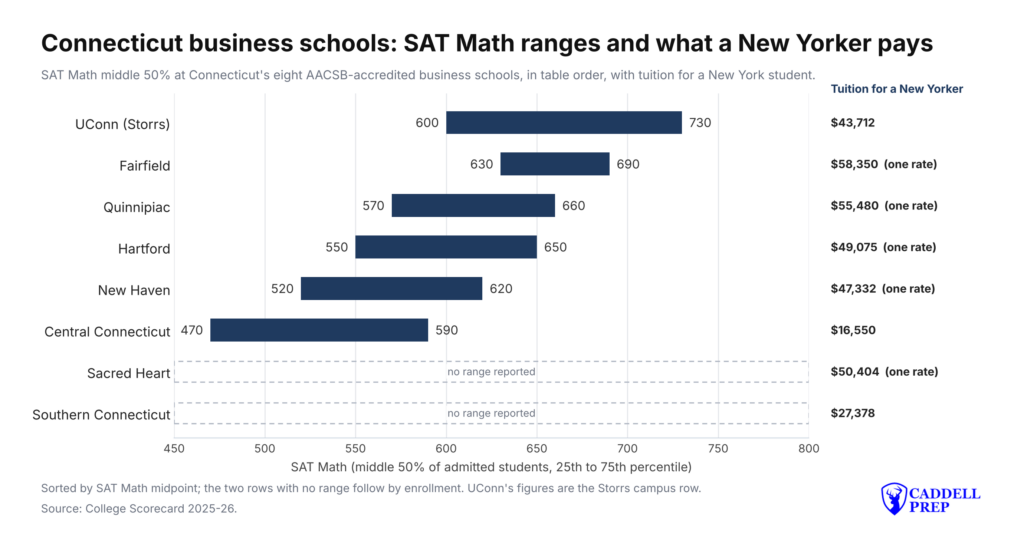
A student can see where his Math score sits on this ladder in the image above.
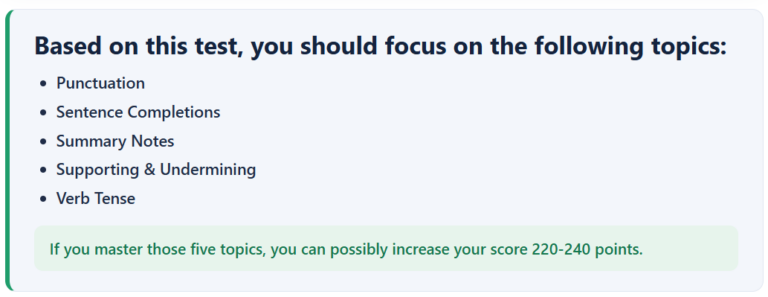
Want to Know What 5 Topics Will Improve Your SAT Score the Most?
Sample Feedback from our Diagnostic Test:
University of Connecticut
The University of Connecticut in Storrs awards its business degrees through its School of Business, and UConn reports the highest SAT range of the eight and runs the one business-school gate in this series that publishes its own admit rate.
Reading & Writing 610 to 710, Math 600 to 730. ACT composite 28 to 33. The top quarter of admitted students scored at or above 730 on Math and 33 on the ACT. Cost of attendance $39,426, with tuition and fees at $21,044 in-state and $43,712 out-of-state. 19,835 undergraduates, 52% admitted.
UConn admits a freshman who checks a business major on the application directly to the School of Business, and admits its other students at 40 credits, the subject of the next section. The cost of attendance in the table is a resident’s. A non-resident’s comes to approximately $62,094 once the higher tuition is substituted, and the $43,712 that drives it is $9,540 above what the University of Alabama charges a New Yorker and $1,206 below Boulder’s figure. The Stamford campus is a separate row in the Scorecard, with a Math range of 460 to 630, an 83% admit rate, 2,432 undergraduates and $40,818 in non-resident tuition [VERIFY the Stamford row].
Quinnipiac University
Quinnipiac University in Hamden awards its business degrees through its School of Business, and Quinnipiac reports the same 660 at the top of both SAT sections.
Reading & Writing 580 to 660, Math 570 to 660. ACT composite 25 to 30. The top quarter of admitted students scored at or above 660 on Math and 30 on the ACT. Cost of attendance $72,215, with tuition and fees at $55,480 for all students. 6,531 undergraduates, 72% admitted.
Quinnipiac admits 72% of applicants on a Math floor 60 points below Fairfield’s and 30 below UConn’s, and charges $55,480, $2,870 below Fairfield. A New York student with a 650 on Math sits inside Quinnipiac’s range and 10 points under its 660 ceiling.
University of Hartford
The University of Hartford in West Hartford awards its business degrees through the Barney School of Business, and Hartford admits 96% of its applicants, the highest rate of the eight.
Reading & Writing 570 to 660, Math 550 to 650. ACT composite 24 to 30. The top quarter of admitted students scored at or above 650 on Math and 30 on the ACT. Cost of attendance $64,729, with tuition and fees at $49,075 for all students. 4,146 undergraduates, 96% admitted.
University of New Haven
The University of New Haven in West Haven awards its business degrees through the Pompea College of Business, reaccredited by AACSB International in 2025, and New Haven charges the lowest private tuition on the page, $47,332.
Reading & Writing 540 to 645, Math 520 to 620. New Haven reports no ACT range. The top quarter of admitted students scored at or above 620 on Math. Cost of attendance $66,962, with tuition and fees at $47,332 for all students. 4,841 undergraduates, 60% admitted.
Central Connecticut State University
Central Connecticut State University in New Britain awards its business degrees through its School of Business, and Central charges a New Yorker $16,550, the lowest non-resident tuition of the eight and $3,500 above what it charges a Connecticut resident.
Reading & Writing 490 to 600, Math 470 to 590. Central reports no ACT range. The top quarter of admitted students scored at or above 590 on Math. Cost of attendance $24,870, with tuition and fees at $13,050 in-state and $16,550 out-of-state. 7,822 undergraduates, 73% admitted.
Central’s non-resident premium of $3,500 is the smallest on this page and the second smallest in this series after Henderson State’s $2,376, and its $16,550 is $27,162 below what UConn charges the same New Yorker. Its Math floor of 470 is the lowest of the six that report one. The cost of attendance in the table is a resident’s, and a non-resident’s comes to approximately $28,370 with the higher tuition substituted.
Sacred Heart University
Sacred Heart University in Fairfield awards its business degrees through the Jack Welch College of Business and Technology, AACSB-accredited and extended at its most recent review, and Sacred Heart is the largest private university on the page and reports no SAT or ACT range.
Sacred Heart reports no score ranges. Cost of attendance $69,289, with tuition and fees at $50,404 for all students. 7,087 undergraduates, 65% admitted.
Sacred Heart sits five miles from Fairfield University, admits 65% of applicants to Fairfield’s 33%, and charges $7,946 less. The absence of a range is a reporting choice and not a policy of the state, because Connecticut’s public universities report theirs.
Southern Connecticut State University
Southern Connecticut State University in New Haven awards its business degrees through its School of Business, the newest AACSB-accredited business school in the state, and Southern reports no SAT or ACT range to the Scorecard.
Southern reports no score ranges. Cost of attendance $29,673, with tuition and fees at $13,438 in-state and $27,378 out-of-state. 6,295 undergraduates, 91% admitted.
Eight rows say who got into the university. The next section is about the UConn student who got in and is not yet in its School of Business.
How Does a UConn Student Get Into the School of Business?
A University of Connecticut student who was not admitted to the School of Business as a freshman applies in the first two weeks of a fall or spring term once he holds 40 earned credits, a 3.000 cumulative GPA and credit in seven critical courses, and the School admits 45 to 60% of the students who ask for a Storrs business major each term.
The first door is the application to the university. UConn’s School of Business says undergraduates “are admitted to UConn’s School of Business directly as a First-Year or Transfer student,” and tells applicants to “check off a business major when applying,” with each application naming one major at one campus [VERIFY on the Prospective Business Students page]. A freshman who does that and is admitted is a business major on arrival.
The second door is internal admission, and the School publishes its rules in full. A current UConn student may apply during the first two weeks of the fall and spring terms, for spring 2027 from August 31 to September 14, 2026, once he holds 40 earned credits on his UConn transcript with at least 24 in residence, a cumulative GPA of at least 3.000, a cumulative business GPA of at least 2.000, and earned credit in the critical courses: ACCT 2001, COMM 1000 or 1100, ECON 1201 or ARE 1150 and ECON 1202 or 1200, ENGL 1007, 1010 or 1011, a two-course math sequence of MATH 1070Q and 1071Q, 1070Q and 1131Q, or 1131Q and 1132Q, and STAT 1000Q or 1100Q. Each application names one major at one campus, review weighs academics at 60% and the essay and resume at 40%, decisions come in early or mid-October before registration, and the page’s words are these: “Admission to the School of Business is competitive and reliant on space available as determined by each campus,” and “Late applications are not considered.” A conditionally admitted student keeps the seat with a 3.000 semester GPA, a 3.000 cumulative GPA and a 3.000 business GPA at the end of the term [VERIFY on the Admission to Business Majors page].
What the School then publishes is the part no other business school in this series does. Its Internal Admission Summary page reads: “Admission rates for students who select Storrs Business majors as their first choice: 45 – 60% each term,” and “Admission rates for students who select regional campus Business majors as their first choice: 65 – 80% each term.” Admitted students’ cumulative GPAs run from 3.0 to 4.0 and average 3.5, and their critical-course GPAs run from 2.4 to 4.0 and average 3.5 with five courses graded, with the note that the figures vary term over term and cover all campuses [VERIFY on the Summary and Averages page]. The 3.000 is the floor. The 3.5 is the room.
The regional campuses are the other half of the rule. A Storrs first-choice applicant is encouraged to list Stamford, Hartford or Waterbury as a second choice, read only if the first is refused, and the School says plainly that “being admitted to a regional major means you will be unable to take Business courses at the Storrs campus.” For a New York student that sentence has an address on it: Stamford is forty miles from the Bronx line, admits business majors at the higher band, and keeps them there.
On our page on business colleges in Colorado, Leeds and Colorado State also hold a second door for the student the first one turned away, and neither says how many get through it. UConn says.
| Door | Who | What it asks | What UConn publishes about it |
|---|---|---|---|
| First-year, direct | High school senior who checks a business major | The university’s admission review, one major at one campus | No separate rate |
| Internal, Storrs first choice | UConn student at 40 credits | 3.000 cumulative, 2.000 business GPA, seven critical courses, essay and resume at 40% | Admitted 45 to 60% each term, average GPA 3.5 |
| Internal, regional first choice (Stamford, Hartford, Waterbury) | UConn student at 40 credits | Same | Admitted 65 to 80% each term, no Storrs business courses afterward |
| Transfer in first UConn term | New transfer student | 12 UConn credits in progress, the same courses | Decision after one semester, on space |
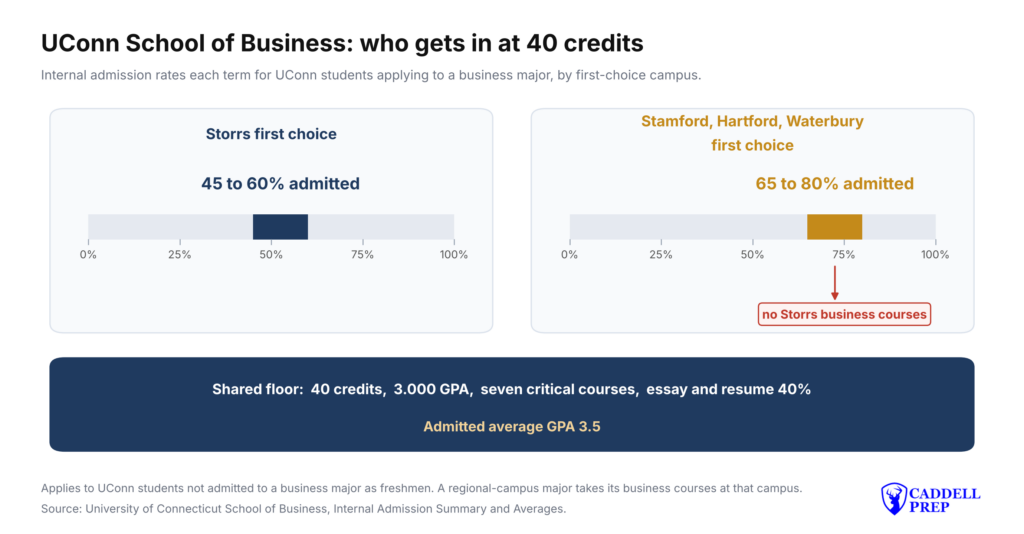
The image above shows the two admit-rate bands UConn publishes for its own students.
A 3.000 is enough to apply and not enough to be at the average, because the admitted students’ average is 3.5. A student who misses the September window waits for the January one, because late applications are not read.
The price follows the schools and not the doors. UConn charges a New Yorker $43,712 in tuition, $9,540 above the University of Alabama’s figure and $1,206 below Boulder’s, and its Stamford campus charges $40,818. Central charges a non-resident $16,550, the lowest on the page, and Southern $27,378. The five private schools charge every student between $47,332 at New Haven and $58,350 at Fairfield. Four years is $174,848 at UConn, $221,920 at Quinnipiac, $233,400 at Fairfield and $66,200 at Central. New England’s regional tuition break covers residents of the six New England states, and New York is not one of them [VERIFY the NEBHE Tuition Break rules].
The one business degree Connecticut licenses is accounting. The Connecticut State Board of Accountancy lets a candidate sit for the CPA exam with a 120-hour bachelor’s degree and 46 credit hours in accounting and related subjects, at least 24 of them in accounting, and certifies on 150 hours with 36 in accounting, including the 24, 30 in economics and business administration, including the 22 submitted for the exam, and 60 in general education, with the extra credits earned, in the state society’s words, “at any time prior to applying for the CPA credential” [Connecticut Society of CPAs page, VERIFY on the board’s page, including experience and the ethics exam]. Alabama asks 24 accounting hours to sit, Arkansas 30 beyond principles, Colorado 27. Connecticut’s 46 in accounting and related subjects is the largest count to sit on these pages so far.
Take a New York student with a 1300 on the SAT, 650 on each section, and a 3.5 GPA. At UConn he is inside the 600 to 730 Math range and the 610 to 710 Reading & Writing range, admitted at 52%. If he checked a business major he is in the School of Business on arrival. If he did not, he applies at 40 credits with a 3.000, lands in a pool admitted at 45 to 60% for Storrs, and a 3.5 in college would put him at the admitted average. At Fairfield he is inside 630 to 690 and 630 to 700, admitted at 33%, at $58,350 a year. At Quinnipiac he is inside 570 to 660, admitted at 72%. At Central he is above the 470 to 590 Math range entirely, admitted at 73%, at $16,550. Four years of tuition is $174,848 at UConn, $233,400 at Fairfield and $66,200 at Central. The score decided the first door everywhere, and UConn’s second door, if he needs it, reads a 3.000 and admits about half.
The honest version is that UConn publishes bands and averages, not counts, and “each term” is not tied to a named year. The other seven schools’ admission rules were not found for this page and are not described here, rather than described as absent [VERIFY each catalog]. Sacred Heart and Southern report no range. The Stamford figures are a separate Scorecard row. The page does not say which business school is better. It says who gets in at the application, who applies at 40 credits, and what share of them UConn says yes to.
Families reading the second-choice rule frequently ask whether Stamford is a way into Storrs.
Can a UConn Student Admitted to Business at Stamford Take Classes at Storrs?
No, a UConn student admitted to a business major at the Stamford campus cannot take business courses at Storrs, and the School of Business says so in one sentence: “being admitted to a regional major means you will be unable to take Business courses at the Storrs campus.”
A Storrs first-choice applicant may list a regional campus second, and the second choice is read only if the first is refused. A student who wants to move campuses afterward goes through the campus change procedure with an advisor rather than through the business application [VERIFY the procedure]. Stamford itself stands in the Scorecard as its own row, with a Math range of 460 to 630, an 83% admit rate and $40,818 in non-resident tuition, $2,894 below Storrs.
Two doors, two bands, one sentence about Stamford. Which schools hold the accreditation is the next section.
Which Connecticut Universities Have AACSB-Accredited Business Schools?
Eight Connecticut universities hold business accreditation from AACSB International, three public and five private, and the list below names each with its city and the school that awards the business degree [VERIFY all eight on the AACSB directory before publishing].
- The University of Connecticut in Storrs awards its business degrees through its AACSB-accredited School of Business.
- Fairfield University in Fairfield awards its business degrees through the AACSB-accredited Dolan School of Business.
- Quinnipiac University in Hamden awards its business degrees through its AACSB-accredited School of Business.
- The University of Hartford in West Hartford awards its business degrees through the AACSB-accredited Barney School of Business.
- The University of New Haven in West Haven awards its business degrees through the AACSB-accredited Pompea College of Business.
- Central Connecticut State University in New Britain awards its business degrees through its AACSB-accredited School of Business.
- Sacred Heart University in Fairfield awards its business degrees through the AACSB-accredited Jack Welch College of Business and Technology.
- Southern Connecticut State University in New Haven awards its business degrees through its AACSB-accredited School of Business.
Accreditation matters for a reason that is easy to miss at seventeen. Business itself is not a licensed profession, and the one business degree that leads to a license, accounting, leads to it through the state board rather than through the school. A CPA in Connecticut normally needs 150 semester hours with 36 in accounting and 30 in economics and business, the Uniform CPA Examination and the board’s experience and ethics requirements, and may sit for the exam on a 120-hour degree with 46 hours in accounting and related subjects [VERIFY on the board’s page]. AACSB status matters on the way there because business schools use it to decide whose courses they will accept in transfer.
Yale’s School of Management is AACSB-accredited and awards no undergraduate business degree, so Yale is not a row. Western Connecticut State University’s Ancell School of Business and Eastern Connecticut State University award business degrees without AACSB accreditation [VERIFY Western’s ACBSP status and Eastern’s]. The University of Bridgeport, Post University, Albertus Magnus College, the University of Saint Joseph, Mitchell College and Goodwin University award business bachelor’s degrees without AACSB accreditation [VERIFY each]. The United States Coast Guard Academy in New London awards a management degree, charges no tuition and does not hold AACSB accreditation [VERIFY].
Nothing on this page ranks the eight. They are eight schools with the same accreditor, one of them publishing the odds at its second door, and the pages for business colleges in New York, business colleges in Massachusetts and business colleges in Rhode Island carry the neighbors a student looking at Connecticut is likely comparing.
What If Your Score Is Below the Range You Want?
In Connecticut two Math floors sit above 570, Fairfield’s 630 and UConn’s 600, and Central’s 470 is the lowest of the six that report one. A student under the floor he wants is not ruled out, because a quarter of admitted students were there too. He is in the quarter that needs the rest of the application to carry more.
The first step is finding out where the score actually is, section by section. A free diagnostic SAT gives a Math score that can be set directly against UConn’s 600 floor and Fairfield’s 630.
The Math section rewards the same handful of topics on every test date, and a student who knows which of them he is missing can close a gap of 50 to 100 points in weeks rather than months. The method is on our page on improving your SAT Math score, and at UConn the same algebra fills the two-course math sequence, MATH 1070Q and 1071Q or 1131Q and 1132Q, that stands among the seven critical courses a student passes before internal admission.
How to Read These Score Ranges
Each range in the table covers the middle 50% of admitted students who submitted that test, so a quarter of admitted students were below the lower number and a quarter were at or above the upper one.
A range describes the students who chose to submit at all. Where a school is test-optional, the range describes the submitters, and the submitters are the students whose scores helped them. More on what SAT score you need for college and on test-optional colleges.
Should You Take the ACT Instead?
Connecticut gives the SAT to every public school junior as the state test [VERIFY current Connecticut statewide testing], and only four of the eight schools report an ACT range at all.
A New York student who holds an SAT should send it to the six schools that publish an SAT range and leave the ACT alone unless a school outside the state asks for it. Nothing at UConn’s second door reads either test.
Business Programs in Nearby States
Connecticut borders New York, Massachusetts and Rhode Island, and each has AACSB-accredited business schools of its own [VERIFY the lists before linking].
See business colleges in New York, business colleges in Massachusetts, and business colleges in Rhode Island.
Business Colleges in Other States
We publish the same breakdown for business programs in every state.
See business colleges by state for the full list.

Glyn Caddell
Glyn Caddell holds a BS in Mechanical Engineering from NJIT and has been tutoring New York City students since 2008. He founded Caddell Prep in 2012 and is the author of Digital SAT Math Secrets: Lessons & Tricks to Quickly Improve to a Perfect 800 on the Math Test, which contains over 900 practice problems and is used in Caddell Prep’s SAT math classes. He is founding president of the Staten Island Technical High School alumni association and teaches every lesson on this site personally.
Finally, an SAT course that students actually understand
Every question has a video explanation. Not most — every one.
The on-demand Digital SAT course covers all 17 math topics and 15 reading and writing topics, with 5 full-length practice tests and a 100-point score increase guarantee. Keep access for the rest of high school. No subscription.
Want to Know What 5 Topics Will Improve Your SAT Score the Most?
Sample Feedback from our Diagnostic Test: