
Home » College SAT Score Ranges, Costs, and Programs by Major and State » Best Business Colleges » Business Colleges in Arizona: SAT Scores, ACT Scores, Costs, and Programs
By Glyn Caddell, BSME · Author of Digital SAT Math Secrets · Tutoring since 2008 — Updated November 7, 2026
Three Arizona universities hold AACSB-accredited business schools, the University of Arizona, Arizona State University and Northern Arizona University, and this page lists the SAT and ACT scores of the students they admit, what each costs a New York student, and the gate each business school puts between admission to the university and admission to the business major.
One of the three, Arizona, reports a score range, so the table has one middle 50% to read and two rows without one.
At ASU the business school reads a test score of its own, an SAT of 1230 or an ACT of 25, while at Arizona and NAU the gate is a college GPA after the first year or two.
Table of Contents
- Arizona Business Colleges by SAT and ACT Score
- What Does It Take to Enter a Business Major in Arizona?
- Which Arizona Universities Have AACSB-Accredited Business Schools?
- What If Your Score Is Below the Range You Want?
Arizona Business Colleges by SAT and ACT Score
Arizona’s three AACSB-accredited business schools sit at universities that admit 86% to 90% of their applicants, and the table below lists each with the one SAT and ACT range the state publishes, Arizona’s, and the cost of attendance, enrollment and admit rate of all three. The rows are sorted by the midpoint of the SAT Math range, with the two rows that report no range following in order of enrollment, so the order can be checked from the table itself.
| College | SAT Reading & Writing | SAT Math | ACT composite | Business school | Cost of attendance | Undergraduates | Admit rate |
|---|---|---|---|---|---|---|---|
| University of Arizona | 580 to 700 | 570 to 720 | 21 to 29 | Eller College of Management | $29,423 | 42,537 | 86% |
| Arizona State University | Does not report SAT data | Does not report SAT data | Does not report ACT data | W. P. Carey School of Business | $30,111 | 64,674 | 90% |
| Northern Arizona University | Does not report SAT data | Does not report SAT data | Does not report ACT data | W. A. Franke College of Business | $29,933 | 22,903 | 90% |
Each range covers the middle 50% of admitted students who submitted that test. A quarter scored below the lower number, and the top quarter scored at or above the upper one. Being under the lower number does not rule a student out, and being just above it is not as safe as it looks. Business school names the AACSB-accredited school within the university that awards the business degree. Arizona State University’s figures are the Scorecard’s Campus Immersion row, and its online arm is not listed separately.
Schools whose business accreditation comes from another body, or from none, are left off this list and named further down. Online and for-profit institutions that report no scores are left off.
Three things about that table are worth pausing on.
Three Arizona universities hold AACSB business accreditation and all three admit at least 86% of their applicants, and each business school then runs a gate of its own: a high school number at ASU, a ranked application at Arizona, a GPA floor at NAU.
Arizona charges a New Yorker $42,278 in tuition, $9,139 more than ASU and $12,397 more than NAU, for the one middle 50% published in the state, 570 to 720 on Math.
ASU reports no score range, and the only Arizona score a business applicant can read is the W. P. Carey School’s own direct-admission line, an SAT of 1230 or an ACT of 25.
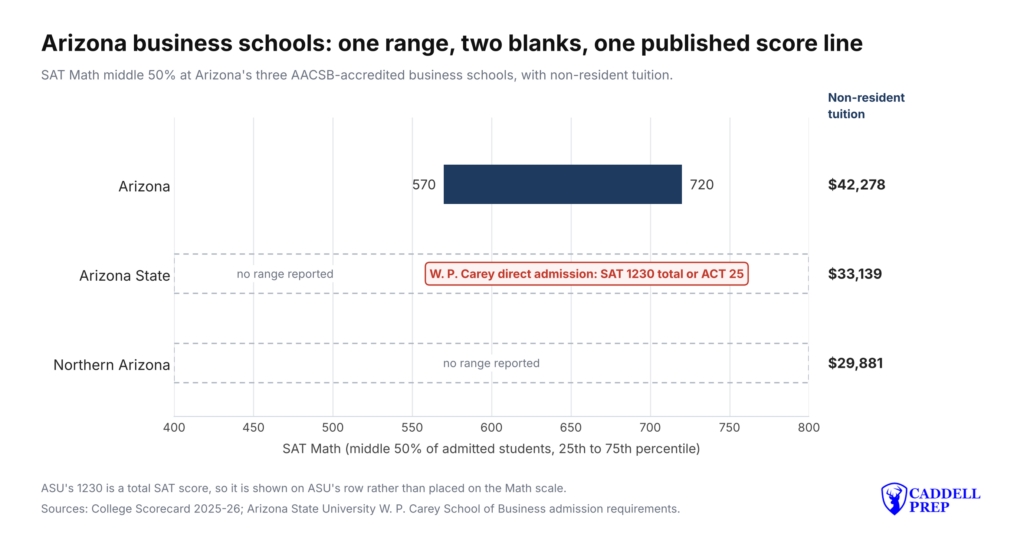
A student can see the one range Arizona publishes and the one line ASU draws in the image above.
Want to Know What 5 Topics Will Improve Your SAT Score the Most?
Sample Feedback from our Diagnostic Test:

University of Arizona
The University of Arizona in Tucson awards its business degrees through the Eller College of Management, and Arizona is the one university of the three that reports a score range and the one that charges a New Yorker the most.
Reading & Writing 580 to 700, Math 570 to 720. ACT composite 21 to 29. The top quarter of admitted students scored at or above 720 on Math and 29 on the ACT. Cost of attendance $29,423, with tuition and fees at $13,926 in-state and $42,278 out-of-state. 42,537 undergraduates, 86% admitted.
Arizona admits a first-year business applicant to the university as a Business Management major, and Eller’s own admission comes later, after the Foundation courses, on a 2.75 GPA and, for most majors, a ranking. The cost of attendance in the table is a resident’s. A non-resident’s comes to approximately $57,775 once the higher tuition is substituted, and the $42,278 that drives it is $8,106 above what the University of Alabama charges a New Yorker and the highest non-resident tuition on any business page in this series so far.
Arizona State University
Arizona State University in Tempe awards its business degrees through the W. P. Carey School of Business, and ASU is the largest university on this page and the only one whose business school publishes a test score of its own.
ASU reports no SAT or ACT range to the Scorecard. Cost of attendance $30,111, with tuition and fees at $12,223 in-state and $33,139 out-of-state. 64,674 undergraduates, 90% admitted.
The figures are the Scorecard’s row for ASU’s campus programs. Its online arm, listed separately in the Scorecard with 53,782 undergraduates and no cost of attendance, holds the same accreditation and is not a separate row here. W. P. Carey admits a first-year student directly to a Bachelor of Science major on an SAT of 1230, an ACT of 25, a top-8% class rank or a 3.4 GPA, any one of the four. A non-resident’s cost of attendance comes to approximately $51,027 with the higher tuition substituted, $6,748 below Arizona’s.
Northern Arizona University
Northern Arizona University in Flagstaff awards its business degrees through the W. A. Franke College of Business, and NAU charges a New Yorker the least of the three.
NAU reports no SAT or ACT range to the Scorecard. Cost of attendance $29,933, with tuition and fees at $13,009 in-state and $29,881 out-of-state. 22,903 undergraduates, 90% admitted.
NAU’s non-resident premium, $16,872, is the smallest of the three, against $20,916 at ASU and $28,352 at Arizona, because its resident tuition is the second highest and its non-resident tuition the lowest. Admission to the Franke College’s Business Professional Program comes at 56 units on a 2.0, with a 2.75 in the required courses guaranteeing a place. A non-resident’s cost of attendance comes to approximately $46,805 with the higher tuition substituted.
Three rows say who got into the university. The next section is about the three gates that decide who is a business major.
What Does It Take to Enter a Business Major in Arizona?
Arizona’s three business schools put three different gates between admission to the university and admission to the business major, and the W. P. Carey School of Business at ASU is the one that reads a test score, an SAT of 1230 or an ACT of 25.
ASU’s gate comes on the first-year application. Direct admission to a Bachelor of Science major in W. P. Carey requires any one of four marks: an SAT of 1230 on a test taken in March 2016 or later, an ACT composite of 25, a class rank in the top 8%, or a 3.4 high school GPA on ASU’s competency courses. The student then needs a 3.0 cumulative GPA at ASU and a C or higher in any business skills course he takes, CIS 105, MAT 210, MAT 211, ECN 211, ECN 212, ACC 231, ACC 241 and ECN 221. A student with none of the four marks may submit a portfolio to the Undergraduate Programs Office, and the page calls that “a competitive admissions process” in which admission is “not guaranteed.” The Bachelor of Arts in Business majors ask less, a 3.0 at ASU and a C in eight skills courses, or 24 ASU hours, a 2.75 and a C in four, and the BA in Applied Business and Technology Solutions and the BA in Entrepreneurial Leadership ask only what the university asks [VERIFY all of this on the W. P. Carey direct admission page].
Arizona’s gate comes after the Foundation courses. A first-year student is admitted to the university as a Business Management major and applies for Professional Admission to Eller with at least 36 units completed and 50 by the end of the semester, on a cumulative GPA of 2.75 over 12 or more University of Arizona units. The Fall 2026 packet’s words: “The minimum GPA of 2.75 guarantees a Business Management major.” Every other traditional major, Accounting, Business Analytics, Business Economics, Finance, Management Information Systems, Marketing, and Operations and Supply Chain Management, is competitive when interest exceeds capacity, and applicants are compared on cumulative GPA, Foundation GPA and performance across all attempts including repeats, specific Foundation grades for some majors, and a cover letter, resume and interview. A 3.75 cumulative GPA and a 3.75 Foundation GPA earn Admission with Excellence and a guaranteed first-choice major. A student may apply twice. For Fall 2026 the window ran from January 21 to February 6, with interviews on February 20 and 21 and decisions around March 6 [VERIFY on the packet].
NAU’s gate comes at 56 units. Admission to the Franke College’s Business Professional Program requires 56 units with a cumulative GPA of 2.0, a C or better in each required course, and six Pathways experiences, one of them the Career Steps module. A 2.75 or higher in the required courses guarantees admission. A GPA of 2.5 to 2.74 in those courses admits on a space-available basis, ranked by GPA. A student who has the C in every course and falls under the line may repeat up to two of them once. Until admitted, the advising page says, a student “will be restricted from taking upper-division business courses” [VERIFY on the NAU Accountancy page and the Franke advising page].
| School | When the business school admits you to the major | What it reads | GPA |
|---|---|---|---|
| ASU | On the first-year application (direct admission) | SAT 1230, or ACT 25, or top-8% rank, or 3.4 high school GPA, and a portfolio otherwise | 3.0 at ASU to stay |
| Arizona | After the Foundation courses, 36 units at application and 50 by the end of the semester | Cumulative GPA, Foundation GPA, cover letter, resume, interview, with most majors ranked | 2.75 guarantees Business Management, and 3.75 and 3.75 guarantee the first choice |
| NAU | After 56 units and six Pathways experiences | GPA in the required courses | 2.0 to apply, 2.75 guarantees, 2.5 to 2.74 space-available |
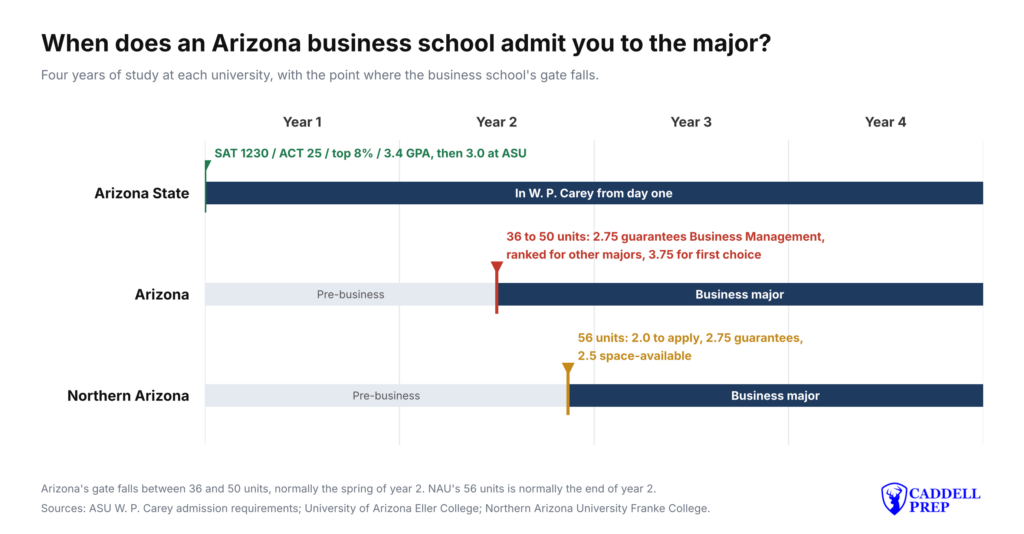
The image above marks when each of the three business schools admits a student to the major.
The three gates read three different things. ASU reads a high school number, and a student who has it is a business major before he arrives. Arizona reads a college record, and a student who has a 2.75 is a Business Management major while Finance and Accounting rank him against the others. NAU reads a college floor, and a student who has a 2.75 in the required courses is in. The three universities admit 86%, 90% and 90% of their applicants, and none of the three business schools is as open as its university.
A student with a 3.4 and an 1100 clears ASU’s gate on the GPA alone, because the four routes are alternatives. What a 2.75 gets at Eller is Business Management, guaranteed, and a ranked chance at everything else.
A New Yorker pays $42,278 in tuition at Arizona, $33,139 at ASU and $29,881 at NAU, $169,112, $132,556 and $119,524 over four years. The Western Undergraduate Exchange rate the Arizona universities offer does not reach him, because it applies to residents of the WICHE states and New York is not one [VERIFY each university’s WUE participation and the WICHE member list].
The one business degree Arizona licenses is accounting. The Arizona State Board of Accountancy lets a candidate sit for the CPA exam with a bachelor’s degree and 24 semester hours of upper-level accounting, and certifies on 150 semester hours with 36 hours of accounting, 30 of them upper-level, 30 hours of related business courses, supervised experience and a 90% on the AICPA ethics exam, with no residency requirement [VERIFY every figure on azaccountancy.gov, since this page read a third-party summary]. Alabama asks 150 hours with 33 in accounting. Alaska, from 2026, asks a bachelor’s and two years. Arizona sits with Alabama.
Take a New York student with a 1300 on the SAT, 650 on each section, and a 3.5 GPA. At ASU the 1300 clears the 1230 and the 3.5 clears the 3.4, so he is admitted directly to a W. P. Carey Bachelor of Science major on his application and keeps it with a 3.0 at ASU and a C in the skills courses. At Arizona he is inside the 570 to 720 Math range and the 580 to 700 Reading & Writing range, he is admitted at 86% as a Business Management major, and the next thing that decides anything is the Foundation courses, 36 units and a 2.75, with a ranking if he wants Finance or Accounting and a 3.75 and 3.75 if he wants it guaranteed. At NAU there is no range to be inside, he is admitted at 90%, and 56 units, a 2.0 and a 2.75 in the required courses put him in the Business Professional Program. Four years of tuition is $132,556 at ASU, $169,112 at Arizona and $119,524 at NAU. The score decided something at exactly one of the three, and it decided it on the day he applied.
The honest version is that none of the three publishes how many applicants reach the business major. ASU’s page says portfolio admission is competitive and not guaranteed and gives no count. Eller’s packet gives no capacity by major and no number admitted. NAU’s space-available tier is ranked by GPA with no published cutoff. ASU’s 1230 is one of four routes, so a student with a 3.4 never needs it. Eller’s 2.75 guarantees Business Management and nothing else. The page does not say which business school is better. It says what each reads and when.
Families reading ASU’s four routes frequently ask whether the SAT is the one that counts.
Does ASU Require an SAT Score for the W. P. Carey School of Business?
No, Arizona State University does not require an SAT score for direct admission to a Bachelor of Science major in the W. P. Carey School of Business, because the SAT 1230 is one of four routes and an ACT composite of 25, a top-8% class rank or a 3.4 high school GPA on ASU’s competency courses does the same work.
A student with none of the four submits a portfolio, and the page says admission by portfolio is competitive and not guaranteed. The Bachelor of Arts in Business majors have no first-year threshold of their own, and the BA in Applied Business and Technology Solutions and the BA in Entrepreneurial Leadership admit on the university’s requirements alone [VERIFY]. A New York student with a 1230 or better should send it, because it is the one route that costs him nothing to show.
Four routes, one score. Which schools hold the accreditation is the next section.
Which Arizona Universities Have AACSB-Accredited Business Schools?
Three Arizona universities hold business accreditation from AACSB International, and the list below names each with its city and the school that awards the business degree [VERIFY all three on the AACSB directory before publishing].
- The University of Arizona in Tucson awards its business degrees through the AACSB-accredited Eller College of Management.
- Arizona State University in Tempe awards its business degrees through the AACSB-accredited W. P. Carey School of Business.
- Northern Arizona University in Flagstaff awards its business degrees through the AACSB-accredited W. A. Franke College of Business.
Accreditation matters for a reason that is easy to miss at seventeen. Business itself is not a licensed profession, and the one business degree that leads to a license, accounting, leads to it through the state board rather than through the school. A CPA in Arizona normally needs 150 semester hours with 36 in accounting and 30 in related business courses, the Uniform CPA Examination, supervised experience and the ethics exam, and may sit for the exam on a bachelor’s degree with 24 upper-level accounting hours [VERIFY on azaccountancy.gov]. AACSB status matters on the way there because business schools use it to decide whose courses they will accept in transfer.
Grand Canyon University’s Colangelo College of Business and Embry-Riddle Aeronautical University’s Prescott campus hold business accreditation from the ACBSP rather than AACSB, and they are the two Arizona schools a New York family is most likely to ask about. Grand Canyon reports 518 to 580 on Reading & Writing, 488 to 533 on Math and 73,371 undergraduates, more than ASU’s campus programs, and Embry-Riddle Prescott reports 580 to 680 and 560 to 690 and charges $44,149 to every student. Arizona Christian University, Ottawa University in Surprise and Prescott College award business bachelor’s degrees without AACSB accreditation [VERIFY each school’s accreditor]. The University of Arizona Global Campus, the University of Phoenix and the other online and for-profit institutions in the state report no scores to the Scorecard, and Thunderbird is a graduate school.
Nothing on this page ranks the three. They are three schools with the same accreditor, three different gates and three prices, and the pages for business colleges in Nevada and business colleges in New Mexico carry the neighbors a student looking at Arizona is likely comparing.
What If Your Score Is Below the Range You Want?
In Arizona there are two floors to be under, the Scorecard’s 570 on Math at Arizona and W. P. Carey’s 1230 total at ASU, and they are different kinds of number. A student under 570 at Arizona is not ruled out, because a quarter of admitted students were there too. A student under 1230 at ASU is not ruled out either, because a 3.4 or a top-8% rank does the same work and a portfolio remains.
The first step is finding out where the score actually is, section by section. A free diagnostic SAT gives a Math score that can be set directly against Arizona’s 570 floor and against the arithmetic of ASU’s 1230: a student with a 650 on Reading & Writing needs a 580 on Math to reach it.
The Math section rewards the same handful of topics on every test date, and a student who knows which of them he is missing can close a gap of 50 to 100 points in weeks rather than months. The method is on our page on improving your SAT Math score, and the 1230 is the kind of total that moves on Math alone. At ASU the same algebra fills MAT 210 and MAT 211, two of the business skills courses a W. P. Carey
How to Read These Score Ranges
Each range in the table covers the middle 50% of admitted students who submitted that test, so a quarter of admitted students were below the lower number and a quarter were at or above the upper one.
Two of the three rows have no range, because ASU and NAU report none to the Scorecard, and ASU’s 1230 is a floor for direct admission to one school within the university, not a description of the admitted class. A range describes the students who chose to submit at all. More on what SAT score you need for college and on test-optional colleges.
Should You Take the ACT Instead?
Arizona gives the ACT to public school juniors as its state test [VERIFY current Arizona statewide testing], and the one university that reports a range reports both.
A New York student who holds an SAT should send it. ASU’s 25 on the ACT and 1230 on the SAT are alternatives, so a student who holds one never needs the other, and Arizona publishes both ranges. Nothing at NAU reads either test.
Business Programs in Nearby States
Arizona borders Nevada, Utah, New Mexico, Colorado and California, and each has AACSB-accredited business schools of its own [VERIFY the lists before linking].
See business colleges in Nevada, business colleges in New Mexico, and business colleges in Utah.
Business Colleges in Other States
We publish the same breakdown for business programs in every state.
See business colleges by state for the full list.

Glyn Caddell
Glyn Caddell holds a BS in Mechanical Engineering from NJIT and has been tutoring New York City students since 2008. He founded Caddell Prep in 2012 and is the author of Digital SAT Math Secrets: Lessons & Tricks to Quickly Improve to a Perfect 800 on the Math Test, which contains over 900 practice problems and is used in Caddell Prep’s SAT math classes. He is founding president of the Staten Island Technical High School alumni association and teaches every lesson on this site personally.
Finally, an SAT course that students actually understand
Every question has a video explanation. Not most — every one.
The on-demand Digital SAT course covers all 17 math topics and 15 reading and writing topics, with 5 full-length practice tests and a 100-point score increase guarantee. Keep access for the rest of high school. No subscription.
Want to Know What 5 Topics Will Improve Your SAT Score the Most?
Sample Feedback from our Diagnostic Test: