
Home » College SAT Score Ranges, Costs, and Programs by Major and State » Best Business Colleges » Business Colleges in Delaware: SAT Scores, ACT Scores, Costs, and Programs
By Glyn Caddell, BSME · Author of Digital SAT Math Secrets · Tutoring since 2008 — Updated November 8, 2026
Two Delaware universities hold AACSB-accredited business schools, the University of Delaware and Delaware State University, and this page lists the SAT and ACT scores of the students they admit, what each costs a New York student, and what a Lerner freshman must do to keep the major he was admitted for.
Both report both tests, so the table leads with the SAT and has two ranges to read.
At Lerner a freshman is guaranteed his choice of sixteen majors until October 1 of sophomore year and not after it, and a student who comes from outside the college needs a 3.0 to get in.
Table of Contents
- Delaware Business Colleges by SAT and ACT Score
- When Does a Lerner Freshman Have to Declare a Business Major?
- Which Delaware Universities Have AACSB-Accredited Business Schools?
- What If Your Score Is Below the Range You Want?
Delaware Business Colleges by SAT and ACT Score
Delaware’s two AACSB-accredited business schools are the flagship’s Lerner College in Newark and Delaware State’s College of Business in Dover, and the table below lists each with its SAT and ACT ranges, cost of attendance, enrollment and admit rate. Both are public and both report both tests, and the rows are sorted by the midpoint of the SAT Math range, so the order can be checked from the table itself.
| College | SAT Reading & Writing | SAT Math | ACT composite | Business school | Cost of attendance | Undergraduates | Admit rate |
|---|---|---|---|---|---|---|---|
| University of Delaware | 600 to 690 | 590 to 680 | 28 to 32 | Alfred Lerner College of Business and Economics | $30,952 | 19,071 | 71% |
| Delaware State University | 420 to 520 | 380 to 500 | 20 to 24 | College of Business | $27,939 | 4,398 | 47% |
Each range covers the middle 50% of admitted students who submitted that test. A quarter scored below the lower number, and the top quarter scored at or above the upper one. Being under the lower number does not rule a student out, and being just above it is not as safe as it looks. Business school names the AACSB-accredited college within the university that awards the business degree. The cost of attendance shown is a resident’s.
Schools whose business accreditation comes from another body are left off this list and named further down.
Three things about that table are worth pausing on.
Two Delaware universities hold AACSB business accreditation, the flagship and the state’s historically Black university, and the HBCU is the harder admit: Delaware State takes 47% of applicants and Delaware 71%.
Delaware charges a New Yorker $41,400 in tuition and Delaware State $20,634, a gap of $20,766 a year and $83,064 over four years, on Math ranges that sit 210 points apart at the floor.
Both schools report both tests, so a New Yorker with an SAT has two ranges to read in Delaware and no conversion to make, and Lerner’s gate reads neither test, only a date
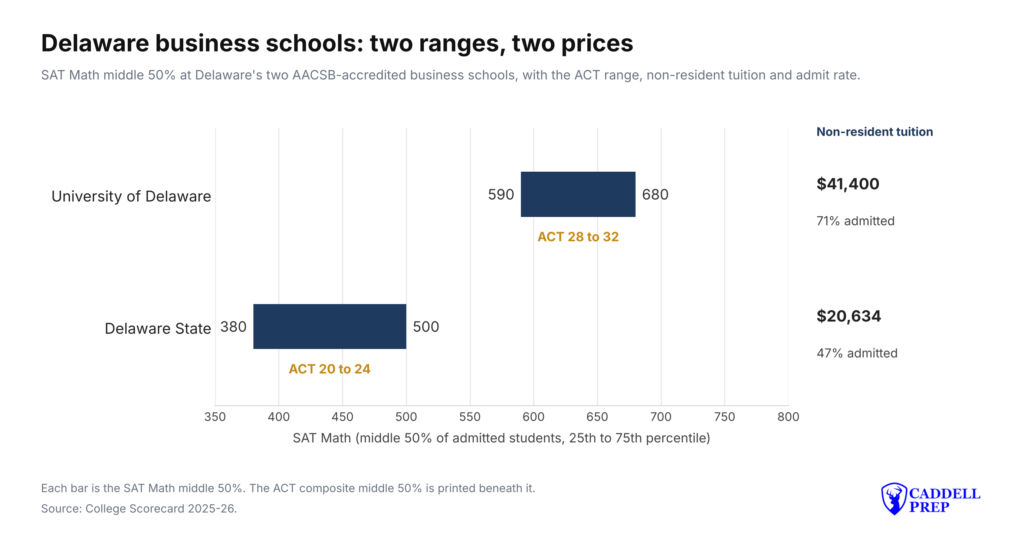
A student can see where his Math score sits on this ladder in the image above.
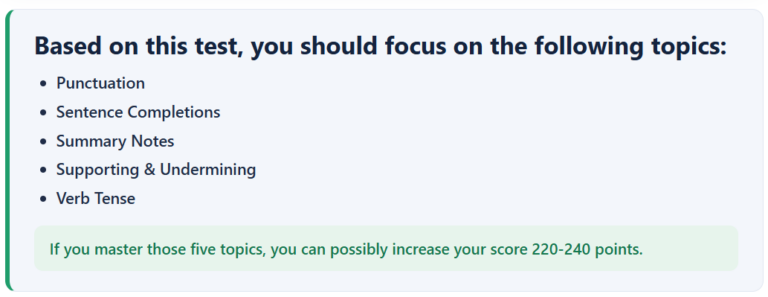
Want to Know What 5 Topics Will Improve Your SAT Score the Most?
Sample Feedback from our Diagnostic Test:
University of Delaware
The University of Delaware in Newark awards its business degrees through the Alfred Lerner College of Business and Economics, accredited by AACSB International in both business and accounting, and Delaware reports a Math range of 590 to 680 and charges a New Yorker $41,400.
Reading & Writing 600 to 690, Math 590 to 680. ACT composite 28 to 32. The top quarter of admitted students scored at or above 680 on Math and 32 on the ACT. Cost of attendance $30,952, with tuition and fees at $16,810 in-state and $41,400 out-of-state. 19,071 undergraduates, 71% admitted.
Lerner admits a freshman as Business Undeclared or into a major and guarantees his choice of major until a date in his sophomore year, the subject of the next section. The cost of attendance in the table is a resident’s. A non-resident’s comes to approximately $55,542 once the higher tuition is substituted, and the $41,400 that drives it is $7,228 above what the University of Alabama charges a New Yorker, $2,312 below UConn’s figure and $3,518 below Boulder’s. Delaware’s non-resident premium over its own residents, $24,590, is the largest of the three.
Delaware State University
Delaware State University in Dover awards its business degrees through its College of Business, AACSB-accredited since 2007 and reaffirmed in 2012 and 2018, and Delaware State is a historically Black university that admits 47% of its applicants, fewer than the flagship.
Reading & Writing 420 to 520, Math 380 to 500. ACT composite 20 to 24. The top quarter of admitted students scored at or above 500 on Math and 24 on the ACT. Cost of attendance $27,939, with tuition and fees at $10,670 in-state and $20,634 out-of-state. 4,398 undergraduates, 47% admitted.
Delaware State’s 2018 release counted its College of Business as “one among only 36 HBCUs” holding AACSB accreditation [VERIFY the current term on the AACSB directory]. Its $20,634 is less than half of what the flagship charges a New Yorker, and its premium over resident tuition, $9,964, is $14,626 smaller than Newark’s. Its Math ceiling of 500 sits 90 points under the flagship’s floor of 590.
Two rows say who got into the university. The next section is about what a Lerner freshman has to do before a date to keep the major he came for.
When Does a Lerner Freshman Have to Declare a Business Major?
A freshman admitted to the University of Delaware’s Alfred Lerner College of Business and Economics is guaranteed his choice of sixteen business majors if he declares one by October 1 of his sophomore year, and the guarantee ends on that date.
The college’s own page sets out the rule. A Lerner student admitted in the fall declares by October 1 of sophomore year, and a student admitted in the spring by March 1, and until then he is guaranteed his choice among Accounting, Business Analytics, Economics as a B.S. or B.A., Economics Education, Finance, Financial Planning and Wealth Management, Fintech, Global Business, Hospitality and Event Business Management, Hospitality Industry Management, Human Resource Management, Management Information Systems, Management, Marketing, Operations Management and Sport Management. After the date the page says: “You are not guaranteed the major of your choice after October 1/March 1 of your sophomore year.” The same rule binds every freshman who arrived without a major: “All business undeclared students are required to declare a major within the Lerner College by the deadlines” [VERIFY on the Declaring & Changing Majors page].
Two majors sit outside the guarantee. Entrepreneurship takes an application and an interview, prefers a 3.0, requires ENTR 350 at C- or better, and the page says “admission into the major is highly selective due to capacity limitations.” Computer Science and Business requires enrollment in the Honors College, a 3.4, and ECON 101, CISC 108 and MATH 232 or 241.
A student who comes to a business major from outside Lerner, or a Lerner student who let the date pass, meets a GPA. For Accounting, Business Analytics, Finance, Fintech, Financial Planning and Wealth Management, Global Business, Human Resource Management, Management, Marketing, Operations Management and Management Information Systems the page asks a 3.0 cumulative GPA, ECON 101 and one of MATH 115, 221, 232 or 241 at C- or better, and 12 credits at Delaware. For the two Hospitality majors and Sport Management it asks a 2.8, ECON 101 and the intro course, HOSP 180 or SPTM 210. Fintech and Financial Planning add an interview, Global Business reads applications twice a year, and for most majors “requests for admission below the minimum GPA are considered on a case-by-case basis.” A student outside Lerner may complete at most 25 Lerner credits in his undergraduate career, not counting ACCT 200, BUAD 100, ECON 100 and FINC 200, transfer credit or test credit, and the same cap falls on a Lerner student who misses the deadline [VERIFY].
The gate is a different kind from the ones on the earlier pages. On our page on business colleges in Alabama, the GPA came for every Culverhouse freshman at 61 hours. On our page on business colleges in Connecticut, UConn held a second door for the student the first one refused and published how many got through. At Delaware the freshman who got in holds every major but two for thirteen months and loses the guarantee on a date, and the GPA appears only for the student who arrives from outside, at a 3.0.
| Who | When | What Lerner asks | Guarantee |
|---|---|---|---|
| Lerner freshman, Business Undeclared or in a major | By October 1 of sophomore year (March 1 for spring admits) | Declare one of sixteen majors | Guaranteed choice |
| Lerner freshman after the deadline | After October 1 | The same declaration | “Not guaranteed the major of your choice” |
| Student outside Lerner, most majors | Any time | 3.0 cumulative, ECON 101 and MATH 115, 221, 232 or 241 at C-, 12 UD credits | Case-by-case below 3.0 |
| Student outside Lerner, Hospitality or Sport Management | Any time | 2.8, ECON 101 and HOSP 180 or SPTM 210, 12 UD credits | Case-by-case below 2.8 |
| Entrepreneurship, any student | Application and interview | ENTR 350 at C-, preference for a 3.0 | “Highly sele |
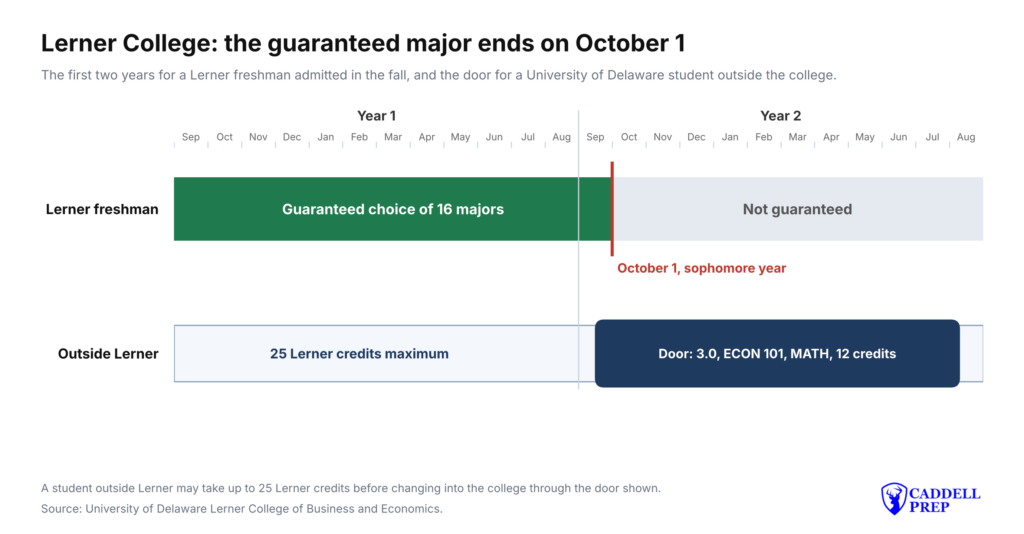
The image above marks the date on which a Lerner freshman’s guaranteed major ends.
What happens to a Business Undeclared student who lets October 1 pass is that his choice is no longer guaranteed and the 25-credit cap falls on him until he declares. What a 2.9 gets a student outside the college is a case-by-case reading, in the page’s words, and nothing more.
The price has one flagship figure and one that is half of it. Delaware charges a New Yorker $41,400 in tuition, $7,228 above the University of Alabama’s figure, $2,312 below UConn’s and $3,518 below Boulder’s, and Delaware State charges $20,634. Four years is $165,600 at Newark and $82,536 at Dover, and the gap between them over four years, $83,064, is a little more than two years of the flagship.
The one business degree Delaware licenses is accounting. The Delaware Board of Accountancy lets a candidate sit for the CPA exam with a bachelor’s degree and 120 semester hours including 24 in accounting that cover financial accounting, auditing and taxation, and licenses on 150 hours with a concentration in accounting and 24 accounting hours, 2,000 hours of experience under a licensed CPA over one to three years, and the AICPA ethics course passed at 90%. The board also asks for a Social Security number and Delaware residency for the permit to practice [Becker’s summary, VERIFY every figure on the board’s page, the residency rule first, because it decides whether a New Yorker who goes home can hold a Delaware permit at all]. Alabama asks 150 hours with 33 in accounting, Connecticut 46 hours in accounting and related subjects to sit, Colorado 1,800 hours of experience. Delaware’s 2,000 hours is the largest experience count stated on these pages so far.
Take a New York student with a 1300 on the SAT, 650 on each section, and a 3.5 GPA. At Delaware he is inside the 590 to 680 Math range and the 600 to 690 Reading & Writing range, admitted at 71%. Admitted to Lerner as Business Undeclared, he holds every major but two until October 1 of his sophomore year. Admitted to Arts and Sciences instead, he needs a 3.0, ECON 101 and a math course at C- and 12 credits to come over, and 25 Lerner credits is all he may take until he does. At Delaware State he is above the 380 to 500 Math range and the 420 to 520 Reading & Writing range entirely, admitted at 47%, at $20,634 a year. Four years of tuition is $165,600 at Newark and $82,536 at Dover. The score decided the first door at both, and at Newark the second door is a date.
The honest version is that Lerner publishes no count of how many Business Undeclared students declare in time or how many change-of-major requests it grants, and “case-by-case” is all it says about students under a 3.0. Entrepreneurship’s capacity is not published. Delaware State’s business-school rules were not found for this page and are not described here [VERIFY the DSU catalog]. The residency rule for the CPA permit is a Becker reading until the board’s page confirms it. The page does not say which business school is better. It says what each costs a New Yorker and what Lerner asks of him by a date.
Families reading the 25-credit cap frequently ask whether a student outside Lerner can take business courses at all.
Can a Student Outside Lerner Take Business Courses at Delaware?
Yes, a University of Delaware student outside the Lerner College may take up to 25 Lerner credits in his undergraduate career, not counting the four Business Essentials courses, ACCT 200, BUAD 100, ECON 100 and FINC 200, transfer credit or test credit.
The cap also falls on a Lerner student who misses his declaration deadline, and the way past it in either case is the change of major: a 3.0, ECON 101 and a math course at C-, and 12 credits at Delaware for most business majors, or a 2.8 and the intro course for Hospitality and Sport Management [VERIFY]. A student who wants Finance and arrived in another college has 25 credits to show the college what he can do.
One date, one cap, one 3.0. Which schools hold the accreditation is the next section.
Which Delaware Universities Have AACSB-Accredited Business Schools?
Two Delaware universities hold business accreditation from AACSB International, both public, and the list below names each with its city and the school that awards the business degree [VERIFY both on the AACSB directory before publishing].
- The University of Delaware in Newark awards its business degrees through the AACSB-accredited Alfred Lerner College of Business and Economics.
- Delaware State University in Dover awards its business degrees through its AACSB-accredited College of Business.
Accreditation matters for a reason that is easy to miss at seventeen. Business itself is not a licensed profession, and the one business degree that leads to a license, accounting, leads to it through the state board rather than through the school. A CPA in Delaware normally needs 150 semester hours with 24 in accounting, the Uniform CPA Examination, 2,000 hours of experience and the ethics course, and may sit for the exam at 120 hours with 24 accounting hours, and the board asks Delaware residency for the permit [VERIFY on the board’s page]. AACSB status matters on the way there because business schools use it to decide whose courses they will accept in transfer.
Wilmington University in New Castle holds business accreditation from the IACBE and Goldey-Beacom College in Wilmington from the ACBSP, and neither is a row [VERIFY both accreditors]. Strayer University’s Delaware campus is for-profit and reports no scores, and Delaware Technical Community College is a two-year college.
Nothing on this page ranks the two. They are two public schools with the same accreditor, one gate that is a date and one price that is half the other, and the pages for business colleges in Pennsylvania, business colleges in New Jersey and business colleges in Maryland carry the neighbors a student looking at Delaware is likely comparing.
What If Your Score Is Below the Range You Want?
In Delaware the flagship’s floors are 590 on Math and 28 on the ACT, and Delaware State’s are 380 and 20. A student under the floor he wants is not ruled out, because a quarter of admitted students were there too. He is in the quarter that needs the rest of the application to carry more.
The first step is finding out where the score actually is, section by section. A free diagnostic SAT gives a Math score that can be set directly against Delaware’s 590 floor.
The Math section rewards the same handful of topics on every test date, and a student who knows which of them he is missing can close a gap of 50 to 100 points in weeks rather than months. The method is on our page on improving your SAT Math score, and at Delaware the same algebra fills MATH 115, 221, 232 or 241, the course a student outside Lerner brings back at C- or better to change into a business major.
How to Read These Score Ranges
Each range in the table covers the middle 50% of admitted students who submitted that test, so a quarter of admitted students were below the lower number and a quarter were at or above the upper one.
A range describes the students who chose to submit at all. Where a school is test-optional, the range describes the submitters, and the submitters are the students whose scores helped them. More on what SAT score you need for college and on test-optional colleges.
Should You Take the ACT Instead?
Delaware gives the SAT to every public school junior as the state test [VERIFY current Delaware statewide testing], and both schools on this page report both tests.
A New York student who holds an SAT should send it to both and leave the ACT alone unless a school outside the state asks for it. Nothing at Lerner’s door reads either test.
Business Programs in Nearby States
Delaware borders Pennsylvania, New Jersey and Maryland, and each has AACSB-accredited business schools of its own [VERIFY the lists before linking].
See business colleges in Pennsylvania, business colleges in New Jersey, and business colleges in Maryland.
Business Colleges in Other States
We publish the same breakdown for business programs in every state.
See business colleges by state for the full list.

Glyn Caddell
Glyn Caddell holds a BS in Mechanical Engineering from NJIT and has been tutoring New York City students since 2008. He founded Caddell Prep in 2012 and is the author of Digital SAT Math Secrets: Lessons & Tricks to Quickly Improve to a Perfect 800 on the Math Test, which contains over 900 practice problems and is used in Caddell Prep’s SAT math classes. He is founding president of the Staten Island Technical High School alumni association and teaches every lesson on this site personally.
Finally, an SAT course that students actually understand
Every question has a video explanation. Not most — every one.
The on-demand Digital SAT course covers all 17 math topics and 15 reading and writing topics, with 5 full-length practice tests and a 100-point score increase guarantee. Keep access for the rest of high school. No subscription.
Want to Know What 5 Topics Will Improve Your SAT Score the Most?
Sample Feedback from our Diagnostic Test: