
Home » College SAT Score Ranges, Costs, and Programs by Major and State » Best Business Colleges » Business Colleges in Maryland: SAT Scores, ACT Scores, Costs, and Programs
By Glyn Caddell, BSME · Author of Digital SAT Math Secrets · Tutoring since 2008 — Updated November 11, 2026
Eight Maryland universities hold AACSB-accredited business schools, seven public and one private, and this page lists the SAT and ACT scores of the students they admit, what each costs a New York student, and what the Robert H. Smith School of Business at College Park asks of a student who was not admitted to it as a freshman.
Six report an SAT range and five an ACT range, so the table leads with the SAT.
At Maryland a student applies to Smith once, with 45 credits and three gateway courses, and a 3.600 admits him while a 3.000 to 3.599 earns a review for whatever space is left.
Table of Contents
- Maryland Business Colleges by SAT and ACT Score
- What Does It Take to Enter the Smith School of Business?
- Which Maryland Universities Have AACSB-Accredited Business Schools?
- What If Your Score Is Below the Range You Want?
Maryland Business Colleges by SAT and ACT Score
Maryland’s eight AACSB-accredited business schools run from the Robert H. Smith School of Business at the University of Maryland, College Park, with a Math range of 710 to 780, to two campuses that report no range, and the table below lists each with its SAT and ACT ranges where reported, cost of attendance, enrollment and admit rate. Seven are public and one private, six report an SAT range, and the rows are sorted by the midpoint of the SAT Math range, with the two non-reporters following in order of enrollment, so the order can be checked from the table itself.
| College | SAT Reading & Writing | SAT Math | ACT composite | Business school | Cost of attendance | Undergraduates | Admit rate |
|---|---|---|---|---|---|---|---|
| University of Maryland-College Park | 690 to 750 | 710 to 780 | 32 to 35 | Robert H. Smith School of Business | $29,299 | 30,760 | 45% |
| Loyola University Maryland | 620 to 690 | 580 to 680 | 28 to 32 | Sellinger School of Business and Management | $74,055 | 3,869 | 75% |
| Salisbury University | 600 to 670 | 580 to 650 | 20 to 29 | Franklin P. Perdue School of Business | $28,310 | 6,057 | 87% |
| Towson University | 490 to 635 | 460 to 600 | 19 to 27 | College of Business and Economics | $28,535 | 16,136 | 82% |
| University of Baltimore | 370 to 650 | 370 to 680 | not reported | Merrick School of Business | $26,406 | 1,133 | 79% |
| Morgan State University | 400 to 520 | 440 to 550 | 16 to 21 | Earl G. Graves School of Business and Management | $25,413 | 9,019 | 82% |
| Frostburg State University | not reported | not reported | not reported | College of Business | $27,056 | 2,909 | 89% |
| University of Maryland Eastern Shore | not reported | not reported | not repo |
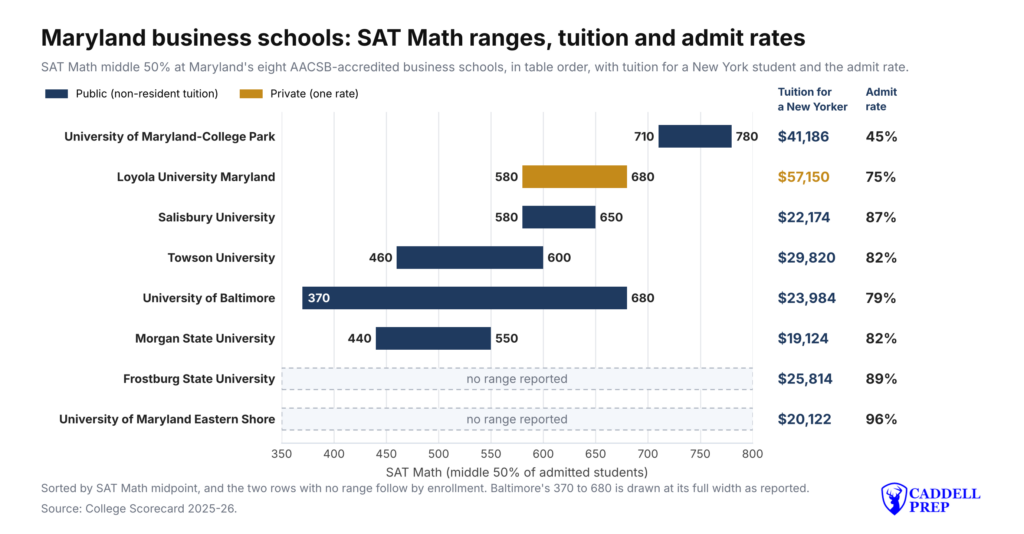
A student can see where his Math score sits on this ladder in the image above.
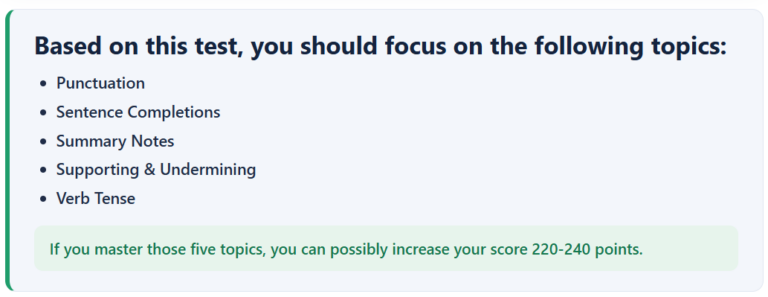
Want to Know What 5 Topics Will Improve Your SAT Score the Most?
Sample Feedback from our Diagnostic Test:
University of Maryland-College Park
The University of Maryland, College Park, listed in the Scorecard as University of Maryland-College Park, awards its business degrees through the Robert H. Smith School of Business, and College Park reports the highest Math range on the page, 710 to 780, admits 45% of applicants to the university, the lowest rate on the page, and charges a New Yorker $41,186.
Reading & Writing 690 to 750, Math 710 to 780. ACT composite 32 to 35. The top quarter of admitted students scored at or above 780 on Math and 35 on the ACT. Cost of attendance $29,299, with tuition and fees at $11,809 in-state and $41,186 out-of-state. 30,760 undergraduates, 45% admitted.
College Park is the largest campus on the page, close to twice Towson’s size, and its 710 Math floor is 30 points above Loyola’s 680 ceiling and 20 above Purdue’s 760 ceiling at the top. The 45% is the university’s rate, and the Scorecard does not separate Smith’s own. The Smith School is a Limited Enrollment Program with a number on its door, the subject of the next section. The cost of attendance in the table is a resident’s. A non-resident’s comes to approximately $58,676 once the higher tuition is substituted, and the $41,186 that drives it is $705 below Indiana University-Bloomington’s $41,891 and $2,526 below UConn’s $43,712, with a premium of $29,377 over a resident, the largest on the page.
Loyola University Maryland
Loyola University Maryland in Baltimore awards its business degrees through the Sellinger School of Business and Management, and Loyola is the one private on the page, reports the second highest Math range, 580 to 680, and charges every student $57,150.
Reading & Writing 620 to 690, Math 580 to 680. ACT composite 28 to 32. The top quarter of admitted students scored at or above 680 on Math and 32 on the ACT. Cost of attendance $74,055, with tuition and fees at $57,150 for all students. 3,869 undergraduates, 75% admitted.
Loyola’s 680 Math ceiling matches Baltimore’s and sits 30 above Salisbury’s on the same 580 floor, and its 28 ACT floor is one point under Towson’s ceiling. Its $57,150 is $15,964 above what College Park charges a New Yorker, and its $74,055 cost of attendance is the highest on the page. Four years of tuition is $228,600.
Salisbury University
Salisbury University awards its business degrees through the Franklin P. Perdue School of Business, and Salisbury reports the highest public Math range on the page after College Park’s, 580 to 650, and charges a New Yorker $22,174, the third lowest tuition on the page.
Reading & Writing 600 to 670, Math 580 to 650. ACT composite 20 to 29. The top quarter of admitted students scored at or above 650 on Math and 29 on the ACT. Cost of attendance $28,310, with tuition and fees at $11,084 in-state and $22,174 out-of-state. 6,057 undergraduates, 87% admitted.
Salisbury’s 580 Math floor is 120 points above Towson’s and its 650 ceiling 50 above, at $7,646 a year less for a New Yorker. The cost of attendance in the table is a resident’s. A non-resident’s comes to approximately $39,400 with the higher tuition substituted, and the $22,174 that drives it carries a premium of $11,090 over a resident. Whether the Perdue School asks anything of a business major after the university admits him was not read for this page [VERIFY].
Towson University
Towson University awards its business degrees through its College of Business and Economics, and Towson is the second largest campus on the page, with 16,136 undergraduates, and charges a New Yorker $29,820, the second highest public tuition on the page.
Reading & Writing 490 to 635, Math 460 to 600. ACT composite 19 to 27. The top quarter of admitted students scored at or above 600 on Math and 27 on the ACT. Cost of attendance $28,535, with tuition and fees at $11,728 in-state and $29,820 out-of-state. 16,136 undergraduates, 82% admitted.
Towson’s $29,820 is $11,366 below College Park’s and $7,646 above Salisbury’s on a Math range 120 points lower at the floor. The cost of attendance in the table is a resident’s. A non-resident’s comes to approximately $46,627 with the higher tuition substituted, and the $29,820 that drives it carries a premium of $18,092 over a resident, the second largest on the page. Four years of tuition is $119,280.
University of Baltimore
The University of Baltimore awards its business degrees through the Merrick School of Business, and Baltimore reports a Math range of 370 to 680, 310 points from floor to ceiling, the widest range in this series, on the smallest campus on the page, 1,133 undergraduates.
Reading & Writing 370 to 650, Math 370 to 680. Baltimore reports no ACT range. The top quarter of admitted students scored at or above 680 on Math. Cost of attendance $26,406, with tuition and fees at $9,992 in-state and $23,984 out-of-state. 1,133 undergraduates, 79% admitted.
Baltimore enrolls largely transfer and adult students, so the few first-year scores it reports to the Scorecard spread across the whole scale, and its 680 ceiling, matching Loyola’s, says less about the campus than the 370 floor does. The figures are printed as reported, and a student should read the university’s own page for what it expects [VERIFY the range at the source]. The cost of attendance in the table is a resident’s. A non-resident’s comes to approximately $40,398 with the higher tuition substituted, and the $23,984 that drives it carries a premium of $13,992 over a resident. Four years of tuition is $95,936.
Morgan State University
Morgan State University in Baltimore awards its business degrees through the Earl G. Graves School of Business and Management, and Morgan State is a historically Black university, the third largest campus on the page at 9,019 undergraduates, and charges a New Yorker $19,124, the lowest tuition on the page.
Reading & Writing 400 to 520, Math 440 to 550. ACT composite 16 to 21. The top quarter of admitted students scored at or above 550 on Math and 21 on the ACT. Cost of attendance $25,413, with tuition and fees at $8,229 in-state and $19,124 out-of-state. 9,019 undergraduates, 82% admitted.
Morgan State’s $19,124 is $22,062 below College Park’s and $998 below Eastern Shore’s, with a premium of $10,895 over a resident, the smallest on the page. Its 440 Math floor is 20 points under Towson’s and 70 above Baltimore’s. The cost of attendance in the table is a resident’s, and a non-resident’s comes to approximately $36,308 with the higher tuition substituted. Four years of tuition is $76,496.
Frostburg State University
Frostburg State University awards its business degrees through its College of Business, and Frostburg is the larger of the two rows on the page that report no score range, with 2,909 undergraduates, and charges a New Yorker $25,814.
Score ranges not reported. Cost of attendance $27,056, with tuition and fees at $10,220 in-state and $25,814 out-of-state. 2,909 undergraduates, 89% admitted.
Frostburg’s $25,814 is $1,830 above Baltimore’s and $3,640 above Salisbury’s, with a premium of $15,594 over a resident, the third largest on the page. The Scorecard has no range for it, so a student should read Frostburg’s own admissions page for the score it expects. The cost of attendance in the table is a resident’s, and a non-resident’s comes to approximately $42,650 with the higher tuition substituted. Four years of tuition is $103,256.
University of Maryland Eastern Shore
The University of Maryland Eastern Shore in Princess Anne awards its business degrees through its School of Business and Technology, and Eastern Shore is a historically Black university that admits 96% of applicants, the highest rate on the page, and reports no score range.
Score ranges not reported. Cost of attendance $25,941, with tuition and fees at $9,076 in-state and $20,122 out-of-state. 2,391 undergraduates, 96% admitted.
Eastern Shore’s $20,122 is the second lowest tuition on the page, $998 above Morgan State’s, with a premium of $11,046 over a resident. The Scorecard has no range for it, so a student should read the university’s own admissions page for the score it expects. The cost of attendance in the table is a resident’s, and a non-resident’s comes to approximately $36,987 with the higher tuition substituted. Four years of tuition is $80,488.
Eight rows say who got into the university. The next section is about the business school on the page that gives a student one application and tells him in advance what number ends it.
What Does It Take to Enter the Smith School of Business?
A University of Maryland student who was not admitted to the Robert H. Smith School of Business as a freshman applies once, with at least 45 credits and three gateway courses at C- or better, and is admitted outright at a cumulative GPA of 3.600 or reviewed for remaining space between 3.000 and 3.599.
Maryland’s Limited Enrollment Programs page for Business lists three gateway courses, each at a C- or better: BMGT 220 Principles of Accounting I, BMGT 230 or 231 Business Statistics, with a published list of substitutes from other departments, and MATH 120, 136 or 140, Applied Calculus I or Calculus I. A current student or transfer applies with at least 45 cumulative credits by the end of the semester he applies, and a minimum 3.0 GPA across all college coursework is required “for consideration” [VERIFY every item on the LEP page and the Smith transfer page].
Then the page draws the line. An applicant with the 45 credits, every gateway course complete and a cumulative GPA of 3.600 or higher is admitted directly, with decisions in April for fall and October for spring. An applicant still finishing credits or courses, or sitting under 3.600, is reviewed after final grades post, and admitted directly if he then meets the 3.600 standard. An applicant between 3.000 and 3.599 with the gateway complete is reviewed “for remaining space after 3.600+ applicants are admitted,” and the page says what happens when there is none: if the transfer slots are filled by 3.600 applicants, “no additional applicants will be admitted through a competitive admissions review process,” and no further LEP applications to Smith are accepted in later semesters.
The rules around the line are as firm as the line. A student may apply to a Limited Enrollment Program once. One gateway course may be repeated, once, to earn the grade, a second course from a substitute list counts as the repeat, and a W counts as an attempt. The deadlines for current students are March 1 for fall and October 8 for spring. After admission a student holds a 2.00 cumulative GPA or is dismissed from the major, and a student who is denied or dismissed “may appeal in writing to the individual LEP.”
The line reaches the freshmen too. A student admitted directly to Smith from high school completes the same three gateway courses and passes a performance review at 45 credits, and a student who fails it is dismissed and “may not reapply.” Smith’s own freshman admit rate is not separated from the university’s 45% in the Scorecard [VERIFY on the Smith freshman admission page]. The Shady Grove campus’s business major asks 60 credits and a longer course list.
The other seven schools on the page were not read for a gate. As far as this page knows, each admits a business major on the university application, and a family should read each catalog for any rule that follows [VERIFY all seven].
Set against the earlier pages, Smith’s door has the highest number in the series and the hardest edge. On our page on business colleges in Kentucky, Gatton asks a 3.0 twice of every premajor and gives no warning. On our page on business colleges in Illinois, Gies runs a pool that takes about a third and reads a 3.0 as priority. Smith publishes a 3.600 that admits, a band beneath it that may admit nobody, one application, one repeat, and a review that reaches the students it already let in.
| Applicant | GPA | What Smith does |
|---|---|---|
| Direct-admit freshman | Admitted from high school | Completes the three gateway courses at C- and passes a performance review at 45 credits, or is dismissed and may not reapply |
| Internal transfer, 45 credits, gateway complete | 3.600 or higher | Admitted directly, with decisions in April or October |
| Internal transfer, still finishing | Any | Reviewed after final grades, and admitted if he then meets 3.600 |
| Internal transfer, gateway complete | 3.000 to 3.599 | Reviewed for remaining space after the 3.600 applicants. If they fill the slots, no one is admitted through review and no further applications are accepted |
| Any applicant | Under 3.000 | Not considered |
| Every applicant | Any | One application to an LEP, one repeat of one gateway course, and a W counts as an attempt |
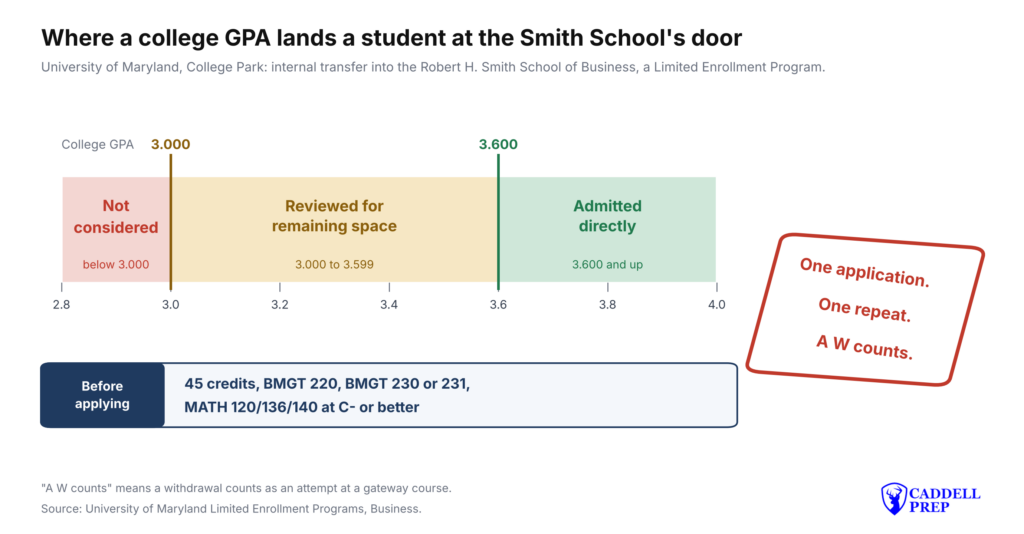
The image above shows where a Maryland student’s college GPA lands him at the Smith School’s door.
Does a 3.5 College GPA Get a Maryland Student Into Smith?
No, a 3.5 college GPA does not get a University of Maryland student into the Smith School of Business, because a 3.5 clears Smith’s 3.000 floor and falls short of its 3.600 direct-admission line, so it earns a review for remaining space after the 3.600 applicants are seated, and if those applicants fill the slots no one is admitted through the review.
The one-application rule is what makes the tenth of a point matter. A 3.5 applicant who is reviewed and denied does not apply again, and the student with a 3.6 and the same 45 credits and the same three courses is admitted in April. The difference between the two is the difference between a maybe and a seat.
A 3.600 that admits, a band that may not, one application. Which schools hold the accreditation is the next section.
Which Maryland Universities Have AACSB-Accredited Business Schools?
Eight Maryland universities hold business accreditation from AACSB International, seven public and one private, and the list below names each with its city and the school that awards the business degree [VERIFY all eight on the AACSB directory before publishing, Eastern Shore’s current status in particular].
- The University of Maryland, College Park awards its business degrees through the AACSB-accredited Robert H. Smith School of Business.
- Towson University in Towson awards its business degrees through its AACSB-accredited College of Business and Economics.
- Salisbury University in Salisbury awards its business degrees through the AACSB-accredited Franklin P. Perdue School of Business.
- The University of Baltimore in Baltimore awards its business degrees through the AACSB-accredited Merrick School of Business.
- Morgan State University in Baltimore awards its business degrees through the AACSB-accredited Earl G. Graves School of Business and Management, and is a historically Black university.
- Frostburg State University in Frostburg awards its business degrees through its AACSB-accredited College of Business.
- The University of Maryland Eastern Shore in Princess Anne awards its business degrees through its AACSB-accredited School of Business and Technology, and is a historically Black university.
- Loyola University Maryland in Baltimore awards its business degrees through the AACSB-accredited Sellinger School of Business and Management.
Accreditation matters for a reason that is easy to miss at seventeen. Business itself is not a licensed profession, and the one business degree that leads to a license, accounting, leads to it through the state board rather than through the school. A CPA in Maryland normally sits at 120 hours with the board’s accounting group, licenses at 150 hours with 21 in business, a year of experience and the ethics exam, and from October 1, 2026 can license instead on a bachelor’s and two years of experience [VERIFY on the board’s page]. AACSB status matters on the way there because business schools use it to decide whose courses they will accept in transfer.
Johns Hopkins University in Baltimore is the school a New York family names first, and it is not a row. Its Carey Business School holds AACSB accreditation for a graduate school that awards no undergraduate business major, and this series leaves graduate-only schools off the table, as it did Kellogg, Booth, Yale, UCLA Anderson and the Stanford GSB. Hopkins reports 780 to 800 on Math, admits 6% and charges every student $65,230, and the bachelor’s degrees the Scorecard files under business at Hopkins come from a school other than Carey [VERIFY which program]. Bowie State University in Bowie and Coppin State University in Baltimore are public historically Black universities whose business colleges hold ACBSP accreditation, per their own pages. Bowie State admits 72%, reports no range and charges a New Yorker $19,938, and Coppin State admits 46%, reports 420 to 510 on Math and charges $14,024. The University of Maryland, Baltimore County awards no business major, offering financial economics and information systems instead, and reports 610 to 720 on Math at $31,275 for a New Yorker. The University of Maryland Global Campus enrolls 49,664 undergraduates with no AACSB-accredited business school and charges a non-resident $12,336 [VERIFY]. St. Mary’s College of Maryland is a public honors college with no AACSB business school, at 553 to 650 on Math and $31,374. Mount St. Mary’s, Stevenson, McDaniel, Hood, Goucher and Washington College award business degrees under the ACBSP, the IACBE or no business accreditor, at $40,560 to $55,326 for every student [VERIFY each]. None of them is a row.
Nothing on this page ranks the eight. They are seven public universities and one private with the same accreditor, one 3.600 at College Park, a $22,062 spread among the publics, and the pages for business colleges in Pennsylvania, business colleges in Delaware and business colleges in Virginia carry the schools a student looking at Maryland is likely comparing.
What If Your Scores Are Below the Range You Want?
In Maryland the flagship’s floors are 710 on Math and 32 on the ACT, Loyola’s 580 and 28, Salisbury’s 580 and 20, Towson’s 460 and 19, Morgan State’s 440 and 16, Baltimore’s 370 with no ACT, and two rows publish none. A student under the floor he wants is not ruled out, because a quarter of admitted students were there too. He is in the quarter that needs the rest of the application to carry more.
The first step is finding out where the score actually is, section by section. A free diagnostic SAT gives a Math score that can be set directly against Salisbury’s 580 floor and College Park’s 710.
The Math section rewards the same handful of topics on every test date, and a student who knows which of them he is missing can close a gap of 50 to 100 points in weeks rather than months. The method is on our page on improving your SAT Math score, and at College Park the same algebra is MATH 120, 136 or 140, the calculus gateway course Smith asks at C- or better, with one repeat allowed and a W counted as an attempt.
How to Read These Score Ranges
Each range in the table covers the middle 50% of admitted students who submitted that test, so a quarter of admitted students were below the lower number and a quarter were at or above the upper one.
A range describes the students who chose to submit at all. Where a school is test-optional, the range describes the submitters, and the submitters are the students whose scores helped them. A row marked not reported means the Scorecard has no range for that university, and a student should read the university’s own admissions page for the score it expects. A range as wide as Baltimore’s describes a campus where few first-year students submit at all, and it says less than a narrow one. More on what SAT score you need for college and on test-optional colleges.
Should You Take the ACT Instead?
Maryland requires no statewide college-entrance test of its public school juniors [VERIFY], and five of the eight rows report both tests.
A New York student who holds an SAT should send it everywhere in Maryland and leave the ACT alone unless a school elsewhere asks for it. Nothing at the Smith School’s Limited Enrollment door reads either test.
Business Programs in Nearby States
Maryland borders four states, and each has its own page in this series.
See business colleges in Pennsylvania, business colleges in Delaware, business colleges in Virginia and business colleges in West Virginia.
Business Colleges in Other States
We publish the same breakdown for business programs in every state.
See business colleges by state for the full list.

Glyn Caddell
Glyn Caddell holds a BS in Mechanical Engineering from NJIT and has been tutoring New York City students since 2008. He founded Caddell Prep in 2012 and is the author of Digital SAT Math Secrets: Lessons & Tricks to Quickly Improve to a Perfect 800 on the Math Test, which contains over 900 practice problems and is used in Caddell Prep’s SAT math classes. He is founding president of the Staten Island Technical High School alumni association and teaches every lesson on this site personally.
Finally, an SAT course that students actually understand
Every question has a video explanation. Not most — every one.
The on-demand Digital SAT course covers all 17 math topics and 15 reading and writing topics, with 5 full-length practice tests and a 100-point score increase guarantee. Keep access for the rest of high school. No subscription.
Want to Know What 5 Topics Will Improve Your SAT Score the Most?
Sample Feedback from our Diagnostic Test: