
Home » College SAT Score Ranges, Costs, and Programs by Major and State » Best Business Colleges » Business Colleges in New Jersey: SAT Scores, ACT Scores, Costs, and Programs
By Glyn Caddell, BSME · Author of Digital SAT Math Secrets · Tutoring since 2008 — Updated November 13, 2026
Seventeen New Jersey business school rows hold AACSB accreditation, eleven public and six private, and this page lists the SAT and ACT scores of the students the universities admit, what each costs a New York student from across the river, and what Rutgers Business School asks of a Rutgers student it did not admit as a freshman.
Thirteen report an SAT range and eleven an ACT range, so the table leads with the SAT.
At New Brunswick a current student applies once a year, February 1 to April 30, with 24 credits, precalculus and two of four foundational courses at a C, into a review the school calls competitive against a GPA it no longer prints, and New Jersey’s CPA law has licensed on a bachelor’s degree and two years of experience since February 11, 2026.
Table of Contents
- New Jersey Business Colleges by SAT and ACT Score
- What Does It Take to Transfer Into Rutgers Business School?
- Which New Jersey Universities Have AACSB-Accredited Business Schools?
- What If Your Score Is Below the Range You Want?
New Jersey Business Colleges by SAT and ACT Score
New Jersey’s seventeen AACSB-accredited business school rows run from the School of Business at Stevens Institute of Technology in Hoboken, with a Math range of 710 to 770, to four campuses that report no range, and the table below lists each with its SAT and ACT ranges where reported, cost of attendance, enrollment and admit rate. Eleven are public and six private, thirteen report an SAT range, and the rows are sorted by the midpoint of the SAT Math range, with ties broken on the ACT composite midpoint and then on enrollment and the four non-reporters following in order of enrollment, so the order can be checked from the table itself. Two pairs of rows sit under one accredited school each: Rutgers Business School covers the New Brunswick and Newark campuses, and Fairleigh Dickinson’s Silberman College covers the Metropolitan and Florham campuses.
| College | SAT Reading & Writing | SAT Math | ACT composite | Business school | Cost of attendance | Undergraduates | Admit rate |
|---|---|---|---|---|---|---|---|
| Stevens Institute of Technology | 670 to 735 | 710 to 770 | 31 to 34 | School of Business | $79,790 | 4,222 | 48% |
| Rutgers University-New Brunswick | 650 to 730 | 660 to 770 | 28 to 33 | Rutgers Business School-Newark and New Brunswick | $36,993 | 37,751 | 58% |
| New Jersey Institute of Technology | 600 to 710 | 610 to 750 | 27 to 34 | Martin Tuchman School of Management | $32,859 | 9,019 | 65% |
| Seton Hall University | 620 to 700 | 600 to 690 | 27 to 32 | Stillman School of Business | $68,263 | 6,036 | 73% |
| The College of New Jersey | 570 to 670 | 570 to 670 | 26 to 31 | School of Business | $38,860 | 7,105 | 62% |
| Monmouth University | 580 to 660 | 560 to 650 | 24 to 29 | Leon Hess Business School | $62,904 | 3,684 | 89% |
| Rider University | 550 to 670 | 550 to 650 | 27 to 31 | Norm Brodsky College of Business | $55,967 | 3,106 | 79% |
| Rowan University | 560 to 660 | 550 to 650 | 23 to 29 | William G. Rohrer College of Business | $35,842 | 15,841 | 78% |
| Ramapo College of New Jersey | 580 to 650 | 550 to 650 | 22 to 30 | Anisfield School of Business | $29,483 | 4,898 | 71% |
| Rutgers University-Camden | 540 to 640 | 510 to 660 | 19 to 25 | School of Business-Camden | $35,178 | 3,753 | 66% |
| Stockton University | 530 to 620 | 500 to 610 | 21 to 25 | School of Business | $35,139 | 7,537 | 89% |
| Kean University | 460 to 565 | 470 to 585 | not reported | College of Business and Public Management | $26,949 | 11,433 | 76% |
| Montclair State University | 480 to 620 | 430 to 590 | not reported | Feliciano School of Business | $28,305 | 18,376 | 88% |
| Rutgers University-Newark | not reported | not reported | not reported | Rutgers Business School-Newark and New Brunswick | $35,654 | 7,709 | 71% |
| William Paterson University of New Jersey | not reported | not reported | not reported | Cotsakos College of Business | $28,476 | 6,614 | 90% |
| Fairleigh Dickinson University-Metropolitan Campus | not reported | not reported | not reported | Silberman College of Business | $50,305 | 2,627 | 91% |
| Fairleigh Dickinson University-Florham Campus | not reported | not reported | not rep |
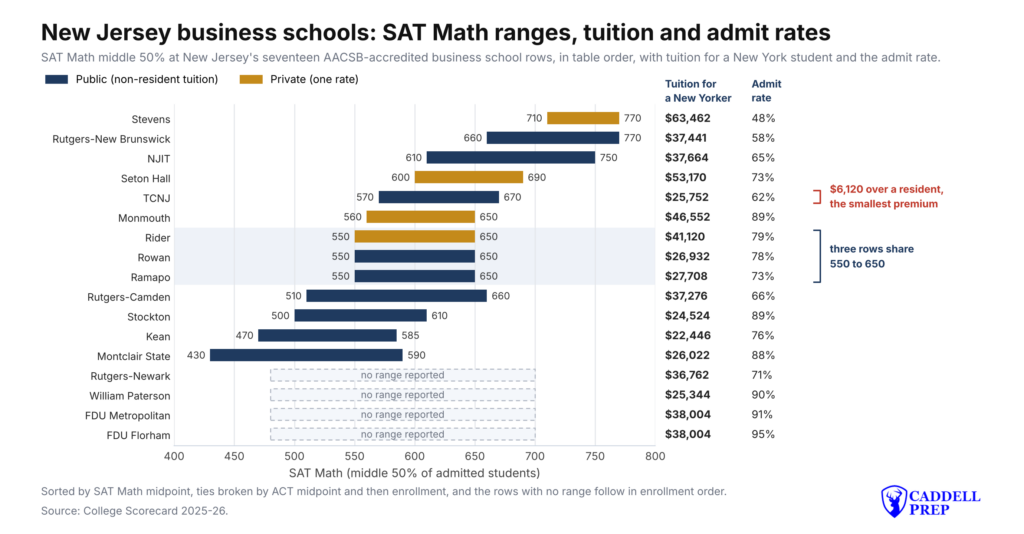
A student can see where his Math score sits on this ladder in the image above.
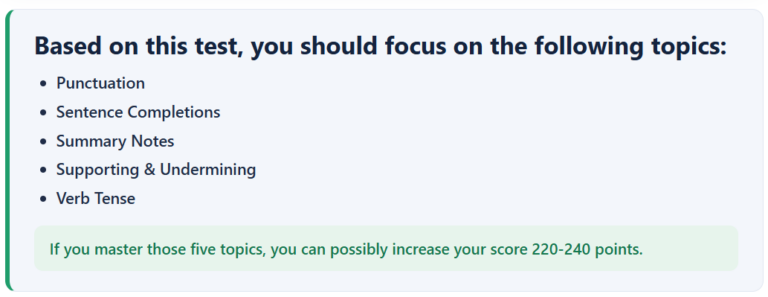
Want to Know What 5 Topics Will Improve Your SAT Score the Most?
Sample Feedback from our Diagnostic Test:
Stevens Institute of Technology
Stevens Institute of Technology in Hoboken awards its business degrees through its School of Business, and Stevens reports the highest Math range on the page, 710 to 770, admits 48%, the lowest rate on the page, and charges every student $63,462, the highest tuition on the page.
Reading & Writing 670 to 735, Math 710 to 770. ACT composite 31 to 34. The top quarter of admitted students scored at or above 770 on Math and 34 on the ACT. Cost of attendance $79,790, with tuition and fees at $63,462 for every student. 4,222 undergraduates, 48% admitted.
Stevens’ 710 to 770 on Math sits under MIT’s 780 to 800 and WashU’s 770 to 800 in this series and 50 points above Rutgers’ floor, and its 31 to 34 on the ACT is the only range on the page that starts above 28. The $63,462 is $10,292 above Seton Hall’s and $7,240 under Boston College’s $70,702, the high in this series, and it is the same for a New Jerseyan and a New Yorker, so the cost of attendance in the table is every student’s. Four years of tuition is $253,848.
Rutgers University-New Brunswick
ath shares its ceiling with Stevens’ and starts 50 under it, and its 28 to 33 on the ACT sits three points above TCNJ’s at the ceiling. The 58% is the university’s rate, and Rutgers Business School admits a current student through a school-to-school window with no printed GPA, the subject of the next section. The cost of attendance in the table is a resident’s. A non-resident’s comes to approximately $56,505 once the higher tuition is substituted, and the $37,441 that drives it is $921 under Minnesota’s $38,362 and $685 above Maine’s $36,756, with a premium of $19,512 over a resident, the largest on the page and the same at all three Rutgers campuses. Four years of tuition is $149,764.
New Jersey Institute of Technology
The New Jersey Institute of Technology in Newark awards its business degrees through the Martin Tuchman School of Management, and NJIT charges a New Yorker $37,664, the highest public non-resident tuition on the page, and reports the widest ACT range on the page, 27 to 34.
Reading & Writing 600 to 710, Math 610 to 750. ACT composite 27 to 34. The top quarter of admitted students scored at or above 750 on Math and 34 on the ACT. Cost of attendance $32,859, with tuition and fees at $19,974 in-state and $37,664 out-of-state. 9,019 undergraduates, 65% admitted.
NJIT’s 610 to 750 on Math sits 50 under Rutgers’ at the floor and 20 at the ceiling, and its 27 to 34 on the ACT spans seven points and shares its 34 ceiling with Stevens. The $37,664 is $223 above Rutgers’, with a premium of $17,690 over a resident. The cost of attendance in the table is a resident’s, and a non-resident’s comes to approximately $50,549 with the higher tuition substituted. Four years of tuition is $150,656.
Seton Hall University
Seton Hall University in South Orange awards its business degrees through the Stillman School of Business, and Seton Hall reports 600 to 690 on Math, the highest private range on the page after Stevens, and charges every student $53,170.
Reading & Writing 620 to 700, Math 600 to 690. ACT composite 27 to 32. The top quarter of admitted students scored at or above 690 on Math and 32 on the ACT. Cost of attendance $68,263, with tuition and fees at $53,170 for every student. 6,036 undergraduates, 73% admitted.
Seton Hall’s 600 to 690 on Math sits 10 under NJIT’s at the floor and 60 at the ceiling, and its 27 to 32 on the ACT matches NJIT’s floor. The $53,170 is $12,050 above Rider’s and $10,292 under Stevens’, and it is the same for every student, so the cost of attendance in the table is every student’s. Four years of tuition is $212,680.
The College of New Jersey
The College of New Jersey in Ewing awards its business degrees through its School of Business, and TCNJ charges a New Yorker $25,752, $6,120 above a resident, the smallest premium on the page’s public rows, and reports the same range on both SAT sections, 570 to 670.
Reading & Writing 570 to 670, Math 570 to 670. ACT composite 26 to 31. The top quarter of admitted students scored at or above 670 on Math and 31 on the ACT. Cost of attendance $38,860, with tuition and fees at $19,632 in-state and $25,752 out-of-state. 7,105 undergraduates, 62% admitted.
TCNJ’s 570 to 670 is the same on both sections, and its 26 to 31 on the ACT sits one point under Seton Hall’s at each end. The $25,752 is $1,180 under Rowan’s and $1,228 above Stockton’s, with a premium of $6,120 over a resident, the smallest on the page among publics. The cost of attendance in the table is a resident’s, and a non-resident’s comes to approximately $44,980 with the higher tuition substituted. Four years of tuition is $103,008.
Monmouth University
Monmouth University in West Long Branch awards its business degrees through the Leon Hess Business School, and Monmouth admits 89%, charges every student $46,552, and reports 560 to 650 on Math.
Reading & Writing 580 to 660, Math 560 to 650. ACT composite 24 to 29. The top quarter of admitted students scored at or above 650 on Math and 29 on the ACT. Cost of attendance $62,904, with tuition and fees at $46,552 for every student. 3,684 undergraduates, 89% admitted.
Monmouth’s 560 to 650 on Math sits 10 under TCNJ’s at the floor and 20 at the ceiling, and its 89% is the highest private admit rate on the page after the two FDU campuses. The $46,552 is $5,432 above Rider’s and the same for every student, so the cost of attendance in the table is every student’s. Four years of tuition is $186,208.
Rider University
Rider University in Lawrenceville awards its business degrees through the Norm Brodsky College of Business, and Rider leads the three rows tied at a 600 Math midpoint on the ACT, 27 to 31, and charges every student $41,120.
Reading & Writing 550 to 670, Math 550 to 650. ACT composite 27 to 31. The top quarter of admitted students scored at or above 650 on Math and 31 on the ACT. Cost of attendance $55,967, with tuition and fees at $41,120 for every student. 3,106 undergraduates, 79% admitted.
Rider’s 550 to 650 on Math is the range three rows share, and its 27 to 31 on the ACT puts it ahead of Rowan’s 23 to 29 and Ramapo’s 22 to 30 on the midpoint, 29 to 26 and 26. The $41,120 is $12,050 under Seton Hall’s and the same for every student, so the cost of attendance in the table is every student’s. Four years of tuition is $164,480.
Rowan University
Rowan University in Glassboro awards its business degrees through the William G. Rohrer College of Business, and Rowan is the second largest campus on the page, with 15,841 undergraduates, shares its 550 to 650 Math range with Rider and Ramapo, and charges a New Yorker $26,932.
Reading & Writing 560 to 660, Math 550 to 650. ACT composite 23 to 29. The top quarter of admitted students scored at or above 650 on Math and 29 on the ACT. Cost of attendance $35,842, with tuition and fees at $16,574 in-state and $26,932 out-of-state. 15,841 undergraduates, 78% admitted.
Rowan’s 550 to 650 on Math is the range three rows share, and its 23 to 29 on the ACT ties Ramapo’s on the midpoint, so Rowan leads on enrollment, 15,841 to 4,898. The $26,932 is $776 under Ramapo’s and $1,180 above TCNJ’s, with a premium of $10,358 over a resident. The cost of attendance in the table is a resident’s, and a non-resident’s comes to approximately $46,200 with the higher tuition substituted. Four years of tuition is $107,728.
Ramapo College of New Jersey
Ramapo College of New Jersey in Mahwah awards its business degrees through the Anisfield School of Business, and Ramapo shares its 550 to 650 Math range with Rider and Rowan, reports an ACT range of 22 to 30, eight points wide, and charges a New Yorker $27,708.
Reading & Writing 580 to 650, Math 550 to 650. ACT composite 22 to 30. The top quarter of admitted students scored at or above 650 on Math and 30 on the ACT. Cost of attendance $29,483, with tuition and fees at $16,777 in-state and $27,708 out-of-state. 4,898 undergraduates, 71% admitted.
Ramapo’s 550 to 650 on Math is the range three rows share, and its 22 to 30 on the ACT has the lowest floor and the highest ceiling of the three. The $27,708 is $776 above Rowan’s, with a premium of $10,931 over a resident. The cost of attendance in the table is a resident’s, and a non-resident’s comes to approximately $40,414 with the higher tuition substituted. Four years of tuition is $110,832.
Rutgers University-Camden
Rutgers University-Camden awards its business degrees through its School of Business-Camden, and Camden reports the widest Math range on the page, 510 to 660, admits 66%, and charges a New Yorker $37,276.
Reading & Writing 540 to 640, Math 510 to 660. ACT composite 19 to 25. The top quarter of admitted students scored at or above 660 on Math and 25 on the ACT. Cost of attendance $35,178, with tuition and fees at $17,764 in-state and $37,276 out-of-state. 3,753 undergraduates, 66% admitted.
Camden’s 510 to 660 on Math spans 150 points, the widest range on the page, with a ceiling at Rutgers-New Brunswick’s floor, and its 19 to 25 on the ACT is the lowest ACT floor on the page. The $37,276 is $165 under New Brunswick’s and carries the same $19,512 premium. The cost of attendance in the table is a resident’s, and a non-resident’s comes to approximately $54,690 with the higher tuition substituted. Four years of tuition is $149,104.
Stockton University
Stockton University in Galloway awards its business degrees through its School of Business, and Stockton admits 89%, reports 500 to 610 on Math, and charges a New Yorker $24,524.
Reading & Writing 530 to 620, Math 500 to 610. ACT composite 21 to 25. The top quarter of admitted students scored at or above 610 on Math and 25 on the ACT. Cost of attendance $35,139, with tuition and fees at $16,266 in-state and $24,524 out-of-state. 7,537 undergraduates, 89% admitted.
Stockton’s 500 to 610 on Math sits 10 under Camden’s at the floor and 50 at the ceiling, and its 89% ties Monmouth’s. The $24,524 is $1,228 under TCNJ’s and $2,078 above Kean’s, with a premium of $8,258 over a resident. The cost of attendance in the table is a resident’s, and a non-resident’s comes to approximately $43,397 with the higher tuition substituted. Four years of tuition is $98,096.
Kean University
Kean University in Union awards its business degrees through its College of Business and Public Management, and Kean charges a New Yorker $22,446, the lowest non-resident tuition on the page, reports 470 to 585 on Math and no ACT range, and admits 76%.
Reading & Writing 460 to 565, Math 470 to 585. The top quarter of admitted students scored at or above 585 on Math. Cost of attendance $26,949, with tuition and fees at $14,299 in-state and $22,446 out-of-state. 11,433 undergraduates, 76% admitted.
Kean’s 470 to 585 on Math sits 30 under Stockton’s at the floor, and the Scorecard has no ACT range for it. The $22,446 is $2,078 under Stockton’s and the lowest non-resident figure on the page, with a premium of $8,147 over a resident, the smallest on the page after TCNJ’s. The cost of attendance in the table is a resident’s, and a non-resident’s comes to approximately $35,096 with the higher tuition substituted. Four years of tuition is $89,784.
Montclair State University
Montclair State University in Montclair awards its business degrees through the Feliciano School of Business, and Montclair is the third largest campus on the page, with 18,376 undergraduates, reports the lowest Math floor among the reporting rows, 430, and charges a New Yorker $26,022.
Reading & Writing 480 to 620, Math 430 to 590. The top quarter of admitted students scored at or above 590 on Math. Cost of attendance $28,305, with tuition and fees at $15,912 in-state and $26,022 out-of-state. 18,376 undergraduates, 88% admitted.
Montclair’s 430 to 590 on Math has the lowest floor among the thirteen reporting rows, 40 under Kean’s, and the Scorecard has no ACT range for it. The $26,022 is $270 above TCNJ’s and $910 under Rowan’s, with a premium of $10,110 over a resident. The cost of attendance in the table is a resident’s, and a non-resident’s comes to approximately $38,415 with the higher tuition substituted. Four years of tuition is $104,088.
Rutgers University-Newark
Rutgers University-Newark awards its business degrees through Rutgers Business School-Newark and New Brunswick, the same accredited school as the New Brunswick campus, and Newark is the largest of the four rows that report no range, with 7,709 undergraduates, admits 71%, and charges a New Yorker $36,762.
Score ranges not reported. Cost of attendance $35,654, with tuition and fees at $17,250 in-state and $36,762 out-of-state. 7,709 undergraduates, 71% admitted.
Newark’s $36,762 is $679 under New Brunswick’s with the same $19,512 premium, and the Scorecard has no range for it, so a student should read the campus’s own admissions page for the score it expects. The cost of attendance in the table is a resident’s, and a non-resident’s comes to approximately $55,166 with the higher tuition substituted. Four years of tuition is $147,048.
William Paterson University of New Jersey
William Paterson University of New Jersey in Wayne awards its business degrees through the Cotsakos College of Business, and William Paterson reports no score range, admits 90%, and charges a New Yorker $25,344.
Score ranges not reported. Cost of attendance $28,476, with tuition and fees at $15,704 in-state and $25,344 out-of-state. 6,614 undergraduates, 90% admitted.
William Paterson’s $25,344 is $408 under TCNJ’s, with a premium of $9,640 over a resident, and the Scorecard has no range for it, so a student should read the university’s own admissions page for the score it expects. The cost of attendance in the table is a resident’s, and a non-resident’s comes to approximately $38,116 with the higher tuition substituted. Four years of tuition is $101,376.
Fairleigh Dickinson University (Metropolitan Campus)
Fairleigh Dickinson University’s Metropolitan Campus in Teaneck awards its business degrees through the Silberman College of Business, the same accredited school as the Florham campus, and the Metropolitan campus reports no score range, admits 91%, and charges every student $38,004.
Score ranges not reported. Cost of attendance $50,305, with tuition and fees at $38,004 for every student. 2,627 undergraduates, 91% admitted.
The Metropolitan campus’s $38,004 is the same figure as Florham’s and $563 above Rutgers-New Brunswick’s non-resident price, and the Scorecard has no range for it, so a student should read the university’s own admissions page for the score it expects. The tuition is the same for every student, so the cost of attendance in the table is every student’s. Four years of tuition is $152,016.
Fairleigh Dickinson University (Florham Campus)
Fairleigh Dickinson University’s Florham Campus in Madison awards its business degrees through the Silberman College of Business, and Florham is the smallest campus on the page, with 1,990 undergraduates, admits 95%, the highest rate on the page, and charges every student $38,004.
Score ranges not reported. Cost of attendance $54,204, with tuition and fees at $38,004 for every student. 1,990 undergraduates, 95% admitted.
Florham’s $38,004 matches the Metropolitan campus’s, its 95% is four points above the Metropolitan campus’s 91%, and the Scorecard has no range for it, so a student should read the university’s own admissions page for the score it expects. The tuition is the same for every student, so the cost of attendance in the table is every student’s. Four years of tuition is $152,016.
Seventeen rows say who got into the university. The next section is about the business school on the page that prints every rule for a current student but the number.
What Does It Take to Transfer Into Rutgers Business School?
A current Rutgers student enters Rutgers Business School-New Brunswick through the school-to-school process in one window a year, February 1 to April 30 for the following fall, with 24 or more Rutgers credits and no more than 90, precalculus, and two of four foundational courses at a C or better, through a review the school calls competitive for a limited number of seats, against a cumulative GPA the school says may vary from one cycle to the next and no longer prints.
The window comes first. A student registered at another Rutgers school in the spring semester, who expects 24 or more Rutgers credits by the end of that spring and has completed no more than 90, applies between February 1 and April 30 for the following fall only. Spring grades are read after they post, summer coursework finished after the window closes is not considered, and decisions go out June 30. A student may choose one school and submit one application a semester, and an admitted student enters the second or third year of the program [VERIFY every item on the school-to-school page].
The courses come second. For fall 2026 the eligibility page asks Precalculus 01:640:115 or an equivalent, and two of four foundational business courses with a grade of at least a C by the end of spring: Introduction to Microeconomics 01:220:102, Introduction to Macroeconomics 01:220:103, Calculus I 01:640:135, and Introductory Statistics for Business 01:960:285. A foundational course taken at Rutgers-New Brunswick with less than a C may be repeated only at Rutgers-New Brunswick, a prospective accounting major with less than a B in Introduction to Financial Accounting is under the same rule, a course failed outside Rutgers with a D, F or NC must be repeated at a Rutgers school, and a TZ counts as an F unless it is changed by the time of review [VERIFY on the eligibility page for the current cycle].
The review comes third, and the school says what it is. “Admission is competitive, based on a limited number of seats available each fall semester.” The listed criteria are minimums and do not guarantee admission. On the GPA, the eligibility page prints no number and prints a sentence instead: “the cumulative grade-point average needed for admission may also vary from one application cycle to the next.” The last figure the school printed was in a 2016 requirement sheet from Rutgers Admissions, a 3.100 cumulative for a New Brunswick applicant and a 3.500 for a Newark or Camden applicant, with six eligibility courses at a C and a B in financial accounting for accounting, and the page prints it with its date and nothing more [VERIFY the 2016 sheet and that no current figure is published elsewhere]. An admitted student then earns 45 business credits at New Brunswick, a C in every business core and major course and a 2.000 to graduate.
The Newark and Camden business schools run their own school-to-school processes and were not read for this page, and the other fourteen rows were not read for a gate. As far as this page knows, each admits a business major on the university application, and a family should read each catalog for any rule that follows [VERIFY all].
Set against the earlier pages, Rutgers is the first business school in this grid to publish the whole gate but the number. On our page on business colleges in Minnesota, Carlson prints a 3.0 minimum and an average above 3.50. On our page on business colleges in Missouri, Trulaske prints a 2.600 and the exit for a student who misses it. Rutgers prints the credits, the four courses, the C, the window, the cap and the word competitive, and in the GPA’s place a sentence that the GPA moves.
| Item | What RBS-New Brunswick prints for fall 2026 | What it printed in 2016 |
|---|---|---|
| Who | A student registered at another Rutgers school in spring, with 24 or more Rutgers credits by the end of spring and no more than 90 completed | 24 degree credits by the end of spring |
| Courses | Precalculus 01:640:115, and two of 01:220:102, 01:220:103, 01:640:135 and 01:960:285 at a C or better | Expository Writing at a C, precalculus, and six eligibility courses at a C, with a B in financial accounting for accounting |
| GPA | None printed. “The cumulative grade-point average needed for admission may also vary from one application cycle to the next.” | 3.100 cumulative for New Brunswick, 3.500 for Newark and Camden |
| Window | February 1 to April 30, fall only, decisions June 30 | February 1 to April 30, decisions by June 1 |
| Review | “Admission is competitive, based on a limited number of seats available each fall semester.” Minimums do not guarantee admission. | Competitive. Minimums do not guarantee admission. |
| After admission | Second or third year, 45 business credits at New Brunswick, a C in every business core and major course, a 2.000 to graduate | The same |
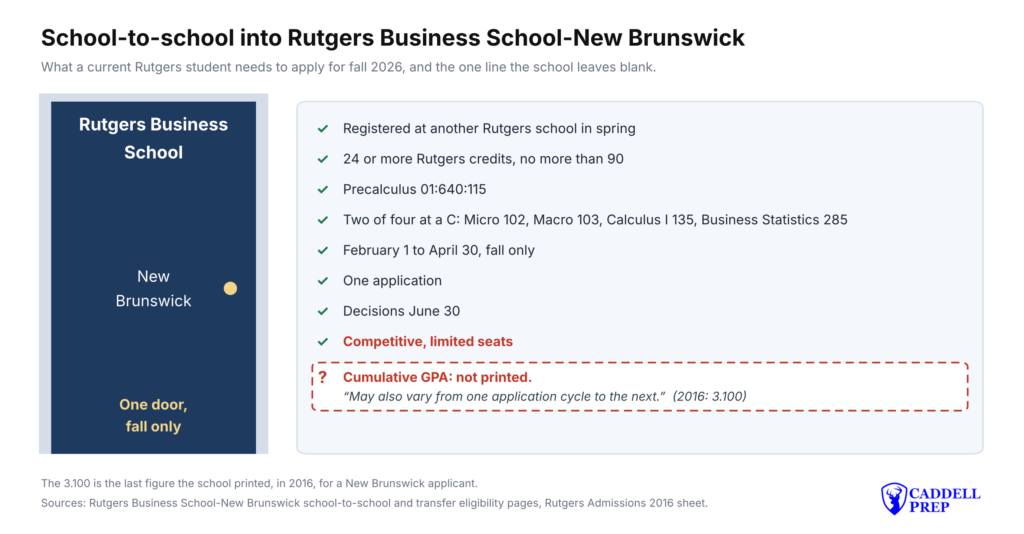
The image above shows the one door and the one line Rutgers leaves blank.
Does Rutgers Business School Publish a Minimum GPA for Transfer?
No, Rutgers Business School-New Brunswick does not publish a minimum cumulative GPA for a current Rutgers student applying through the school-to-school process for fall 2026, and writes instead that the GPA needed for admission may also vary from one application cycle to the next, so the printed lines are the courses, the credits and the window, and the number is set by the pool.
The last figure the school printed was a 3.100 in 2016, with a 3.500 for a Newark or Camden applicant, and a student should read it as a floor from a decade ago and the word competitive as the current rule. The two of four foundational courses at a C are the line he controls, and the window, one application between February 1 and April 30, is the line he cannot move.
Every rule but one, and that one left blank. Which schools hold the accreditation is the next section.
Which New Jersey Universities Have AACSB-Accredited Business Schools?
Seventeen New Jersey business school rows hold business accreditation from AACSB International under fifteen accreditations, eleven public and six private, and the list below names each with its city and the school that awards the business degree, with Rutgers Business School covering two campuses and Fairleigh Dickinson’s Silberman College covering two [VERIFY all on the AACSB directory before publishing].
- Stevens Institute of Technology in Hoboken awards its business degrees through the AACSB-accredited School of Business.
- Rutgers University-New Brunswick in New Brunswick awards its business degrees through the AACSB-accredited Rutgers Business School-Newark and New Brunswick.
- New Jersey Institute of Technology in Newark awards its business degrees through the AACSB-accredited Martin Tuchman School of Management.
- Seton Hall University in South Orange awards its business degrees through the AACSB-accredited Stillman School of Business.
- The College of New Jersey in Ewing awards its business degrees through the AACSB-accredited School of Business.
- Monmouth University in West Long Branch awards its business degrees through the AACSB-accredited Leon Hess Business School.
- Rider University in Lawrenceville awards its business degrees through the AACSB-accredited Norm Brodsky College of Business.
- Rowan University in Glassboro awards its business degrees through the AACSB-accredited William G. Rohrer College of Business.
- Ramapo College of New Jersey in Mahwah awards its business degrees through the AACSB-accredited Anisfield School of Business.
- Rutgers University-Camden in Camden awards its business degrees through the AACSB-accredited School of Business-Camden.
- Stockton University in Galloway awards its business degrees through the AACSB-accredited School of Business.
- Kean University in Union awards its business degrees through the AACSB-accredited College of Business and Public Management.
- Montclair State University in Montclair awards its business degrees through the AACSB-accredited Feliciano School of Business.
- Rutgers University-Newark in Newark awards its business degrees through the AACSB-accredited Rutgers Business School-Newark and New Brunswick.
- William Paterson University of New Jersey in Wayne awards its business degrees through the AACSB-accredited Cotsakos College of Business.
- Fairleigh Dickinson University-Metropolitan Campus in Teaneck awards its business degrees through the AACSB-accredited Silberman College of Business.
- Fairleigh Dickinson University-Florham Campus in Madison awards its business degrees through the AACSB-accredited Silberman College of Business.
Accreditation matters for a reason that is easy to miss at seventeen. Business itself is not a licensed profession, and the one business degree that leads to a license, accounting, leads to it through the state board rather than through the school. A CPA in New Jersey normally sits at 120 hours with 24 of accounting and 24 of business, and licenses on a bachelor’s and two years of experience or 150 credits and one year, with a CPA from another state practicing in New Jersey on a bachelor’s, the exam and one licensed year [VERIFY on the board’s page]. AACSB status matters on the way there because business schools use it to decide whose courses they will accept in transfer.
New Jersey City University in Jersey City is the public university left off, a campus of 3,681 undergraduates whose catalog names the Accreditation Council for Business Schools and Programs as its accreditor, and it reports no range, admits 98% and charges every student $14,460. It merged into Kean University on July 1, 2026 and became Kean Jersey City, so the row will not appear under its own name in the next Scorecard [VERIFY the name on the publish date]. Saint Peter’s University in Jersey City (no range, 90% admitted, $42,552) holds its accreditation from the International Accreditation Council for Business Education, and Caldwell University (590 to 740 on Math from a small pool, 71%, $40,848), Georgian Court University in Lakewood and Thomas Edison State University in Trenton ($8,856 non-resident, no range or rate) are accredited by the ACBSP as far as this page could confirm [VERIFY each]. Felician University in Lodi ($39,300), Centenary University in Hackettstown and Berkeley College in Woodland Park ($29,800) hold IACBE accreditation [VERIFY each], and Drew University in Madison (24 to 30 on the ACT, 533 to 650 on Math, 68% admitted, $47,100) awards business degrees under no business accreditor [VERIFY]. Princeton University awards no business degree. None of them is a row.
Nothing on this page ranks the seventeen. They are eleven public universities and six private under fifteen accreditations, one flagship door with every rule printed but the number, one public with a $6,120 premium, and the pages for business colleges in New York, business colleges in Pennsylvania and business colleges in Delaware carry the schools a student looking at New Jersey is likely comparing.
What If Your Scores Are Below the Range You Want?
In New Jersey Stevens’ floors are 710 on Math and 31 on the ACT, Rutgers’ 660 and 28, NJIT’s 610 and 27, Seton Hall’s 600 and 27, TCNJ’s 570 and 26, Monmouth’s 560 and 24, Rider’s, Rowan’s and Ramapo’s 550 with 27, 23 and 22, Rutgers-Camden’s 510 and 19, Stockton’s 500 and 21, Kean’s 470, Montclair’s 430, and four rows publish none. A student under the floor he wants is not ruled out, because a quarter of admitted students were there too. He is in the quarter that needs the rest of the application to carry more.
The first step is finding out where the score actually is, section by section. A free diagnostic SAT gives a Math score that can be set directly against TCNJ’s 570 floor, Rutgers’ 660 and Stevens’ 710, and a total that can be set against the 1300 that clears every public range on the page but the first two.
The Math section rewards the same handful of topics on every test date, and a student who knows which of them he is missing can close a gap of 50 to 100 points in weeks rather than months. The method is on our page on improving your SAT Math score, and at Rutgers the same algebra is Precalculus 01:640:115 and Calculus I 01:640:135, two of the courses the business school names at the second door, the second of them at a C or better.
How to Read These Score Ranges
Each range in the table covers the middle 50% of admitted students who submitted that test, so a quarter of admitted students were below the lower number and a quarter were at or above the upper one.
A range describes the students who chose to submit at all. Where a school is test-optional, the range describes the submitters, and the submitters are the students whose scores helped them. A row marked not reported means the Scorecard has no range for that university, and a student should read the university’s own admissions page for the score it expects. More on what SAT score you need for college and on test-optional colleges.
Should You Take the ACT Instead?
New Jersey requires no statewide college admission test of its public school juniors [VERIFY current New Jersey testing], thirteen of the seventeen rows report the SAT, and eleven report the ACT.
A New York student who holds an SAT should send it everywhere in New Jersey and leave the ACT alone unless a school elsewhere asks for it. Rutgers and Stevens are test-optional [VERIFY both for the current cycle], and each reports an SAT range from a large enough pool to read directly. Kean and Montclair report no ACT range, and four rows report neither, so a student should read those universities’ own pages before deciding whether a score helps there.
Business Programs in Nearby States
New Jersey borders three states, and each has its own page in this series.
See business colleges in New York, business colleges in Pennsylvania and business colleges in Delaware.
Business Colleges in Other States
We publish the same breakdown for business programs in every state.
See business colleges by state for the full list.

Glyn Caddell
Glyn Caddell holds a BS in Mechanical Engineering from NJIT and has been tutoring New York City students since 2008. He founded Caddell Prep in 2012 and is the author of Digital SAT Math Secrets: Lessons & Tricks to Quickly Improve to a Perfect 800 on the Math Test, which contains over 900 practice problems and is used in Caddell Prep’s SAT math classes. He is founding president of the Staten Island Technical High School alumni association and teaches every lesson on this site personally.
Finally, an SAT course that students actually understand
Every question has a video explanation. Not most — every one.
The on-demand Digital SAT course covers all 17 math topics and 15 reading and writing topics, with 5 full-length practice tests and a 100-point score increase guarantee. Keep access for the rest of high school. No subscription.
Want to Know What 5 Topics Will Improve Your SAT Score the Most?
Sample Feedback from our Diagnostic Test: