
Home » College SAT Score Ranges, Costs, and Programs by Major and State » Engineering Colleges by State: SAT Scores, ACT Scores, Costs, and ABET Programs » Engineering Colleges in North Dakota: ACT Scores, Costs, and Programs
By Glyn Caddell, BSME · Author of Digital SAT Math Secrets · Tutoring since 2008 — Updated October 25, 2026
Two North Dakota universities offer ABET-accredited engineering degrees, and this page lists what they cost and the test scores of the students they admit.
One of them awards seven accredited engineering degrees that a student can earn without moving to the campus, the only such school in this series, covered below the table.
Scores are given on the ACT, because neither university reports an SAT range and one reports no range at all.
Table of Contents
- North Dakota Engineering Colleges by ACT Score
- Can You Earn an Accredited Engineering Degree From North Dakota Without Living There?
- Which North Dakota Universities Have ABET-Accredited Engineering Schools?
- What If Your Score Is Below the Range You Want?
North Dakota Engineering Colleges by ACT Score
The two universities below are the ones in North Dakota that hold an ABET-accredited bachelor’s degree in an engineering discipline. North Dakota State reports an ACT range and is listed first, and the University of North Dakota reports none and is listed second.
| College | ACT composite | ACT Math | Cost of attendance | Undergraduates | Admit rate |
|---|---|---|---|---|---|
| North Dakota State University | 19 to 25 | 16 to 25 | $23,716 | 9,471 | 95% |
| University of North Dakota | Does not report ACT data | Does not report ACT data | $25,605 | 9,981 | 77% |
Each range covers the middle 50% of admitted students who submitted the ACT. A quarter scored below the lower number, and the top quarter scored at or above the upper one. Being under the lower number does not rule a student out, and being just above it is not as safe as it looks.
Only universities with an ABET-accredited engineering bachelor’s degree are listed. Neither university reports an SAT range to the Scorecard, and the University of North Dakota reports no ACT range either.
Three things about that table are worth pausing on.
The University of North Dakota holds seven ABET-accredited engineering degrees, and its accreditation page says each is the same accredited degree whether a student earns it in Grand Forks or at a distance. No other school in this series says that about its engineering degrees, and the next section is about what it means.
The two universities charge a student from outside North Dakota $15,570 and $15,764 a year in tuition and fees. Those are the two lowest out-of-state figures at any flagship or land-grant university on any page in this series, by approximately $10,000.
North Dakota State admits 95% of applicants and reports a range. The University of North Dakota admits 77% and reports none, so a student can set his ACT score against one of the state’s two engineering schools and not the other.
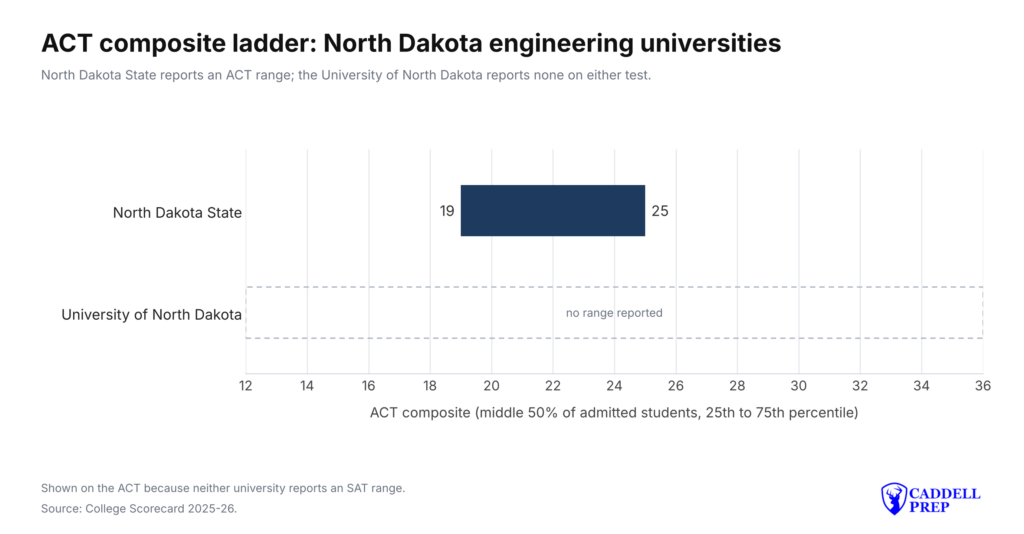
A student can see where his ACT score sits against the one range the state reports in the image above.
Want to Know What 5 Topics Will Improve Your SAT Score the Most?
Sample Feedback from our Diagnostic Test:

North Dakota State University
North Dakota State University’s College of Engineering in Fargo holds ABET accreditation in disciplines including agricultural and biosystems, civil, computer, construction, electrical, industrial, manufacturing and mechanical engineering, and North Dakota State is the only engineering school in the state that reports an admitted score range.
ACT composite 19 to 25, ACT Math 16 to 25. The top quarter of admitted students scored at or above 25 on both. North Dakota State reports no SAT range. Cost of attendance $23,716, with tuition and fees at $11,110 in state and $15,764 out of state. 9,471 undergraduates, 95% admitted.
North Dakota State is the land-grant university, the cheaper of the two by total cost, and the one that admits nearly every applicant. Its out-of-state tuition is $194 above the flagship’s, and a Minnesota student pays close to the resident rate under the two states’ reciprocity agreement.
University of North Dakota
The University of North Dakota’s College of Engineering and Mines in Grand Forks holds ABET accreditation in biomedical, chemical, civil, electrical, geological, mechanical and petroleum engineering, and the University of North Dakota awards each of the seven as the same accredited degree to students on campus and students at a distance.
The University of North Dakota reports no SAT or ACT range to the Scorecard. Cost of attendance $25,605, with tuition and fees at $10,951 in state and $15,570 out of state for campus students, and the university’s engineering cost page says that “online students pay the same tuition rate regardless of residency.” 9,981 undergraduates, 77% admitted.
The University of North Dakota is the flagship, the larger of the two by 510 students, the more selective, and the holder of the state’s petroleum and geological engineering degrees. It is also the one school in this series whose engineering degrees do not require a student to live where the school is.
One range and one blank say who got in. One of the two schools does not ask where a student lives, and the next section is about it.
Can You Earn an Accredited Engineering Degree From North Dakota Without Living There?
A student can earn an ABET-accredited engineering degree from the University of North Dakota without living there. The university’s seven accredited engineering degrees are accredited as the same degree whether earned on campus or at a distance, electrical engineering is listed by ABET as available fully online, and the other six require some in-person laboratory work on campus, scheduled in the summer.
The accreditation page puts it in one sentence: the online and in-person versions are “accredited as the same degree from ABET regardless of amount of online content.” Electrical engineering carries ABET’s “100% Available Online” listing. The other six are not listed as fully online because they require laboratory work in Grand Forks, and the university publishes the schedule. Mechanical engineering requires three on-campus labs of four, four and five days. Civil engineering requires five labs of two to five days that can be completed in one summer or several. Petroleum engineering requires two labs of five days each. Chemical engineering requires three labs of twelve, fourteen and fifteen days taken over several summers. Geological engineering requires two labs and a five-week field camp run by the South Dakota School of Mines. Electrical engineering labs are completed at home with lab kits. Summer housing is available for students who travel in.
| Degree | ABET-accredited | On-campus laboratory requirement |
|---|---|---|
| Electrical engineering | Yes, listed as 100% available online | None, labs by kit at home |
| Mechanical engineering | Yes | Three labs, 13 days |
| Civil engineering | Yes | Five labs, approximately 15 days |
| Petroleum engineering | Yes | Two labs, 10 days |
| Chemical engineering | Yes | Three labs, 41 days over several summers |
| Geological engineering | Yes | Two labs and a five-week field camp |
| Biomedical engineering | Yes | One lab of 5 days (mechanical track) or two labs of 7 and 14 days (chemical track) |
The program is not new. The university’s own account dates it to fall 1988, when a 3M manager asked the dean for a course his engineers could take without leaving the plant, eleven students enrolled, and lectures went out on videotape with a three-week lag each way. ABET evaluated the distance delivery in 1997, the spring the Red River flood closed the campus, and accredited it. Cargill, Hewlett-Packard and Sony joined 3M as employer partners, the capstone moved to students’ job sites, and the program added petroleum, geological, mechanical, civil and chemical engineering. It now runs more than 100 courses a semester and has more than 500 alumni, and its dean has said that as far as he knows no other American university offers a full suite of accredited undergraduate engineering degrees at a distance.
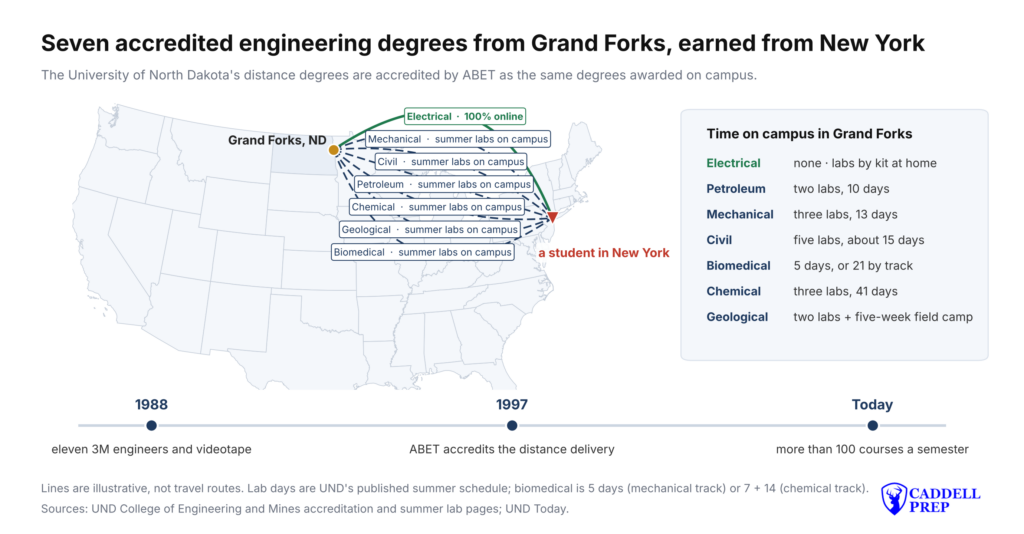
The image above shows seven accredited degrees, one campus, and a student who never has to see it except for the labs.
Take a New York student with a 23 on the ACT. At North Dakota State he is in the upper half of the admitted range, 19 to 25, and pays $15,764 a year to live in Fargo. At the University of North Dakota he has no range to measure himself against, is admitted at 77%, and pays $15,570 to live in Grand Forks, or the university’s single online rate, the same for every state, to stay home and travel in for two or three weeks of summer labs if he chooses mechanical or petroleum engineering, or never if he chooses electrical. At the University of Minnesota, the reciprocity neighbor, he would pay $38,362, on our page on engineering colleges in Minnesota. The cheapest flagship engineering degree in this series for a New York student is in a state he may never visit.
North Dakota State is the state’s other engineering school and the one a campus student is more likely to choose. Its College of Engineering in Fargo holds eight accredited disciplines, including the state’s agricultural and biosystems, construction, industrial and manufacturing engineering degrees, admits 95% of applicants on an ACT range of 19 to 25, and charges $11,110 in state and $15,764 out of state. North Dakota and Minnesota have a tuition reciprocity agreement under which a Minnesota student pays close to the resident rate at either university, and both universities also publish reduced rates for students from neighboring states and provinces. A student from New York pays the figures above.
The honest version is that the distance program was built for working engineers and still reads that way. Its first students were 3M employees, its partners were employers, and its capstone is done at the student’s job. A seventeen-year-old who wants a campus should read the University of North Dakota’s row as a campus, and the university admits him to Grand Forks like any flagship. A student who wants an accredited engineering degree while working, or who cannot leave home, has one page in this series that answers him, and it is this one. The university reports no score range, so this page cannot say where any student’s ACT sits in its class. The online tuition figure was not published on the page this article read, and the page says only what the university says, that online students pay one rate regardless of residency. Six of the seven degrees require travel to Grand Forks for labs, and the university’s schedule above is the number of days.
Families reading the accreditation page frequently ask whether the online degree is the same degree.
Is UND's Online Engineering Degree the Same Degree as the Campus One?
The University of North Dakota’s online engineering degree is the same degree as the campus one. In the university’s words, the two are “accredited as the same degree from ABET regardless of amount of online content,” and the accreditation covers all seven engineering programs.
The difference is in the labs. Electrical engineering is done entirely at a distance with lab kits, and the other six require between ten days and several summers in Grand Forks, with the schedule set by each department and summer housing available. Licensure as a professional engineer looks for the ABET-accredited degree, and the university awards the same one either way.
The university’s program is its own. The degrees are what the next section lists.
Which North Dakota Universities Have ABET-Accredited Engineering Schools?
Two North Dakota universities hold ABET-accredited engineering bachelor’s degrees, both public, and both are in the table above.
In Grand Forks, the University of North Dakota’s College of Engineering and Mines holds seven disciplines, including the petroleum and geological engineering degrees that serve the Bakken oil field in the state’s west, and Grand Forks Air Force Base is across the river. In Fargo, North Dakota State’s College of Engineering holds eight, with Microsoft’s Fargo campus, Bobcat in West Fargo and the state’s agricultural equipment makers the largest engineering employers in the state’s largest city.
Accreditation matters for a reason that is easy to miss at seventeen. Licensure as a professional engineer normally requires a degree from an ABET-accredited engineering program. The University of Mary in Bismarck has offered engineering since 2015 in a structure that paired its own engineering science degree with the University of North Dakota’s accredited online degree, and this page lists the University of North Dakota as the accredited school in that arrangement. Minot State, Valley City State, Dickinson State, Mayville State and the University of Jamestown award no engineering degree.
Nothing on this page ranks the two. The table’s order is a stated number where one exists, and the choice between two accredited programs comes down to cost, discipline and whether a student intends to live in the state at all.
What If Your Scores Are Below the Range You Want?
In North Dakota there is one admitted range to be below, 19 to 25 at North Dakota State, and a flagship that publishes none, so the score’s job at both universities is placement into the first math course rather than admission.
The gap from a 21 to the top of North Dakota State’s range is four points of ACT composite, two or three questions a section, and a student who closes it is choosing between two universities that admit 95% and 77% and charge him under $16,000 from out of state. A New York student has one range, two out-of-state figures that are the lowest at any flagship or land-grant in this series, and one degree he can earn without leaving New York.
The first step is finding out where the score actually is, section by section. A free diagnostic SAT gives a Math score that can be converted to the ACT scale and set against the one range on the page.
The Math section rewards the same handful of topics on every test date, and a student who knows which of them he is missing can close a gap of 50 to 100 points in weeks rather than months. The method is on our page on improving your SAT Math score, and the same topics carry the ACT Math section.
How to Read These Score Ranges
The one range on this page covers the middle 50% of admitted students who submitted the ACT. The lower number is the 25th percentile and the upper number is the 75th, so a quarter of admitted students scored at or above it.
A school that reports no range gives a student nothing to compare himself to, and this page says so rather than guessing. Maine’s flagship published no range either, on our page on engineering colleges in Maine, and gave one placement line instead. The University of North Dakota gives neither, and a student applying there is admitted or not on his transcript and placed on the university’s own measures.
Because most colleges are now test-optional, the ranges that are published describe only the students who chose to submit at all. Students with strong scores submit and students with weak ones don’t, so a published range sits higher than the range for everyone who was actually admitted. More on what SAT score you need for college and on test-optional colleges.
Should You Take the SAT Instead?
Neither North Dakota university reports an SAT range, and most North Dakota students take the ACT, so this page gives the ACT alone.
Both universities accept either test, and a student from outside the state who holds an SAT should submit it and expect to be placed by it. A student should take whichever test he scores higher on.
Engineering Programs in Nearby States
North Dakota borders Minnesota, South Dakota and Montana, and its reciprocity agreement with Minnesota means students cross that line in both directions at close to resident rates.
See engineering colleges in Minnesota, engineering colleges in South Dakota, and engineering colleges in Montana.
Engineering Colleges in Other States
We publish the same breakdown for engineering programs in every state.
See engineering colleges by state for the full list.

Glyn Caddell
Glyn Caddell holds a BS in Mechanical Engineering from NJIT and has been tutoring New York City students since 2008. He founded Caddell Prep in 2012 and is the author of Digital SAT Math Secrets: Lessons & Tricks to Quickly Improve to a Perfect 800 on the Math Test, which contains over 900 practice problems and is used in Caddell Prep’s SAT math classes. He is founding president of the Staten Island Technical High School alumni association and teaches every lesson on this site personally.
Finally, an SAT course that students actually understand
Every question has a video explanation. Not most — every one.
The on-demand Digital SAT course covers all 17 math topics and 15 reading and writing topics, with 5 full-length practice tests and a 100-point score increase guarantee. Keep access for the rest of high school. No subscription.
Want to Know What 5 Topics Will Improve Your SAT Score the Most?
Sample Feedback from our Diagnostic Test: