
The Digital SAT provides a math reference to students during the math modules. It can be accessed during the test by pressing the icon on the top right with an 


- To find the slope from one,
, point to another,

You’ll use this more than any other formula on this list. Linear functions are 15% of the math section, which makes them the most common topic on the test.

- where
is the slope and
is the
-intercept
Most linear function questions either give you an equation in this form or expect you to write one. Knowing which number is the slope and which is the starting value is normally the whole question.

- where
,
are constants.
This is the form you’ll see most often, and it’s the form the quadratic formula uses. The c value is the y-intercept.

- where (h, k) is the vertex
If a question asks for the vertex, the minimum, or the maximum, this is the form you want. Both coordinates can be read directly without doing any work.

- where
and
are the zeros (roots)
- where
The fastest form for finding where a parabola crosses the x-axis. If a question asks for the zeros and gives you this form, you can read them off.

, and
Use it when a quadratic doesn’t factor easily. The part under the radical, b² − 4ac, also tells you how many solutions there are, which comes up on its own.

- where (h, k) is the center and the radius is
The reference sheet gives you the area and circumference of a circle but not its equation. Questions that give you an equation and ask for the center or radius are common, and this is the only way to answer them.

- where
is the number of sides
The sum of the exterior angles of any convex polygon is always 360°, no matter how many sides it has.
The ratio between the central angle and a full circle (

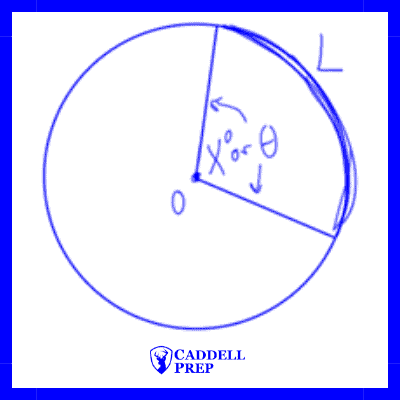


The ratio between the central angle and a full circle (
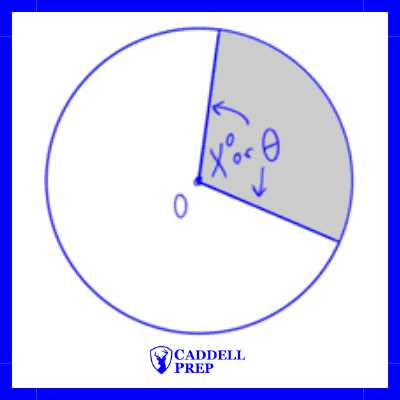


- Where
is the starting amount,
is the percent change, and
is the number of time periods
Use the plus for growth and the minus for decay. Any question about population, interest, or something increasing or decreasing by a percentage over time uses this.


The second version matters more than students expect. Questions often give you an average and ask what happens when a value is added or removed, and you need the sum to answer them.

- where
is the total distance and
The word “average” makes students reach for the mean of the individual speeds, which is wrong when the distances or times aren’t equal. If a car goes 30 mph for one hour and 60 mph for two hours, the average speed isn’t 45. It’s 150 miles divided by 3 hours, which is 50.
Always go back to total distance over total time.
Instead of memorizing three different formulas to find the percent, find the part, or find the whole, you can simply use one proportion to solve for a missing value.

If you want to memorize the three versions, here they are:
Find x percent of a number n:

Find what percent n is of m:

Find what number n is x percent of:

The third one is the version students get wrong most often. If a question says a value is 25% of some number and asks for the original, you divide rather than multiply.
Percent questions are approximately 3.1% of the math section, and they also show up inside other topics. A ratio question, a data question, or an exponential growth question can all require a percent calculation partway through.

- where
is the number of desired outcomes and
is the total number of possible outcomes
A probability of 1 means something is certain. A probability of 0 means it can’t happen. Every probability on the SAT falls between those two.
The formula is simple. What makes these questions difficult is figuring out what belongs in the denominator.
Most SAT probability questions give you a two-way table and add a condition, like “if a person is chosen at random from those who recalled at least one dream.” That condition changes the total. You’re no longer dividing by everyone in the table, only by the group the question named.
Reading the condition carefully is the whole question. Data and probability is 8.7% of the math section, which makes it the third most common topic on the test.
There are three trigonometric ratios to remember, SOH-CAH-TOA, that can only be applied in right triangles. In the three formulas below A represents the measure of one of the acute angles in the right triangle.


The reference sheet gives you the Pythagorean theorem and the special right triangles, but no trigonometric ratios at all. If a question involves an angle that isn’t 30, 45, or 60 degrees, you need these.
There is another relationship that should be remembered for 

If A and B are complementary angles, then:

In other words,

The formula for area of a circle is provided.

The formula for circumference of a circle is also provided.

where
The formula for area of a rectangle is provided.

where 

The formula for area of a triangle is provided.

where 
The formula for Pythagorean Theorem is provided.

where
The relationship among the sides of 30-60-90 right triangle is provided.
There is a ratio that exists among the sides.
The hypotenuse is

The side opposite (across from) the 30 degree angle is
The side opposite the 60 degree angle is 
If you know the lengths of any of the sides, you can solve for 
The relationship among the sides of 45-45-90 right triangle is provided.
There is a ratio that exists among the sides.
The hypotenuse is

Since two angles are both 45 degrees, this is an isosceles triangle, making the two sides opposite the 45 degree angles congruent. They are both 
If you know the lengths of any of the sides, you can solve for
The formula for volume of a rectangular prism is provided.

where 
The formula for volume of a cylinder is provided.

where
The formula for volume of a sphere is provided.

where
The formula for volume of a cone is provided.

where
The formula for volume of a pyramid is provided.

where
The math reference states the following two facts:
The number of degrees of arc in a circle is 360.
The number of radians of arc in a circle is
By stating these two facts, it also tells us how degrees and radians are related:

Review our circles lesson to see how these relationships come in handy.