
Home » College SAT Score Ranges, Costs, and Programs by Major and State » Best Business Colleges » Business Colleges in New Mexico: SAT Scores, ACT Scores, Costs, and Programs
By Glyn Caddell, BSME · Author of Digital SAT Math Secrets · Tutoring since 2008 — Updated November 13, 2026
Two New Mexico universities hold AACSB-accredited business schools, both public, and this page lists the SAT and ACT scores of the students they admit, what each costs a New York student, and the published rule at the flagship that turns the non-resident price into the resident’s.
Both report an SAT range and both an ACT range, so the table leads with the SAT.
UNM pays the resident rate to a freshman from outside the western exchange region with a 3.0 or a 20 ACT or a 1030 SAT, its Anderson School moves a student to major status automatically at 40 hours with a C in each course and a 2.5, and New Mexico’s CPA law has licensed on a bachelor’s degree and two years of experience since January 1, 2026.
Table of Contents
- New Mexico Business Colleges by SAT and ACT Score
- What Does a New York Student Actually Pay at UNM?
- Which New Mexico Universities Have AACSB-Accredited Business Schools?
- What If Your Score Is Below the Range You Want?
New Mexico Business Colleges by SAT and ACT Score
New Mexico’s two AACSB-accredited business schools are the Anderson School of Management at the University of New Mexico in Albuquerque, with a Math range of 430 to 570, and the College of Business at New Mexico State University in Las Cruces, with 420 to 540, and the table below lists each with its SAT and ACT ranges, cost of attendance, enrollment and admit rate. Both are public, both report both tests, and the rows are sorted by the midpoint of the SAT Math range, so the order can be checked from the table itself.
| College | SAT Reading & Writing | SAT Math | ACT composite | Business school | Cost of attendance | Undergraduates | Admit rate |
|---|---|---|---|---|---|---|---|
| University of New Mexico | 460 to 600 | 430 to 570 | 19 to 26 | Anderson School of Management | $21,259 | 17,244 | 95% |
| New Mexico State University | 450 to 570 | 420 to 540 | 17 to 24 |
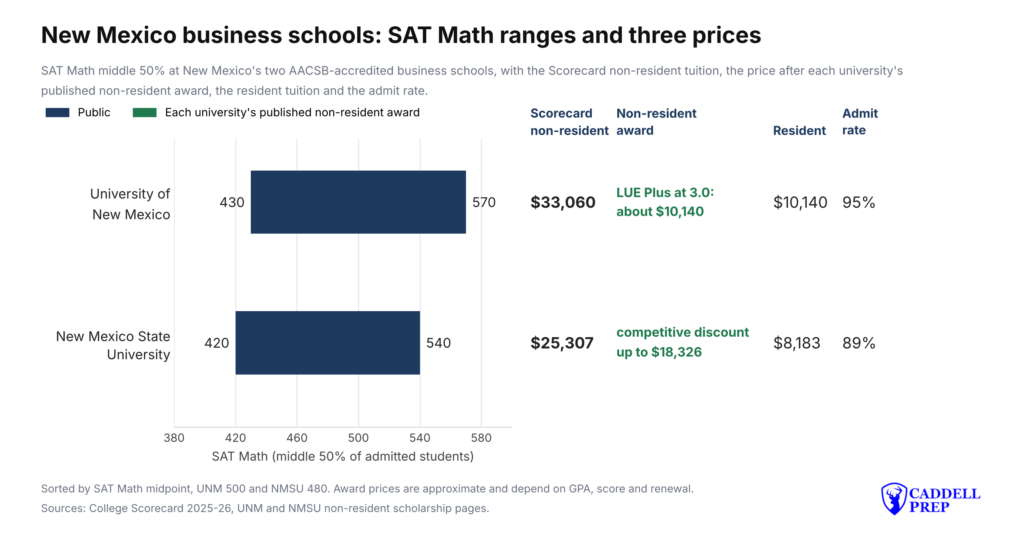
A student can see where his Math score sits on this ladder in the image above.
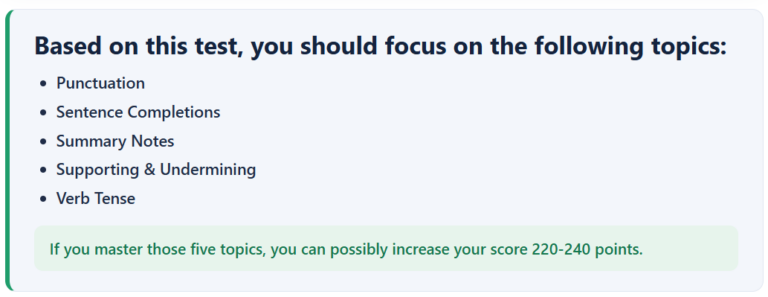
Want to Know What 5 Topics Will Improve Your SAT Score the Most?
Sample Feedback from our Diagnostic Test:
University of New Mexico
The University of New Mexico in Albuquerque awards its business degrees through the Anderson School of Management, and UNM reports the higher Math range on the page, 430 to 570, admits 95%, and charges a New Yorker $33,060 on the Scorecard and approximately the resident’s $10,140 under the scholarship it publishes for a 3.0.
Reading & Writing 460 to 600, Math 430 to 570. ACT composite 19 to 26. The top quarter of admitted students scored at or above 570 on Math and 26 on the ACT. Cost of attendance $21,259, with tuition and fees at $10,140 in-state and $33,060 out-of-state. 17,244 undergraduates, 95% admitted.
UNM’s 430 to 570 on Math sits 10 above NMSU’s at the floor and 30 at the ceiling, and its 19 to 26 on the ACT is two points above NMSU’s at each end. The 95% is the university’s rate, and Anderson moves a student to Phase II on a 2.5, the subject of the next section. The cost of attendance in the table is a resident’s. A non-resident’s comes to approximately $44,179 once the Scorecard’s higher tuition is substituted, and the $33,060 that drives it is $227 under Montana State’s $33,287 and $5,340 above Reno’s $27,720, with a premium of $22,920 over a resident, 3.26 times the resident figure. Under LUE Plus a New Yorker with a 3.0 pays approximately $10,140, within $105 of St. Cloud State’s one rate, and four years is $132,240 on the Scorecard or approximately $40,560 under the award.
New Mexico State University
New Mexico State University in Las Cruces awards its business degrees through its College of Business, and NMSU admits 89%, reports 420 to 540 on Math, and charges a New Yorker $25,307 on the Scorecard, with a published discount of up to $18,326 for a non-resident with a 3.5 and a 23 ACT.
Reading & Writing 450 to 570, Math 420 to 540. ACT composite 17 to 24. The top quarter of admitted students scored at or above 540 on Math and 24 on the ACT. Cost of attendance $23,274, with tuition and fees at $8,183 in-state and $25,307 out-of-state. 11,946 undergraduates, 89% admitted.
NMSU’s 420 to 540 on Math has the lower floor on the page by 10 points, and its 17 to 24 on the ACT starts two under UNM’s. The $25,307 carries a premium of $17,124 over a resident, and the Out-of-State Competitive Discount, up to $18,326 a year in a limited number, brings a qualifying New Yorker to approximately the resident rate, since the discount and the Scorecard figure come from different years. The cost of attendance in the table is a resident’s, and a non-resident’s comes to approximately $40,398 with the higher tuition substituted. Four years of tuition is $101,228 on the Scorecard.
Two rows say who got into the university and what the Scorecard says a New Yorker pays. The next section is about the published rule at the flagship that changes the second figure.
What Does a New York Student Actually Pay at UNM?
A New York freshman at the University of New Mexico pays approximately the resident tuition rate rather than the $33,060 on the Scorecard when he holds a 3.0 GPA or a 20 ACT or a 1030 SAT and applies by February 1, under the Lobo Undergraduate Exchange Plus scholarship the university publishes for students from states outside the western exchange region, and he is then admitted to the Anderson School of Management as a Phase I student who moves to Phase II automatically at 40 credit hours with a C in each named course and a 2.5.
UNM prints its awards for a non-resident freshman in one table, and two of its lines are written for a student from a state outside the Western Undergraduate Exchange, the fifteen western states and Pacific territories, and New York is outside it. The Lobo Undergraduate Exchange, LUE, pays 1.5 times the resident rate, about $18,854 a year in the 2027-28 table, to a freshman with “2.8 GPA OR 18 ACT (960 SAT).” LUE Plus pays the New Mexico resident rate, about $23,149 a year in that table, to a freshman with “3.0 GPA OR 20 ACT (1030 SAT).” The Amigo Scholarship, open to any non-resident, pays the same about $23,149 plus a $200 stipend to a freshman with “3.5 GPA and 23ACT (1130 SAT) OR 3.0 GPA & 26 ACT (1240 SAT).” Each is applied for by February 1, renews for four years, and renews on 15 credit hours and a 2.5 GPA each semester. The Regents’ Scholarship, at a 3.90 and a December 1 deadline, covers base tuition, fees and housing with a waiver to the resident rate, and a freshman holding one of the tuition awards may add a one-year Lobo Housing Scholarship of $1,000 to $4,000 [VERIFY every cell on the scholarships page for the entering year, and the LUE residency definition].
New Mexico State prints its own lines. The Out-of-State Competitive Discount pays up to $18,326 a year to a non-resident freshman with “3.5 GPA and 23 ACT or 3.0 GPA and 26 ACT or 3.5 cumulative college GPA,” in a limited number, with no application. The 1888 Leadership award adds $2,000 at a 3.5 to 3.69 with no application, Crimson Success $3,000 at 3.7 to 3.89 and Hadley $4,000 at 3.9 by December 1, and the Western Undergraduate Exchange discount is for the western states and does not reach New York [VERIFY on the NMSU page, including whether an SAT equivalent satisfies the ACT lines].
Set against the Scorecard, UNM charges a New Yorker $33,060 and a New Mexican $10,140, and a New Yorker with a 3.0 under LUE Plus pays approximately $10,140, the resident figure, with the award’s dollar value in the 2027-28 table, about $23,149, close to the $22,920 gap in the 2025-26 Scorecard. A 2.8 student under LUE pays approximately 1.5 times the resident rate, about $15,210 on the Scorecard figures. NMSU charges $25,307 and $8,183, and a qualifying New Yorker with one of the limited discounts pays approximately the resident rate. Every price after an award on this page is approximate, because the scholarship table and the Scorecard are two years apart and the award is written against tuition, not fees.
After the price comes the business school, and at UNM it asks one number once and then moves the student itself. A student who declares the B.B.A. is admitted to the Anderson School of Management as a Phase I, pre-major student: “Phase I (pre-major) students are Anderson students.” He completes 40 credit hours of pre-admission coursework, ENGL 1120 and ENGL 2120 or 2210, MATH 1350 and MATH 1430, ECON 2110 and ECON 2120, PSYC 1110 or SOCI 1110, ACCT 2110, BCIS 1110 within five years of admission to the program, and general-education hours in science, humanities, a second language and arts, each with a minimum grade of C and an “overall cumulative grade point average requirement of 2.5.” He declares pre-Business Administration by February 1 for summer, June 1 for fall or September 1 for spring, and “Students move into it automatically after completing all Phase I requirements.” To graduate he holds a C in the Phase I courses and a C- in the core and concentration courses [VERIFY every item on the catalog page]. NMSU’s College of Business was not read for a gate, and a family should read its catalog for any rule that follows [VERIFY].
Set against the earlier pages, New Mexico’s flagship prints the price rule the grid has been circling. On our page on business colleges in Mississippi, Ole Miss and Mississippi State print charts that cut a non-resident’s price by GPA band. On our page on business colleges in Montana, the two flagships print four doors and a price near four times the resident’s with the western exchange closed to New York. UNM prints a line for the student the western exchange leaves out, and the line pays the resident rate at a 3.0.
| Award | Who | Line | What it pays | Deadline |
|---|---|---|---|---|
| UNM LUE | A freshman from a state outside the WUE region | 2.8 GPA, or 18 ACT, or 960 SAT | 1.5 times the resident rate, about $18,854 in the 2027-28 table | February 1 |
| UNM LUE Plus | The same | 3.0 GPA, or 20 ACT, or 1030 SAT | The resident rate, about $23,149 in the 2027-28 table | February 1 |
| UNM Amigo | Any non-resident freshman | 3.5 GPA and 23 ACT or 1130 SAT, or 3.0 GPA and 26 ACT or 1240 SAT | The same about $23,149 plus $200 a year | February 1 |
| UNM Regents’ | Any freshman | 3.90 GPA | Base tuition, fees and housing, about $24,000, with a waiver to the resident rate | December 1 |
| NMSU Out-of-State Competitive Discount | A non-resident freshman, in a limited number | 3.5 GPA and 23 ACT, or 3.0 GPA and 26 ACT | Up to $18,326 a year | None |
| NMSU 1888 Leadership | A non-resident freshman | 3.5 to 3.69 GPA | $2,000 a year, stackable with a discount |
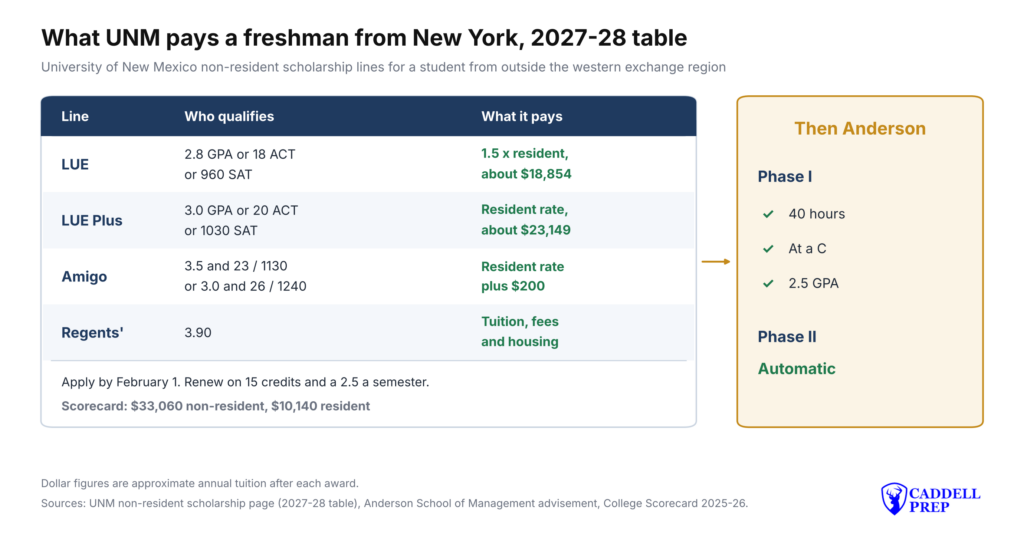
The image above shows the four lines on UNM’s table that reach a New Yorker and the business school’s rule after them.
Does a New York Student Pay In-State Tuition at UNM With a 3.0?
Yes, a New York freshman with a 3.0 high school GPA pays the New Mexico resident tuition rate at the University of New Mexico under the Lobo Undergraduate Exchange Plus scholarship, because the university publishes that award for residents of states outside the western exchange region at a 3.0 GPA or a 20 ACT or a 1030 SAT, so the GPA alone meets the line and the application by February 1 is the other condition.
The award renews for four years on 15 credit hours and a 2.5 each semester, it is written against tuition and the page did not check fees or housing, a 2.8 student falls to LUE at 1.5 times the resident rate, and a student should read the year on the table he is looking at, since this page read the 2027-28 version against a 2025-26 Scorecard.
One line, three ways onto it, one price. Which schools hold the accreditation is the next section.
Which New Mexico Universities Have AACSB-Accredited Business Schools?
Two New Mexico universities hold business accreditation from AACSB International, both public, and the list below names each with its city and the school that awards the business degree [VERIFY both on the AACSB directory before publishing].
- University of New Mexico in Albuquerque awards its business degrees through the AACSB-accredited Anderson School of Management.
- New Mexico State University in Las Cruces awards its business degrees through its AACSB-accredited College of Business.
Accreditation matters for a reason that is easy to miss at seventeen. Business itself is not a licensed profession, and the one business degree that leads to a license, accounting, leads to it through the state board rather than through the school. A CPA in New Mexico normally licenses on a bachelor’s and two years of experience, a bachelor’s plus 30 hours and one year, or a master’s and one year, with 30 months to pass the four exam sections and no residency rule [VERIFY on the board’s page]. AACSB status matters on the way there because business schools use it to decide whose courses they will accept in transfer.
Eastern New Mexico University in Portales is the public university left off that a New Yorker should still see, a campus of 3,357 undergraduates whose College of Business holds accreditation from the Accreditation Council for Business Schools and Programs as far as this page could confirm [VERIFY], and it reports 17 to 23 on the ACT and 400 to 520 on Math, admits 92%, and charges a New Yorker $9,174 against $7,194 for a resident. Western New Mexico University in Silver City (no range, $14,342 non-resident, 2,026 undergraduates) and New Mexico Highlands University in Las Vegas (no range, $12,336, 1,451) are the two other public four-year campuses, and neither holds AACSB accreditation [VERIFY both]. The New Mexico Institute of Mining and Technology in Socorro reports the highest range in the state, 20 to 29 on the ACT and 530 to 650 on Math, admits 44% and charges a New Yorker $27,247, and it has no business school, with a management program under no business accreditor [VERIFY]. Northern New Mexico College and Navajo Technical University are predominantly associate-degree institutions, and St. John’s College in Santa Fe awards no business degree. None of them is a row.
Nothing on this page ranks the two. They are two public universities with the same accreditor, one published line that pays a New Yorker the resident rate, one business school that moves its student to major status on its own, and the pages for business colleges in Arizona, business colleges in Colorado, business colleges in Texas, business colleges in Oklahoma and business colleges in Utah carry the schools a student looking at New Mexico is likely comparing.
What If Your Scores Are Below the Range You Want?
In New Mexico UNM’s floors are 430 on Math and 19 on the ACT, and NMSU’s 420 and 17, the two lowest flagship floors on these pages so far [VERIFY against every earlier state]. A student under the floor he wants is not ruled out, because a quarter of admitted students were there too, and in New Mexico the score has a second job: at UNM a 1030 puts a student on the LUE Plus line and a 960 on the LUE line when his GPA does not, and at NMSU the discount lines are written in ACT terms, 23 or 26, beside a GPA.
The first step is finding out where the score actually is, section by section. A free diagnostic SAT gives a Math score that can be set directly against UNM’s 430 floor and 570 ceiling, and a total that can be set against the 960, the 1030 and the 1130 on UNM’s table.
The Math section rewards the same handful of topics on every test date, and a student who knows which of them he is missing can close a gap of 50 to 100 points in weeks rather than months. The method is on our page on improving your SAT Math score, and at UNM the same algebra is MATH 1350 and MATH 1430, two of the courses Anderson asks at a C in Phase I.
How to Read These Score Ranges
Each range in the table covers the middle 50% of admitted students who submitted that test, so a quarter of admitted students were below the lower number and a quarter were at or above the upper one.
A range describes the students who chose to submit at all. Where a school is test-optional, the range describes the submitters, and the submitters are the students whose scores helped them. More on what SAT score you need for college and on test-optional colleges.
Should You Take the ACT Instead?
New Mexico gives the SAT to its public school juniors as the state test [VERIFY current New Mexico testing], and both rows report both tests, so the SAT leads this table by the tie rule.
A New York student who holds an SAT should send it everywhere in New Mexico and leave the ACT alone unless a school elsewhere asks for it. UNM’s scholarship lines print an SAT beside every ACT, 960, 1030, 1130 and 1240, and NMSU’s discount lines are written as ACT scores, so a New Yorker reads his SAT through the concordance there [VERIFY that NMSU accepts the SAT equivalent]. Neither business school’s own rule reads a test score.
Business Programs in Nearby States
New Mexico borders five states by land, and each has its own page in this series.
See business colleges in Arizona, business colleges in Colorado, business colleges in Texas, business colleges in Oklahoma and business colleges in Utah.
Business Colleges in Other States
We publish the same breakdown for business programs in every state.
See business colleges by state for the full list.

Glyn Caddell
Glyn Caddell holds a BS in Mechanical Engineering from NJIT and has been tutoring New York City students since 2008. He founded Caddell Prep in 2012 and is the author of Digital SAT Math Secrets: Lessons & Tricks to Quickly Improve to a Perfect 800 on the Math Test, which contains over 900 practice problems and is used in Caddell Prep’s SAT math classes. He is founding president of the Staten Island Technical High School alumni association and teaches every lesson on this site personally.
Finally, an SAT course that students actually understand
Every question has a video explanation. Not most — every one.
The on-demand Digital SAT course covers all 17 math topics and 15 reading and writing topics, with 5 full-length practice tests and a 100-point score increase guarantee. Keep access for the rest of high school. No subscription.
Want to Know What 5 Topics Will Improve Your SAT Score the Most?
Sample Feedback from our Diagnostic Test: