
Home » College SAT Score Ranges, Costs, and Programs by Major and State » Best Business Colleges » Business Colleges in Mississippi: ACT Scores, SAT Scores, Costs, and Programs
By Glyn Caddell, BSME · Author of Digital SAT Math Secrets · Tutoring since 2008 — Updated November 13, 2026
Six Mississippi universities hold AACSB-accredited business schools, four public and two private, and this page lists the ACT and SAT scores of the students they admit, what each costs a New York student, and how far that cost falls under the automatic non-resident awards the two flagships publish.
All six report an ACT range and four an SAT range, so the table leads with the ACT.
A New Yorker with a 3.5 GPA and a 1300 SAT pays approximately $18,600 at Ole Miss and $15,637 at Mississippi State by the schools’ own 2026-27 charts, and Mississippi’s CPA law has licensed on a bachelor’s degree and two years of experience since July 1, 2026.
Table of Contents
- Mississippi Business Colleges by ACT and SAT Score
- What Does a New York Student Actually Pay at Ole Miss and Mississippi State?
- Which Mississippi Universities Have AACSB-Accredited Business Schools?
- What If Your Score Is Below the Range You Want?
Mississippi Business Colleges by ACT and SAT Score
Mississippi’s six AACSB-accredited business schools run from the University of Mississippi and Mississippi State University, tied at an ACT range of 21 to 29, to Jackson State University at 15 to 20, and the table below lists each with its ACT and SAT ranges where reported, cost of attendance, enrollment and admit rate. Four are public and two private, all six report an ACT range, and the rows are sorted by the midpoint of the ACT composite range, with ties broken on the ACT Math midpoint and then on enrollment, so the order can be checked from the table itself.
| College | ACT composite | SAT Reading & Writing | SAT Math | Business school | Cost of attendance | Undergraduates | Admit rate |
|---|---|---|---|---|---|---|---|
| University of Mississippi | 21 to 29 | 510 to 610 | 490 to 590 | School of Business Administration | $28,660 | 21,473 | 97% |
| Mississippi State University | 21 to 29 | 560 to 670 | 540 to 680 | College of Business | $29,267 | 18,397 | 78% |
| Millsaps College | 21 to 28 | 495 to 575 | 530 to 575 | Else School of Management | $60,061 | 549 | 43% |
| University of Southern Mississippi | 20 to 29 | not reported | not reported | College of Business and Economic Development | $26,566 | 10,075 | 99% |
| Mississippi Christian University | 19 to 25 | not reported | not reported | School of Business | $41,214 | 2,518 | 29% |
| Jackson State University | 15 to 20 | 430 to 550 | 390 to 520 | College of Bu |
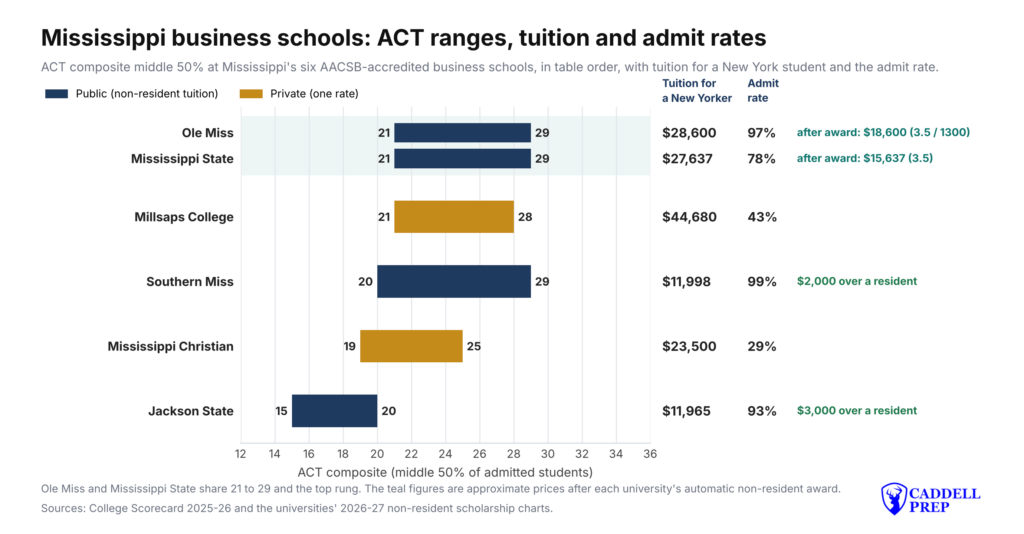
A student can see where his ACT score sits on this ladder in the image above.
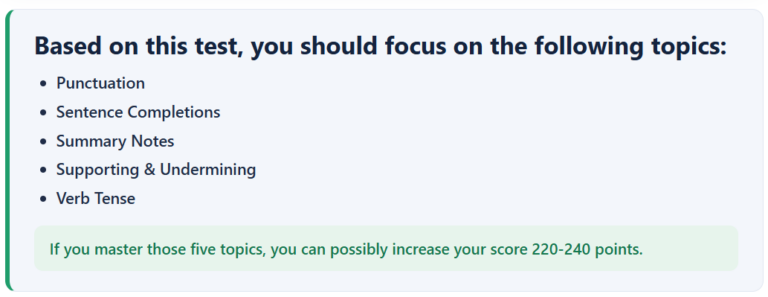
Want to Know What 5 Topics Will Improve Your SAT Score the Most?
Sample Feedback from our Diagnostic Test:
University of Mississippi
The University of Mississippi in Oxford awards its business degrees through the School of Business Administration and its accounting degrees through the Patterson School of Accountancy, each AACSB-accredited, and Ole Miss shares the highest ACT range on the page, 21 to 29, with Mississippi State, is the largest campus on the page at 21,473 undergraduates, and charges a New Yorker $28,600 before the award its chart sets by GPA.
ACT composite 21 to 29, ACT Math 19 to 27. Reading & Writing 510 to 610, Math 490 to 590. The top quarter of admitted students scored at or above 29 on the ACT and 590 on Math. Cost of attendance $28,660, with tuition and fees at $9,772 in-state and $28,600 out-of-state. 21,473 undergraduates, 97% admitted.
Ole Miss’s 21 to 29 matches Mississippi State’s at both ends, and its 490 to 590 on Math sits 50 under Mississippi State’s at the floor and 90 at the ceiling, so the two flagships tie on one test and split on the other. The 97% is the university’s rate, and the business school asks a 2.25 after 36 hours, the subject of the next section. The cost of attendance in the table is a resident’s. A non-resident’s comes to approximately $47,488 once the higher tuition is substituted, and the $28,600 that drives it is $963 above Mississippi State’s, $31 under LSU’s $28,631, and carries a non-resident fee of $18,828 over a resident, the fee the university’s chart reduces by GPA and score. Four years of tuition at the Scorecard figure is $114,400.
Mississippi State University
Mississippi State University in Starkville awards its business degrees through its College of Business and its accounting degrees through the Adkerson School of Accountancy, each AACSB-accredited, and Mississippi State reports the highest SAT Math range on the page, 540 to 680, admits 78%, and charges a New Yorker $27,637 before the award its sheet sets by GPA alone.
ACT composite 21 to 29, ACT Math 19 to 27. Reading & Writing 560 to 670, Math 540 to 680. The top quarter of admitted students scored at or above 29 on the ACT and 680 on Math. Cost of attendance $29,267, with tuition and fees at $10,202 in-state and $27,637 out-of-state. 18,397 undergraduates, 78% admitted.
Mississippi State’s 540 to 680 on Math is the only range on the page whose floor clears 530, and its 78% is the lowest public admit rate on the page, 19 points under Ole Miss’s. The scholarship sheet the university publishes prints $28,736 as 2025-26 out-of-state tuition and fees, $1,099 above the Scorecard’s $27,637, and this page uses the Scorecard’s figure throughout. The cost of attendance in the table is a resident’s. A non-resident’s comes to approximately $46,702 with the higher tuition substituted, and the $27,637 that drives it carries a premium of $17,435 over a resident. Four years of tuition at the Scorecard figure is $110,548.
Millsaps College
Millsaps College in Jackson awards its business degrees through the Else School of Management, and Millsaps is the smallest campus on the page, with 549 undergraduates, charges every student $44,680, the highest tuition on the page, and reports the narrowest Math range, 530 to 575.
ACT composite 21 to 28, ACT Math 19 to 26. Reading & Writing 495 to 575, Math 530 to 575. The top quarter of admitted students scored at or above 28 on the ACT and 575 on Math. Cost of attendance $60,061, with tuition and fees at $44,680 for every student. 549 undergraduates, 43% admitted.
Millsaps’s 21 to 28 shares its 21 floor with the two flagships and sits one point under them at the ceiling, and its Math range spans 45 points, the narrowest on the page, with a floor 40 above Ole Miss’s. The $44,680 is $21,180 above Mississippi Christian’s and $16,080 above what Ole Miss charges a New Yorker, and it is the same for a Mississippian and a New Yorker, so the cost of attendance in the table is every student’s. Four years of tuition is $178,720.
University of Southern Mississippi
The University of Southern Mississippi in Hattiesburg awards its business degrees through the College of Business and Economic Development, and Southern Miss admits 99%, the highest rate on the page, and charges a New Yorker $11,998, $2,000 above a resident.
ACT composite 20 to 29, ACT Math 17 to 25. SAT ranges not reported. The top quarter of admitted students scored at or above 29 on the ACT. Cost of attendance $26,566, with tuition and fees at $9,998 in-state and $11,998 out-of-state. 10,075 undergraduates, 99% admitted.
Southern Miss’s 20 to 29 shares its 29 ceiling with the two flagships and starts one point under them, and the Scorecard has no SAT range for it, so a New Yorker with an SAT should read the university’s own page for the score it expects. The $11,998 is $6 under Governors State’s $12,004 and $33 above Jackson State’s, and the $2,000 it adds over a resident is the smallest premium on the page. The cost of attendance in the table is a resident’s, and a non-resident’s comes to approximately $28,566 with the higher tuition substituted. Four years of tuition is $47,992.
Mississippi Christian University
Mississippi Christian University in Clinton, the university known as Mississippi College until 2025, awards its business degrees through its School of Business, and Mississippi Christian admits 29%, the lowest rate on the page, and charges every student $23,500.
ACT composite 19 to 25, ACT Math 17 to 24. SAT ranges not reported. The top quarter of admitted students scored at or above 25 on the ACT. Cost of attendance $41,214, with tuition and fees at $23,500 for every student. 2,518 undergraduates, 29% admitted.
Mississippi Christian’s 19 to 25 sits two points under Ole Miss’s at the floor and four at the ceiling, and its 29% is 14 points under Millsaps’s, the next lowest on the page. The $23,500 is $5,100 under what Ole Miss charges a New Yorker and the same for every student, so the cost of attendance in the table is every student’s, and the Scorecard has no SAT range for it, so a student should read the university’s own page for the score it expects. Four years of tuition is $94,000.
Jackson State University
Jackson State University in Jackson awards its business degrees through its College of Business, and Jackson State reports the lowest ACT range on the page, 15 to 20, charges a New Yorker $11,965, the lowest non-resident tuition on the page, and reports the highest resident cost of attendance among the four publics, $32,415.
ACT composite 15 to 20, ACT Math 15 to 18. Reading & Writing 430 to 550, Math 390 to 520. The top quarter of admitted students scored at or above 20 on the ACT and 520 on Math. Cost of attendance $32,415, with tuition and fees at $8,965 in-state and $11,965 out-of-state. 4,600 undergraduates, 93% admitted.
Jackson State’s 15 to 20 ends where the two flagships’ ranges begin, with its ceiling one point under their 21 floor, and its 390 to 520 on Math sits 100 under Ole Miss’s at the floor. The $11,965 is $33 under Southern Miss’s and $39 under Governors State’s, with a premium of $3,000 over a resident. The cost of attendance in the table is a resident’s, and a non-resident’s comes to approximately $35,415 with the higher tuition substituted. Four years of tuition is $47,860.
Six rows say who got into the university and what the Scorecard says it costs. The next section is about the two universities on the page that publish how far that figure falls.
What Does a New York Student Actually Pay at Ole Miss and Mississippi State?
A New York freshman at the University of Mississippi or Mississippi State University pays less than the non-resident tuition on the Scorecard when his high school GPA reaches the first tier of the automatic scholarship chart each university publishes, 3.0 at Ole Miss and 3.30 at Mississippi State, with the award set by GPA and test score at Ole Miss and by GPA alone at Mississippi State.
Ole Miss prints its chart for 2026-27 non-resident freshmen with at least a 3.0 high school GPA. At 3.0 to 3.49, the award is $3,000 a year with no test score, $4,000 at a 24 or 25 ACT or 1160 to 1220 SAT, $5,000 at 26 or 27 or 1230 to 1290, $8,000 at 28 or 29 or 1300 to 1350, $10,000 at 30 or 31 or 1360 to 1410, and $15,000 at a 32 or 1420 and above. At 3.5 to 3.74, the same columns pay $5,000, $7,000, $8,000, $10,000, $15,000 and $20,790. At 3.75 to 4.0, they pay $8,000, $9,000, $10,000, $12,000, $18,000 and $20,790. Superscores count within one test type, the award applies to the non-resident fee, and it is renewable for up to four years “as long as all terms and conditions are met” [VERIFY every cell and the renewal terms on the financial aid page for the entering year].
Mississippi State prints three tiers for 2026-27 non-resident freshmen, “automatically awarded upon MSU admission” from the 9th-through-11th-grade GPA: $12,000 a year at 3.30 to 3.59, $16,000 at 3.60 to 4.09 and $19,000 at 4.10 and above, and each tier rises by $5,000, to $17,000, $21,000 and $24,000, with a 31 ACT superscore or a 1390 SAT. The award renews for up to eight semesters on the MSU GPA, and the 2027-28 sheet prints the same three base tiers [VERIFY both sheets and the renewal GPA].
Set against the Scorecard, Ole Miss charges a New Yorker $28,600 and Mississippi State $27,637. A New Yorker with a 3.5 GPA and a 1300 SAT sits in Ole Miss’s 3.5 to 3.74 band in the 1300 to 1350 column, $10,000 a year, and pays approximately $18,600. The same student sits in Mississippi State’s 3.30 to 3.59 tier, $12,000 a year with no test condition, and pays approximately $15,637, with his 1300 short of the 1390 that adds $5,000. Neither award needs an application. Both figures are approximate because fees change by year and the Ole Miss award is written against the non-resident fee, $18,828 in the Scorecard year, and the chart’s top award of $20,790 exceeds that fee [VERIFY what the $20,790 covers].
After the price comes the business school, and at Ole Miss it asks less than any school on these pages. A student who meets university admission and plans a B.B.A. “will enter the university as a general business major.” He declares a specialty major after 36 hours that include the first year of the general education core, Accy 201, either Econ 202 or Econ 203, and either Bus 250 or Bus 271, and “Students must have a minimum GPA of 2.25 on these 36 hours to declare a specialty major.” A student under 2.25 stays a general business major, with an appeal available, and the school requires a 2.00 in all business and accounting courses taken at the university to graduate [2024 catalog, VERIFY in the current one]. Mississippi State’s College of Business and the other four schools on the page were not read for a gate, and a family should read each catalog for any rule that follows [VERIFY all five].
Set against the earlier pages, the line at Ole Miss is a 2.25 where the flagship business schools before it printed more. On our page on business colleges in Minnesota, Carlson prints a 3.0 minimum and an average above 3.50. On our page on business colleges in Maryland, Smith prints a 3.600 that admits. In Mississippi the number that moves a New Yorker’s four years is the high school GPA on the chart, and the business school’s own floor is the lowest in the grid.
| University | What sets the award | Tiers | The page’s student (3.5 GPA, 1300 SAT) | Scorecard non-resident tuition |
|---|---|---|---|---|
| University of Mississippi | High school GPA band and best ACT or SAT superscore, or no score | 3.0 to 3.49: $3,000 to $15,000. 3.5 to 3.74: $5,000 to $20,790. 3.75 to 4.0: $8,000 to $20,790 | $10,000 a year, approximately $18,600 | $28,600 |
| Mississippi State University | 9th-through-11th-grade GPA, automatic on admission | 3.30 to 3.59: $12,000. 3.60 to 4.09: $16,000. 4.10 and above: $19,000. Each plus $5,000 at a 31 ACT superscore or 1390 SAT | $12,000 a year, approximately $1 |
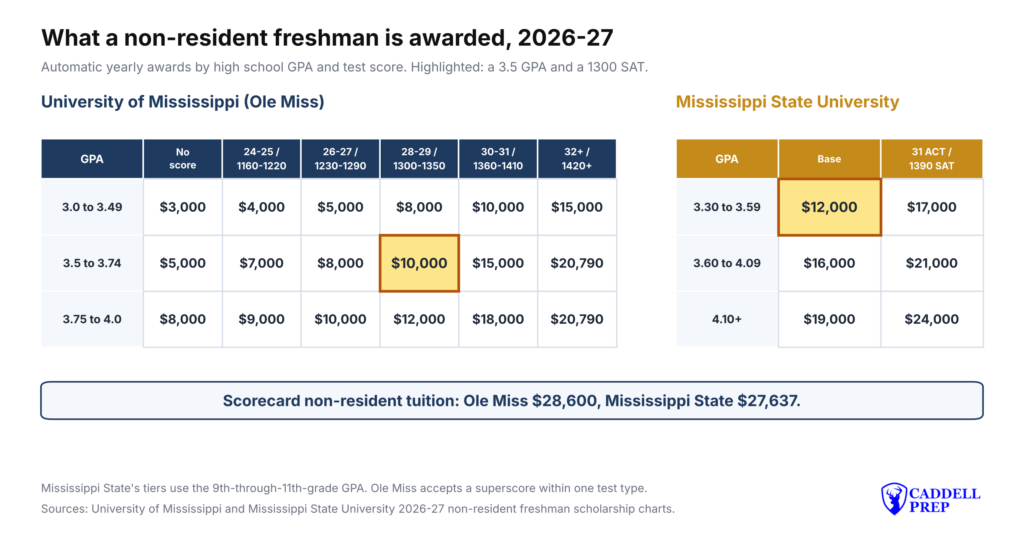
The image above shows both charts with the page’s student marked on each.
Does a 3.5 GPA Cut a New Yorker's Tuition at Ole Miss?
Yes, a 3.5 high school GPA cuts a New Yorker’s tuition at the University of Mississippi, because it places a non-resident freshman in the 3.5 to 3.74 band of the university’s 2026-27 chart, where the automatic award runs from $5,000 a year with no test score to $20,790 at a 32 ACT or 1420 SAT, so the GPA alone cuts the price and the score sets the size of the cut.
The award applies to the non-resident fee, renews for up to four years on the terms the financial aid page states, and needs no application beyond admission. A student at 3.49 is in the band below, $2,000 to $5,790 a year lower at every score, so the half-point between 3.49 and 3.5 is worth more at Ole Miss than at most schools on these pages, and a student at 3.5 who moves his SAT from 1300 to 1360 moves his award from $10,000 to $15,000.
Two charts, one 2.25, one residency rule. Which schools hold the accreditation is the next section.
Which Mississippi Universities Have AACSB-Accredited Business Schools?
Six Mississippi universities hold business accreditation from AACSB International, four public and two private, and the list below names each with its city and the school that awards the business degree [VERIFY all six on the AACSB directory before publishing].
- University of Mississippi in Oxford awards its business degrees through the AACSB-accredited School of Business Administration and its accounting degrees through the AACSB-accredited Patterson School of Accountancy.
- Mississippi State University in Starkville awards its business degrees through its AACSB-accredited College of Business and its accounting degrees through the AACSB-accredited Adkerson School of Accountancy.
- Millsaps College in Jackson awards its business degrees through the AACSB-accredited Else School of Management.
- University of Southern Mississippi in Hattiesburg awards its business degrees through the AACSB-accredited College of Business and Economic Development.
- Mississippi Christian University in Clinton awards its business degrees through its AACSB-accredited School of Business.
- Jackson State University in Jackson awards its business degrees through its AACSB-accredited College of Business.
Accreditation matters for a reason that is easy to miss at seventeen. Business itself is not a licensed profession, and the one business degree that leads to a license, accounting, leads to it through the state board rather than through the school. A CPA in Mississippi normally sits on a bachelor’s degree with 24 hours of accounting and licenses on a bachelor’s and two years of experience, a master’s and one year, or 150 hours and one year, with residency or a place of business in the state required to sit [VERIFY on the board’s page]. AACSB status matters on the way there because business schools use it to decide whose courses they will accept in transfer.
Delta State University in Cleveland is the largest public left off by score range, a campus of 1,620 undergraduates whose College of Business and Aviation names the Accreditation Council for Business Schools and Programs as its accreditor, and it reports 17 to 23 on the ACT, 450 to 620 on Math, admits 100% and charges every student $8,605. Alcorn State University’s School of Business holds the same council’s accreditation and reports 15 to 19 at $8,785 for every student, and Mississippi University for Women in Columbus (17 to 24, $8,492) and Mississippi Valley State University in Itta Bena (13 to 17, $7,692, the lowest figure in the state) are accredited by the same council as far as this page could confirm [VERIFY both]. Belhaven University in Jackson (19 to 24, 520 to 630 on Math, 50% admitted, $30,250) and William Carey University in Hattiesburg (19 to 25, 500 to 600, 60%, $15,480) hold accreditation from the International Accreditation Council for Business Education [VERIFY both]. Blue Mountain Christian University (19 to 24, $20,180), Rust College in Holly Springs ($13,265), Tougaloo College and Strayer University’s Mississippi campus award business degrees under other accreditors or none [VERIFY each]. None of them is a row.
Nothing on this page ranks the six. They are four public universities and two private with the same accreditor, two flagships with a published chart, two publics within $40 of each other and of Governors State, and the pages for business colleges in Alabama, business colleges in Tennessee, business colleges in Arkansas and business colleges in Louisiana carry the schools a student looking at Mississippi is likely comparing.
What If Your Scores Are Below the Range You Want?
In Mississippi the two flagships’ floors are 21 on the ACT, with 490 on Math at Ole Miss and 540 at Mississippi State, Millsaps’s 21 and 530, Southern Miss’s 20 with no SAT range, Mississippi Christian’s 19, and Jackson State’s 15 and 390. A student under the floor he wants is not ruled out, because a quarter of admitted students were there too. He is in the quarter that needs the rest of the application to carry more, and in Mississippi a higher score is also a larger award, since a 3.5 student at Ole Miss moves from $7,000 at 1160 to $10,000 at 1300 and $15,000 at 1360, so 60 points is $5,000 a year.
The first step is finding out where the score actually is, section by section. A free diagnostic SAT gives a Math score that can be set directly against Mississippi State’s 540 floor and Ole Miss’s 490, and a total that can be set against the 1300, 1360 and 1420 lines on the Ole Miss chart and the 1390 on Mississippi State’s.
The Math section rewards the same handful of topics on every test date, and a student who knows which of them he is missing can close a gap of 50 to 100 points in weeks rather than months. The method is on our page on improving your SAT Math score, and at Ole Miss the same work carries into Accy 201, one of the three courses in the 36 hours a business student completes before he declares a major.
How to Read These Score Ranges
Each range in the table covers the middle 50% of admitted students who submitted that test, so a quarter of admitted students were below the lower number and a quarter were at or above the upper one.
A range describes the students who chose to submit at all. Where a school is test-optional, the range describes the submitters, and the submitters are the students whose scores helped them. A row marked not reported means the Scorecard has no range for that university, and a student should read the university’s own admissions page for the score it expects. More on what SAT score you need for college and on test-optional colleges.
Should You Take the ACT Instead?
Mississippi gives the ACT to its public school juniors as the state test [VERIFY current Mississippi testing], all six rows report it, and four report the SAT.
A New York student who holds an SAT should send it everywhere in Mississippi and leave the ACT alone unless a school elsewhere asks for it. Both flagship charts print an SAT column beside every ACT column, so a New Yorker reads his band from the SAT directly, and Mississippi State’s $5,000 add-on reads a 1390 SAT or a three-part ACT superscore without the Science section. Southern Miss and Mississippi Christian report no SAT range, so a student should read each university’s own page before deciding whether a score helps there.
Business Programs in Nearby States
Mississippi borders four states by land, and each has its own page in this series.
See business colleges in Alabama, business colleges in Tennessee, business colleges in Arkansas and business colleges in Louisiana.
Business Colleges in Other States
We publish the same breakdown for business programs in every state.
See business colleges by state for the full list.

Glyn Caddell
Glyn Caddell holds a BS in Mechanical Engineering from NJIT and has been tutoring New York City students since 2008. He founded Caddell Prep in 2012 and is the author of Digital SAT Math Secrets: Lessons & Tricks to Quickly Improve to a Perfect 800 on the Math Test, which contains over 900 practice problems and is used in Caddell Prep’s SAT math classes. He is founding president of the Staten Island Technical High School alumni association and teaches every lesson on this site personally.
Finally, an SAT course that students actually understand
Every question has a video explanation. Not most — every one.
The on-demand Digital SAT course covers all 17 math topics and 15 reading and writing topics, with 5 full-length practice tests and a 100-point score increase guarantee. Keep access for the rest of high school. No subscription.
Want to Know What 5 Topics Will Improve Your SAT Score the Most?
Sample Feedback from our Diagnostic Test: