
Home » College SAT Score Ranges, Costs, and Programs by Major and State » Best Business Colleges » Business Colleges in Arkansas: ACT Scores, SAT Scores, Costs, and Programs
By Glyn Caddell, BSME · Author of Digital SAT Math Secrets · Tutoring since 2008 — Updated November 7, 2026
Eight Arkansas universities hold AACSB-accredited business schools, and this page lists the ACT and SAT scores of the students they admit, what each charges a New York student, and what the flagship’s Walton College asks before a student is a business major.
Seven of the eight report an ACT range, so the table leads with the ACT and sorts by it.
At the University of Arkansas the score admits a student to the university and thirteen courses at a 2.50 admit him to the major, and four of the other seven charge a New Yorker less than $15,000 a year.
Table of Contents
- Arkansas Business Colleges by ACT and SAT Score
- What Does It Take to Enter the Walton College of Business?
- Which Arkansas Universities Have AACSB-Accredited Business Schools?
- What If Your Score Is Below the Range You Want?
Arkansas Business Colleges by ACT and SAT Score
Arkansas’s eight AACSB-accredited business schools are all at public universities, and the table below lists each with its ACT and SAT ranges, cost of attendance, enrollment and admit rate, from the flagship’s 21 to 28 down to Henderson State, where no range is reported. The rows are sorted by the midpoint of the ACT composite range, with ties broken by the ACT Math midpoint and then by enrollment, so the order can be checked from the table itself.
| College | ACT composite | SAT Reading & Writing | SAT Math | Business school | Cost of attendance | Undergraduates | Admit rate |
|---|---|---|---|---|---|---|---|
| University of Arkansas | 21 to 28 | 520 to 620 | 510 to 600 | Sam M. Walton College of Business | $27,767 | 28,677 | 74% |
| University of Central Arkansas | 19 to 25 | 480 to 590 | 430 to 580 | College of Business | $25,029 | 7,762 | 89% |
| Arkansas State University | 18 to 24 | 490 to 570 | 480 to 620 | Neil Griffin College of Business | $25,082 | 9,110 | 82% |
| University of Arkansas at Little Rock | 17 to 24 | 490 to 630 | 470 to 580 | College of Business | $22,519 | 4,949 | 59% |
| University of Arkansas at Fort Smith | 18 to 23 | Does not report SAT data | Does not report SAT data | College of Business and Industry | $19,048 | 4,091 | 80% |
| Southern Arkansas University | 17 to 24 | 450 to 565 | 425 to 540 | Rankin College of Business | $24,951 | 2,708 | 75% |
| Arkansas Tech University | 17 to 23 | 450 to 550 | 430 to 550 | College of Business and Economic Development | $22,808 | 5,388 | 96% |
| Henderson State University | Does not report ACT data | Does not report SAT data | Does not report SAT data | School of Business | $27,385 | 1,456 | Not reported |
Each range covers the middle 50% of admitted students who submitted that test. A quarter scored below the lower number, and the top quarter scored at or above the upper one. Being under the lower number does not rule a student out, and being just above it is not as safe as it looks. Business school names the AACSB-accredited college or school within the university that awards the business degree [VERIFY each name on the university’s site].
Schools whose business accreditation comes from another body, or from none, are left off this list and named further down. Online and for-profit institutions that report no scores are left off, and so are community colleges.
Three things about that table are worth pausing on.
Eight Arkansas universities hold AACSB business accreditation and all eight are public, and four of them, Henderson State, Fort Smith, Arkansas State and Arkansas Tech, charge a New Yorker less than $15,000 a year in tuition.
The flagship reports the highest ACT range, 21 to 28, and charges a non-resident $29,966, $4,206 less than the University of Alabama and the only flagship non-resident tuition under $30,000 on a business page so far.
Seven of the eight report an ACT range and six report SAT ranges. Fort Smith reports only the ACT and Henderson State reports neither, so a New Yorker with an SAT has six ranges to read in Arkansas.
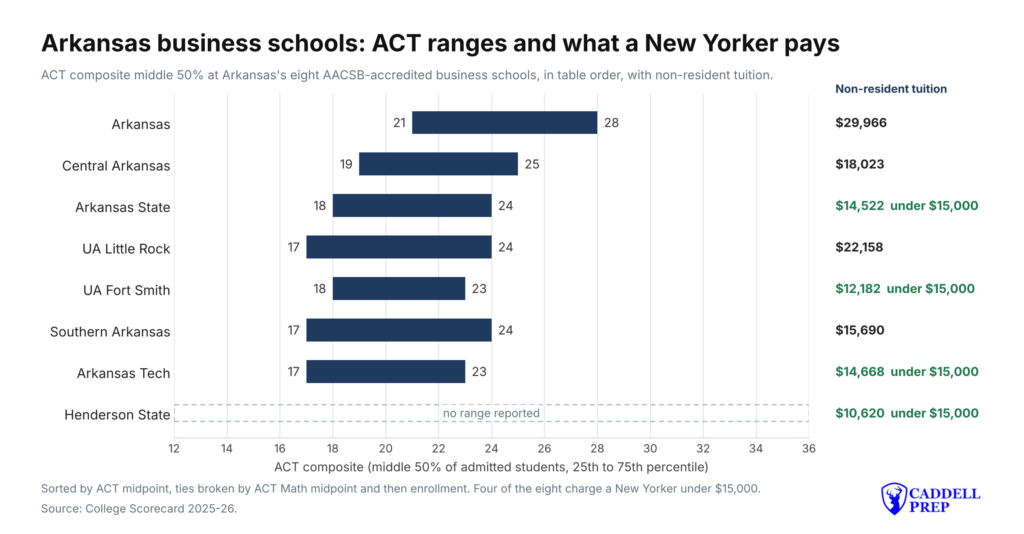
A student can see where his ACT score sits on this ladder in the image above.
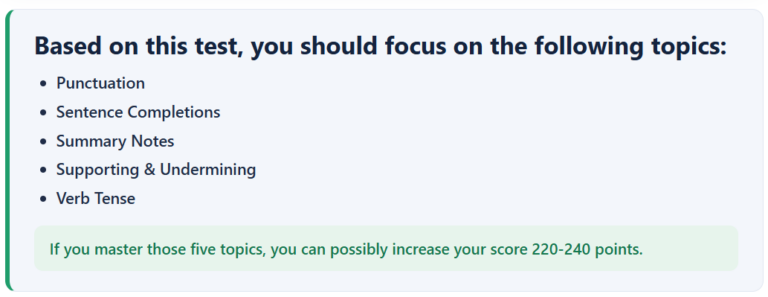
Want to Know What 5 Topics Will Improve Your SAT Score the Most?
Sample Feedback from our Diagnostic Test:
University of Arkansas
The University of Arkansas in Fayetteville awards its business degrees through the Sam M. Walton College of Business, an AACSB member since 1931 with its accounting program separately accredited since 1986, and Arkansas reports the highest score range of the eight.
ACT composite 21 to 28. Reading & Writing 520 to 620, Math 510 to 600. The top quarter of admitted students scored at or above 28 on the ACT and 600 on Math. Cost of attendance $27,767, with tuition and fees at $10,104 in-state and $29,966 out-of-state. 28,677 undergraduates, 74% admitted.
Arkansas admits a business applicant to Walton as a pre-business student with an intended major, and the college admits him to the major after thirteen courses, the subject of the next section. The cost of attendance in the table is a resident’s. A non-resident’s comes to approximately $47,629 once the higher tuition is substituted, and the $29,966 that drives it is the lowest flagship non-resident tuition in this series so far, before any award.
University of Central Arkansas
The University of Central Arkansas in Conway awards its business degrees through its College of Business, and Central Arkansas reports the second highest ACT range in the state, 19 to 25.
ACT composite 19 to 25. Reading & Writing 480 to 590, Math 430 to 580. The top quarter of admitted students scored at or above 25 on the ACT and 580 on Math. Cost of attendance $25,029, with tuition and fees at $10,523 in-state and $18,023 out-of-state. 7,762 undergraduates, 89% admitted.
Central Arkansas charges a resident $419 more than the flagship does and a non-resident $11,943 less, so its non-resident premium, $7,500, is the kind of number a New Yorker reads twice. Its Math floor of 430 is 80 points below Fayetteville’s and its Math ceiling of 580 is 20 points below.
Arkansas State University
Arkansas State University in Jonesboro awards its business degrees through the Neil Griffin College of Business, with its BS in Accounting and Master of Accountancy listed among its AACSB-accredited degrees, and Arkansas State charges a New Yorker $14,522, less than half of what the flagship charges.
ACT composite 18 to 24. Reading & Writing 490 to 570, Math 480 to 620. The top quarter of admitted students scored at or above 24 on the ACT and 620 on Math. Cost of attendance $25,082, with tuition and fees at $8,090 in-state and $14,522 out-of-state. 9,110 undergraduates, 82% admitted.
Arkansas State’s Math ceiling of 620 is the highest in the state, 20 points above the flagship’s 600, on an ACT range that sits three points lower at the top. Its resident tuition, $8,090, is the second lowest of the eight, and its non-resident premium of $6,432 is $13,430 below the flagship’s $19,862.
University of Arkansas at Little Rock
The University of Arkansas at Little Rock awards its business degrees through its College of Business, and UA Little Rock admits 59% of its applicants, the lowest rate of the eight.
ACT composite 17 to 24. Reading & Writing 490 to 630, Math 470 to 580. The top quarter of admitted students scored at or above 24 on the ACT and 580 on Math. Cost of attendance $22,519, with tuition and fees at $9,748 in-state and $22,158 out-of-state. 4,949 undergraduates, 59% admitted.
UA Little Rock sits above Fort Smith and Southern Arkansas in the table on the tie-break, all three at an ACT midpoint of 20.5, because its ACT Math midpoint of 19.5 matches Fort Smith’s and beats Southern Arkansas’s 19.0, and its enrollment is the larger of the two that remain. Its Reading & Writing ceiling of 630 is the highest in the state.
University of Arkansas at Fort Smith
The University of Arkansas at Fort Smith awards its business degrees through the College of Business and Industry, whose Bachelor of Business Administration its accreditation page lists as accredited by AACSB International, and Fort Smith reports an ACT range and no SAT range.
ACT composite 18 to 23. Fort Smith reports no SAT range. The top quarter of admitted students scored at or above 23 on the ACT. Cost of attendance $19,048, with tuition and fees at $7,334 in-state and $12,182 out-of-state. 4,091 undergraduates, 80% admitted.
Southern Arkansas University
Southern Arkansas University in Magnolia awards its business degrees through the Rankin College of Business, and Southern Arkansas reports the lowest SAT Math range of the eight, 425 to 540.
ACT composite 17 to 24. Reading & Writing 450 to 565, Math 425 to 540. The top quarter of admitted students scored at or above 24 on the ACT and 540 on Math. Cost of attendance $24,951, with tuition and fees at $9,960 in-state and $15,690 out-of-state. 2,708 undergraduates, 75% admitted.
Arkansas Tech University
Arkansas Tech University in Russellville awards its business degrees through the College of Business and Economic Development, and Arkansas Tech admits 96% of its applicants, the highest rate of the eight.
ACT composite 17 to 23. Reading & Writing 450 to 550, Math 430 to 550. The top quarter of admitted students scored at or above 23 on the ACT and 550 on Math. Cost of attendance $22,808, with tuition and fees at $8,674 in-state and $14,668 out-of-state. 5,388 undergraduates, 96% admitted.
Henderson State University
Henderson State University in Arkadelphia awards its business degrees through its School of Business, whose AACSB accreditation was extended in May 2025, and Henderson State charges a New Yorker $10,620, the lowest non-resident tuition of the eight and $516 above what the flagship charges a resident.
Henderson State reports no ACT or SAT range and no admit rate to the Scorecard. Cost of attendance $27,385, with tuition and fees at $8,244 in-state and $10,620 out-of-state. 1,456 undergraduates.
Eight rows say who got into the university. The next section is about the thirteen courses that stand between a Walton freshman and the business major.
What Does It Take to Enter the Walton College of Business?
The University of Arkansas admits a student to the university on his test score and to a major in the Sam M. Walton College of Business on thirteen pre-business courses passed at a C or better with a 2.50 GPA in those courses and a 2.50 overall.
The catalog sets the rule out in full. Admission to the University of Arkansas makes a student “eligible for admission to the Sam M. Walton College of Business,” and a degree-seeking student is classified as pre-business with an intended major until he completes the pre-business requirements. Those are 37 credit hours in thirteen courses: ACCT 20103, ACCT 20203 or SEVI 20503, BUSI 11101, ECON 21003, ECON 22003, ENGL 10103, ENGL 10203, ISYS 10303, ISYS 11203, ISYS 20303, MATH 22003, MATH 20503 and SPCH 10003, each with a C or better, with at least a 2.50 GPA in those courses and a 2.50 overall. Accounting and finance majors must take ACCT 20203 rather than the alternative. The pre-business requirements must be complete before a student enrolls in any junior- or senior-level Walton course, the college reviews records each semester to move students into a major, and a student follows the catalog of his first semester in Walton rather than his first at the university [VERIFY all of this on the catalog’s Walton page].
The transfer rule shows what the accreditation is for. Junior- and senior-level core courses transfer into Walton from AACSB-accredited schools, and the same courses from a four-year school without AACSB accreditation must be repeated or validated. Freshman- and sophomore-level business courses from anywhere do not count as junior- or senior-level equivalents. To graduate, a student needs a 2.00 in all University of Arkansas coursework, in the major, and in the business core.
The gate reads no test score. It reads thirteen courses, and the two math courses on the list, MATH 22003 and MATH 20503, are where the Math score a student arrives with does its last work, because it decides whether he starts in them or in the course below them [VERIFY the university’s math placement rules before stating a cutoff].
Set against the other pages in this series, Walton’s gate is the longest. On our page on business colleges in Alabama, the University of Alabama asks nine courses, 27 hours and a 2.5 at 61 hours. On our page on business colleges in Arizona, the University of Arizona’s Eller College ranks applicants after the Foundation courses on a 2.75. Walton asks thirteen courses, 37 hours and two 2.50s.
| School | When the business school admits you to the major | What it asks | GPA |
|---|---|---|---|
| Arkansas (Walton) | After the 37-hour pre-business core, normally the end of the sophomore year | Thirteen courses at C or better | 2.50 in the core and 2.50 overall |
| Alabama (Culverhouse) | Junior standing, 61 hours | Nine courses at C- or better | 2.5 |
| Arizona (Eller) | After the Foundation courses, 36 to 50 units | Foundation GPA, cover letter, resume, interview | 2.75 for Business Management, ranked otherwise |
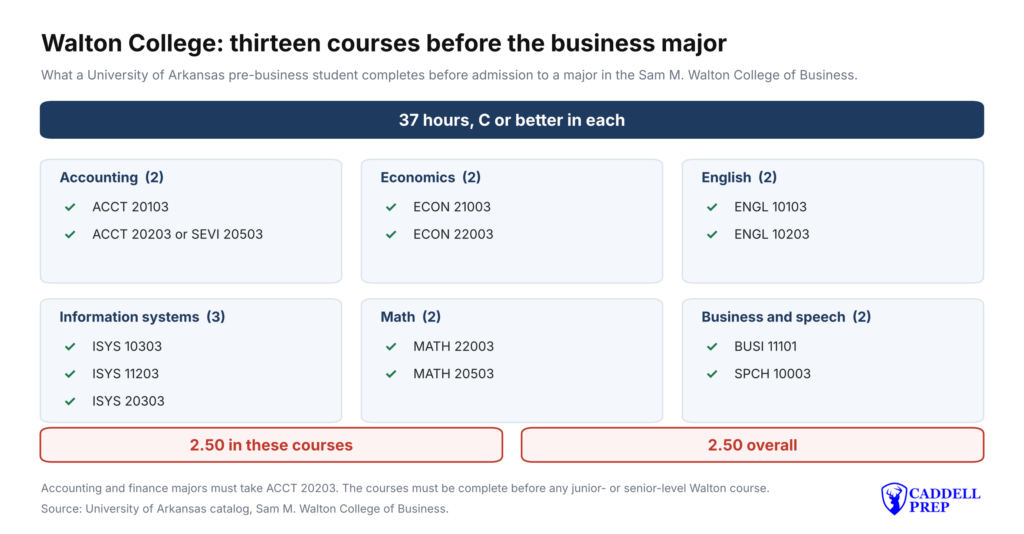
The image above lists the thirteen courses a Walton pre-business student passes before the major.
What happens to a pre-business student under a 2.50 is that he stays pre-business. The catalog names no petition and no alternative major with a lower floor, and until the thirteen courses and the two GPAs are in place the junior- and senior-level Walton courses are closed to him [VERIFY whether Walton publishes a petition route].
The price is the second thing this page is about, because Arkansas is the cheapest state in this series so far for a New Yorker. Henderson State charges a non-resident $10,620, Fort Smith $12,182, Arkansas State $14,522 and Arkansas Tech $14,668, four schools under $15,000, and Henderson State’s non-resident tuition is $516 above what the flagship charges an Arkansan. The flagship itself charges a non-resident $29,966, a premium of $19,862 over its resident tuition, and four years of it is $119,864 against $58,088 at Jonesboro and $42,480 at Arkadelphia.
The flagship then pays part of that premium back. The New Arkansan Non-Resident Tuition Award goes to incoming freshmen from outside Arkansas with a 3.20 high school GPA and an ACT or SAT score on file by February 1, with no minimum score named, and it covers a share of the difference between non-resident and resident tuition. For nine surrounding states, Georgia, Illinois, Kansas, Louisiana, Mississippi, Missouri, Oklahoma, Tennessee and Texas, the share is 70% at a 3.20, 80% at a 3.60 and 90% at a 3.80. For the university’s extended states the share is 50% at a 3.20 and 80% at a 3.60, renewed on 24 hours a year and a 2.75 [VERIFY WHETHER NEW YORK IS AN EXTENDED STATE on the eligibility map at nrta.uark.edu, then keep one of the next two sentences]. If New York is an extended state, a New Yorker with a 3.20 pays approximately $20,035 a year in tuition at Fayetteville after the award and one with a 3.60 pays approximately $14,076, inside the range of the four schools that charge under $15,000 with no award at all. If New York is not an extended state, the award does not reach him and the $29,966 stands.
The one business degree Arkansas licenses is accounting. The Arkansas State Board of Public Accountancy lets a candidate sit for the CPA exam with 120 semester hours including a bachelor’s degree and 30 semester hours of accounting beyond principles at a C or better, covering financial accounting, auditing, taxation, management accounting and governmental or not-for-profit accounting, and licenses on 150 semester hours [Walton accounting department page citing Board Rule 3, VERIFY on the board’s site, including business hours and experience]. Alabama asks 150 hours with 33 in accounting, Arizona 150 with 36, and Alaska a bachelor’s degree from 2026. Arkansas asks the most accounting hours of the four to sit and sits with Alabama and Arizona on the license.
Take a New York student with a 1300 on the SAT, 650 on each section, and a 3.5 GPA. At Arkansas he is above the 510 to 600 Math range and the 520 to 620 Reading & Writing range entirely, in the top quarter on both, admitted at 74%, and he enters Walton as a pre-business student with the thirteen courses in front of him, normally through the end of his sophomore year. If New York is an extended state, his 3.5 earns half the differential, $9,931 a year, and a 3.60 before the first day of class would earn 80% [VERIFY]. At Arkansas State he is above 480 to 620 on Math, admitted at 82%, and he pays $14,522 with no award needed. At Henderson State there is no range and he pays $10,620. Four years of tuition is $119,864 at Fayetteville before any award, $58,088 at Jonesboro and $42,480 at Arkadelphia. The score put him in the top quarter at the flagship, and the gate there reads thirteen courses, not the score.
The honest version is that Walton does not publish how many pre-business students reach a major. The other seven business schools’ admission rules were not found for this page and are not described here, rather than described as absent [VERIFY each catalog]. The award’s extended-state list could not be read and New York’s place on it is the page’s largest open question. Henderson State reports no range and no admit rate. The page does not say which business school is better. It says what the flagship asks before the major and what each school charges a New Yorker.
Families reading the thirteen courses frequently ask whether a freshman is in Walton at all.
Does the University of Arkansas Admit Freshmen Directly to the Walton College?
A freshman admitted to the University of Arkansas is admitted to the Sam M. Walton College of Business as a pre-business student with an intended major, and he becomes a business major only after the thirteen pre-business courses are complete at a 2.50 in those courses and a 2.50 overall.
Pre-business standing puts a student in the college, with its advising and its freshman business course, BUSI 11101, and keeps him out of every junior- and senior-level Walton course until the college reclassifies him. The reclassification happens on the semester review once the record shows the thirteen courses and the two GPAs [VERIFY]. The letter from the university is the first door. The thirteen courses are the second.
One college, two doors. Which schools hold the accreditation is the next section.
Which Arkansas Universities Have AACSB-Accredited Business Schools?
Eight Arkansas universities hold business accreditation from AACSB International, and the list below names each with its city and the school that awards the business degree [VERIFY all eight on the AACSB directory before publishing].
- The University of Arkansas in Fayetteville awards its business degrees through the AACSB-accredited Sam M. Walton College of Business.
- The University of Central Arkansas in Conway awards its business degrees through its AACSB-accredited College of Business.
- Arkansas State University in Jonesboro awards its business degrees through the AACSB-accredited Neil Griffin College of Business.
- The University of Arkansas at Little Rock awards its business degrees through its AACSB-accredited College of Business.
- The University of Arkansas at Fort Smith awards its business degrees through the AACSB-accredited College of Business and Industry.
- Southern Arkansas University in Magnolia awards its business degrees through the AACSB-accredited Rankin College of Business.
- Arkansas Tech University in Russellville awards its business degrees through the AACSB-accredited College of Business and Economic Development.
- Henderson State University in Arkadelphia awards its business degrees through its AACSB-accredited School of Business.
Accreditation matters for a reason that is easy to miss at seventeen. Business itself is not a licensed profession, and the one business degree that leads to a license, accounting, leads to it through the state board rather than through the school. A CPA in Arkansas normally needs 150 semester hours, the Uniform CPA Examination and experience the board accepts, and may sit for the exam at 120 hours with a bachelor’s degree and 30 accounting hours beyond principles [VERIFY on the board’s site]. AACSB status matters on the way there because business schools use it to decide whose courses they will accept, and Walton’s own catalog takes junior- and senior-level core courses in transfer only from AACSB-accredited schools.
Harding University’s Paul R. Carter College of Business in Searcy and the University of Arkansas at Pine Bluff’s School of Business and Management hold business accreditation from the ACBSP rather than AACSB, and Ouachita Baptist University and John Brown University hold the same [VERIFY the last two]. Harding reports 530 to 660 on Reading & Writing and 520 to 630 on Math on an ACT range of 20 to 29, higher at the top than any school in the table, and charges $26,262 to every student. Hendrix College, Lyon College, the University of the Ozarks, Central Baptist, Williams Baptist, Philander Smith, Arkansas Baptist, Crowley’s Ridge and Ecclesia award business bachelor’s degrees without AACSB accreditation, and so does the University of Arkansas at Monticello [VERIFY each]. UA Grantham and Strayer are online or for-profit and report no scores.
Nothing on this page ranks the eight. They are eight public schools with the same accreditor, one published gate and eight prices, and the pages for business colleges in Tennessee and business colleges in Missouri carry the neighbors a student looking at Arkansas is likely comparing.
What If Your Score Is Below the Range You Want?
In Arkansas the highest floor is the flagship’s, 510 on Math and 21 on the ACT, and five of the seven schools that report a Math range have floors under 500. A student under the floor he wants is not ruled out, because a quarter of admitted students were there too. He is in the quarter that needs the rest of the application to carry more.
The first step is finding out where the score actually is, section by section. A free diagnostic SAT gives a Math score that can be set directly against Fayetteville’s 510 floor, and the same score is the one the Non-Resident Tuition Award wants on file by February 1, with no minimum attached.
The Math section rewards the same handful of topics on every test date, and a student who knows which of them he is missing can close a gap of 50 to 100 points in weeks rather than months. The method is on our page on improving your SAT Math score, and at Walton the same algebra fills MATH 22003 and MATH 20503, two of the thirteen courses a pre-business student passes before the major.
How to Read These Score Ranges
Each range in the table covers the middle 50% of admitted students who submitted that test, so a quarter of admitted students were below the lower number and a quarter were at or above the upper one.
A range describes the students who chose to submit at all. Where a school is test-optional, the range describes the submitters, and the submitters are the students whose scores helped them. More on what SAT score you need for college and on test-optional colleges.
Should You Take the ACT Instead?
Arkansas gives the ACT to every public school junior as the state test [VERIFY current Arkansas statewide testing], and that is why seven of the eight schools report an ACT range and Fort Smith reports the ACT alone.
A New York student who holds an SAT should send it to the six schools that publish an SAT range and read Fort Smith’s 18 to 23 through a concordance rather than take the ACT for one school’s sake. The Non-Resident Tuition Award accepts either test.
Business Programs in Nearby States
Arkansas borders Missouri, Tennessee, Mississippi, Louisiana, Texas and Oklahoma, and each has AACSB-accredited business schools of its own [VERIFY the lists before linking].
See business colleges in Tennessee, business colleges in Missouri, and business colleges in Oklahoma.
Business Colleges in Other States
We publish the same breakdown for business programs in every state.
See business colleges by state for the full list.

Glyn Caddell
Glyn Caddell holds a BS in Mechanical Engineering from NJIT and has been tutoring New York City students since 2008. He founded Caddell Prep in 2012 and is the author of Digital SAT Math Secrets: Lessons & Tricks to Quickly Improve to a Perfect 800 on the Math Test, which contains over 900 practice problems and is used in Caddell Prep’s SAT math classes. He is founding president of the Staten Island Technical High School alumni association and teaches every lesson on this site personally.
Finally, an SAT course that students actually understand
Every question has a video explanation. Not most — every one.
The on-demand Digital SAT course covers all 17 math topics and 15 reading and writing topics, with 5 full-length practice tests and a 100-point score increase guarantee. Keep access for the rest of high school. No subscription.
Want to Know What 5 Topics Will Improve Your SAT Score the Most?
Sample Feedback from our Diagnostic Test: