
Home » College SAT Score Ranges, Costs, and Programs by Major and State » Best Business Colleges » Business Colleges in New York: SAT Scores, ACT Scores, Costs, and Programs
By Glyn Caddell, BSME · Author of Digital SAT Math Secrets · Tutoring since 2008 — Updated November 13, 2026
Forty-one New York universities hold AACSB-accredited business schools, fifteen public and twenty-six private, and this page lists the SAT and ACT scores of the students they admit, what each costs a New Yorker at home, where he is the resident, and what the two public business schools he reads first ask once he is in.
Thirty-eight report an SAT range and thirty-five an ACT range, so the table leads with the SAT.
Baruch’s Zicklin admits from pre-business at 45 units on a 2.3 and a 2.3 under a 2.25 rule, Binghamton’s School of Management calls internal transfer extremely competitive with recent admits near a 3.7, and New York’s CPA law opens a 120-hour, two-year route on November 21, 2026.
Table of Contents
- New York Business Colleges by SAT and ACT Score
- What Do Zicklin and Binghamton’s School of Management Ask of Their Own Students?
- Which New York Universities Have AACSB-Accredited Business Schools?
- What If Your Score Is Below the Range You Want?
New York Business Colleges by SAT and ACT Score
New York’s forty-one AACSB-accredited business schools run from the Cornell SC Johnson College of Business in Ithaca and the Stern School at New York University, with Math ranges of 770 to 800 and 760 to 800, to three campuses that report no range, and the table below lists each with its SAT and ACT ranges where reported, cost of attendance, enrollment and admit rate, with the cost of attendance at every public row the New Yorker’s own, because on this page he is the resident. Fifteen are public and twenty-six private, thirty-eight report an SAT range, and the rows are sorted by the midpoint of the SAT Math range, with ties broken on the ACT composite midpoint and then on enrollment and the three non-reporters following in order of enrollment, so the order can be checked from the table itself.
| College | SAT Reading & Writing | SAT Math | ACT composite | Business school | Cost of attendance | Undergraduates | Admit rate |
|---|---|---|---|---|---|---|---|
| Cornell University | 730 to 770 | 770 to 800 | 33 to 35 | Cornell SC Johnson College of Business | $88,140 | 15,995 | 9% |
| New York University | 720 to 760 | 760 to 800 | 34 to 35 | Leonard N. Stern School of Business | $84,374 | 28,663 | 9% |
| University of Rochester | 680 to 750 | 730 to 790 | 31 to 34 | Simon Business School | $85,962 | 6,331 | 40% |
| Rensselaer Polytechnic Institute | 670 to 740 | 705 to 770 | 30 to 34 | Lally School of Management | $82,404 | 5,714 | 63% |
| Stony Brook University | 650 to 730 | 680 to 770 | 29 to 33 | College of Business | $30,539 | 18,101 | 49% |
| Yeshiva University | 670 to 740 | 670 to 770 | 29 to 33 | Sy Syms School of Business | $70,892 | 2,852 | 56% |
| Binghamton University | 670 to 740 | 670 to 760 | 30 to 32 | School of Management | $30,345 | 14,655 | 39% |
| Fordham University | 660 to 730 | 660 to 750 | 30 to 33 | Gabelli School of Business | $82,762 | 10,512 | 59% |
| Rochester Institute of Technology | 650 to 720 | 650 to 740 | 29 to 33 | Saunders College of Business | $74,626 | 13,215 | 67% |
| Syracuse University | 640 to 720 | 630 to 720 | 29 to 32 | Martin J. Whitman School of Management | $84,517 | 15,477 | 46% |
| New York Institute of Technology | 590 to 690 | 600 to 730 | 24 to 32 | School of Management | $56,976 | 3,440 | 81% |
| Hofstra University | 620 to 700 | 610 to 700 | 28 to 32 | Frank G. Zarb School of Business | $70,624 | 6,488 | 68% |
| University at Buffalo | 600 to 680 | 610 to 700 | 27 to 32 | School of Management | $30,785 | 20,112 | 74% |
| Clarkson University | 590 to 690 | 610 to 700 | 25 to 32 | David D. Reh School of Business | $79,022 | 2,196 | 77% |
| Ithaca College | 630 to 710 | 600 to 680 | 27 to 30 | School of Business | $68,699 | 4,242 | 69% |
| Manhattan University | 580 to 680 | 600 to 678 | 25 to 29 | O’Malley School of Business | $64,348 | 2,744 | 79% |
| SUNY Geneseo | 600 to 670 | 590 to 670 | 26 to 31 | School of Business | $27,709 | 3,869 | 66% |
| SUNY Fredonia | 590 to 680 | 570 to 690 | 23 to 28 | School of Business | $25,879 | 2,755 | 78% |
| Baruch College (CUNY) | 550 to 690 | 550 to 710 | not reported | Zicklin School of Business | $14,170 | 16,154 | 48% |
| Marist University | 600 to 680 | 590 to 660 | 25 to 31 | School of Management | $67,574 | 5,182 | 57% |
| Siena University | 550 to 680 | 560 to 680 | 27 to 33 | School of Business | $64,870 | 3,409 | 69% |
| Le Moyne College | 580 to 670 | 580 to 660 | 25 to 30 | Madden School of Business | $53,183 | 2,439 | 83% |
| St. John’s University | 580 to 670 | 570 to 670 | 24 to 29 | Peter J. Tobin College of Business | $65,527 | 9,477 | 83% |
| Pace University | 600 to 680 | 580 to 660 | 24 to 29 | Lubin School of Business | $69,550 | 7,665 | 76% |
| Adelphi University | 570 to 660 | 550 to 680 | 24 to 30 | Robert B. Willumstad School of Business | $63,189 | 5,276 | 66% |
| LIU Post | 560 to 670 | 550 to 680 | 21 to 30 | College of Management | $55,424 | 5,520 | 86% |
| SUNY New Paltz | 600 to 690 | 570 to 650 | 25 to 29 | School of Business | $28,428 | 6,086 | 62% |
| St. John Fisher University | 560 to 650 | 560 to 650 | 23 to 28 | School of Business | $55,201 | 2,565 | 66% |
| Iona University | 570 to 650 | 540 to 650 | 24 to 29 | LaPenta School of Business | $60,247 | 2,951 | 87% |
| Alfred University | 555 to 660 | 540 to 650 | 24 to 29 | College of Business | $57,445 | 1,423 | 74% |
| SUNY Brockport | 550 to 640 | 550 to 640 | 23 to 26 | School of Business and Management | $26,046 | 5,784 | 71% |
| SUNY Oswego | 530 to 630 | 540 to 640 | 23 to 29 | School of Business | $27,052 | 5,473 | 81% |
| St. Bonaventure University | 535 to 650 | 530 to 640 | 24 to 30 | School of Business | $57,271 | 2,012 | 82% |
| Brooklyn College (CUNY) | 460 to 660 | 490 to 680 | not reported | Murray Koppelman School of Business | $14,151 | 10,543 | 58% |
| SUNY Plattsburgh | 540 to 640 | 540 to 610 | 22 to 28 | School of Business and Economics | $28,244 | 3,769 | 78% |
| Niagara University | 530 to 625 | 530 to 610 | 22 to 28 | Holzschuh College of Business Administration | $51,632 | 2,653 | 87% |
| Farmingdale State College | 520 to 620 | 520 to 620 | 20 to 28 | School of Business | $18,966 | 9,552 | 63% |
| College of Staten Island (CUNY) | 460 to 620 | 430 to 630 | not reported | Lucille and Jay Chazanoff School of Business | $14,795 | 9,657 | 92% |
| University at Albany | not reported | not reported | not reported | Massry School of Business | $28,802 | 12,564 | 69% |
| SUNY Old Westbury | not reported | not reported | not reported | School of Business | $21,287 | 4,162 | 84% |
| Canisius University | not reported | not reported | not reported |
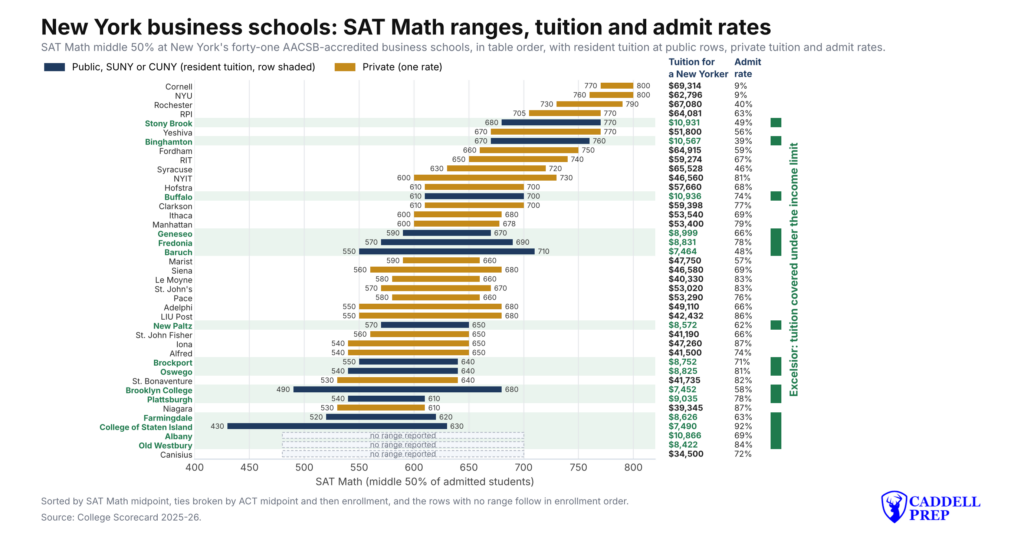
A student can see where his Math score sits on this ladder in the image above.
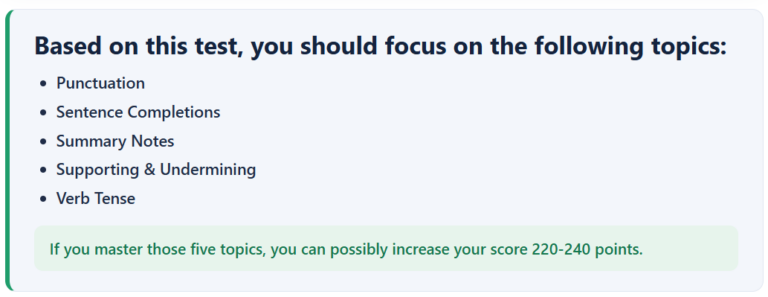
Want to Know What 5 Topics Will Improve Your SAT Score the Most?
Sample Feedback from our Diagnostic Test:
Cornell University
Cornell University in Ithaca awards its undergraduate business degrees through the Cornell SC Johnson College of Business, and Cornell reports the highest Math range on the page, 770 to 800, admits 9%, the lowest rate on the page with NYU, and charges every student $69,314, the highest tuition on the page.
Reading & Writing 730 to 770, Math 770 to 800. ACT composite 33 to 35. The top quarter of admitted students scored at or above 800 on Math and 35 on the ACT. Cost of attendance $88,140, with tuition and fees at $69,314 for every student. 15,995 undergraduates, 9% admitted.
Cornell’s 770 to 800 on Math sits 10 above NYU’s at the floor and shares its ceiling, and its 33 to 35 on the ACT is one of two ranges on the page that start above 32. The $69,314 is $6,518 above NYU’s and the same for every student, so the cost of attendance in the table is every student’s. Four years of tuition is $277,256.
New York University
New York University awards its business degrees through the Leonard N. Stern School of Business, and NYU is the largest campus on the page, with 28,663 undergraduates, reports 760 to 800 on Math, admits 9%, and charges every student $62,796.
Reading & Writing 720 to 760, Math 760 to 800. ACT composite 34 to 35. The top quarter of admitted students scored at or above 800 on Math and 35 on the ACT. Cost of attendance $84,374, with tuition and fees at $62,796 for every student. 28,663 undergraduates, 9% admitted.
NYU’s 760 to 800 on Math sits 10 under Cornell’s at the floor, and its 34 to 35 on the ACT is the highest ACT floor on the page. The $62,796 is $6,518 under Cornell’s and the same for every student, so the cost of attendance in the table is every student’s, and Stern’s own rule for a current NYU student was not read for this page [VERIFY]. Four years of tuition is $251,184.
University of Rochester
The University of Rochester awards its business degrees through the Simon Business School, and Rochester reports 730 to 790 on Math, the third range on the page, admits 40%, and charges every student $67,080.
Reading & Writing 680 to 750, Math 730 to 790. ACT composite 31 to 34. The top quarter of admitted students scored at or above 790 on Math and 34 on the ACT. Cost of attendance $85,962, with tuition and fees at $67,080 for every student. 6,331 undergraduates, 40% admitted.
Rochester’s 730 to 790 on Math sits 30 under NYU’s at the floor and 25 above RPI’s, and its 40% is the lowest admit rate on the page after Cornell’s, NYU’s and Binghamton’s. The $67,080 is the same for every student, so the cost of attendance in the table is every student’s. Four years of tuition is $268,320.
Rensselaer Polytechnic Institute
Rensselaer Polytechnic Institute in Troy awards its business degrees through the Lally School of Management, and RPI reports 705 to 770 on Math, admits 63%, and charges every student $64,081.
Reading & Writing 670 to 740, Math 705 to 770. ACT composite 30 to 34. The top quarter of admitted students scored at or above 770 on Math and 34 on the ACT. Cost of attendance $82,404, with tuition and fees at $64,081 for every student. 5,714 undergraduates, 63% admitted.
RPI’s 705 to 770 on Math sits 25 above Stony Brook’s at the floor and shares its ceiling, and its 30 to 34 on the ACT matches Rochester’s ceiling. The $64,081 is the same for every student, so the cost of attendance in the table is every student’s. Four years of tuition is $256,324.
Stony Brook University
Stony Brook University awards its business degrees through its College of Business, and Stony Brook reports the highest public Math range on the page, 680 to 770, admits 49%, and charges a New Yorker $10,931.
Reading & Writing 650 to 730, Math 680 to 770. ACT composite 29 to 33. The top quarter of admitted students scored at or above 770 on Math and 33 on the ACT. Cost of attendance $30,539, with tuition and fees at $10,931 for a New Yorker and $32,741 for a non-resident. 18,101 undergraduates, 49% admitted.
Stony Brook’s 680 to 770 on Math sits 10 above Binghamton’s at the floor and 10 at the ceiling, and 20 above Rutgers-New Brunswick’s floor across the river, and its 29 to 33 on the ACT is the highest public ACT range on the page. The $10,931 is the New Yorker’s price, with a non-resident paying $32,741, and under Excelsior a New Yorker under the income limit pays no tuition. Four years of tuition is $43,724.
Yeshiva University
Yeshiva University in Manhattan awards its business degrees through the Sy Syms School of Business, and Yeshiva reports 670 to 770 on Math, admits 56%, and charges every student $51,800.
Reading & Writing 670 to 740, Math 670 to 770. ACT composite 29 to 33. The top quarter of admitted students scored at or above 770 on Math and 33 on the ACT. Cost of attendance $70,892, with tuition and fees at $51,800 for every student. 2,852 undergraduates, 56% admitted.
Yeshiva’s 670 to 770 on Math shares its floor with Binghamton’s and its ceiling with Stony Brook’s, and its 29 to 33 on the ACT matches Stony Brook’s. The $51,800 is $13,728 under Fordham’s and the same for every student, so the cost of attendance in the table is every student’s. Four years of tuition is $207,200.
Binghamton University
Binghamton University in Vestal awards its business degrees through its School of Management, and Binghamton admits 39%, the lowest public rate on the page, reports 670 to 760 on Math, and charges a New Yorker $10,567, the lowest figure among the four SUNY university centers.
Reading & Writing 670 to 740, Math 670 to 760. ACT composite 30 to 32. The top quarter of admitted students scored at or above 760 on Math and 32 on the ACT. Cost of attendance $30,345, with tuition and fees at $10,567 for a New Yorker and $30,447 for a non-resident. 14,655 undergraduates, 39% admitted.
Binghamton’s 670 to 760 on Math sits 10 under Stony Brook’s at each end and 10 above Rutgers-New Brunswick’s floor, and its 39% is 10 points under Stony Brook’s. The 39% is the university’s rate, and the School of Management calls internal transfer extremely competitive, the subject of the next section. The $10,567 is the New Yorker’s price, with a non-resident paying $30,447, and four years of tuition is $42,268.
Fordham University
Fordham University in the Bronx awards its business degrees through the Gabelli School of Business, and Fordham reports 660 to 750 on Math, admits 59%, and charges every student $64,915.
Reading & Writing 660 to 730, Math 660 to 750. ACT composite 30 to 33. The top quarter of admitted students scored at or above 750 on Math and 33 on the ACT. Cost of attendance $82,762, with tuition and fees at $64,915 for every student. 10,512 undergraduates, 59% admitted.
Fordham’s 660 to 750 on Math sits 10 under Binghamton’s at each end, and its 30 to 33 on the ACT matches Binghamton’s floor. The $64,915 is $834 above RPI’s and the same for every student, so the cost of attendance in the table is every student’s. Four years of tuition is $259,660.
Rochester Institute of Technology
Rochester Institute of Technology awards its business degrees through the Saunders College of Business, and RIT reports 650 to 740 on Math, admits 67%, and charges every student $59,274, with 13,215 undergraduates.
Reading & Writing 650 to 720, Math 650 to 740. ACT composite 29 to 33. The top quarter of admitted students scored at or above 740 on Math and 33 on the ACT. Cost of attendance $74,626, with tuition and fees at $59,274 for every student. 13,215 undergraduates, 67% admitted.
RIT’s 650 to 740 on Math sits 10 under Fordham’s at each end, and its 29 to 33 on the ACT matches Stony Brook’s and Yeshiva’s. The $59,274 is the same for every student, so the cost of attendance in the table is every student’s. Four years of tuition is $237,096.
Syracuse University
Syracuse University awards its business degrees through the Martin J. Whitman School of Management, and Syracuse reports 630 to 720 on Math, admits 46%, and charges every student $65,528, with 15,477 undergraduates.
Reading & Writing 640 to 720, Math 630 to 720. ACT composite 29 to 32. The top quarter of admitted students scored at or above 720 on Math and 32 on the ACT. Cost of attendance $84,517, with tuition and fees at $65,528 for every student. 15,477 undergraduates, 46% admitted.
Syracuse’s 630 to 720 on Math sits 20 under RIT’s at each end, and its 46% is three points under Baruch’s. The $65,528 is $1,552 under Rochester’s and the same for every student, so the cost of attendance in the table is every student’s. Four years of tuition is $262,112.
New York Institute of Technology
The New York Institute of Technology in Old Westbury awards its business degrees through its School of Management, and NYIT reports 600 to 730 on Math beside an ACT range of 24 to 32, eight points wide, admits 81%, and charges every student $46,560.
Reading & Writing 590 to 690, Math 600 to 730. ACT composite 24 to 32. The top quarter of admitted students scored at or above 730 on Math and 32 on the ACT. Cost of attendance $56,976, with tuition and fees at $46,560 for every student. 3,440 undergraduates, 81% admitted.
NYIT’s 600 to 730 on Math spans 130 points, the widest range among the privates on the page, and its 24 to 32 on the ACT has the lowest floor among the top eleven rows. The $46,560 is the same for every student, so the cost of attendance in the table is every student’s. Four years of tuition is $186,240.
Hofstra University
Hofstra University in Hempstead awards its business degrees through the Frank G. Zarb School of Business, and Hofstra leads the three rows tied at a 655 Math midpoint on the ACT, 28 to 32, admits 68%, and charges every student $57,660.
Reading & Writing 620 to 700, Math 610 to 700. ACT composite 28 to 32. The top quarter of admitted students scored at or above 700 on Math and 32 on the ACT. Cost of attendance $70,624, with tuition and fees at $57,660 for every student. 6,488 undergraduates, 68% admitted.
Hofstra’s 610 to 700 on Math is the range three rows share within five points, and its 28 to 32 on the ACT leads Buffalo’s 27 to 32 and Clarkson’s 25 to 32 on the midpoint. The $57,660 is the same for every student, so the cost of attendance in the table is every student’s. Four years of tuition is $230,640.
University at Buffalo
The University at Buffalo awards its business degrees through its School of Management, and Buffalo is the largest public campus on the page, with 20,112 undergraduates, shares a 655 Math midpoint with Hofstra and Clarkson, admits 74%, and charges a New Yorker $10,936.
Reading & Writing 600 to 680, Math 610 to 700. ACT composite 27 to 32. The top quarter of admitted students scored at or above 700 on Math and 32 on the ACT. Cost of attendance $30,785, with tuition and fees at $10,936 for a New Yorker and $31,536 for a non-resident. 20,112 undergraduates, 74% admitted.
Buffalo’s 610 to 700 on Math matches Hofstra’s and Clarkson’s at both ends, and the three fall on the ACT midpoint, 30, 29.5 and 28.5. The $10,936 is the New Yorker’s price, $5 above Stony Brook’s, with a non-resident paying $31,536, and four years of tuition is $43,744.
Clarkson University
Clarkson University in Potsdam awards its business degrees through the David D. Reh School of Business, and Clarkson shares a 655 Math midpoint with Hofstra and Buffalo, admits 77%, and charges every student $59,398.
Reading & Writing 590 to 690, Math 610 to 700. ACT composite 25 to 32. The top quarter of admitted students scored at or above 700 on Math and 32 on the ACT. Cost of attendance $79,022, with tuition and fees at $59,398 for every student. 2,196 undergraduates, 77% admitted.
Clarkson’s 610 to 700 on Math matches Hofstra’s and Buffalo’s, and its 25 to 32 on the ACT has the lowest floor of the three. The $59,398 is the same for every student, so the cost of attendance in the table is every student’s. Four years of tuition is $237,592.
Ithaca College
Ithaca College awards its business degrees through its School of Business, and Ithaca reports 600 to 680 on Math, admits 69%, and charges every student $53,540.
Reading & Writing 630 to 710, Math 600 to 680. ACT composite 27 to 30. The top quarter of admitted students scored at or above 680 on Math and 30 on the ACT. Cost of attendance $68,699, with tuition and fees at $53,540 for every student. 4,242 undergraduates, 69% admitted.
Ithaca’s 600 to 680 on Math sits 10 under the three rows above it at the floor and 20 at the ceiling, and its 630 to 710 on Reading & Writing is higher than its Math range. The $53,540 is the same for every student, so the cost of attendance in the table is every student’s. Four years of tuition is $214,160.
Manhattan University
Manhattan University in Riverdale awards its business degrees through the O’Malley School of Business, and Manhattan reports 600 to 678 on Math, admits 79%, and charges every student $53,400.
Reading & Writing 580 to 680, Math 600 to 678. ACT composite 25 to 29. The top quarter of admitted students scored at or above 678 on Math and 29 on the ACT. Cost of attendance $64,348, with tuition and fees at $53,400 for every student. 2,744 undergraduates, 79% admitted.
Manhattan’s 600 to 678 on Math shares its floor with Ithaca’s, and its 25 to 29 on the ACT sits two points under Ithaca’s at the floor. The $53,400 is $140 under Ithaca’s and the same for every student, so the cost of attendance in the table is every student’s. Four years of tuition is $213,600.
SUNY Geneseo
SUNY Geneseo awards its business degrees through its School of Business, and Geneseo reports 590 to 670 on Math, the highest range among the SUNY comprehensives, admits 66%, and charges a New Yorker $8,999.
Reading & Writing 600 to 670, Math 590 to 670. ACT composite 26 to 31. The top quarter of admitted students scored at or above 670 on Math and 31 on the ACT. Cost of attendance $27,709, with tuition and fees at $8,999 for a New Yorker and $19,569 for a non-resident. 3,869 undergraduates, 66% admitted.
Geneseo’s 590 to 670 on Math is the range three rows share at a 630 midpoint, and its 26 to 31 on the ACT leads Fredonia’s 23 to 28, with Baruch reporting none. The $8,999 is the New Yorker’s price, with a non-resident paying $19,569, and four years of tuition is $35,996.
SUNY Fredonia
SUNY Fredonia awards its business degrees through its School of Business, and Fredonia shares a 630 Math midpoint with Geneseo and Baruch, admits 78%, and charges a New Yorker $8,831.
Reading & Writing 590 to 680, Math 570 to 690. ACT composite 23 to 28. The top quarter of admitted students scored at or above 690 on Math and 28 on the ACT. Cost of attendance $25,879, with tuition and fees at $8,831 for a New Yorker and $19,771 for a non-resident. 2,755 undergraduates, 78% admitted.
Fredonia’s 570 to 690 on Math shares the 630 midpoint and spans 120 points, 40 more than Geneseo’s, and its 23 to 28 on the ACT is three points under Geneseo’s at each end. The $8,831 is the New Yorker’s price, with a non-resident paying $19,771, and four years of tuition is $35,324.
Baruch College (CUNY)
Baruch College in Manhattan awards its business degrees through the Zicklin School of Business, and Baruch reports the highest CUNY range on the page, 550 to 710 on Math, admits 48%, and charges a New Yorker $7,464.
Reading & Writing 550 to 690, Math 550 to 710. The top quarter of admitted students scored at or above 710 on Math. Cost of attendance $14,170, with tuition and fees at $7,464 for a New Yorker and $15,414 for a non-resident. 16,154 undergraduates, 48% admitted.
Baruch’s 550 to 710 on Math shares the 630 midpoint with Geneseo and Fredonia and spans 160 points, and the Scorecard has no ACT range for it, so it falls last of the three. The 48% is the college’s rate, and Zicklin admits from pre-business on a 2.3 under a 2.25 rule, the subject of the next section. The $7,464 is the New Yorker’s price, with a non-resident paying $15,414, and four years of tuition is $29,856.
Marist University
Marist University in Poughkeepsie awards its business degrees through its School of Management, and Marist reports 590 to 660 on Math, admits 57%, and charges every student $47,750.
Reading & Writing 600 to 680, Math 590 to 660. ACT composite 25 to 31. The top quarter of admitted students scored at or above 660 on Math and 31 on the ACT. Cost of attendance $67,574, with tuition and fees at $47,750 for every student. 5,182 undergraduates, 57% admitted.
Marist’s 590 to 660 on Math shares its floor with Geneseo’s and ends 10 lower, and its 25 to 31 on the ACT matches Geneseo’s ceiling. The $47,750 is the same for every student, so the cost of attendance in the table is every student’s. Four years of tuition is $191,000.
Siena University
Siena University in Loudonville awards its business degrees through its School of Business, and Siena leads the four rows tied at a 620 Math midpoint on the ACT, 27 to 33, admits 69%, and charges every student $46,580.
Reading & Writing 550 to 680, Math 560 to 680. ACT composite 27 to 33. The top quarter of admitted students scored at or above 680 on Math and 33 on the ACT. Cost of attendance $64,870, with tuition and fees at $46,580 for every student. 3,409 undergraduates, 69% admitted.
Siena’s 560 to 680 on Math shares a 620 midpoint with three rows, and its 27 to 33 on the ACT leads them and matches Cornell’s ceiling. The $46,580 is the same for every student, so the cost of attendance in the table is every student’s. Four years of tuition is $186,320.
Le Moyne College
Le Moyne College in Syracuse awards its business degrees through the Madden School of Business, and Le Moyne shares the 620 Math midpoint, admits 83%, and charges every student $40,330.
Reading & Writing 580 to 670, Math 580 to 660. ACT composite 25 to 30. The top quarter of admitted students scored at or above 660 on Math and 30 on the ACT. Cost of attendance $53,183, with tuition and fees at $40,330 for every student. 2,439 undergraduates, 83% admitted.
Le Moyne’s 580 to 660 on Math shares the 620 midpoint, and its 25 to 30 on the ACT sits second among the four at 27.5. The $40,330 is the same for every student, so the cost of attendance in the table is every student’s. Four years of tuition is $161,320.
St. John's University
St. John’s University in Queens awards its business degrees through the Peter J. Tobin College of Business, and St. John’s shares the 620 Math midpoint, admits 83%, and charges every student $53,020, with 9,477 undergraduates.
Reading & Writing 580 to 670, Math 570 to 670. ACT composite 24 to 29. The top quarter of admitted students scored at or above 670 on Math and 29 on the ACT. Cost of attendance $65,527, with tuition and fees at $53,020 for every student. 9,477 undergraduates, 83% admitted.
St. John’s 570 to 670 on Math shares the 620 midpoint, and it leads Pace on enrollment after the two tie on the ACT at 24 to 29. The $53,020 is $270 under Pace’s and the same for every student, so the cost of attendance in the table is every student’s. Four years of tuition is $212,080.
Pace University
Pace University in Manhattan awards its business degrees through the Lubin School of Business, and Pace shares the 620 Math midpoint and the 24 to 29 ACT range with St. John’s, admits 76%, and charges every student $53,290.
Reading & Writing 600 to 680, Math 580 to 660. ACT composite 24 to 29. The top quarter of admitted students scored at or above 660 on Math and 29 on the ACT. Cost of attendance $69,550, with tuition and fees at $53,290 for every student. 7,665 undergraduates, 76% admitted.
Pace’s 580 to 660 on Math shares the 620 midpoint and its 24 to 29 on the ACT matches St. John’s, so Pace falls behind it on enrollment, 7,665 to 9,477. The $53,290 is the same for every student, so the cost of attendance in the table is every student’s. Four years of tuition is $213,160.
Adelphi University
Adelphi University in Garden City awards its business degrees through the Robert B. Willumstad School of Business, and Adelphi reports 550 to 680 on Math, admits 66%, and charges every student $49,110.
Reading & Writing 570 to 660, Math 550 to 680. ACT composite 24 to 30. The top quarter of admitted students scored at or above 680 on Math and 30 on the ACT. Cost of attendance $63,189, with tuition and fees at $49,110 for every student. 5,276 undergraduates, 66% admitted.
Adelphi’s 550 to 680 on Math shares a 615 midpoint with LIU Post and leads it on the ACT, 27 to 25.5, and its 24 to 30 on the ACT is one point wider than Pace’s. The $49,110 is the same for every student, so the cost of attendance in the table is every student’s. Four years of tuition is $196,440.
LIU Post
Long Island University’s Post campus in Brookville awards its business degrees through its College of Management, and LIU Post shares a 615 Math midpoint with Adelphi, admits 86%, and charges every student $42,432.
Reading & Writing 560 to 670, Math 550 to 680. ACT composite 21 to 30. The top quarter of admitted students scored at or above 680 on Math and 30 on the ACT. Cost of attendance $55,424, with tuition and fees at $42,432 for every student. 5,520 undergraduates, 86% admitted.
LIU Post’s 550 to 680 on Math matches Adelphi’s at both ends, and its 21 to 30 on the ACT spans nine points, the widest ACT range on the page. The $42,432 is the same for every student, so the cost of attendance in the table is every student’s. Four years of tuition is $169,728.
SUNY New Paltz
SUNY New Paltz awards its business degrees through its School of Business, and New Paltz reports 570 to 650 on Math, admits 62%, and charges a New Yorker $8,572, the lowest SUNY figure on the page.
Reading & Writing 600 to 690, Math 570 to 650. ACT composite 25 to 29. The top quarter of admitted students scored at or above 650 on Math and 29 on the ACT. Cost of attendance $28,428, with tuition and fees at $8,572 for a New Yorker and $18,822 for a non-resident. 6,086 undergraduates, 62% admitted.
New Paltz’s 570 to 650 on Math sits 20 under Geneseo’s at each end, and its 600 to 690 on Reading & Writing is 30 above its Math range at the floor. The $8,572 is the New Yorker’s price, with a non-resident paying $18,822, and four years of tuition is $34,288.
St. John Fisher University
St. John Fisher University in Rochester awards its business degrees through its School of Business, and Fisher reports the same range on both SAT sections, 560 to 650, admits 66%, and charges every student $41,190.
Reading & Writing 560 to 650, Math 560 to 650. ACT composite 23 to 28. The top quarter of admitted students scored at or above 650 on Math and 28 on the ACT. Cost of attendance $55,201, with tuition and fees at $41,190 for every student. 2,565 undergraduates, 66% admitted.
Fisher’s 560 to 650 is the same on both sections, and its 23 to 28 on the ACT matches Fredonia’s. The $41,190 is the same for every student, so the cost of attendance in the table is every student’s. Four years of tuition is $164,760.
Iona University
Iona University in New Rochelle awards its business degrees through the LaPenta School of Business, and Iona leads the three rows tied at a 595 Math midpoint on enrollment after an ACT tie with Alfred, admits 87%, and charges every student $47,260.
Reading & Writing 570 to 650, Math 540 to 650. ACT composite 24 to 29. The top quarter of admitted students scored at or above 650 on Math and 29 on the ACT. Cost of attendance $60,247, with tuition and fees at $47,260 for every student. 2,951 undergraduates, 87% admitted.
Iona’s 540 to 650 on Math shares a 595 midpoint with Alfred and Brockport, and its 24 to 29 on the ACT ties Alfred’s, so Iona leads on enrollment, 2,951 to 1,423. The $47,260 is the same for every student, so the cost of attendance in the table is every student’s. Four years of tuition is $189,040.
Alfred University
Alfred University awards its business degrees through its College of Business, and Alfred is the smallest campus on the page, with 1,423 undergraduates, shares the 595 Math midpoint, admits 74%, and charges every student $41,500.
Reading & Writing 555 to 660, Math 540 to 650. ACT composite 24 to 29. The top quarter of admitted students scored at or above 650 on Math and 29 on the ACT. Cost of attendance $57,445, with tuition and fees at $41,500 for every student. 1,423 undergraduates, 74% admitted.
Alfred’s 540 to 650 on Math matches Iona’s at both ends and its 24 to 29 on the ACT matches it too, so enrollment decides. The $41,500 is the same for every student, so the cost of attendance in the table is every student’s. Four years of tuition is $166,000.
SUNY Brockport
SUNY Brockport awards its business degrees through its School of Business and Management, and Brockport reports the same range on both SAT sections, 550 to 640, admits 71%, and charges a New Yorker $8,752.
Reading & Writing 550 to 640, Math 550 to 640. ACT composite 23 to 26. The top quarter of admitted students scored at or above 640 on Math and 26 on the ACT. Cost of attendance $26,046, with tuition and fees at $8,752 for a New Yorker and $15,822 for a non-resident. 5,784 undergraduates, 71% admitted.
Brockport’s 550 to 640 on Math shares the 595 midpoint, and its 23 to 26 on the ACT spans three points, the narrowest ACT range on the page. The $8,752 is the New Yorker’s price, with a non-resident paying $15,822, the lowest non-resident figure among the SUNY rows, and four years of tuition is $35,008.
SUNY Oswego
SUNY Oswego awards its business degrees through its School of Business, and Oswego reports 540 to 640 on Math, admits 81%, and charges a New Yorker $8,825.
Reading & Writing 530 to 630, Math 540 to 640. ACT composite 23 to 29. The top quarter of admitted students scored at or above 640 on Math and 29 on the ACT. Cost of attendance $27,052, with tuition and fees at $8,825 for a New Yorker and $18,735 for a non-resident. 5,473 undergraduates, 81% admitted.
Oswego’s 540 to 640 on Math sits 10 under Brockport’s at the floor and matches its ceiling, and its 23 to 29 on the ACT is three points wider. The $8,825 is the New Yorker’s price, with a non-resident paying $18,735, and four years of tuition is $35,300.
St. Bonaventure University
St. Bonaventure University awards its business degrees through its School of Business, and St. Bonaventure shares a 585 Math midpoint with Brooklyn College and leads it for reporting an ACT range, admits 82%, and charges every student $41,735.
Reading & Writing 535 to 650, Math 530 to 640. ACT composite 24 to 30. The top quarter of admitted students scored at or above 640 on Math and 30 on the ACT. Cost of attendance $57,271, with tuition and fees at $41,735 for every student. 2,012 undergraduates, 82% admitted.
St. Bonaventure’s 530 to 640 on Math shares a 585 midpoint with Brooklyn College, and its 24 to 30 on the ACT matches Adelphi’s. The $41,735 is the same for every student, so the cost of attendance in the table is every student’s. Four years of tuition is $166,940.
Brooklyn College (CUNY)
Brooklyn College awards its business degrees through the Murray Koppelman School of Business, and Brooklyn reports 490 to 680 on Math, a 190-point range, admits 58%, and charges a New Yorker $7,452, the lowest tuition on the page.
Reading & Writing 460 to 660, Math 490 to 680. The top quarter of admitted students scored at or above 680 on Math. Cost of attendance $14,151, with tuition and fees at $7,452 for a New Yorker and $15,402 for a non-resident. 10,543 undergraduates, 58% admitted.
Brooklyn’s 490 to 680 on Math spans 190 points, the widest range on the page, with a ceiling 30 under Baruch’s, and the Scorecard has no ACT range for it. The $7,452 is the New Yorker’s price, $12 under Baruch’s, with a non-resident paying $15,402, and four years of tuition is $29,808.
SUNY Plattsburgh
SUNY Plattsburgh awards its business degrees through its School of Business and Economics, and Plattsburgh reports 540 to 610 on Math, admits 78%, and charges a New Yorker $9,035, the highest SUNY comprehensive figure on the page.
Reading & Writing 540 to 640, Math 540 to 610. ACT composite 22 to 28. The top quarter of admitted students scored at or above 610 on Math and 28 on the ACT. Cost of attendance $28,244, with tuition and fees at $9,035 for a New Yorker and $18,945 for a non-resident. 3,769 undergraduates, 78% admitted.
Plattsburgh’s 540 to 610 on Math sits 30 under Oswego’s at the ceiling, and its 22 to 28 on the ACT matches Niagara’s. The $9,035 is the New Yorker’s price, with a non-resident paying $18,945, and four years of tuition is $36,140.
Niagara University
Niagara University awards its business degrees through the Holzschuh College of Business Administration, and Niagara leads Farmingdale at a 570 Math midpoint on the ACT, 22 to 28 against 20 to 28, admits 87%, and charges every student $39,345, the lowest private tuition on the page after Canisius.
Reading & Writing 530 to 625, Math 530 to 610. ACT composite 22 to 28. The top quarter of admitted students scored at or above 610 on Math and 28 on the ACT. Cost of attendance $51,632, with tuition and fees at $39,345 for every student. 2,653 undergraduates, 87% admitted.
Niagara’s 530 to 610 on Math shares a 570 midpoint with Farmingdale, and its 22 to 28 on the ACT leads Farmingdale’s 20 to 28 on the midpoint, 25 to 24. The $39,345 is the same for every student, so the cost of attendance in the table is every student’s. Four years of tuition is $157,380.
Farmingdale State College
Farmingdale State College awards its business degrees through its School of Business, and Farmingdale reports the same range on both SAT sections, 520 to 620, admits 63%, and charges a New Yorker $8,626, with 9,552 undergraduates.
Reading & Writing 520 to 620, Math 520 to 620. ACT composite 20 to 28. The top quarter of admitted students scored at or above 620 on Math and 28 on the ACT. Cost of attendance $18,966, with tuition and fees at $8,626 for a New Yorker and $18,536 for a non-resident. 9,552 undergraduates, 63% admitted.
Farmingdale’s 520 to 620 is the same on both sections, and its 20 to 28 on the ACT has the lowest floor among the ACT reporters on the page. The $8,626 is the New Yorker’s price, with a non-resident paying $18,536, and four years of tuition is $34,504.
College of Staten Island (CUNY)
The College of Staten Island awards its business degrees through the Lucille and Jay Chazanoff School of Business, accredited by AACSB in November 2025, and Staten Island reports the lowest Math floor among the reporting rows, 430, admits 92%, the highest rate on the page, and charges a New Yorker $7,490.
Reading & Writing 460 to 620, Math 430 to 630. The top quarter of admitted students scored at or above 630 on Math. Cost of attendance $14,795, with tuition and fees at $7,490 for a New Yorker and $15,440 for a non-resident. 9,657 undergraduates, 92% admitted.
Staten Island’s 430 to 630 on Math spans 200 points from the lowest floor among the reporting rows, and the Scorecard has no ACT range for it. The $7,490 is the New Yorker’s price, $26 above Baruch’s, with a non-resident paying $15,440, and four years of tuition is $29,960.
University at Albany
The University at Albany awards its business degrees through the Massry School of Business, and Albany is the largest of the three rows that report no range, with 12,564 undergraduates, admits 69%, and charges a New Yorker $10,866.
Score ranges not reported. Cost of attendance $28,802, with tuition and fees at $10,866 for a New Yorker and $31,256 for a non-resident. 12,564 undergraduates, 69% admitted.
Albany’s $10,866 is the New Yorker’s price, $65 under Stony Brook’s, with a non-resident paying $31,256, and the Scorecard has no range for it, so a student should read the university’s own admissions page for the score it expects. Four years of tuition is $43,464.
SUNY Old Westbury
SUNY Old Westbury awards its business degrees through its School of Business, and Old Westbury reports no score range, admits 84%, and charges a New Yorker $8,422, the lowest SUNY figure on the page.
Score ranges not reported. Cost of attendance $21,287, with tuition and fees at $8,422 for a New Yorker and $18,842 for a non-resident. 4,162 undergraduates, 84% admitted.
Old Westbury’s $8,422 is the New Yorker’s price, $150 under New Paltz’s, with a non-resident paying $18,842, and the Scorecard has no range for it, so a student should read the college’s own admissions page for the score it expects. Four years of tuition is $33,688.
Canisius University
Canisius University in Buffalo awards its business degrees through the Wehle School of Business, and Canisius reports no score range, admits 72%, and charges every student $34,500, the lowest private tuition on the page.
Score ranges not reported. Cost of attendance $44,322, with tuition and fees at $34,500 for every student. 1,685 undergraduates, 72% admitted.
Canisius’s $34,500 is $4,845 under Niagara’s and the same for every student, so the cost of attendance in the table is every student’s, and the Scorecard has no range for it, so a student should read the university’s own admissions page for the score it expects. Four years of tuition is $138,000.
Forty-one rows say who got into the university and what a New Yorker pays. The next section is about the two public business schools on the page he reads first, and the two numbers they ask.
What Do Zicklin and Binghamton's School of Management Ask of Their Own Students?
A New Yorker who enters Baruch College or Binghamton University without a seat in the business school applies for one from inside, at Baruch by meeting three printed criteria, 45 completed units, a 2.3 Baruch GPA and a 2.3 in the pre-business courses under a rule that settles at 2.25, and at Binghamton through an intra-university transfer the university calls extremely competitive, with no cutoff, A or B in four prerequisites, and recent admits near a 3.7 and 57 credits.
Zicklin prints three criteria. A pre-business Baruch student is cleared to enroll in Zicklin courses on his scheduled enrollment date when his record shows 45 completed units, a current Baruch GPA of 2.3 or higher, and a 2.3 or higher in the pre-business courses he has completed, with transferred grades counting and international grades not, and with every applicable pre-business course on his Baruch transcript. A student who entered or re-entered Baruch in fall 2021 or later under the early entry requirements needs 30 units rather than 45. Once all pre-business courses are complete, “the 2.25 rule for admission to Zicklin will apply to both the pre-business courses GPA and overall Baruch GPA.” “Students will only be granted permission when their record shows that they have an intended BBA plan (major).” A student with an INC or PEN grade is not evaluated until it is resolved, and a student finishing a pre-business course on permit is cleared after the grade posts [VERIFY every item on the Zicklin pre-business page].
Binghamton prints no cutoff and says so. A current Binghamton student applies to the School of Management through intra-university transfer by November 15 for spring or March 15 for fall, after attending an information session, with microeconomics, macroeconomics, calculus and statistics ideally complete by the end of the semester he applies, and “Grades of A or B are necessary in each.” The page writes that “Internal transfer is extremely competitive to the programs in SOM,” that there is “no GPA or credit cutoff for admission or denial,” that a student with only one semester at Binghamton at the time of application needs at least a 3.5, and that recently admitted students typically had a 3.7 average and at least 57 credits, in the university’s own word for it. A late application is read only if space remains, decisions follow the current semester’s grades, and an admitted student who declines tells admissions within five days [VERIFY every item on the SOM IUT page].
The other thirty-nine schools on the page were not read for a gate, Stern’s rule for a current NYU student and Dyson’s for a current Cornell student among them. As far as this page knows, each admits a business major on the university application, and a family should read each catalog for any rule that follows [VERIFY all thirty-nine].
Set against the earlier pages, New York’s two public doors are the widest pair in one state the grid has printed. On our page on business colleges in Nevada, the two campuses of one system ask a 2.0 and a 2.75. On our page on business colleges in Minnesota, Carlson asks a 3.0 and reports an average above 3.50. Zicklin’s 2.25 is the lowest running line in the grid beside Ole Miss’s, and SOM’s 3.7 is the highest admitted average the grid has printed for a student transferring from inside, and a New Yorker can reach either on a MetroCard or a Route 17 bus.
| Door | Who | What the school asks | What the school says |
|---|---|---|---|
| Zicklin, Baruch College | A pre-business Baruch student | 45 completed units (30 under early entry for fall 2021 and later entrants), a current Baruch GPA of 2.3 or higher, a 2.3 or higher in completed pre-business courses, every pre-business course on the Baruch transcript, an intended BBA major on record | “The 2.25 rule for admission to Zicklin will apply to both the pre-business courses GPA and overall Baruch GPA.” Permission on the scheduled enrollment date when all three are met. |
| School of Management, Binghamton | A current Binghamton student in another school | Microeconomics, macroeconomics, calculus and statistics with “Grades of A or B are necessary in each,” an information session, an application by November 15 for spring or March 15 for fall, at least a 3.5 for a one-semester applicant |
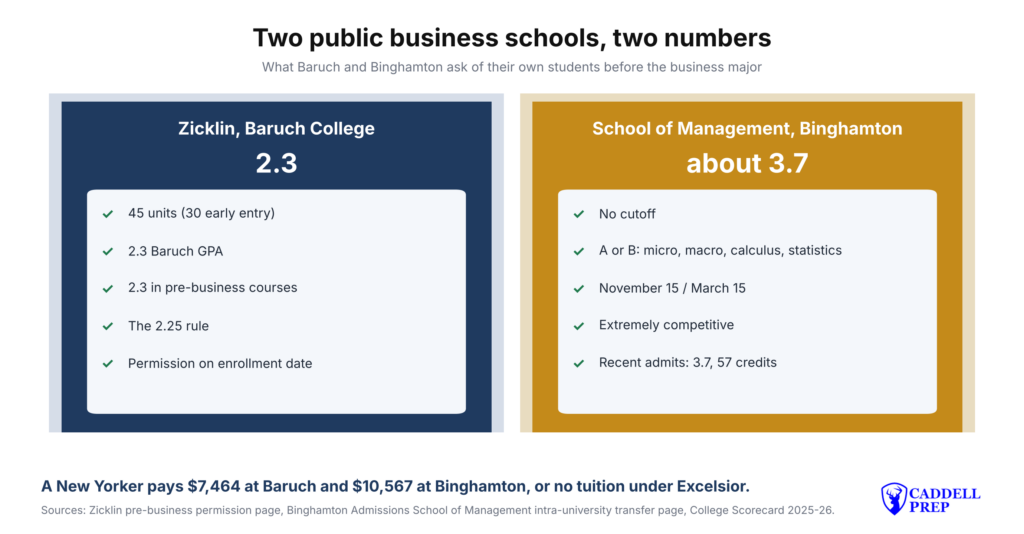
The image above shows the two public doors and the number at each
Is a 3.5 Enough to Transfer Into Binghamton's School of Management?
No, a 3.5 is not enough on its own to transfer into Binghamton University’s School of Management, because the university names a 3.5 as a minimum only for a student with one semester on campus when he applies, publishes no GPA or credit cutoff for admission or denial, and writes that internal transfer is extremely competitive and that recently admitted students typically held a 3.7 with at least 57 credits, so a 3.5 is read against a pool two tenths above it.
The A or B in microeconomics, macroeconomics, calculus and statistics is the line a student can see and hold, and the deadlines are November 15 and March 15 with late applications read only on space. Across the state system the same New Yorker enters Zicklin on a 2.3 and a 2.3 at 45 units, so the choice between the two public business schools is a choice between a rule that clears him and a review that reads him.
Two public doors, a 2.25 and a 3.7. Which schools hold the accreditation is the next section.
Which New York Universities Have AACSB-Accredited Business Schools?
Forty-one New York universities hold business accreditation from AACSB International, fifteen public and twenty-six private, and the list below names each with its city and the school that awards the business degree, in the table’s order [VERIFY all forty-one on the AACSB directory before publishing, Cornell’s undergraduate mapping, SUNY Poly’s absence, and Canisius, Alfred and LIU Post in particular].
- Cornell University in Ithaca awards its business degrees through the AACSB-accredited Cornell SC Johnson College of Business.
- New York University in Manhattan awards its business degrees through the AACSB-accredited Leonard N. Stern School of Business.
- University of Rochester in Rochester awards its business degrees through the AACSB-accredited Simon Business School.
- Rensselaer Polytechnic Institute in Troy awards its business degrees through the AACSB-accredited Lally School of Management.
- Stony Brook University in Stony Brook awards its business degrees through the AACSB-accredited College of Business.
- Yeshiva University in Manhattan awards its business degrees through the AACSB-accredited Sy Syms School of Business.
- Binghamton University in Vestal awards its business degrees through the AACSB-accredited School of Management.
- Fordham University in the Bronx awards its business degrees through the AACSB-accredited Gabelli School of Business.
- Rochester Institute of Technology in Rochester awards its business degrees through the AACSB-accredited Saunders College of Business.
- Syracuse University in Syracuse awards its business degrees through the AACSB-accredited Martin J. Whitman School of Management.
- New York Institute of Technology in Old Westbury awards its business degrees through the AACSB-accredited School of Management.
- Hofstra University in Hempstead awards its business degrees through the AACSB-accredited Frank G. Zarb School of Business.
- University at Buffalo in Buffalo awards its business degrees through the AACSB-accredited School of Management.
- Clarkson University in Potsdam awards its business degrees through the AACSB-accredited David D. Reh School of Business.
- Ithaca College in Ithaca awards its business degrees through the AACSB-accredited School of Business.
- Manhattan University in Riverdale awards its business degrees through the AACSB-accredited O’Malley School of Business.
- SUNY Geneseo in Geneseo awards its business degrees through the AACSB-accredited School of Business.
- SUNY Fredonia in Fredonia awards its business degrees through the AACSB-accredited School of Business.
- Baruch College (CUNY) in Manhattan awards its business degrees through the AACSB-accredited Zicklin School of Business.
- Marist University in Poughkeepsie awards its business degrees through the AACSB-accredited School of Management.
- Siena University in Loudonville awards its business degrees through the AACSB-accredited School of Business.
- Le Moyne College in Syracuse awards its business degrees through the AACSB-accredited Madden School of Business.
- St. John’s University in Queens awards its business degrees through the AACSB-accredited Peter J. Tobin College of Business.
- Pace University in Manhattan awards its business degrees through the AACSB-accredited Lubin School of Business.
- Adelphi University in Garden City awards its business degrees through the AACSB-accredited Robert B. Willumstad School of Business.
- LIU Post in Brookville awards its business degrees through the AACSB-accredited College of Management.
- SUNY New Paltz in New Paltz awards its business degrees through the AACSB-accredited School of Business.
- St. John Fisher University in Rochester awards its business degrees through the AACSB-accredited School of Business.
- Iona University in New Rochelle awards its business degrees through the AACSB-accredited LaPenta School of Business.
- Alfred University in Alfred awards its business degrees through the AACSB-accredited College of Business.
- SUNY Brockport in Brockport awards its business degrees through the AACSB-accredited School of Business and Management.
- SUNY Oswego in Oswego awards its business degrees through the AACSB-accredited School of Business.
- St. Bonaventure University in St. Bonaventure awards its business degrees through the AACSB-accredited School of Business.
- Brooklyn College (CUNY) in Brooklyn awards its business degrees through the AACSB-accredited Murray Koppelman School of Business.
- SUNY Plattsburgh in Plattsburgh awards its business degrees through the AACSB-accredited School of Business and Economics.
- Niagara University in Lewiston awards its business degrees through the AACSB-accredited Holzschuh College of Business Administration.
- Farmingdale State College in Farmingdale awards its business degrees through the AACSB-accredited School of Business.
- College of Staten Island (CUNY) in Staten Island awards its business degrees through the AACSB-accredited Lucille and Jay Chazanoff School of Business.
- University at Albany in Albany awards its business degrees through the AACSB-accredited Massry School of Business.
- SUNY Old Westbury in Old Westbury awards its business degrees through the AACSB-accredited School of Business.
- Canisius University in Buffalo awards its business degrees through the AACSB-accredited Wehle School of Business.
Accreditation matters for a reason that is easy to miss at seventeen. Business itself is not a licensed profession, and the one business degree that leads to a license, accounting, leads to it through the state board rather than through the school. A CPA in New York normally licenses on 150 hours and one year of experience, and from November 21, 2026 on 120 hours in an accountancy program and two years, with the Office of the Professions’ rule on the coursework still to be read [VERIFY]. AACSB status matters on the way there because business schools use it to decide whose courses they will accept in transfer.
Seven CUNY senior colleges are left off because they hold no AACSB-accredited business school, and a New Yorker will look for them first. Hunter College (550 to 720 on Math, 54% admitted, $7,382 for a New Yorker, 16,289 undergraduates), City College (530 to 730, 60%, $7,340), Queens College (510 to 640, 64%, $7,538), Lehman College (410 to 560, $7,410, with a School of Business that opened in 2022 and lists no AACSB accreditation), New York City College of Technology, York College and Medgar Evers College award business degrees without it [VERIFY each]. Skidmore College in Saratoga Springs (660 to 730 on Math, 21% admitted, $67,290) offers a management and business major without an AACSB-accredited school, and Union, Bard, Hamilton, Colgate and Vassar have no business major or no AACSB school [VERIFY each]. West Point awards no business degree. SUNY Cortland, Oneonta (550 to 650, $8,831), Buffalo State (490 to 610, $8,533), Potsdam, Cobleskill, Canton, Maritime and Poly (520 to 690, $8,625) award business degrees under other accreditors or none [VERIFY each, Poly in particular], and Empire State and Excelsior are online. Wagner College on Staten Island (590 to 630, $53,200), St. Joseph’s University in Brooklyn ($36,550), Mercy University (85% admitted, $22,880), Touro, Molloy, Utica, Nazareth, Daemen, Manhattanville, Marymount Manhattan, Dominican, St. Francis, Mount Saint Vincent, D’Youville, Roberts Wesleyan, Russell Sage, LIM, Berkeley, Hilbert, Keuka, Hartwick, St. Thomas Aquinas, Mount Saint Mary, Hobart and William Smith and St. Lawrence award business degrees without an AACSB-accredited business school [VERIFY each]. None of them is a row.
Nothing on this page ranks the forty-one. They are fifteen public universities and twenty-six private with the same accreditor, two public doors at a 2.25 and a 3.7, a resident’s price with Excelsior behind it, and the pages for business colleges in New Jersey, business colleges in Pennsylvania, business colleges in Connecticut, business colleges in Massachusetts and business colleges in Vermont carry the schools a New Yorker is likely comparing with home.
What If Your Scores Are Below the Range You Want?
In New York Cornell’s floors are 770 on Math and 33 on the ACT, NYU’s 760 and 34, Rochester’s 730 and 31, RPI’s 705 and 30, Stony Brook’s 680 and 29, Yeshiva’s and Binghamton’s 670, Fordham’s 660 and 30, RIT’s 650, Syracuse’s 630, Buffalo’s 610 and 27, Baruch’s 550, Brooklyn’s 490, Staten Island’s 430, and three rows publish none. A student under the floor he wants is not ruled out, because a quarter of admitted students were there too. He is in the quarter that needs the rest of the application to carry more.
The first step is finding out where the score actually is, section by section. A free diagnostic SAT gives a Math score that can be set directly against Baruch’s 550 floor, Binghamton’s 670 and Stony Brook’s 680, and a total that can be set against the 1300 that clears every CUNY and SUNY comprehensive range on the page.
The Math section rewards the same handful of topics on every test date, and a student who knows which of them he is missing can close a gap of 50 to 100 points in weeks rather than months. The method is on our page on improving your SAT Math score, and in New York the same algebra is the calculus and statistics Binghamton’s School of Management asks at an A or B and the pre-business courses Zicklin asks at a 2.3.
How to Read These Score Ranges
Each range in the table covers the middle 50% of admitted students who submitted that test, so a quarter of admitted students were below the lower number and a quarter were at or above the upper one.
A range describes the students who chose to submit at all. Where a school is test-optional, the range describes the submitters, and the submitters are the students whose scores helped them. A row marked not reported means the Scorecard has no range for that university, and a student should read the university’s own admissions page for the score it expects. More on what SAT score you need for college and on test-optional colleges.
Should You Take the ACT Instead?
New York requires no statewide college admission test, and the Regents examinations are not one, so a New Yorker chooses his test, and thirty-eight of the forty-one rows report the SAT while thirty-five report the ACT.
A New York student who holds an SAT should send it everywhere in the state and leave the ACT alone unless a school elsewhere asks for it. The three CUNY rows report no ACT range at all, SUNY and CUNY test policies should be read for the entering year [VERIFY both systems’ current test-optional status], and three rows report no range, so a student should read those pages before deciding whether a score helps there.
Business Programs in Nearby States
New York borders five states by land, and each has its own page in this series.
See business colleges in New Jersey, business colleges in Pennsylvania, business colleges in Connecticut, business colleges in Massachusetts and business colleges in Vermont.
Business Colleges in Other States
We publish the same breakdown for business programs in every state.
See business colleges by state for the full list.

Glyn Caddell
Glyn Caddell holds a BS in Mechanical Engineering from NJIT and has been tutoring New York City students since 2008. He founded Caddell Prep in 2012 and is the author of Digital SAT Math Secrets: Lessons & Tricks to Quickly Improve to a Perfect 800 on the Math Test, which contains over 900 practice problems and is used in Caddell Prep’s SAT math classes. He is founding president of the Staten Island Technical High School alumni association and teaches every lesson on this site personally.
Finally, an SAT course that students actually understand
Every question has a video explanation. Not most — every one.
The on-demand Digital SAT course covers all 17 math topics and 15 reading and writing topics, with 5 full-length practice tests and a 100-point score increase guarantee. Keep access for the rest of high school. No subscription.
Want to Know What 5 Topics Will Improve Your SAT Score the Most?
Sample Feedback from our Diagnostic Test: