
Home » College SAT Score Ranges, Costs, and Programs by Major and State » What SAT Score Do You Need for College? Turning a Score Into a School List
By Glyn Caddell, BSME · Author of Digital SAT Math Secrets · Tutoring since 2008 — Published September 11, 2026
Most sources answer this question backwards. You name a school and they give you a score range.
That’s useful once you already know where you’re applying. It’s not useful the morning your scores come back and you’re looking at a number wondering what it means for the list you haven’t built yet.
This page runs it the other way. Start with the score you have, and work out which schools it fits. The first thing you need is what a school’s published range actually is, because most students misread it.
Table of Contents
Where Does a School's SAT Range Come From?
When a college publishes a score range, it’s publishing the middle 50% of the students it admitted.
The lower number is the 25 percentile. A quarter of admitted students scored below it. The upper number is the 75 percentile. A quarter scored above it.
So a school reporting 1300 to 1470 admitted plenty of students under 1300 and plenty over 1470. The range isn’t a minimum and it isn’t a maximum. It’s the middle half.
Students read it as a cutoff, and it isn’t one. A score below the bottom number doesn’t disqualify anyone, and a score above the top number doesn’t guarantee anything.
What the two numbers do give you is a way to sort schools into three groups.
How Do You Sort Schools Into Reach, Target, and Likely?
Take your score and compare it to each school’s published range.
Below the 25 percentile: a reach. You’re in the bottom quarter of the admitted class. It can happen and it happens every year, but the score isn’t what’s getting you in.
Inside the middle 50%: a target. Your score is normal for that school. It won’t hurt you and it won’t carry you.
Above the 75 percentile: likely. You’re in the top quarter of admitted students. The score is an asset.
We tell students elsewhere to aim for the 75 percentile of the schools on their list. In this framework, that’s the same advice said a different way. Aiming for the 75 percentile means aiming to turn your target schools into likely ones.
One caution on the bottom end. The 25 percentile isn’t made up of ordinary applicants who got lucky. It includes recruited athletes, legacy applicants, and students admitted for reasons that have nothing to do with a test score. A regular applicant sitting at that number is in a weaker spot than the number suggests. More on that in what counts as a good SAT score.
Once you’ve sorted the schools, the question becomes how many of each you should have.
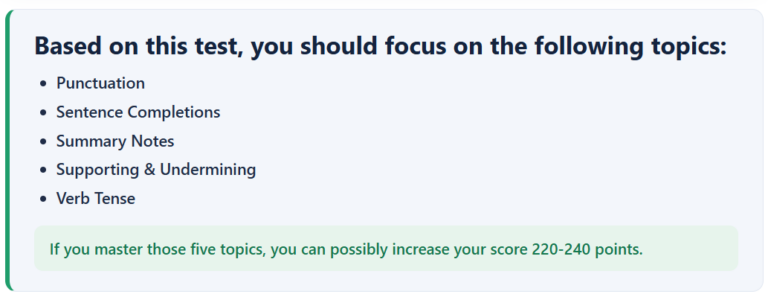
Want to Know What 5 Topics Will Improve Your SAT Score the Most?
Sample Feedback from our Diagnostic Test:
How Many of Each Should a List Have?
All three kinds. That part isn’t controversial.
The mix is, and anyone who gives you a formula is guessing. It depends on how much risk you’re comfortable with, what your family can afford, and whether there’s a school at the likely end you’d actually be happy to attend.
That last one is the part students skip. A list with three likely schools that a student has no interest in attending is a list with no likely schools. It’s just three more applications.
Here’s the only rule that always holds. At least one school on the list should be one you’re confident about and would genuinely go to. Everything else is a judgment call about how much you’re willing to gamble.
Before you finalize any of it, check one thing about the ranges you just used.
Why the School's Overall Range May Not Be Your Range
A university’s published range covers everyone it admitted, across every program.
It isn’t the range for the engineering school. It isn’t the range for nursing. It isn’t the range for the honors college. Competitive programs admit on tighter numbers than the institution as a whole, and sometimes the gap is large.
A student applying to a university’s business program and comparing himself to the university’s overall range may be looking at a number that has very little to do with the decision he’s waiting on.
So look for the program’s numbers first. Where a school publishes them, use those. Where it doesn’t, treat the overall range as a floor rather than a target, because a competitive major almost certainly sits above it.
This is why we organize our college information by major rather than only by school. See SAT score ranges by college, including the schools with the strongest programs in a given field, or go straight to a major. Our most detailed breakdowns are for pre-med programs, and we also cover nursing and engineering.
There’s one more thing that can make a published range misleading.
How Does Test-Optional Change the Numbers?
At a test-optional school, the published range only includes students who chose to submit a score.
Students with strong scores submit. Students with weak ones don’t. So the range describes a self-selected group rather than the admitted class, and it sits higher than the real range for everyone the school took.
The practical effect is that a test-optional school’s numbers look tougher than they are, and a student comparing himself to them is comparing himself to the strongest slice.
That doesn’t mean ignore the numbers. It means treat them as a bar for whether submitting helps, rather than as a description of who got in. More on test-optional colleges and how to decide whether to send a score.
Once the list exists, there’s only one number left to deal with.
What If Your Score Doesn't Fit the List You Want?
By this point you have two numbers. The score you have, and the score your list needs.
The distance between them is the only part of this you can change. The schools aren’t moving.
How Much Can You Realistically Move It?
Based on the students we’ve worked with since 2008, a 70 to 130 point improvement takes approximately 40 hours of effective studying. A 130 to 250 point improvement takes approximately 80 hours.
Whether that’s available to you depends on the calendar more than anything else. A junior in the spring has room for both of those. A senior in November has room for neither, and is better off spending the time on the rest of the application.
If the timing works, how to improve your SAT score covers the method, including how to decide which section to work on first.
Which Topics Are Costing You the Points?
Knowing the gap doesn’t tell you where the points are.
A free diagnostic SAT gives an accurate score based on College Board scoring, plus a ranked list of which of the 32 tested topics are costing the most points. The gap tells you how far. The list tells you where to start.
Does a Higher Score Change What You Pay?
It can, and this is the part students rarely factor in when deciding whether a retake is worth it.
Merit aid responds to test scores. Need-based aid doesn’t. And merit thresholds normally sit above admission thresholds, because aid is competitive among students who were already admitted.
So a score that turns a target school into a likely one may also turn a no-aid offer into an offer. More on SAT scores and merit scholarships and how merit grids work.
Where Do You Find a Specific School's Numbers?
Start with the school’s own admissions page or its common data set for the current cycle. That’s the authority, and third-party numbers lag it.
If your major has its own admission process, look for that program’s page separately. Check the financial aid page on its own too, because aid policies and admission policies are often written by different offices.
For the schools we cover, the ranges are already compiled. See colleges by major and by state.

Glyn Caddell
Glyn Caddell holds a BS in Mechanical Engineering from NJIT and has been tutoring New York City students since 2008. He founded Caddell Prep in 2012 and is the author of Digital SAT Math Secrets: Lessons & Tricks to Quickly Improve to a Perfect 800 on the Math Test, which contains over 900 practice problems and is used in Caddell Prep’s SAT math classes. He is founding president of the Staten Island Technical High School alumni association and teaches every lesson on this site personally.
Finally, an SAT course that students actually understand
Every question has a video explanation. Not most — every one.
The on-demand Digital SAT course covers all 17 math topics and 15 reading and writing topics, with 5 full-length practice tests and a 100-point score increase guarantee. Keep access for the rest of high school. No subscription.
Want to Know What 5 Topics Will Improve Your SAT Score the Most?
Sample Feedback from our Diagnostic Test: