
Home » The Digital SAT: What’s Tested, How It’s Scored, and How to Improve Your Score » SAT Scores: How Scoring Works, What’s a Good Score, and How to Raise Yours » What Is a Good SAT Score? The Benchmark, the Percentile, and Your School List
By Glyn Caddell, BSME · Author of Digital SAT Math Secrets · Tutoring since 2008 — Published September 8, 2026
There is no such thing as a good SAT score in the abstract. There is a score that opens a particular set of schools and a score that doesn’t, and which one you have depends on where you’re applying.
That said, there are three ways to judge a score, and each one is more useful than the last. An absolute floor set by the College Board. A relative position among test takers. And a target based on the specific schools on your list.
This page covers all three, plus what a good score means for scholarships, for test-optional schools, and for deciding whether to retake.
Table of Contents
- The Absolute Floor: The College Board’s Readiness Benchmark
- Your Relative Position: What the Percentiles Say
- The Number That Actually Matters: The 75 Percentile of Your School List
- Good Enough for What?
- What About Test-Optional Schools?
- What If Your Score Isn’t Where You Want It?
- Frequently Asked Questions
The Absolute Floor: The College Board's Readiness Benchmark
One standard doesn’t depend on where you’re applying. The College Board publishes College and Career Readiness Benchmarks for each section of the test.
| Section | Benchmark | Not yet approaching | Approaching | Meets or exceeds |
|---|---|---|---|---|
| Reading & Writing | 480 | 200 to 450 | 460 to 470 | 480 to 800 |
| Math | 530 | 200 to 500 | 510 to 520 | 530 to 800 |
A student who meets the Reading & Writing benchmark has a 75% chance of earning at least a C in a first-semester college course in history, literature, social sciences, or writing. A student who meets the math benchmark has the same 75% chance in algebra, statistics, precalculus, or calculus.
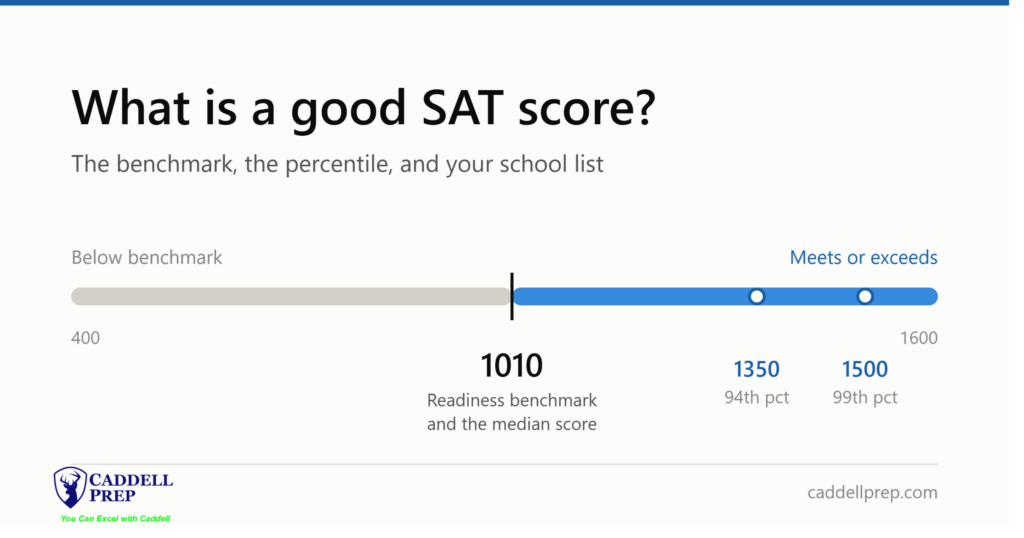
Here is the part worth sitting with. The two benchmarks add up to 1010, which is also the median SAT score. A student scoring exactly at the middle of all test takers is sitting exactly at the College Board’s own readiness threshold. By that standard, half of all students who take the SAT are below it.
That’s a more useful floor than the national average. A 1010 doesn’t mean average in the sense of fine. It means the minimum the organization that writes the test considers ready.
The College Board adds that readiness is a continuum, and that students scoring below the benchmarks can still succeed in college with additional preparation. That’s true and worth saying. But if you’re deciding whether a score needs work, the benchmark is a clearer line than the average.
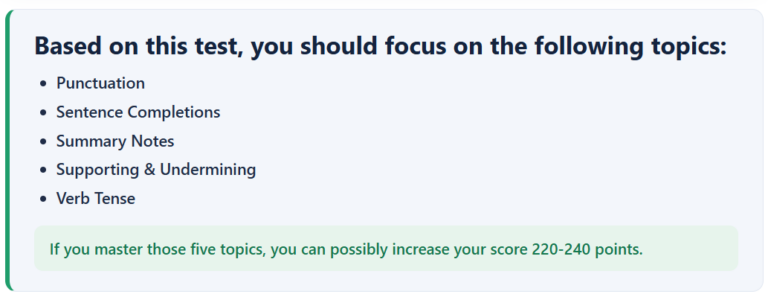
Want to Know What 5 Topics Will Improve Your SAT Score the Most?
Sample Feedback from our Diagnostic Test:
Your Relative Position: What the Percentiles Say
A percentile tells you what percentage of test takers scored below you. Here are the reference points most students want.
| Total score | Percentile |
|---|---|
| 1500 | 99 |
| 1400 | 97 |
| 1350 | 94 |
| 1200 | 81 |
| 1010 | 50 |
Percentiles are from the College Board’s Understanding SAT Scores report. See the full percentile table for every score band.
There’s a limit to what a percentile tells you, and most students miss it.
A percentile compares you to everyone who took the SAT. It does not compare you to the people applying to your schools. Those are different populations, and at a selective school the applicant pool is far stronger than the national one. A 1350 is the 94 percentile nationally and below the middle of the range at plenty of universities.
So a percentile is useful for knowing where you stand. It isn’t useful for knowing whether you’ll get in.
The Number That Actually Matters: The 75 Percentile of Your School List
Most students compare their score to a school’s average, or to the bottom of the school’s published range. Both are the wrong number.
Colleges normally publish the middle 50% of admitted students’ scores. A school might report a range of 1450 to 1550. Students see the 1450 and conclude that a 1450 makes them competitive.
It doesn’t. A 1450 at that school puts you at the bottom of the admitted range. And the bottom of that range includes recruited athletes, legacy applicants, and students admitted for reasons other than their test score. A regular applicant sitting at the 25 percentile is in a weaker position than the number suggests.
If you want a score that helps your application rather than one that doesn’t hurt it, aim for the 75 percentile of the schools on your list.
That means doing one piece of work. Look up the published range for each school you’re considering, take the top number, and use the highest one as your target. You can find SAT score ranges by college, organized by major and by state.
Good Enough for What?
“Good” changes depending on what you want the score to do.
For admission, the answer is the 75 percentile of your list, as above.
For merit scholarships, the target is normally higher than the admission range. Aid is competitive within the pool of admitted students, so a score that gets you in is not necessarily a score that pays for it. Thresholds vary by school and many publish them, so check the ones on your list rather than assuming. More on SAT scores and merit scholarships.
For course placement, some programs use SAT scores to place students into honors tracks or to skip introductory courses. This is more common in math than in other subjects.
For your own decision about retaking, the question isn’t whether the score is good. It’s whether the gap between your score and your target is worth the hours it would take to close. That’s covered further down.
What About Test-Optional Schools?
If a school is test-optional, the question changes from “is my score good enough to get in” to “is my score good enough to help.”
The general principle is straightforward. A score at or above the 75 percentile of that school’s admitted range helps your application. A score below the 25 percentile normally doesn’t, and you’re better off not submitting it. In between is a judgment call that depends on the rest of your application.
Two things make this harder than it sounds. Policies vary by school, and they have been changing. Many colleges went test-optional in 2020, and a number have reinstated requirements since 2024. Dartmouth was the first Ivy League school to do so, announcing in February 2024, and others followed.
Check each school’s current policy rather than assuming. More on test-optional colleges and how to decide whether to submit.
Want to Know What 5 Topics Will Improve Your SAT Score the Most?
Sample Feedback from our Diagnostic Test:
What If Your Score Isn't Where You Want It?
If you’ve worked through the three numbers above, you now have a target and a gap. The gap is the part you can do something about.
How Much Can You Realistically Raise It?
Based on the students we’ve worked with since 2008, a 70 to 130 point improvement takes approximately 40 hours of effective studying, and a 130 to 250 point improvement takes approximately 80 hours.
Keep in mind that the last 50 points take longer than the first 50. Going from 1000 to 1200 means closing content gaps, which are easy to find. Going from 1450 to 1550 means fixing errors that show up once every few tests, which are not.
More on how to improve your SAT score, including guides for specific starting points and targets.
Find Out Where Your Points Are Going
Knowing the gap doesn’t tell you which topics stand between you and closing it.
A free diagnostic SAT gives you an accurate score based on College Board scoring, plus a ranked list showing which of the 32 tested topics are costing you the most points. That list is what a study plan should be built around.
Should You Retake the SAT?
Retaking makes sense in three situations.
The gap to your target is within reach of the time you have left. A 100-point gain with four months and a study plan is realistic. The same gain with three weeks is not.
It was your first attempt. Most students improve on a second test simply from knowing what the day feels like.
Only one section needs to move, and your schools superscore. Superscoring means a college takes your highest Math score and your highest Reading & Writing score across test dates and combines them, so you can spend a whole retake on one section. More on superscoring and score choice.
It makes less sense when your score is already above the 75 percentile of every school on your list. At that point the score isn’t what’s holding the application back.
How Scoring Works
For the full picture of how the Digital SAT is scored, including the adaptive modules and the complete percentile table, see how the Digital SAT is scored.
Frequently Asked Questions
Is 1200 a good SAT score?
A 1200 is approximately the 81 percentile, which means you scored higher than about 81% of test takers. It’s above the College Board’s readiness benchmark and competitive at many four-year colleges. Whether it’s good enough depends on your list, so compare it to the 75 percentile of the schools you’re applying to.
Is 1400 a good SAT score?
A 1400 is approximately the 97 percentile. It’s competitive at most selective schools and below the middle of the range at the most selective ones.
What is a good SAT score for Ivy League schools?
Ivy League published ranges normally start around 1450 and run to 1570. Using the 75 percentile rule, a competitive target is approximately 1550. Ranges differ by school and change each year, so check the current published range for each one.
What is the average SAT score?
The national average is approximately 1030, and the median is 1010, which is the 50 percentile.
What SAT score do I need for a scholarship?
It depends entirely on the school. Merit aid thresholds are normally above a school’s admission range, because aid is competitive within the admitted pool. Many schools publish their thresholds, so check the ones on your list.
Is my score good enough to submit to a test-optional school?
If it’s at or above the 75 percentile of that school’s admitted range, submitting it helps. If it’s below the 25 percentile, it normally doesn’t. In between depends on the rest of your application.
Does the SAT still matter if schools are test-optional?
At a test-optional school a strong score is an advantage rather than a requirement. And a number of colleges have reinstated the requirement since 2024, so whether it matters depends on the specific schools you’re applying to.

Glyn Caddell
Glyn Caddell holds a BS in Mechanical Engineering from NJIT and has been tutoring New York City students since 2008. He founded Caddell Prep in 2012 and is the author of Digital SAT Math Secrets: Lessons & Tricks to Quickly Improve to a Perfect 800 on the Math Test, which contains over 900 practice problems and is used in Caddell Prep’s SAT math classes. He is founding president of the Staten Island Technical High School alumni association and teaches every lesson on this site personally.
Finally, an SAT course that students actually understand
Every question has a video explanation. Not most — every one.
The on-demand Digital SAT course covers all 17 math topics and 15 reading and writing topics, with 5 full-length practice tests and a 100-point score increase guarantee. Keep access for the rest of high school. No subscription.
Want to Know What 5 Topics Will Improve Your SAT Score the Most?
Sample Feedback from our Diagnostic Test: