
Home » The Digital SAT: What’s Tested, How It’s Scored, and How to Improve Your Score » SAT Scores: How Scoring Works, What’s a Good Score, and How to Raise Yours » How to Go From a 1200 to a 1400 on the SAT: Study Plan & Topic Breakdown
By Glyn Caddell, BSME · Author of Digital SAT Math Secrets · Tutoring since 2008 — Published August 25, 2026

Going from a 1200 to a 1400 is a 200-point improvement, which takes approximately 80 hours of effective studying.
What makes this jump different from a 200-point improvement at a lower score is where the points come from. A student at 1200 has normally already learned the most common topics. The points are in the topics just below those, and in getting routed to the harder second module consistently.
This page covers what a 1400 means for college applications, where the 200 points come from at this level, and how to spend 80 hours to get them.
Table of Contents
- What a 1200 and a 1400 Actually Mean
- Why 1400 Is the Number Students Target
- How Long Does It Take to Go From 1200 to 1400?
- Where the 200 Points Come From at This Level
- Getting Routed to the Harder Second Module
- An 80-Hour Plan to Get From 1200 to 1400
- Common Mistakes Students Make Going From 1200 to 1400
- Frequently Asked Questions
- Take a Free Diagnostic SAT
What a 1200 and a 1400 Actually Mean
A 1200 already puts you ahead of about four out of five students who take the SAT. Here’s how the scores in between compare.
| Score | Percentile |
|---|---|
| 1200 | 81 |
| 1250 | 86 |
| 1300 | 91 |
| 1350 | 94 |
| 1400 | 97 |
The jump is smaller in points than it is in position. 200 points moves you from beating 81 out of 100 students to beating 97 out of 100.
Why 1400 Is the Number Students Target
Most students who search for this aren’t picking 1400 at random. They’ve looked at the score range a college publishes and worked out the gap.
Colleges normally publish the middle 50% of admitted students’ scores. At many selective schools, a 1400 falls near the bottom of that range, at the 25 percentile.
That’s worth understanding correctly. A 1400 at a school whose middle 50% is 1400 to 1550 doesn’t make you competitive. It makes you eligible. And the bottom of that range includes recruited athletes, legacy applicants, and students admitted for reasons other than their test score.
If you want your score to help your application rather than just not hurt it, aim for the 75 percentile of the schools on your list, not the 25 percentile.
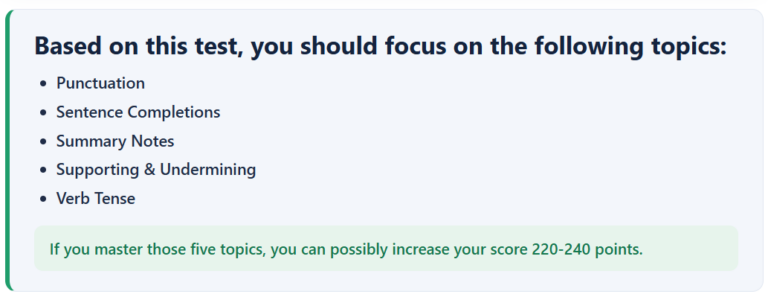
Want to Know What 5 Topics Will Improve Your SAT Score the Most?
Sample Feedback from our Diagnostic Test:
How Long Does It Take to Go From 1200 to 1400?
Based on the students we’ve worked with since 2008:
- To improve 70-130 points, students need approximately 40 hours of effective studying.
- To improve 130-250 points, students need approximately 80 hours of effective studying.
Here’s what 80 hours looks like depending on how much time you can put in each week.
| Hours per week | Weeks to reach 80 hours |
|---|---|
| 5 | 16 weeks |
| 8 | 10 weeks |
| 10 | 8 weeks |
A student scoring 1200 has normally already taken the SAT once, which means they’re usually a junior in the spring. For most of those students, the realistic plan is to study over the summer and retake in the fall, not to try to fit 80 hours between two spring test dates.
If you’re applying early decision, that matters even more. You need the score by October, which means the studying happens in July and August.
There’s one thing to understand about the hours. Effective studying is not the same as studying. Watching a lesson is not effective studying. Reading a solution is not effective studying. Effective studying means attempting problems under test conditions, getting some wrong, and then figuring out why. One hour of that is worth about three hours of reading.
Where the 200 Points Come From at This Level
This is where getting from 1200 to 1400 is different from getting from 1000 to 1200.
A student at 1200 normally doesn’t have an even split of 600 on both sections. It’s not uncommon for the two scores to be 100 points apart, like a 550 and a 650.
At that level, the five most common topics are usually not the problem. A student who consistently missed linear functions questions would not be scoring in this range.
What’s normally still open is the middle of the frequency table, plus consistency on the second module.
Math: Study the Middle of the Frequency Table
| Topic | % of test |
|---|---|
| Data & Probability | 8.7% |
| System of Equations | 8.1% |
| Ratios & Proportions | 5.7% |
| Exponential Growth & Decay | 5.6% |
| Circles | 3.5% |
| Percent | 3.1% |
| Transforming Functions | 2.6% |
Together these are approximately 37% of the math section. For a student scoring in the 550 to 650 range in math, this group is normally where the missed questions are.
Reading & Writing: Get the Grammar Topics to Certainty First
The grammar topics are approximately 25% of the Reading & Writing section. They’re rule-based, so once you know the rule you get the question right every time.
A student scoring in the 550 to 650 range in Reading & Writing normally gets most of the grammar questions right. Most isn’t enough at this level. Getting from 1200 to 1400 means getting all of them right, and that’s achievable in a way that improving on the reading topics isn’t.
After that, the reading topics. At this score level the gains come less from learning new content and more from recognizing why wrong answers are wrong. We’ve written up the wrong answer patterns that repeat across the reading topics on our 800 Reading & Writing page.
See all 15 Digital SAT Reading & Writing topics with lessons and practice questions
Finally, an SAT course that students actually understand
Every question has a video explanation. Not most — every one.
The on-demand Digital SAT course covers all 17 math topics and 15 reading and writing topics, with 5 full-length practice tests and a 100-point score increase guarantee. Keep access for the rest of high school. No subscription.
Getting Routed to the Harder Second Module
A student at 1200 is right at the boundary of where the routing decision gets made, and that alone explains a lot of the score variation students see between test dates.
Each section of the Digital SAT has two modules. Every student gets the same first module. Your performance on that first module determines whether your second module is the harder version or the easier version, and being routed to the harder version sets a much higher ceiling on your score.
For example, if you answer 14 correct on math module 1 (normally the most you can get right and still get the easier module 2), you’ll only end up with approximately a 660 on math, even if you answer all of math module 2 correctly. On Reading & Writing, 17 correct on module 1 means approximately a 640.
Two 660s is a 1320. That’s a ceiling you can hit while answering nearly everything else correctly.
The practical consequence for a student at 1200 is that accuracy on module 1 is worth more than speed on module 2. Practice the easier questions with an emphasis on not missing any, rather than spending all of your time on the hardest problems you can find.
An 80-Hour Plan to Get From 1200 to 1400
This assumes about 8 hours a week over 10 weeks.
| What you do | Hours |
|---|---|
| Take a diagnostic test and review the results | 3 |
| Study the middle-frequency topics in your weaker section | 24 |
| Get the grammar topics to certainty | 10 |
| Study the middle-frequency topics in your stronger section | 18 |
| Take four full-length practice tests, timed | 12 |
| Review each test and categorize what you missed | 8 |
| Practice module 1 questions with a focus on accuracy | 5 |
The order matters more than the exact hours. Diagnose first, work on the weaker section first, and leave enough time at the end for full practice tests.
Common Mistakes Students Make Going From 1200 to 1400
Common mistakes students make when trying to go from a 1200 to a 1400 include restudying topics they already know and ignoring module 1.
1. Restudying the Topics They Already Know
Linear functions feels productive to study because it’s familiar and it’s the most common topic on the test. At a 1200, it’s normally not where your missed questions are. Going back over material you’ve already learned is comfortable, but it doesn’t move a score.
2. Ignoring Module 1
Students at this level normally spend their practice time on the hardest questions they can find. But the routing decision is made on module 1, which contains easier questions. A student who misses three easy questions and answers two hard ones correctly is worse off than the reverse.
3. Retaking the Test Without Changing Anything
Students normally score somewhat higher the second time from familiarity with the format alone. However, that’s a small amount, not 200 points. A retake without studying in between is a retake with the same result.
4. Waiting Until Fall of Senior Year to Start
If you want a 1400 for early applications, you need the score by October. Working backwards, 80 hours means starting in July. A student who begins studying in September is planning for regular decision whether they intend to or not.
5. Using Outdated Material
There was a significant change in content between the old SAT and the Digital SAT. For example, questions with imaginary numbers appeared on the old version of the test but haven’t appeared on the Digital SAT. The old test also had an essay and “NO CHANGE” answer choices, neither of which exist now. A student using a pre-2024 book is spending hours on material that won’t be on the test.
Want to Know What 5 Topics Will Improve Your SAT Score the Most?
Sample Feedback from our Diagnostic Test:
Frequently Asked Questions
Students trying to go from a 1200 to a 1400 frequently ask whether a 1400 is a good score and how long the improvement takes.
Is 1400 a good SAT score?
A 1400 is approximately the 97 percentile, which means you scored higher than about 97% of students who took the test. At most colleges it’s a strong score. At the most selective schools it falls near the bottom of the range of admitted students, so whether it’s good enough depends on your list.
How long does it take to go from 1200 to 1400?
Approximately 80 hours of effective studying. At 8 hours a week, that’s about 10 weeks. Most students at a 1200 study over the summer and retake in the fall.
Is a 200-point improvement from 1200 harder than from 1000?
Somewhat, yes. A student at 1000 has more unlearned material left, and unlearned topics are the fastest points to get. At 1200 the most common topics are normally already closed, so the improvement comes from less common topics and from consistency.
Should I focus on Math or Reading & Writing to reach a 1400?
Start with whichever section you’re currently scoring lower in. If they’re close, the grammar topics in Reading & Writing are normally the fastest group of points on the test, because they’re rule-based.
How many times should I take the SAT to reach a 1400?
Most students take the SAT two or three times. A student at 1200 who studies for approximately 80 hours between attempts can reasonably expect to reach a 1400 on the next one.
What colleges can I get into with a 1400?
A 1400 is competitive at a wide range of four-year colleges and falls near the 25 percentile at many highly selective ones. Compare it to the 25 and 75 percentile scores published by each school on your list rather than to a national average.
Take a Free Diagnostic SAT
At a 1200, the hardest part is knowing which topics are actually costing you points, since the obvious ones normally aren’t. Students can take a free practice SAT with Caddell Prep to get an accurate score based on College Board scoring, along with an assessment showing exactly which topics to study.
If you’d rather work through the material on your own schedule, our on-demand Digital SAT course covers all 17 math topics and all 15 Reading & Writing topics with a video explanation for every practice question, and it comes with a 100-point score increase guarantee.
If you’re looking for a general guide to a 200-point improvement rather than this specific jump, see how to improve your SAT score by 200 points.

Glyn Caddell
Glyn Caddell holds a BS in Mechanical Engineering from NJIT and has been tutoring New York City students since 2008. He founded Caddell Prep in 2012 and is the author of Digital SAT Math Secrets: Lessons & Tricks to Quickly Improve to a Perfect 800 on the Math Test, which contains over 900 practice problems and is used in Caddell Prep’s SAT math classes. He is founding president of the Staten Island Technical High School alumni association and teaches every lesson on this site personally.
Need Help Preparing for the SAT?
Use the only SAT prep course built with an engineer’s approach and taught in a way that students actually understand.
100-point score increase guarantee
Take a Free Diagnostic SAT
Discover the 5 Topics That Could Make the Biggest Difference in Your Score.
Take our free diagnostic and receive a personalized assessment showing exactly what to study next.