
Home » The Digital SAT: What’s Tested, How It’s Scored, and How to Improve Your Score » SAT Prep Options: How Many Hours You Need, What Each One Costs » SAT Study Plans: How Many Hours a Week Your Plan Actually Needs » 2-Week SAT Study Plan: What 14 Days Can and Can’t Do
By Glyn Caddell, BSME · Author of Digital SAT Math Secrets · Tutoring since 2008 — Published September 22, 2026
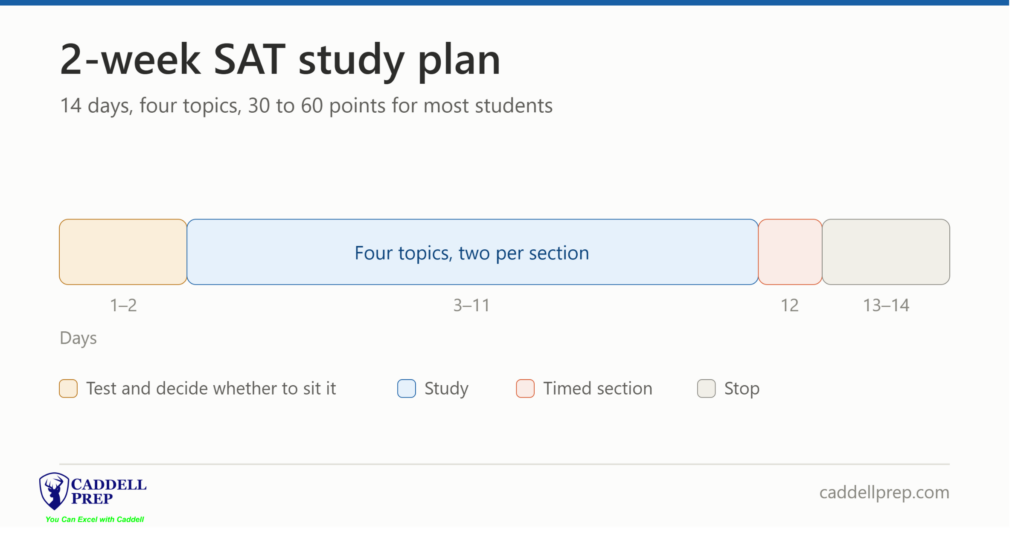
Two weeks is worth 30 to 60 points for most students. It isn’t worth 200, and anyone telling you otherwise is selling something.
What it’s genuinely good for is three things. Learning what a real timed test feels like, closing one or two specific gaps, and deciding whether you should sit for this test at all.
That last one is the most useful and it’s where this page starts.
Table of Contents
Should You Take This Test at All?
At three months out, the test date is settled and the only question is how to prepare. At two weeks it’s a live decision, and it’s worth making deliberately.
Take a full timed practice test in the first two days. Compare that score to the score you need for the schools on your list. That comparison answers it.
If a later test date is available and the gap is large, move. A student who is 200 points short and has the option of a test three months out should take that one. The two weeks are better spent on essays and the rest of the application than on a sitting that won’t produce the score.
If the date is fixed, or the gap is small, sit for it.
There’s something students don’t know that makes this decision lower-stakes than it feels. Most colleges allow Score Choice, which means you decide which test dates to send. So a first sitting can be a real-conditions rehearsal that never gets submitted anywhere.
That matters at this timeline. Taking the test and doing worse than you hoped normally costs you nothing except the fee, and it gives you the single best diagnostic available: a real score under real conditions.
A free diagnostic SAT gives you the comparison score to make the decision with, and what counts as a good SAT score covers how to work out the number you’re aiming for.
If the answer is to sit it, the question becomes what to do with the days.
What Can 14 Days Realistically Cover?
Most students can find 10 to 15 hours a week for two weeks. That’s 20 to 30 hours total. Twenty hours a week is possible over a school break and isn’t realistic during a normal term.
Here’s what those hours buy.
| Topics per section | Total topics | Share of the test | Hours per topic |
|---|---|---|---|
| 2 | 4 | 29% | 3.8 |
| 3 | 6 | 39% | 2.5 |
Take two per section. Four topics total.
Three per section covers more of the test on paper, but it drops you to about 2.5 hours per topic. For comparison, the one-month plan gives 4.7 hours per topic and we consider that the minimum for getting reliable at something.
At 2.5 hours you can be introduced to a topic. You can’t get good at it. And a topic you’re 50% accurate on isn’t worth much more than a topic you didn’t study.
Four topics at 80% accuracy beats six at 50%.
The honest number: 30 to 60 points for most students at 20 to 30 hours. A 100-point gain needs approximately 40 hours, which is 20 hours a week here, and most students carrying a full course load won’t hold that. A student on a break with 40 hours genuinely available is in the 1-month plan’s territory rather than this one’s.
Days 1 and 2: Test, Then Pick Two Topics Per Section
The practice test from the decision above does double duty. It told you whether to sit the test, and it produces your topic list.
Read the results for topics rather than for the total. Take the top two from each section and stop there.
Not four. Not six. Two per section.
If you haven’t taken a diagnostic and won’t, fall back to frequency. The most common math topics are linear functions at 15% of the section and combining like terms and solving equations at 11.7%. On Reading & Writing it’s words in context at 16.5% and punctuation at 13.6%.
Those four alone are approximately 27% of math and 30% of Reading & Writing, which is a reasonable default when there’s no time to measure. The full data is on the 17 Digital SAT math topics and the 15 Digital SAT Reading & Writing topics.
Days 3 to 11: Work Four Topics Properly
Nine days, four topics, approximately two days each.
Each one gets the same treatment as in any plan. Learn it, practice it under time pressure, review what you got wrong and work out why. That’s covered in more detail in how to improve your SAT score.
Here’s the discipline this timeline demands, and it’s the opposite of what feels right.
Don’t add topics. A student who finishes his second topic on day six and feels good about it will want to add a fifth. Don’t. Use the extra time to get the four solid.
The instinct at two weeks is to cover as much ground as possible, because the calendar feels like the enemy. It isn’t. Thin coverage is the enemy, and two weeks punishes it harder than any other timeline because there’s no second pass to fix it.
Day 12: Take One More Timed Section
Not a full test.
There’s no time left to act on a full test at this point, and sitting three hours two days before you sit another three hours costs more in fatigue than the information is worth.
Take one timed section covering the topics you worked. Review it the same day. If something’s still broken, day 13 fixes it.
The Last Two Days: Stop
Light review of your four topics. No new material. Normal sleep both nights.
The arithmetic is the same at every timeline and it bites hardest here. One more topic learned on day 13 is worth at most a question. Arriving tired costs more than that across 98 questions, and it costs it in careless errors on questions you already know how to answer.
At this timeline there’s a specific temptation worth naming. The whole fortnight felt like catching up, so stopping feels like giving up. It isn’t. The studying is done, and the only variable left is how sharp you are on the morning.
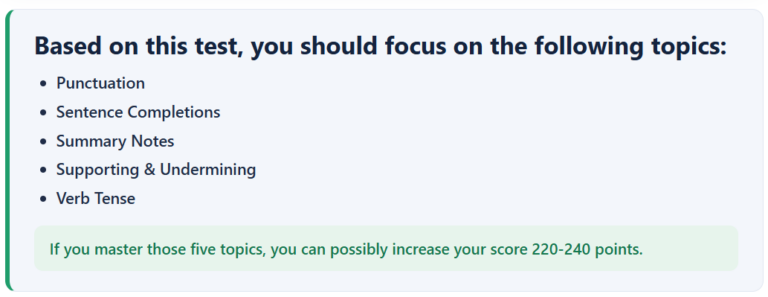
Want to Know What 5 Topics Will Improve Your SAT Score the Most?
Sample Feedback from our Diagnostic Test:
What Should You Do After This Test?
For most students at two weeks, the real plan starts after this test rather than before it.
That’s not a consolation. The score report from a real sitting is better data than any practice test, because it’s produced under conditions no practice test fully replicates. A student who sits this one and then runs a proper plan is in a stronger position than one who postponed and never started.
Plan the Next Sitting Properly
Most students take the SAT two or three times, and the second attempt normally goes better for reasons that have nothing to do with studying. You know what the room feels like.
Work backward from the next test date you’re targeting and build a real plan around it. Twelve weeks is the most common window and it supports a 200-point gain at about 7 hours a week.
See the 3-month SAT study plan, or the 6-month SAT study plan if you have longer.
How to Improve Your SAT Score
The method is the same at every timeline. What changes is how much of it fits.
The short version is that the topics worth your hours are the ones with the most available points, which means how weak you are multiplied by how often the topic appears. That’s why this plan picks two per section from the top rather than four from wherever.
More on how to improve your SAT score.
Superscoring and Score Choice
This matters more at two weeks than at any other timeline, because it’s what makes sitting an underprepared test a low-risk decision.
Most colleges allow Score Choice, so you decide which test dates to send. Many also superscore, taking your highest math score and your highest Reading & Writing score across different dates and combining them.
So a sitting that goes badly normally costs nothing, and a sitting where one section goes well contributes that section to a superscore later. Check each school’s policy, since a few require all scores. More on superscoring and score choice.
What If You Only Have a Few Days?
Some readers will arrive with less than two weeks, so here’s the honest version.
Under a week, there are two things worth doing. Take one full timed test so the format isn’t new, and sleep properly.
There’s no topic work that pays at that range. Three days isn’t enough to get reliable at anything, and spending those days on material instead of rest trades a small possible gain for a real cost.
Would Instruction Help in Two Weeks?
It can compress the topic-selection step and stop you spending three of your nine study days on the wrong material. At this timeline, that’s worth something.
What it can’t do is manufacture time.
Being straight about it: most students who find us two weeks out are better served planning the next sitting than buying anything for this one. If you want help building that plan, see all SAT prep options, and take the diagnostic first either way.

Glyn Caddell
Glyn Caddell holds a BS in Mechanical Engineering from NJIT and has been tutoring New York City students since 2008. He founded Caddell Prep in 2012 and is the author of Digital SAT Math Secrets: Lessons & Tricks to Quickly Improve to a Perfect 800 on the Math Test, which contains over 900 practice problems and is used in Caddell Prep’s SAT math classes. He is founding president of the Staten Island Technical High School alumni association and teaches every lesson on this site personally.
Finally, an SAT course that students actually understand
Every question has a video explanation. Not most — every one.
The on-demand Digital SAT course covers all 17 math topics and 15 reading and writing topics, with 5 full-length practice tests and a 100-point score increase guarantee. Keep access for the rest of high school. No subscription.
Want to Know What 5 Topics Will Improve Your SAT Score the Most?
Sample Feedback from our Diagnostic Test: