
Home » The Digital SAT: What’s Tested, How It’s Scored, and How to Improve Your Score » SAT Prep Options: How Many Hours You Need, What Each One Costs » SAT Study Plans: How Many Hours a Week Your Plan Actually Needs » 1-Month SAT Study Plan: 11 Hours a Week, and Who Schedules Them
By Glyn Caddell, BSME · Author of Digital SAT Math Secrets · Tutoring since 2008 — Updated September 23, 2026
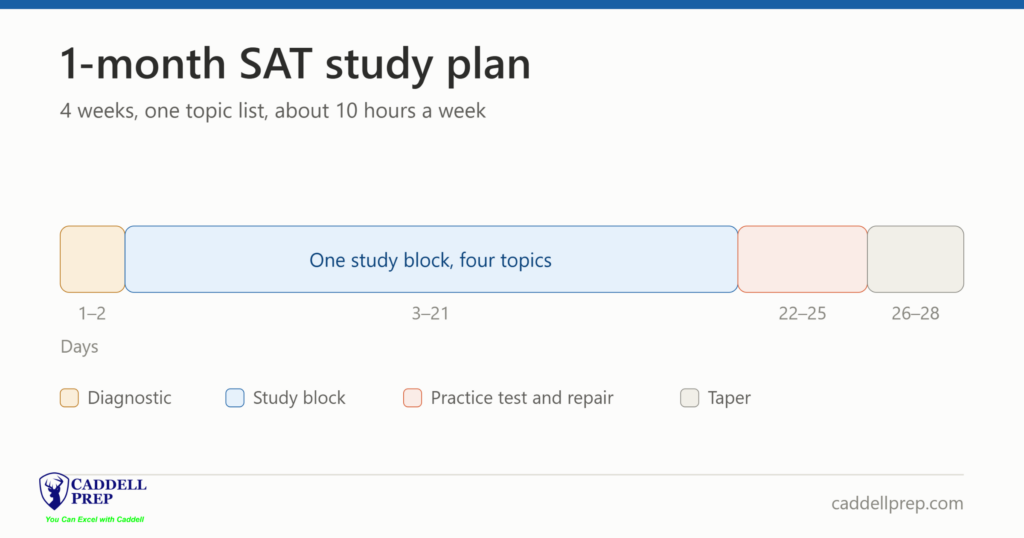
Four weeks supports approximately a 100-point improvement at 10 to 11 hours a week.
Students hear that number and assume it’s out of reach during a school year. It isn’t, and the reason has nothing to do with willpower. It depends on whether anyone is putting those hours on a calendar.
This page covers what four weeks can cover, and the two different ways students actually run it.
Table of Contents
- How Many Hours Does Four Weeks Actually Take?
- Who Schedules the Hours?
- Which Version of the Four Weeks Are You Running?
- Days 1 and 2: Take a Diagnostic and Choose Your Topics
- Weeks 1 to 3: Work the List
- Week 4: Practice Test, Repair, Then Taper
- Is Four Weeks Enough for the Score You Need?
How Many Hours Does Four Weeks Actually Take?
Based on the students we’ve worked with since 2008, a 70 to 130 point improvement takes approximately 40 hours of effective studying. Spread across four weeks, that’s approximately 10 hours a week.
That number sounds worse than it is, and we can show why with our own class.
Our four-week SAT prep class runs at 11 hours a week:
| Hours a week | |
|---|---|
| Two lessons, three hours each | 6 |
| One full practice test | 3 |
| Homework | 2 |
| Total | 11 |
Over four weeks that comes to 44 hours, which sits inside the band above. The class carries a 100-point score increase guarantee, and students complete it.
So 11 hours a week for four weeks isn’t a theoretical maximum. It’s what a full class does. The question worth asking is why it works there and so often doesn’t work on a student’s own.
Want to Know What 5 Topics Will Improve Your SAT Score the Most?
Sample Feedback from our Diagnostic Test:

Who Schedules the Hours?
Look at that table again. Nine of the 11 hours are fixed appointments. Two three-hour lessons and a three-hour practice test. Only about two hours are homework the student does on his own.
That’s 82% of the work happening because it’s on a calendar, not because a student decided on a Tuesday night that it was time to start.
Two students doing 11 hours a week are not doing the same thing.
One of them has to find 11 hours, defend them against homework and practice and everything else in the week, and then actually use them. He has to decide what to work on each time. Nobody notices if he doesn’t.
The other shows up three times and does two hours at home.
Same total. Completely different difficulty.
That’s the thing to understand about a four-week plan. It isn’t a compromised timeline and the hours aren’t impossible. It works when the hours are scheduled and it normally falls apart when they aren’t. Which of those describes your situation decides how the next four weeks should look.
Which Version of the Four Weeks Are You Running?
There are two, and they cover different amounts of ground.
Version A: self-directed. Approximately 10 hours a week that you find yourself. Three or four topics per section, covering about 39% to 49% of the test. One practice test, no rebuild cycle. A realistic target of approximately 100 points.
Version B: a four-week class. 11 hours a week with nine of them scheduled. Full coverage of both sections rather than a chosen subset. Four practice tests instead of one. A 100-point score increase guarantee.
Version B is something we sell, so read that with the appropriate amount of suspicion. What’s worth taking from the comparison is the reason it covers more ground, which isn’t a claim about quality.
It covers more because the hours are higher and because the instructor decides what happens in them. A student working alone under time pressure should pick a few topics and do them properly, because there’s no instructor sequencing the whole test and no second practice test to catch a bad choice.
If you’re taking a class, SAT prep classes covers the format, the schedule, and the guarantee terms.
If you’re working on your own, the rest of this page is your plan, and it starts with two days that decide everything after them.
Days 1 and 2: Take a Diagnostic and Choose Your Topics
Two days, not a full week. A twelve-week plan can afford a week here. This one can’t.
Take a full timed diagnostic, then read the results for topics rather than for the total score. A free diagnostic SAT gives a ranked list of which of the 32 tested topics are costing you the most points.
Then comes the part that’s different from the longer plans. You aren’t ordering the list. You’re cutting it.
Take the top three or four from each section and accept that the rest aren’t getting worked this month. Make that decision deliberately on day two rather than by default in week three when the time runs out.
This matters more at four weeks than anywhere else, because there’s no second measurement. In a twelve-week plan, a bad topic list gets corrected at the week six practice test. Here, the list you build on day two is the list you take to the test.
If you’re in a class, the diagnostic does a different job. The instructor’s sequence already covers both sections, so the list tells you where to spend your two homework hours each week rather than what to study overall.
If you aren’t going to take a diagnostic at all, work from frequency instead. The most common math topics are linear functions, combining like terms and solving equations, and angles, polygons and 3-D shapes. On Reading & Writing it’s words in context, punctuation, and summary notes. The full data is on the 17 Digital SAT math topics and the 15 Digital SAT Reading & Writing topics.
Weeks 1 to 3: Work the List
The single study block, approximately two topics a week across two and a half weeks. At 44 hours with most of it going to topic work, that’s approximately 3.8 hours per topic if you took four per section.
Each topic gets the same treatment. Learn it, practice it under time pressure, then review what you got wrong and work out why.
Here’s the discipline this timeline demands, and it’s the opposite of what feels right.
Don’t add topics. A student who finishes his second topic on day six and feels good about it will want to add a fifth. Don’t. Use the extra time to get the four solid.
Don’t move on from a half-finished topic. At four weeks there’s no coming back to it. In a twelve-week plan a topic worked badly in week three can be picked up again in week eight. Here, a topic worked badly is a topic worked badly.
The instinct when the calendar is tight is to move faster and cover more. It produces worse results than moving at normal speed and covering less.
In a class, these three weeks are where the two homework hours go, on whatever the last lesson covered.
Week 4: Practice Test, Repair, Then Taper
At four weeks the last measurement and the taper share a week.
Early in the week, take one full timed test. Review it the same way, with the review taking about as long as the test.
This test does a different job than the tests in a twelve-week plan. There, a practice test is a pivot that produces a new list for the next four weeks. Here there’s no next four weeks, so it’s a check. What follows is two or three days of targeted repair on whatever it flagged.
If the score comes back lower than you hoped, that isn’t a reason to change strategy. There’s no time for a new strategy, and the topics you chose are still the highest-value ones available to you. Fix what the test flagged and hold the course.
A student in a class is in a different position here. He’s already taken three practice tests by this point, so the fourth is a check on a trend rather than the only data point he has.
The last three days are light. Review the topics you covered, no new material, normal sleep for the final two nights.
The arithmetic is the same at every timeline. One more topic learned on day 26 is worth at most a question. Arriving tired costs more than that across 98 questions, and it costs it in careless errors on questions you already know how to answer.
At four weeks the temptation is stronger, because the month felt rushed and cramming feels like catching up. It isn’t.
Is Four Weeks Enough for the Score You Need?
For approximately 100 points, yes, in either version.
For 200 points, the arithmetic gets difficult. That takes approximately 80 hours, which is 20 hours a week across four weeks. On average, students carrying a full course load and activities won’t hold that. Some do, and every year a few manage it. But building a plan around being the exception is a bad bet when the cost of being wrong is the whole month.
If 100 points isn’t enough, there are three better options than forcing this one.
If You Need More Than 100 Points
Take a later test. This is the option students resist and it’s usually the right one. Moving from a March test to a May test turns this plan into a twelve-week plan, which supports 200 points at about 7 hours a week instead of 20.
Lower the target for this sitting and plan a retake. A 100-point gain now and another 100 in the fall gets you to the same place with two manageable plans instead of one impossible one. If the colleges on your list superscore, this is often the better route anyway.
Commit to the hours, if they genuinely exist. Twenty hours a week is possible for a student on a light course load, over a school break, or with the rest of the schedule cleared. If that’s your situation, the plan works. Just be honest about it in week one rather than week three.
See the 3-month SAT study plan or the 6-month SAT study plan for what a longer timeline changes.
If You Have Less Than Four Weeks
Two weeks doesn’t fit a study block. It becomes format familiarity plus two or three topics, which is worth having and isn’t a score transformation.
See the 2-week SAT study plan.
SAT Prep Classes
Our classes are 24 hours of instruction across four weeks, with four full-length practice tests, capped at eight students, and a 100-point score increase guarantee. They run online and in person on Staten Island.
That’s the 11-hour week described above, with nine of those hours already on a calendar.
See SAT prep classes for the schedule and the guarantee terms.
How to Improve Your SAT Score
The method behind this plan is the same at every timeline. What changes is how much of it fits.
The short version is that the topics worth your hours are the ones with the most available points, which means how weak you are multiplied by how often the topic appears. That’s why the list is ordered the way it is rather than by what feels hardest.
More on how to improve your SAT score.
What If You Miss Several Days?
You might. Four weeks is short enough that losing three days is losing more than a tenth of the plan.
Don’t compress. The instinct is to double up the following week and catch back up, and it produces two topics half-learned instead of one topic learned.
Cut from the bottom instead. If you lose four days, drop a topic. The list is ranked for a reason, and the bottom of it is worth the least.

Glyn Caddell
Glyn Caddell holds a BS in Mechanical Engineering from NJIT and has been tutoring New York City students since 2008. He founded Caddell Prep in 2012 and is the author of Digital SAT Math Secrets: Lessons & Tricks to Quickly Improve to a Perfect 800 on the Math Test, which contains over 900 practice problems and is used in Caddell Prep’s SAT math classes. He is founding president of the Staten Island Technical High School alumni association and teaches every lesson on this site personally.
Finally, an SAT course that students actually understand
Every question has a video explanation. Not most — every one.
The on-demand Digital SAT course covers all 17 math topics and 15 reading and writing topics, with 5 full-length practice tests and a 100-point score increase guarantee. Keep access for the rest of high school. No subscription.
Want to Know What 5 Topics Will Improve Your SAT Score the Most?
Sample Feedback from our Diagnostic Test: