
Home » College SAT Score Ranges, Costs, and Programs by Major and State » Best Business Colleges » Business Colleges in North Carolina: ACT Scores, SAT Scores, Costs, and Programs
By Glyn Caddell, BSME · Author of Digital SAT Math Secrets · Tutoring since 2008 — Updated November 14, 2026
Seventeen North Carolina universities hold AACSB-accredited business schools, fourteen public and three private, and this page lists the ACT and SAT scores of the students they admit, what each costs a New York student, and how the Kenan-Flagler Business School at Chapel Hill fills its seats.
All seventeen report an ACT range and sixteen an SAT range, so the table leads with the ACT.
Kenan-Flagler takes about two-thirds of its majors from the high school application and the rest from a sophomore application with no minimum GPA and an admitted average near 3.83, four public rows charge a New Yorker $3,500 a semester under NC Promise, and North Carolina’s CPA law has licensed on a bachelor’s degree and two years of experience since January 1, 2026.
Table of Contents
- North Carolina Business Colleges by ACT and SAT Score
- How Does Kenan-Flagler Fill Its Seats?
- Which North Carolina Universities Have AACSB-Accredited Business Schools?
- What If Your Score Is Below the Range You Want?
North Carolina Business Colleges by ACT and SAT Score
North Carolina’s seventeen AACSB-accredited business schools run from the School of Business at Wake Forest University in Winston-Salem, with an ACT range of 32 to 34, to Fayetteville State University at 15 to 19, and the table below lists each with its ACT and SAT ranges where reported, cost of attendance, enrollment and admit rate. Fourteen are public and three private, all seventeen report an ACT range, and the rows are sorted by the midpoint of the ACT composite range, with ties broken on the ACT Math midpoint and then on enrollment, so the order can be checked from the table itself.
| College | ACT composite | SAT Reading & Writing | SAT Math | Business school | Cost of attendance | Undergraduates | Admit rate |
|---|---|---|---|---|---|---|---|
| Wake Forest University | 32 to 34 | 700 to 750 | 710 to 770 | School of Business | $87,499 | 5,485 | 22% |
| University of North Carolina at Chapel Hill | 28 to 34 | 690 to 750 | 700 to 780 | Kenan-Flagler Business School | $26,055 | 20,752 | 15% |
| North Carolina State University | 28 to 32 | 650 to 720 | 650 to 750 | Poole College of Management | $26,425 | 27,371 | 42% |
| University of North Carolina Wilmington | 24 to 29 | 620 to 680 | 610 to 660 | Cameron School of Business | $26,547 | 14,922 | 64% |
| Elon University | 23 to 28 | 580 to 650 | 550 to 630 | Martha and Spencer Love School of Business | $62,266 | 6,452 | 66% |
| University of North Carolina at Charlotte | 21 to 28 | 570 to 660 | 570 to 670 | Belk College of Business | $23,010 | 24,453 | 80% |
| University of North Carolina at Greensboro | 22 to 27 | 590 to 685 | 560 to 670 | Bryan School of Business and Economics | $21,373 | 14,062 | 89% |
| Appalachian State University | 21 to 27 | 570 to 660 | 550 to 620 | Walker College of Business | $23,169 | 19,444 | 90% |
| East Carolina University | 21 to 26 | 540 to 630 | 530 to 610 | College of Business | $23,867 | 19,896 | 89% |
| Queens University of Charlotte | 20 to 27 | 560 to 670 | 580 to 670 | McColl School of Business | $65,742 | 1,211 | 62% |
| Western Carolina University | 19 to 25 | 560 to 660 | 520 to 610 | College of Business | $19,992 | 10,024 | 82% |
| North Carolina Central University | 19 to 22 | not reported | not reported | School of Business | $26,556 | 6,081 | 87% |
| University of North Carolina at Pembroke | 18 to 23 | 490 to 600 | 480 to 600 | Thomas School of Business | $17,261 | 5,330 | 93% |
| North Carolina A&T State University | 17 to 23 | 510 to 600 | 510 to 590 | Willie A. Deese College of Business and Economics | $20,427 | 12,182 | 50% |
| Elizabeth City State University | 16 to 22 | 470 to 560 | 450 to 520 | Walter R. Davis School of Business and Economics | $17,701 | 1,975 | 64% |
| Winston-Salem State University | 15 to 20 | 430 to 520 | 400 to 500 | School of Business | $23,147 | 4,170 | 78% |
| Fayetteville State University | 15 to 19 | 460 to 550 | 430 to 540 |
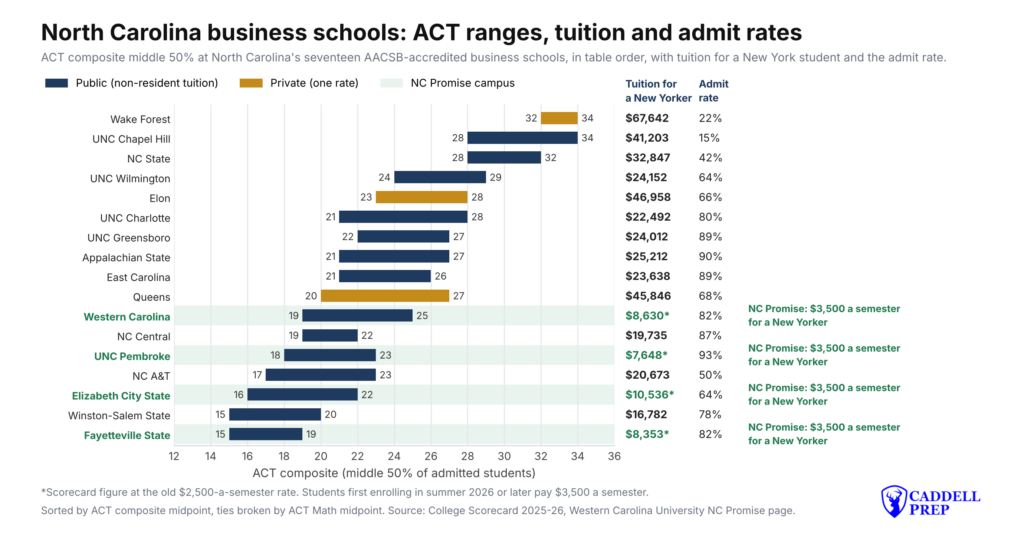
LA student can see where his ACT score sits on this ladder in the image above.
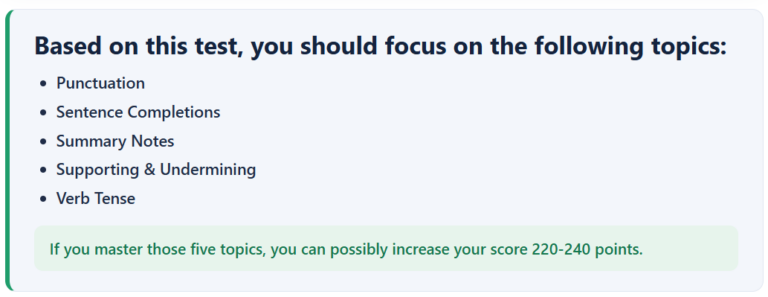
Want to Know What 5 Topics Will Improve Your SAT Score the Most?
Sample Feedback from our Diagnostic Test:
Wake Forest University
Wake Forest University in Winston-Salem awards its business degrees through its School of Business, and Wake Forest reports the highest ACT range on the page, 32 to 34, admits 22%, and charges every student $67,642, the highest tuition on the page.
ACT composite 32 to 34, ACT Math 29 to 34. Reading & Writing 700 to 750, Math 710 to 770. The top quarter of admitted students scored at or above 34 on the ACT and 770 on Math. Cost of attendance $87,499, with tuition and fees at $67,642 for every student. 5,485 undergraduates, 22% admitted.
Wake Forest’s 32 to 34 on the ACT starts four points above Chapel Hill’s and NC State’s, and its 710 to 770 on Math sits 10 above Chapel Hill’s at the floor and 10 under it at the ceiling, so the two trade places on the two tests. The $67,642 is $20,684 above Elon’s and the same for every student, so the cost of attendance in the table is every student’s. Four years of tuition is $270,568.
University of North Carolina at Chapel Hill
The University of North Carolina at Chapel Hill awards its business degrees through the Kenan-Flagler Business School, and Chapel Hill admits 15%, the lowest rate on the page, reports the highest Math range on the page, 700 to 780, and charges a New Yorker $41,203 against $8,994 for a North Carolinian, 4.58 times the resident figure.
ACT composite 28 to 34, ACT Math 26 to 33. Reading & Writing 690 to 750, Math 700 to 780. The top quarter of admitted students scored at or above 34 on the ACT and 780 on Math. Cost of attendance $26,055, with tuition and fees at $8,994 in-state and $41,203 out-of-state. 20,752 undergraduates, 15% admitted.
Chapel Hill’s 28 to 34 on the ACT spans six points, the widest among the top three, and its 700 to 780 on Math sits 50 above NC State’s at the floor and 30 at the ceiling. The 15% is the university’s rate, and Kenan-Flagler fills two-thirds of its seats before the first semester, the subject of the next section. The cost of attendance in the table is a resident’s. A non-resident’s comes to approximately $58,264 once the higher tuition is substituted, and the $41,203 that drives it carries a premium of $32,209 over a resident, the largest on the page and 4.58 times the resident figure, the widest ratio in this series so far [VERIFY against Montana’s 3.94]. Four years of tuition is $164,812.
North Carolina State University
North Carolina State University in Raleigh awards its business degrees through the Poole College of Management, and NC State is the largest campus on the page, with 27,371 undergraduates, shares Chapel Hill’s 28 ACT floor, admits 42%, and charges a New Yorker $32,847.
ACT composite 28 to 32, ACT Math 26 to 32. Reading & Writing 650 to 720, Math 650 to 750. The top quarter of admitted students scored at or above 32 on the ACT and 750 on Math. Cost of attendance $26,425, with tuition and fees at $8,799 in-state and $32,847 out-of-state. 27,371 undergraduates, 42% admitted.
NC State’s 28 to 32 on the ACT shares Chapel Hill’s floor and ends two points under it, and its 650 to 750 on Math sits 50 under Chapel Hill’s at the floor. The $32,847 is $8,356 under Chapel Hill’s and $7,635 above Appalachian’s, with a premium of $24,048 over a resident. The cost of attendance in the table is a resident’s, and a non-resident’s comes to approximately $50,473 with the higher tuition substituted. Four years of tuition is $131,388.
University of North Carolina Wilmington
The University of North Carolina Wilmington awards its business degrees through the Cameron School of Business, and Wilmington reports the fourth ACT range on the page, 24 to 29, admits 64%, and charges a New Yorker $24,152.
ACT composite 24 to 29, ACT Math 23 to 27. Reading & Writing 620 to 680, Math 610 to 660. The top quarter of admitted students scored at or above 29 on the ACT and 660 on Math. Cost of attendance $26,547, with tuition and fees at $7,277 in-state and $24,152 out-of-state. 14,922 undergraduates, 64% admitted.
Wilmington’s 24 to 29 on the ACT sits one point above Elon’s at each end, and its 610 to 660 on Math is the highest range on the page after the top three. The $24,152 is $1,060 under Appalachian’s and $140 above Greensboro’s, with a premium of $16,875 over a resident. The cost of attendance in the table is a resident’s, and a non-resident’s comes to approximately $43,422 with the higher tuition substituted. Four years of tuition is $96,608.
Elon University
Elon University awards its business degrees through the Martha and Spencer Love School of Business, and Elon is the largest private on the page, with 6,452 undergraduates, reports an ACT range of 23 to 28, admits 66%, and charges every student $46,958.
ACT composite 23 to 28, ACT Math 21 to 27. Reading & Writing 580 to 650, Math 550 to 630. The top quarter of admitted students scored at or above 28 on the ACT and 630 on Math. Cost of attendance $62,266, with tuition and fees at $46,958 for every student. 6,452 undergraduates, 66% admitted.
Elon’s 23 to 28 on the ACT sits one point under Wilmington’s at each end, and its 550 to 630 on Math is 30 under Queens’s at the floor though its ACT range is higher. The $46,958 is $1,112 above Queens’s and the same for every student, so the cost of attendance in the table is every student’s. Four years of tuition is $187,832.
University of North Carolina at Charlotte
The University of North Carolina at Charlotte awards its business degrees through the Belk College of Business, and Charlotte is the second largest campus on the page, with 24,453 undergraduates, leads Greensboro at a 24.5 ACT midpoint on ACT Math, admits 80%, and charges a New Yorker $22,492.
ACT composite 21 to 28, ACT Math 20 to 27. Reading & Writing 570 to 660, Math 570 to 670. The top quarter of admitted students scored at or above 28 on the ACT and 670 on Math. Cost of attendance $23,010, with tuition and fees at $7,239 in-state and $22,492 out-of-state. 24,453 undergraduates, 80% admitted.
Charlotte’s 21 to 28 on the ACT shares a 24.5 midpoint with Greensboro’s 22 to 27, and Charlotte leads on the ACT Math midpoint, 23.5 to 22. The $22,492 is the lowest non-resident figure on the page among publics outside NC Promise and NC Central’s $19,735 and A&T’s $20,673, with a premium of $15,253 over a resident. The cost of attendance in the table is a resident’s, and a non-resident’s comes to approximately $38,263 with the higher tuition substituted. Four years of tuition is $89,968.
University of North Carolina at Greensboro
The University of North Carolina at Greensboro awards its business degrees through the Bryan School of Business and Economics, and Greensboro shares a 24.5 ACT midpoint with Charlotte, admits 89%, and charges a New Yorker $24,012.
ACT composite 22 to 27, ACT Math 19 to 25. Reading & Writing 590 to 685, Math 560 to 670. The top quarter of admitted students scored at or above 27 on the ACT and 670 on Math. Cost of attendance $21,373, with tuition and fees at $7,661 in-state and $24,012 out-of-state. 14,062 undergraduates, 89% admitted.
Greensboro’s 22 to 27 on the ACT shares the 24.5 midpoint and falls behind Charlotte on ACT Math, and its 560 to 670 on Math shares Charlotte’s 670 ceiling. The $24,012 is $140 under Wilmington’s and $374 above East Carolina’s, with a premium of $16,351 over a resident. The cost of attendance in the table is a resident’s, and a non-resident’s comes to approximately $37,724 with the higher tuition substituted. Four years of tuition is $96,048.
Appalachian State University
Appalachian State University in Boone awards its business degrees through the Walker College of Business, and Appalachian admits 90%, reports an ACT range of 21 to 27, and charges a New Yorker $25,212, the highest non-resident figure on the page among publics outside Chapel Hill and NC State.
ACT composite 21 to 27, ACT Math 19 to 26. Reading & Writing 570 to 660, Math 550 to 620. The top quarter of admitted students scored at or above 27 on the ACT and 620 on Math. Cost of attendance $23,169, with tuition and fees at $7,579 in-state and $25,212 out-of-state. 19,444 undergraduates, 90% admitted.
Appalachian’s 21 to 27 on the ACT matches Charlotte’s floor and sits one under its ceiling, and its 550 to 620 on Math shares Elon’s floor. The $25,212 is $1,060 above Wilmington’s, with a premium of $17,633 over a resident, the third largest on the page. The cost of attendance in the table is a resident’s, and a non-resident’s comes to approximately $40,802 with the higher tuition substituted. Four years of tuition is $100,848.
East Carolina University
East Carolina University in Greenville awards its business degrees through its College of Business, and East Carolina leads Queens at a 23.5 ACT midpoint on ACT Math, admits 89%, and charges a New Yorker $23,638, with 19,896 undergraduates.
ACT composite 21 to 26, ACT Math 18 to 26. Reading & Writing 540 to 630, Math 530 to 610. The top quarter of admitted students scored at or above 26 on the ACT and 610 on Math. Cost of attendance $23,867, with tuition and fees at $7,361 in-state and $23,638 out-of-state. 19,896 undergraduates, 89% admitted.
East Carolina’s 21 to 26 on the ACT shares a 23.5 midpoint with Queens’s 20 to 27, and East Carolina leads on ACT Math, 22 to 21.5. The $23,638 is $374 under Greensboro’s and $1,146 above Charlotte’s, with a premium of $16,277 over a resident. The cost of attendance in the table is a resident’s, and a non-resident’s comes to approximately $40,144 with the higher tuition substituted. Four years of tuition is $94,552.
Queens University of Charlotte
Queens University of Charlotte awards its business degrees through the McColl School of Business, and Queens is the smallest campus on the page, with 1,211 undergraduates, shares a 23.5 ACT midpoint with East Carolina, and charges every student $45,846.
ACT composite 20 to 27, ACT Math 18 to 25. Reading & Writing 560 to 670, Math 580 to 670. The top quarter of admitted students scored at or above 27 on the ACT and 670 on Math. Cost of attendance $65,742, with tuition and fees at $45,846 for every student. 1,211 undergraduates, 62% admitted.
Queens’s 20 to 27 on the ACT shares the 23.5 midpoint and falls behind East Carolina on ACT Math, and its 580 to 670 on Math is the higher of the two private ranges beneath Wake Forest. The $45,846 is $1,112 under Elon’s and the same for every student, so the cost of attendance in the table is every student’s. Four years of tuition is $183,384.
Western Carolina University
Western Carolina University in Cullowhee awards its business degrees through its College of Business, and Western Carolina is an NC Promise campus, charging a North Carolinian $4,630 and a New Yorker $8,630 in the Scorecard year, with an ACT range of 19 to 25 and 82% admitted.
ACT composite 19 to 25, ACT Math 17 to 25. Reading & Writing 560 to 660, Math 520 to 610. The top quarter of admitted students scored at or above 25 on the ACT and 610 on Math. Cost of attendance $19,992, with tuition and fees at $4,630 in-state and $8,630 out-of-state. 10,024 undergraduates, 82% admitted.
Western Carolina’s 19 to 25 on the ACT sits two points under East Carolina’s at the floor, and its 520 to 610 on Math shares East Carolina’s ceiling. The $8,630 is $612 under Nicholls State’s $9,242 and $277 above Fayetteville State’s, with a $4,000 premium over a resident, and the cost of attendance in the table is a resident’s, with a non-resident’s at approximately $23,992 on the Scorecard figures. Four years of tuition on the Scorecard figure is $34,520. Under NC Promise the General Assembly sets tuition at $500 a semester for a resident and, for a student first enrolling in summer 2026 or later, $3,500 a semester for a non-resident, up from $2,500, so the Scorecard’s figure understates a New Yorker’s current price by approximately $2,000 a year [VERIFY on the campus’s tuition page].
North Carolina Central University
North Carolina Central University in Durham awards its business degrees through its School of Business, and NC Central is the one row on the page that reports no SAT range, with an ACT range of 19 to 22, 87% admitted, and $19,735 for a New Yorker.
ACT composite 19 to 22, ACT Math 17 to 23. SAT ranges not reported. The top quarter of admitted students scored at or above 22 on the ACT. Cost of attendance $26,556, with tuition and fees at $6,699 in-state and $19,735 out-of-state. 6,081 undergraduates, 87% admitted.
NC Central’s 19 to 22 on the ACT spans three points, the narrowest range on the page, and the Scorecard has no SAT range for it, so a New Yorker with an SAT should read the university’s own page for the score it expects. The $19,735 is $938 under A&T’s, with a premium of $13,036 over a resident. The cost of attendance in the table is a resident’s, and a non-resident’s comes to approximately $39,592 with the higher tuition substituted. Four years of tuition is $78,940.
University of North Carolina at Pembroke
The University of North Carolina at Pembroke awards its business degrees through the Thomas School of Business, and Pembroke is an NC Promise campus that charged a New Yorker $7,648 in the Scorecard year, the lowest non-resident tuition on the page, and admits 93%, the highest rate on the page.
ACT composite 18 to 23, ACT Math 16 to 22. Reading & Writing 490 to 600, Math 480 to 600. The top quarter of admitted students scored at or above 23 on the ACT and 600 on Math. Cost of attendance $17,261, with tuition and fees at $3,648 in-state and $7,648 out-of-state. 5,330 undergraduates, 93% admitted.
Pembroke’s 18 to 23 on the ACT shares a 20.5 midpoint with NC Central’s and falls behind it on ACT Math, 19 to 20, and its 480 to 600 on Math is 30 under A&T’s at the floor. The $7,648 is $130 above LSU Shreveport’s $7,518, the lowest row figure in this series, and $705 under Fayetteville State’s, with a $4,000 premium over a resident, and the cost of attendance in the table is a resident’s, with a non-resident’s at approximately $21,261 on the Scorecard figures. Four years of tuition on the Scorecard figure is $30,592. Under NC Promise the General Assembly sets tuition at $500 a semester for a resident and, for a student first enrolling in summer 2026 or later, $3,500 a semester for a non-resident, up from $2,500, so the Scorecard’s figure understates a New Yorker’s current price by approximately $2,000 a year [VERIFY on the campus’s tuition page].
North Carolina A&T State University
North Carolina A&T State University in Greensboro awards its business degrees through the Willie A. Deese College of Business and Economics, and A&T admits 50%, the lowest rate on the page among the publics after Chapel Hill and NC State, reports an ACT range of 17 to 23, and charges a New Yorker $20,673.
ACT composite 17 to 23, ACT Math 16 to 23. Reading & Writing 510 to 600, Math 510 to 590. The top quarter of admitted students scored at or above 23 on the ACT and 590 on Math. Cost of attendance $20,427, with tuition and fees at $6,813 in-state and $20,673 out-of-state. 12,182 undergraduates, 50% admitted.
A&T’s 17 to 23 on the ACT sits one point under Pembroke’s at the floor and shares its ceiling, and its 510 to 590 on Math has a higher floor than Pembroke’s by 30. The $20,673 is $938 above NC Central’s, with a premium of $13,860 over a resident. The cost of attendance in the table is a resident’s, and a non-resident’s comes to approximately $34,287 with the higher tuition substituted. Four years of tuition is $82,692. The Scorecard prints the name with spaced ampersand, and this page closes it.
Elizabeth City State University
Elizabeth City State University awards its business degrees through the Walter R. Davis School of Business and Economics, and Elizabeth City State is an NC Promise campus that charged a New Yorker $10,536 in the Scorecard year, with 1,975 undergraduates, the smallest public on the page, and 64% admitted.
ACT composite 16 to 22, ACT Math 15 to 21. Reading & Writing 470 to 560, Math 450 to 520. The top quarter of admitted students scored at or above 22 on the ACT and 520 on Math. Cost of attendance $17,701, with tuition and fees at $6,536 in-state and $10,536 out-of-state. 1,975 undergraduates, 64% admitted.
Elizabeth City State’s 16 to 22 on the ACT sits one point under A&T’s at each end, and its 450 to 520 on Math is 20 above Fayetteville State’s at the floor. The $10,536 is $1,906 above Western Carolina’s, the highest of the four NC Promise figures because its fees are higher, with a $4,000 premium over a resident, and the cost of attendance in the table is a resident’s, with a non-resident’s at approximately $21,701 on the Scorecard figures. Four years of tuition on the Scorecard figure is $42,144. Under NC Promise the General Assembly sets tuition at $500 a semester for a resident and, for a student first enrolling in summer 2026 or later, $3,500 a semester for a non-resident, up from $2,500, so the Scorecard’s figure understates a New Yorker’s current price by approximately $2,000 a year [VERIFY on the campus’s tuition page].
Winston-Salem State University
Winston-Salem State University awards its business degrees through its School of Business, and Winston-Salem State reports the lowest Math range on the page, 400 to 500, admits 78%, and charges a New Yorker $16,782.
ACT composite 15 to 20, ACT Math 15 to 18. Reading & Writing 430 to 520, Math 400 to 500. The top quarter of admitted students scored at or above 20 on the ACT and 500 on Math. Cost of attendance $23,147, with tuition and fees at $6,126 in-state and $16,782 out-of-state. 4,170 undergraduates, 78% admitted.
Winston-Salem State’s 15 to 20 on the ACT shares its floor with Fayetteville State’s, and its 400 to 500 on Math is the lowest range on the page, 30 under Fayetteville State’s at the floor. The $16,782 is $2,953 under NC Central’s, with a premium of $10,656 over a resident. The cost of attendance in the table is a resident’s, and a non-resident’s comes to approximately $33,803 with the higher tuition substituted. Four years of tuition is $67,128.
Fayetteville State University
Fayetteville State University awards its business degrees through the Broadwell College of Business and Economics, and Fayetteville State is an NC Promise campus that charged a New Yorker $8,353 in the Scorecard year, reports the lowest ACT range on the page, 15 to 19, and admits 82%.
ACT composite 15 to 19, ACT Math 14 to 18. Reading & Writing 460 to 550, Math 430 to 540. The top quarter of admitted students scored at or above 19 on the ACT and 540 on Math. Cost of attendance $16,652, with tuition and fees at $4,353 in-state and $8,353 out-of-state. 5,762 undergraduates, 82% admitted.
Fayetteville State’s 15 to 19 on the ACT is the lowest range on the page, one point under Winston-Salem State’s at the ceiling, and its 430 to 540 on Math sits 30 above Winston-Salem State’s at the floor. The $8,353 is $889 under Nicholls State’s $9,242 and $705 above Pembroke’s, with a $4,000 premium over a resident, and the cost of attendance in the table is a resident’s, with a non-resident’s at approximately $20,652 on the Scorecard figures. Four years of tuition on the Scorecard figure is $33,412. Under NC Promise the General Assembly sets tuition at $500 a semester for a resident and, for a student first enrolling in summer 2026 or later, $3,500 a semester for a non-resident, up from $2,500, so the Scorecard’s figure understates a New Yorker’s current price by approximately $2,000 a year [VERIFY on the campus’s tuition page].
Seventeen rows say who got into the university. The next section is about the business school on the page that decides most of its seats before the student arrives.
How Does Kenan-Flagler Fill Its Seats?
The Kenan-Flagler Business School at the University of North Carolina at Chapel Hill fills about two-thirds of its undergraduate business majors through Assured Enrollment decided on the high school application and the rest through a sophomore application open to any student in good standing after a year in the College of Arts and Sciences, with four prerequisites at a C or better, preference at a 3.0, an admitted average of about 3.83 and about 415 majors admitted each cycle.
The first door is decided before the student arrives. A high school applicant to UNC lists Business Administration among his top three academic interests, answers a short supplemental essay, and is read for “an exemplary high school academic record,” character and integrity, engagement outside class and “demonstrated curiosity about business.” The school writes that “about two-thirds” of its business majors enter this way, that “Decisions for Assured Enrollment are final,” and that it does not share the details of the evaluation. An admit keeps the seat by remaining in good standing, completing BUSI 200 in the first year, and earning a C or better, not a C-, in his first two semesters in calculus (MATH 152, MATH 231 or STOR 113), statistics (DATA 110, STOR 120 or STOR 155), ECON 101 and BUSI 100, and he then confirms his intent through an application the school calls streamlined and non-evaluative [VERIFY every item on the high school students page].
The second door opens after a year in the College of Arts and Sciences. A student applies in the summer after his first year, with the application due in August, and hears in mid-October of his sophomore year. The same four prerequisites are required at a C or better before program coursework, may be in progress at the time he applies, and earn a slight preference when most are complete. “Any student in good standing may apply.” Applicants with a GPA of at least 3.0 receive preference, and “the average GPA of admitted students is about 3.83.” The review weighs UNC performance, prerequisite performance, leadership, written and oral communication, analytical skill, intellectual curiosity, extracurricular and work experience, service, character and the rationale for business, and the page calls admission selective, with about 415 majors and about 104 minors admitted each cycle. A student not admitted may reapply as a junior, and a business major pays a Program Enhancement Fee of $1,000 a term [VERIFY every item on the current UNC students page].
The other sixteen schools on the page were not read for a gate, Poole’s rule for a current NC State student among them. As far as this page knows, each admits a business major on the university application, and a family should read each catalog for any rule that follows [VERIFY all sixteen].
Set against the earlier pages, Kenan-Flagler is the first business school in this grid to print the share of seats filled at the first door. On our page on business colleges in Michigan, Ross prints a count at each of two doors. On our page on business colleges in Minnesota, Carlson prints a minimum of 3.0 and an average above 3.50. Kenan-Flagler prints two-thirds at the first door, no minimum at the second, a preference at 3.0, an average at 3.83 and a seat count of about 415, and the arithmetic a high school senior does with those numbers is that most of the room is gone before his first class.
| Door | Who | What Kenan-Flagler asks | What Kenan-Flagler says |
|---|---|---|---|
| Assured Enrollment | A high school applicant to UNC listing Business Administration among his top three interests, with a supplemental essay | Selection on the UNC application, then good standing, BUSI 200 in year one, and a C or better (not C-) in calculus, statistics, ECON 101 and BUSI 100 in the first two semesters, with a non-evaluative confirmation after year one | “About two-thirds” of business majors. “Decisions for Assured Enrollment are final.” Evaluation details not shared. |
| Sophomore application | Any UNC student in good standing after a year in the College of Arts and Sciences | The same four prerequisites at a C or better, complete or in progress, an application in the summer after year one due in August, a decision in mid-October | “Any student in good standing may apply.” Preference at a 3.0 GPA. Admitted average about 3.83. Selective, with about 415 majors and 104 minors a cycle. Reapply as a junior. A $1,000-a-term Program Enhancement Fee |
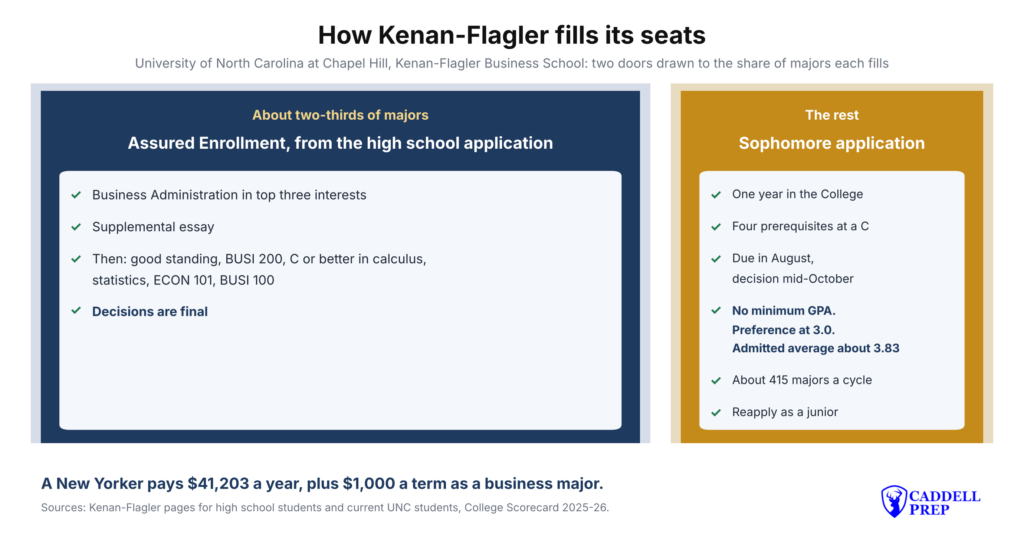
The image above shows the two doors into Kenan-Flagler drawn to the share of seats each fills.
Does a 3.0 Get a UNC Student Into Kenan-Flagler?
No, a 3.0 does not get a University of North Carolina student into the Kenan-Flagler Business School, because a 3.0 earns a preference in the school’s sophomore review rather than a seat, the school prints no minimum GPA and writes that any student in good standing may apply, it calls the review selective, and it reports that the average GPA of admitted students is about 3.83, so a 3.0 enters a pool whose middle sits more than eight tenths above it.
The four prerequisites at a C or better are the line a student controls, and about 415 majors are admitted a cycle with about two-thirds of the seats already filled from the high school application. A student not admitted as a sophomore reapplies as a junior with an optional essay on what changed, and a student who wants the first door asks for it on the UNC application, where the decision is final.
Two doors, two-thirds and the rest. Which schools hold the accreditation is the next section.
Which North Carolina Universities Have AACSB-Accredited Business Schools?
Seventeen North Carolina universities hold business accreditation from AACSB International, fourteen public and three private, and the list below names each with its city and the school that awards the business degree [VERIFY all seventeen on the AACSB directory before publishing, and check UNC Asheville and Meredith, the two this page could not confirm either way].
- Wake Forest University in Winston-Salem awards its business degrees through the AACSB-accredited School of Business.
- University of North Carolina at Chapel Hill in Chapel Hill awards its business degrees through the AACSB-accredited Kenan-Flagler Business School.
- North Carolina State University in Raleigh awards its business degrees through the AACSB-accredited Poole College of Management.
- University of North Carolina Wilmington in Wilmington awards its business degrees through the AACSB-accredited Cameron School of Business.
- Elon University in Elon awards its business degrees through the AACSB-accredited Martha and Spencer Love School of Business.
- University of North Carolina at Charlotte in Charlotte awards its business degrees through the AACSB-accredited Belk College of Business.
- University of North Carolina at Greensboro in Greensboro awards its business degrees through the AACSB-accredited Bryan School of Business and Economics.
- Appalachian State University in Boone awards its business degrees through the AACSB-accredited Walker College of Business.
- East Carolina University in Greenville awards its business degrees through the AACSB-accredited College of Business.
- Queens University of Charlotte in Charlotte awards its business degrees through the AACSB-accredited McColl School of Business.
- Western Carolina University in Cullowhee awards its business degrees through the AACSB-accredited College of Business.
- North Carolina Central University in Durham awards its business degrees through the AACSB-accredited School of Business.
- University of North Carolina at Pembroke in Pembroke awards its business degrees through the AACSB-accredited Thomas School of Business.
- North Carolina A&T State University in Greensboro awards its business degrees through the AACSB-accredited Willie A. Deese College of Business and Economics.
- Elizabeth City State University in Elizabeth City awards its business degrees through the AACSB-accredited Walter R. Davis School of Business and Economics.
- Winston-Salem State University in Winston-Salem awards its business degrees through the AACSB-accredited School of Business.
- Fayetteville State University in Fayetteville awards its business degrees through the AACSB-accredited Broadwell College of Business and Economics.
Accreditation matters for a reason that is easy to miss at seventeen. Business itself is not a licensed profession, and the one business degree that leads to a license, accounting, leads to it through the state board rather than through the school. A CPA in North Carolina normally licenses on a bachelor’s with an accounting concentration and two years of experience, a bachelor’s with the concentration and 24 hours of fields-of-study courses and one year, or a master’s with the concentration and one year, with the accountancy law course, character references and a background check unchanged [VERIFY on the board’s page]. AACSB status matters on the way there because business schools use it to decide whose courses they will accept in transfer.
High Point University is the private university left off that a family will ask about, a campus of 5,129 undergraduates whose own accreditation page lists no business accreditor, and it reports 24 to 33 on the ACT and 550 to 650 on Math, admits 75% and charges every student $45,312. Campbell University in Buies Creek (no range reported, 87% admitted, $41,600), Wingate University (18 to 25, $41,636), Gardner-Webb University in Boiling Springs (19 to 25, $34,760) and the University of Mount Olive (18 to 24, $27,366) hold accreditation from the Accreditation Council for Business Schools and Programs as far as this page could confirm [VERIFY each]. UNC Asheville (23 to 29, 570 to 660 on Math, 92% admitted, $24,849 for a New Yorker) awards business degrees through a department whose pages do not state a business accreditor, and Meredith College in Raleigh (23 to 29, $45,630) is a women’s college whose accreditor this page did not confirm [VERIFY both, and add either as a row if the directory lists it]. Duke University in Durham (34 to 35, 760 to 800 on Math, 6% admitted, $68,758) and Davidson College (31 to 34, 13%, $64,410) award no undergraduate business degree. Methodist, Catawba, Lenoir-Rhyne, Pfeiffer, Barton, Belmont Abbey, Guilford, Johnson C. Smith, Shaw, Livingstone, North Carolina Wesleyan, William Peace, Mars Hill and Brevard award business degrees without an AACSB-accredited business school [VERIFY each], and Strayer University’s North Carolina campus is a for-profit with no ranges. None of them is a row.
Nothing on this page ranks the seventeen. They are fourteen public universities and three private with the same accreditor, one flagship school that fills two-thirds of its seats from high school, four campuses priced by the legislature, and the pages for business colleges in Virginia, business colleges in Tennessee, business colleges in Georgia and business colleges in South Carolina carry the schools a student looking at North Carolina is likely comparing.
What If Your Scores Are Below the Range You Want?
In North Carolina Wake Forest’s floors are 32 on the ACT and 710 on Math, Chapel Hill’s 28 and 700, NC State’s 28 and 650, Wilmington’s 24 and 610, Elon’s 23 and 550, Greensboro’s 22 and 560, Charlotte’s 21 and 570, Appalachian’s 21 and 550, East Carolina’s 21 and 530, Queens’s 20 and 580, Western Carolina’s 19 and 520, NC Central’s 19 with no SAT range, Pembroke’s 18 and 480, A&T’s 17 and 510, Elizabeth City State’s 16 and 450, Winston-Salem State’s 15 and 400, and Fayetteville State’s 15 and 430. A student under the floor he wants is not ruled out, because a quarter of admitted students were there too. He is in the quarter that needs the rest of the application to carry more.
The first step is finding out where the score actually is, section by section. A free diagnostic SAT gives a Math score that can be set directly against NC State’s 650 floor, Chapel Hill’s 700 and Wake Forest’s 710, and a total that can be set against the 1300 that clears every range on the page but those three.
The Math section rewards the same handful of topics on every test date, and a student who knows which of them he is missing can close a gap of 50 to 100 points in weeks rather than months. The method is on our page on improving your SAT Math score, and at Chapel Hill the same algebra is the calculus and statistics Kenan-Flagler asks at a C or better at both of its doors.
How to Read These Score Ranges
Each range in the table covers the middle 50% of admitted students who submitted that test, so a quarter of admitted students were below the lower number and a quarter were at or above the upper one.
A range describes the students who chose to submit at all. Where a school is test-optional, the range describes the submitters, and the submitters are the students whose scores helped them. A row marked not reported means the Scorecard has no range for that university, and a student should read the university’s own admissions page for the score it expects. More on what SAT score you need for college and on test-optional colleges.
Should You Take the ACT Instead?
North Carolina gives the ACT to its public school juniors as the state test [VERIFY current North Carolina testing], all seventeen rows report it, and sixteen report the SAT.
A New York student who holds an SAT should send it everywhere in North Carolina and leave the ACT alone unless a school elsewhere asks for it. The UNC System sets minimum admission requirements and a test policy for its campuses that a student should read for the entering year [VERIFY both], and NC Central reports no SAT range, so a student should read its own page before deciding whether a score helps there.
Business Programs in Nearby States
North Carolina borders four states by land, and each has its own page in this series.
See business colleges in Virginia, business colleges in Tennessee, business colleges in Georgia and business colleges in South Carolina.
Business Colleges in Other States
We publish the same breakdown for business programs in every state.
See business colleges by state for the full list.

Glyn Caddell
Glyn Caddell holds a BS in Mechanical Engineering from NJIT and has been tutoring New York City students since 2008. He founded Caddell Prep in 2012 and is the author of Digital SAT Math Secrets: Lessons & Tricks to Quickly Improve to a Perfect 800 on the Math Test, which contains over 900 practice problems and is used in Caddell Prep’s SAT math classes. He is founding president of the Staten Island Technical High School alumni association and teaches every lesson on this site personally.
Finally, an SAT course that students actually understand
Every question has a video explanation. Not most — every one.
The on-demand Digital SAT course covers all 17 math topics and 15 reading and writing topics, with 5 full-length practice tests and a 100-point score increase guarantee. Keep access for the rest of high school. No subscription.
Want to Know What 5 Topics Will Improve Your SAT Score the Most?
Sample Feedback from our Diagnostic Test: