
Home » The Digital SAT: What’s Tested, How It’s Scored, and How to Improve Your Score » SAT Prep Options: How Many Hours You Need, What Each One Costs » SAT Study Plans: How Many Hours a Week Your Plan Actually Needs » Summer SAT Study Plan: The One Window Where You Can Cover Everything
By Glyn Caddell, BSME · Author of Digital SAT Math Secrets · Tutoring since 2008 — Published September 22, 2026
Every other SAT study plan is limited by how many weeks are left before the test. The summer plan is the only one limited by something else.
During the school year, a student with classes, homework, and activities can find three to seven hours a week for the SAT and not much more. Summer removes that limit. It’s the one time a student can cover every topic on the test at proper depth, because it’s the one time the hours actually exist.
The catch is that summer plans rarely fail from a lack of time. They fail from a lack of routine. The hours come first, though, because they’re larger than most students expect.
Table of Contents
Why Is Summer Different From Every Other Study Plan?
There are 32 topics on the Digital SAT, 17 in math and 15 in Reading & Writing. Covering all of them properly takes approximately 3.5 hours per topic, which comes to approximately 160 hours once practice tests and review are included.
Here’s what 160 hours looks like at different timelines.
| Timeline | Hours a week for full coverage |
|---|---|
| 24 weeks | 6.7 |
| 12 weeks | 13.3 |
| 10 weeks (summer) | 16 |
| 8 weeks (summer with a trip) | 20 |
Sixteen hours a week alongside school isn’t realistic for most students. Sixteen hours a week in July is less time than a lot of summer jobs.
That’s the difference. Every other plan forces a choice between covering the most common topics properly and covering everything thinly. Summer is the one timeline where a student doesn’t have to choose, because he has the hours to do both.
Whether he should use all of those hours is a separate question.
How Many Hours Should You Actually Use?
There are two reasonable versions of a summer plan, and most students should take the first one.
Version A: approximately 8 hours a week. That’s 80 hours over ten weeks, which is enough for a 200-point improvement based on the students we’ve worked with since 2008. It covers the 16 most common topics at approximately 3.5 hours each, and it leaves most of every day free.
Version B: approximately 16 hours a week. That’s 160 hours, which covers all 32 topics at proper depth.
Here’s how to decide between them. Full coverage is only worth it once the common topics are already closed.
For example, a student scoring 1100 has more points available in linear functions than in inference. Linear functions is 15% of the math section. Inference is 0.8% of Reading & Writing. Extra hours spent on the rare topics are wasted while the common ones are still costing him points.
A student scoring 1450 is in a different position. He’s already answering the common topics correctly, so the points he has left are in the rare topics and in careless errors. For him, Version B is where the remaining points are.
You can see how often each topic appears on the 17 Digital SAT math topics and the 15 Digital SAT Reading & Writing topics.
Whichever version you choose, the hours aren’t what normally goes wrong.
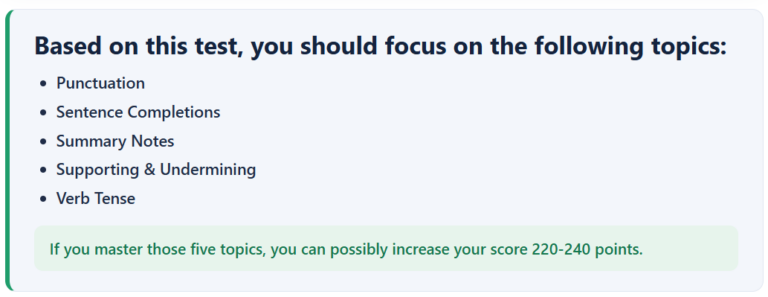
Want to Know What 5 Topics Will Improve Your SAT Score the Most?
Sample Feedback from our Diagnostic Test:
Why Do Summer Plans Fail?
Short study plans fail because the student runs out of time. Six-month plans fail because the middle weeks drift, since nothing is due for months.
Summer plans fail because there’s no routine.
School provides structure whether a student wants it or not. There’s a start time, a schedule, and a reason to be up in the morning. Summer removes all of it. The hours are there and nothing tells a student when to use them, so they get used on whatever happens to be in front of him.
This is the part families don’t expect. A student with plenty of time and no routine normally gets less done than a student with very little time and a fixed schedule.
So the plan has to supply the structure that school normally provides.
Build a Daily Routine, Not a Weekly Target
A weekly target is easy to postpone. “Eight hours a week” turns into “I’ll do it Friday,” and then into next week.
A fixed daily time is much harder to postpone, because it becomes a habit.
For Version A, the whole plan can be one two-hour block, four mornings a week, at the same time every day. For example, 10:00 to 12:00, Monday through Thursday. That’s eight hours, and it never has to be scheduled again.
For Version B, it’s two blocks a day on those same four days.
Keep in mind that mornings work better than afternoons for most students. Summer afternoons fill up with jobs, friends, and the heat, and a study block that competes with those normally loses.
The one thing that reliably breaks a routine is a week away from home.
Plan Around the Family Trip Before You Start
Most families take a trip at some point over the summer. A ten-week summer with a two-week trip is really an eight-week summer.
A plan built for ten weeks and then interrupted for two falls apart around week six. The student then reads it as his own failure, when it was a planning problem from the start.
So mark the trip on the calendar in the first week and build the plan around it.
Put a practice test right before you leave. When you come back, you’ll know exactly where you stand and what to work on next, instead of trying to remember where you left off.
If you’re taking an eight-week summer, the numbers shift. Version A becomes approximately 10 hours a week and Version B becomes approximately 20. Version A still fits comfortably into a summer. Version B at 20 hours a week is a real commitment.
With the trip accounted for, here’s how the weeks fit together.
What Does a Ten-Week Summer Look Like?
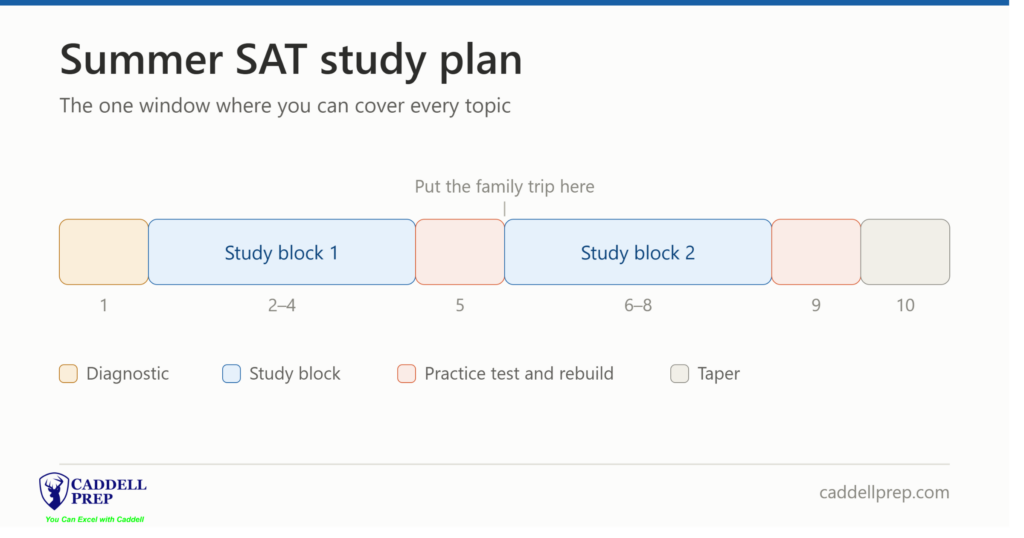
The structure is the same as the other study plans. A diagnostic, two study blocks, and a practice test after each block.
| Week | What happens |
|---|---|
| 1 | Take a diagnostic and build your topic list |
| 2 to 4 | Study block 1: work down the top of the list |
| 5 | Practice test, then rebuild the list |
| 6 to 8 | Study block 2: work the rebuilt list |
| 9 | Second practice test |
| 10 | Light review before the test |
Each topic gets the same treatment it gets in every plan. Learn it, practice it under time pressure, then review what you got wrong and figure out why. That’s covered in detail in the 3-month SAT study plan, which uses the same structure over twelve weeks.
If the family trip falls in the middle of the summer, put it right after the week 5 practice test. That way the trip lands between blocks rather than in the middle of one, and you come back to a list that’s already been rebuilt.
Start week 1 with a free diagnostic SAT, which gives an accurate score based on College Board scoring and a ranked list of which topics are costing you the most points.
Which test the summer leads to depends on which summer it is.
Which Test Are You Preparing For?
A summer of preparation can lead to different tests depending on where a student is in high school. The summer before junior year and the summer before senior year are different situations, and the plan should be built backward from the right test.
The Summer Before Junior Year
Some high-achieving students who are busy during the school year do their SAT preparation the summer before junior year.
By then, they’ve already taken the math classes the test covers. There’s nothing left to learn in school first, so the whole summer goes to preparation. That’s hard to do during a school year that’s already full.
It also opens up the calendar. A student who prepares that summer can take the SAT for the first time in the fall of junior year, which leaves the spring and the following fall for a second or third attempt before applications are due.
Keep in mind that this only applies to students who have finished that math. A student still working through algebra 2 or geometry during junior year shouldn’t read this as a reason to start SAT preparation early.
There’s another benefit. The PSAT is given in October of junior year, and it tests the same content as the SAT. A student who prepares over the summer walks into the PSAT ready for it, and the junior-year PSAT is the one that counts for National Merit. More on the PSAT and how National Merit qualification works.
The Summer Before Senior Year
This summer carries more weight. It’s normally the last full preparation window before college applications, and a test at the end of the summer or early in the fall is normally the last realistic attempt.
Superscoring matters here. Many colleges take your highest math score and your highest Reading & Writing score across different test dates and combine them. So a strong section from a summer sitting can combine with a strong section from an earlier test. Check each school’s policy, and see more on superscoring and score choice.
SAT Test Dates
The SAT is normally offered in August and again in October.
An August test comes right at the end of the summer, which suits a student who wants to take the test while the preparation is fresh. An October test gives September for light review, which suits a student who wants a buffer or has a trip late in the summer.
Both are reasonable. The right choice depends on application deadlines. See the current SAT test dates and registration deadlines.
What If You Have a Summer Job?
A job normally helps rather than hurts.
The biggest problem with summer preparation is the missing routine, and a job fixes the schedule. Put the study block before your shift, at the same time on the same days, and the job supplies the structure that summer otherwise lacks.
Would Instruction Help Over the Summer?
At this timeline, what a class or a tutor provides is the routine itself. There’s a fixed time, and someone expects you to show up.
That’s the one thing summer is missing, which makes summer the timeline where instruction most directly solves the problem most likely to derail the plan.
If that’s the concern, see all SAT prep options.

Glyn Caddell
Glyn Caddell holds a BS in Mechanical Engineering from NJIT and has been tutoring New York City students since 2008. He founded Caddell Prep in 2012 and is the author of Digital SAT Math Secrets: Lessons & Tricks to Quickly Improve to a Perfect 800 on the Math Test, which contains over 900 practice problems and is used in Caddell Prep’s SAT math classes. He is founding president of the Staten Island Technical High School alumni association and teaches every lesson on this site personally.
Finally, an SAT course that students actually understand
Every question has a video explanation. Not most — every one.
The on-demand Digital SAT course covers all 17 math topics and 15 reading and writing topics, with 5 full-length practice tests and a 100-point score increase guarantee. Keep access for the rest of high school. No subscription.
Want to Know What 5 Topics Will Improve Your SAT Score the Most?
Sample Feedback from our Diagnostic Test: