
Home » The Digital SAT: What’s Tested, How It’s Scored, and How to Improve Your Score » SAT Prep Options: How Many Hours You Need, What Each One Costs » SAT Study Plans: How Many Hours a Week Your Plan Actually Needs » 6-Month SAT Study Plan: 24 Weeks, Three Rebuild Cycles, 3 Hours a Week
By Glyn Caddell, BSME · Author of Digital SAT Math Secrets · Tutoring since 2008 — Published September 18, 2026
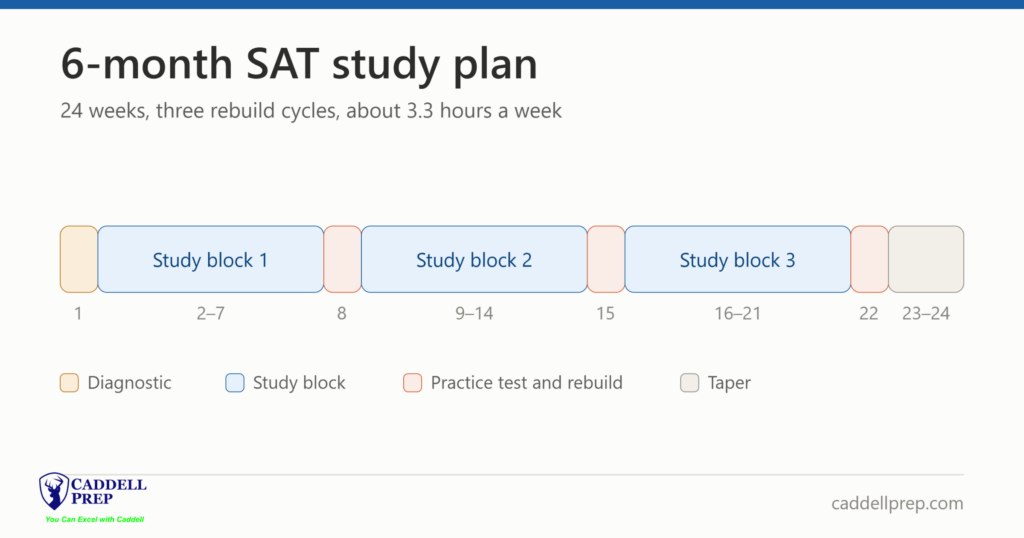
Twenty-four weeks supports a 200-point improvement at approximately 3.3 hours a week. That’s the lightest weekly load of any plan we publish, and for most students it’s the difference between SAT prep fitting around a school year and competing with it.
What six months doesn’t automatically buy is more topics. That surprises people, and the arithmetic below explains why.
What it does buy is three practice test cycles instead of two, which means the plan corrects itself twice more than a three-month plan does.
Table of Contents
- Does Six Months Mean You Can Cover Everything?
- Which Version of the Plan Fits You?
- Week 1: Take a Diagnostic and Build Your Topic List
- Weeks 2 to 7, 9 to 14, and 16 to 21: Three Study Blocks
- Weeks 8, 15 and 22: Three Practice Tests
- The Last Two Weeks: Taper
- Should You Plan to Take the SAT Twice?
Does Six Months Mean You Can Cover Everything?
Not at the same number of hours, and this catches most families out.
A 200-point improvement takes approximately 80 hours of effective studying. Spread those 80 hours across all 32 tested topics and you get about 1.8 hours per topic.
Here’s how that compares to the shorter plans.
| Plan | Total hours | Topics covered | Hours per topic |
|---|---|---|---|
| 1 month | 40 | 6 to 8 | 4.7 |
| 3 months | 80 | 16 | 3.5 |
| 6 months, all topics | 80 | 32 | 1.8 |
A six-month plan that tries to cover everything at the same total hours gives less time per topic than a one-month plan does.
That’s the trade nobody mentions. Breadth isn’t free. It’s paid for in depth, and 1.8 hours on a topic is enough to be introduced to it without being enough to get reliable at it.
So six months buys you a choice, not an automatic upgrade. Either the same depth at a much lighter weekly load, or genuine full coverage at more hours.
Which Version of the Plan Fits You?
What differs is the weekly load and how many topics you take on.
Version A: approximately 3.3 hours a week. The top eight topics in each section, covering about 80% of the test at approximately 3.5 hours per topic. Same depth as the three-month plan, three rebuild cycles instead of two, and half the weekly commitment.
Version B: approximately 7 hours a week. All 17 math topics and all 15 Reading & Writing topics at approximately 3.7 hours each. Real full coverage, at a weekly load similar to the three-month plan.
Most students should take Version A.
Here’s the rule for deciding. Full coverage is worth buying once the common topics are already closed, and not before.
A student sitting at 1100 has more available points in linear functions than in inference. Linear functions is 15% of the math section and inference is 0.8% of Reading & Writing. Spending hours on the rare topics while the common ones are still costing him points is backwards, no matter how much time he has.
A student at 1450 is in a different position. He’s already answering the common topics correctly, so what’s left is in the rare ones and in careless errors. For him, Version B is where the remaining points are.
The frequency data for both sections is on the 17 Digital SAT math topics and the 15 Digital SAT Reading & Writing topics.
Whichever version you pick, the structure is the same, and it starts in the same place.
Week 1: Take a Diagnostic and Build Your Topic List
A full timed diagnostic, then read the results for topics rather than for the total score.
A free diagnostic SAT returns a ranked list of which of the 32 topics are costing you the most points. That list is what the study blocks work down.
One thing is genuinely easier at this timeline. The list gets rebuilt three times over the 24 weeks, so the first version of it matters less than it does on a shorter plan. A one-month plan lives or dies on getting the list right on day one. Here, a mistake in week 1 gets corrected in week 8.
That’s not a reason to be careless about it. It’s a reason not to be paralyzed by it.
Weeks 2 to 7, 9 to 14, and 16 to 21: Three Study Blocks
Three blocks of six weeks each. Two topics a week on Version A, three or four on Version B.
Each topic gets the same treatment in every block. Learn it, practice it under time pressure, then review what you got wrong and work out why. That structure doesn’t change and it’s covered in more detail in how to improve your SAT score.
What does change is the character of the work.
The first block closes content gaps. Topics you don’t know, taught once, now answerable. This is the block where the score moves fastest and where students feel best about the plan.
The second block works topics that are harder to move. Either the concept is more difficult or the gap is smaller and less obvious. Progress slows. This is where most students conclude the plan has stopped working, and it hasn’t.
The third block is normally accuracy rather than knowledge. By this point you can do the problems. What’s left is errors that show up once every few tests, and those get fixed by reviewing your own mistakes carefully rather than by learning anything new.
Same structure across all three. Different job each time.
Weeks 8, 15 and 22: Three Practice Tests
A full timed test at the end of each block, with a review that takes about as long as the test.
Each test does two jobs. It shows whether the score is moving, and it rebuilds your topic list from what you actually got wrong this time rather than what you got wrong six weeks ago.
Three tests means the plan corrects itself twice more than a three-month plan does. That’s the real advantage of this timeline.
There’s a second thing the tests do here that matters more than it does on any shorter plan.
Nobody runs out of time in 24 weeks. That isn’t how six-month plans fail.
They fail by drifting. Weeks 6 through 14 quietly become optional, because the test is months away and nothing is due. A student skips a week, then two, and doesn’t particularly notice. By the time the test is close he’s done a three-month plan badly instead of a six-month plan well.
A practice test every six weeks is a deadline. That’s what makes the weeks before it real. Put the three test dates in a calendar in week 1 and treat them as fixed, because they’re the only structure a long plan has.
The Last Two Weeks: Taper
Two weeks rather than the three days a one-month plan allows, because there’s room for it.
Light review of your topic list. No new material. One timed section rather than a full test in the final week. Normal sleep for the last three nights.
The arithmetic is the same at every timeline. One more topic learned at the end is worth at most a question. Arriving tired costs more than that across 98 questions, and it costs it in careless errors on questions you already know how to answer.
Six months of work deserves to be taken by someone who’s rested.
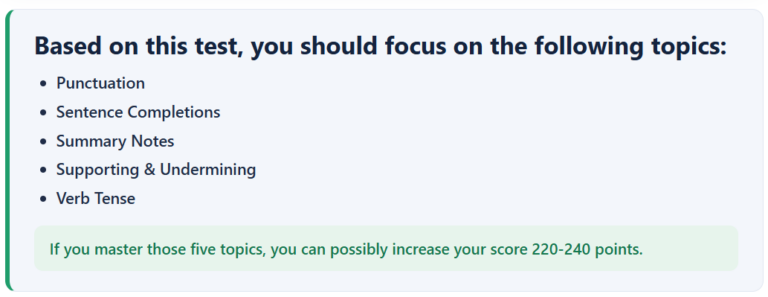
Want to Know What 5 Topics Will Improve Your SAT Score the Most?
Sample Feedback from our Diagnostic Test:
Should You Plan to Take the SAT Twice?
Twenty-four weeks is the only timeline that makes this a real question.
It has room for a full preparation cycle, the actual test, the score coming back two to four weeks later, and a second preparation cycle before applications are due. A three-month plan doesn’t, and a one-month plan isn’t close.
If you’re planning to test twice, that changes the plan rather than just repeating it.
Superscoring and Score Choice
Many colleges superscore, which means they take your highest math score and your highest Reading & Writing score across different test dates and add them together.
If the schools on your list do that, a student testing twice can spend one preparation cycle almost entirely on math and the second almost entirely on Reading & Writing. That’s a materially better use of the hours than splitting attention across both sections twice, because each section gets sustained work instead of half-attention.
Check each school’s policy before planning around it. More on superscoring and score choice.
How to Improve Your SAT Score
The method behind this plan is the same at every timeline. What changes is how many cycles fit.
The short version is that the topics worth your hours are the ones with the most available points, which means how weak you are multiplied by how often the topic appears. That’s why the list is ordered the way it is.
More on how to improve your SAT score.
If Your Timeline Shortens
Plans slip. A student who loses eight weeks isn’t on a compressed six-month plan, he’s on a three-month plan.
Drop the third cycle, not the depth. Two blocks and two tests at full depth beats three blocks rushed, for the same reason three topics done properly beats six done halfway.
See the 3-month SAT study plan, or the 1-month SAT study plan if the timeline has shortened further than that.
What If You Lose Momentum in the Middle?
You might, and the plan is built to absorb it.
Don’t try to reconstruct the weeks you missed. Go to the next scheduled practice test, take it, rebuild the list from what it shows, and run the remaining blocks from there.
A student who missed four weeks in the middle and picks up at the week 15 test has lost four weeks. A student who spends three weeks trying to catch up on the old plan has lost seven.
Would Instruction Help Over Six Months?
At a short timeline, what a tutor or a class buys is protection against spending a week on the wrong topic.
Over six months it’s something different. It’s the weekly expectation. A long plan with nobody checking it is the one that drifts, and the drift is invisible until it’s expensive.
If that’s the risk you’re worried about, see all SAT prep options.

Glyn Caddell
Glyn Caddell holds a BS in Mechanical Engineering from NJIT and has been tutoring New York City students since 2008. He founded Caddell Prep in 2012 and is the author of Digital SAT Math Secrets: Lessons & Tricks to Quickly Improve to a Perfect 800 on the Math Test, which contains over 900 practice problems and is used in Caddell Prep’s SAT math classes. He is founding president of the Staten Island Technical High School alumni association and teaches every lesson on this site personally.
Finally, an SAT course that students actually understand
Every question has a video explanation. Not most — every one.
The on-demand Digital SAT course covers all 17 math topics and 15 reading and writing topics, with 5 full-length practice tests and a 100-point score increase guarantee. Keep access for the rest of high school. No subscription.
Want to Know What 5 Topics Will Improve Your SAT Score the Most?
Sample Feedback from our Diagnostic Test: