
Home » The Digital SAT: What’s Tested, How It’s Scored, and How to Improve Your Score » SAT Prep Options: How Many Hours You Need, What Each One Costs » SAT Study Plans: How Many Hours a Week Your Plan Actually Needs » 3-Month SAT Study Plan: 12 Weeks, Built Around Your Diagnostic
By Glyn Caddell, BSME · Author of Digital SAT Math Secrets · Tutoring since 2008 — Updated September 18, 2026
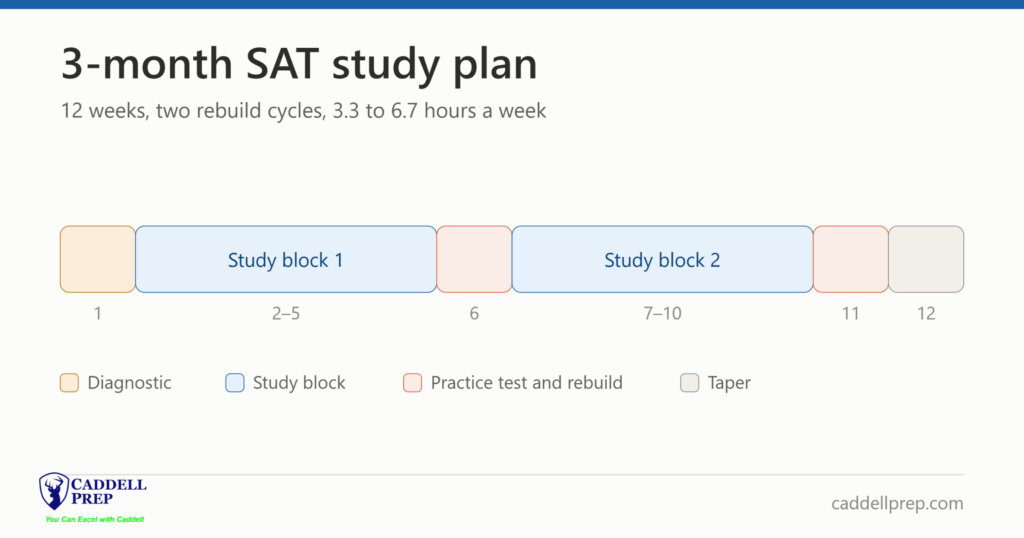
Twelve weeks is enough time for a 100-point improvement comfortably, and enough for 200 if the hours are genuinely there.
The plan below is different from most in one way. The schedule is fixed and the topics are not. Week 1 is a diagnostic, and every week after that works down the list that diagnostic produces. That means the weeks are the same for everyone and the content is different for everyone, which is the only way a written plan can be specific about something it can’t see.
How many hours it takes depends on how many points you need, so start there.
Table of Contents
- How Many Hours a Week Does This Plan Take?
- Week 1: Take a Diagnostic and Build Your Topic List
- Which Topics Should You Start With If You Haven’t Taken a Diagnostic?
- Weeks 2 to 5: Work the Top of the List
- Week 6: Take a Practice Test and Rebuild the List
- Weeks 7 to 10: Work the Rebuilt List
- Week 11: Take a Second Practice Test
- Week 12: Taper, Don’t Cram
- What If Twelve Weeks Isn’t What You Have?
How Many Hours a Week Does This Plan Take?
Based on the students we’ve worked with since 2008, a 70 to 130 point improvement takes approximately 40 hours of effective studying. A 130 to 250 point improvement takes approximately 80 hours.
Across twelve weeks, that works out to:
| Target | Total hours | Hours a week |
|---|---|---|
| 100 points | 40 | 3.3 |
| 200 points | 80 | 6.7 |
The first one is manageable for almost any student. Three to four hours a week is two evenings, and it fits around a full course load without much trouble.
The second one is demanding. Just under seven hours a week, held for three months, alongside school and whatever else a junior is doing. Some students manage it. Plenty don’t, and there’s no point building a plan around hours that won’t exist in week five.
If you need 200 points and you know you can’t commit seven hours a week, you have better options than trying anyway. Target 100 points at this timeline, or move to a longer one. More on working that out in how to build an SAT study plan.
Whichever version applies, the first week is the same.
Week 1: Take a Diagnostic and Build Your Topic List
This is the week that makes the rest of the plan yours instead of generic.
Take a full diagnostic under timed conditions. Not a few practice questions at the kitchen table. A real test, timed, in one sitting, because a casual score tells you nothing useful about where the points are going.
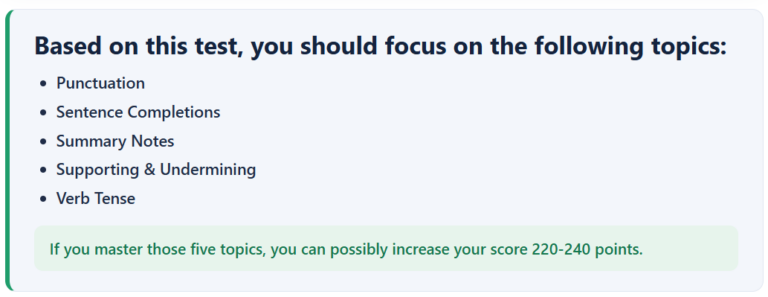
Then read the results for topics rather than for the total. Our free diagnostic SAT returns a ranked list of which of the 32 tested topics are costing you the most points, which is the list the next eleven weeks work down.
One thing about how that list is ordered. It isn’t simply your weakest topics first.
A topic you’re very weak in that appears on one question is worth less of your time than a topic you’re slightly weak in that appears on eight. The points available in a topic depend on how weak you are and how often it shows up. More on that in how to improve your SAT score.
What you should have at the end of week 1 is a ranked list of eight to ten topics. That’s the plan.
If you’d rather start before taking a diagnostic, there’s a default order below that works until you have your own.
Want to Know What 5 Topics Will Improve Your SAT Score the Most?
Sample Feedback from our Diagnostic Test:
Which Topics Should You Start With If You Haven't Taken a Diagnostic?
Take the diagnostic if you can. But plenty of students want a plan today, so here’s the default.
In the absence of information about your own weak spots, the best available guess is to work the topics in order of how often they appear on the test. We counted that. Here’s the order.
| Week | Math topic | % of math | Reading & Writing topic | % of R&W |
|---|---|---|---|---|
| 2 | Linear Functions | 15.0% | Words in Context | 16.5% |
| 3 | Combining Like Terms & Solving Equations | 11.7% | Punctuation | 13.6% |
| 4 | Angles, Polygons & 3-D Shapes | 10.4% | Summary Notes | 10.8% |
| 5 | Quadratic Functions | 9.6% | Transitions | 9.7% |
| 7 | Functions | 8.9% | Verb-Tense | 8.2% |
| 8 | Data & Probability | 8.7% | Function & Purpose | 8.0% |
| 9 | System of Equations | 8.1% | Supporting & Undermining | 7.3% |
| 10 | Ratios & Proportions | 5.7% | Graphs & Charts | 7.0% |
Two topics a week, one from each section, across the eight study weeks.
Here’s what that covers. Those eight math topics account for 78% of the math questions. Those eight Reading & Writing topics account for 81% of that section. Together, that plan puts you in front of 78 of the 98 questions on the test.
If your timeline is shorter, stop earlier and the arithmetic still works in your favor:
- The top three of each section covers 39% of the test
- The top five covers 57%
- The top six covers 66%
- The top eight covers 80%
That’s the argument for working in frequency order rather than textbook order. A student who starts with exponents because it’s chapter one is spending his first week on 1.3% of the math section.
The full frequency data is on the 17 Digital SAT math topics and the 15 Reading & Writing topics.
Replace This Order With Your Own
The table above is what to do when you don’t know where your points are going. It isn’t better than knowing.
A student who’s already answering every linear functions question correctly shouldn’t spend week 2 on linear functions, no matter how common they are. He’d be reviewing something he can already do while a topic he actually needs sits in week 9, or off the list entirely.
So the diagnostic doesn’t replace the plan. It replaces the order. Same twelve weeks, same two topics a week, same rhythm. Different topics in the slots.
That’s the version worth having, and it takes an hour to get.
Weeks 2 to 5: Work the Top of the List
Four weeks, working down the list from the top.
At 3.3 hours a week, that’s about two topics a week. At 6.7 hours, about three.
Each topic gets the same treatment:
- One session to learn it. Work through the lesson and the worked examples.
- Two sessions of timed practice. Problem sets on that topic, under time pressure, so you’re practicing the thing you’ll actually do.
- One review pass. Go back through what you got wrong and work out why you got it wrong.
That last one is where students cut corners, and it’s the part that matters most. Reading the explanation isn’t reviewing. Working out why your approach failed is reviewing.
It also feels the least productive, which is why it gets skipped. Learning a new topic feels like progress. Studying your own mistakes feels like standing still. The score moves on the second one.
At the end of week 5 you’ve covered the top of the list. Now you find out whether it worked.
Week 6: Take a Practice Test and Rebuild the List
A full timed test, then a review that takes about as long as the test did.
The score is the part students care about and the smaller part of what this week is for. What the test actually produces is a new topic list.
Here’s why that matters. You spent four weeks closing the top three or four topics on your list. If that worked, those topics are no longer where your points are. Other topics have moved up to take their place.
A student who takes the test, sees the score went up, and carries on with the original list is studying weaknesses he doesn’t have anymore.
So rebuild it. Take the new results, rank the topics again, and work from the new order. That’s what the second block is for.
Weeks 7 to 10: Work the Rebuilt List
Same structure as weeks 2 to 5. Learn, practice, review. Different topics.
What’s different is how it feels.
The first block closes the easy gaps. Topics you didn’t know, taught once, now answerable. The second block is working on topics that are harder to move, either because the concept is genuinely more difficult or because the problem is careless errors rather than missing knowledge.
So expect the visible progress to slow. That’s normal and it’s not a sign the plan has stopped working.
This is the block where students quit. The score jumped after the first test, the work feels harder, and the next test is still weeks away. Knowing that’s coming is most of what gets a student through it.
At the end of week 10, you take the last measurement that leaves time to act on it.
Week 11: Take a Second Practice Test
Same process. Full timed test, review that takes as long as the test.
What you do with the result depends on where it lands.
If the score is where you wanted it, week 12 is a taper and you’re done. If it’s short, week 12 targets the two or three specific topics this test flagged. Not a broad review. Two or three topics, worked properly.
Either way, the studying is essentially finished. What’s left is arriving in good shape.
Week 12: Taper, Don't Cram
Students do the opposite of this, so it’s worth being blunt about it.
The last week is light. Review the topic list without learning anything new. Do one timed section rather than a full test. Sleep normally for the last three nights, and particularly the two before the test.
The reasoning is simple arithmetic. One more topic learned in the final week might be worth one question. Arriving tired costs more than that across 98 questions, and it costs it in careless errors on questions you already know how to answer.
There’s nothing you can learn in week 12 that beats being sharp on test day.
What If Twelve Weeks Isn't What You Have?
The structure above is built around twelve weeks, and specifically around fitting two full rebuild cycles into them. Shorter and longer timelines change the shape, mostly in how many of those cycles fit.
Here’s what the other plans do differently.
If You Have Longer
Twenty-four weeks fits three rebuild cycles instead of two, and it drops the 200-point version to about 3 hours a week, which is a different kind of commitment.
It also leaves room to take the real test, see the result, and prepare again before applications are due. See the 6-month SAT study plan.
If You Have Less
Four weeks fits one study block and one practice test. There’s no rebuild cycle, so the topic list you build in the first days is the list you work for the whole month. That’s workable for a 100-point target at about 10 hours a week. See the 1-month SAT study plan.
Two weeks doesn’t fit a block at all. It becomes format familiarity plus two or three topics, which is worth having but isn’t a score transformation. See the 2-week SAT study plan.
If You're Planning Around the Summer
Summer is the one timeline defined by available hours rather than remaining weeks.
Seven hours a week in July is straightforward in a way seven hours a week in March is not, because there’s no homework competing for them. That changes what’s achievable, not just how long it takes. See the summer SAT study plan.
What If You Fall Behind?
You will miss a week. Something comes up, and the plan has twelve of them.
The instinct is to compress, doubling up the following week to catch back up. Don’t. A week of rushed work on two topics produces less than a proper week on one.
Cut from the bottom of the list instead. If you lose two weeks, drop the last two topics rather than squeezing all of them in. The list is ranked for a reason, and the bottom of it is worth the least.
Would Help Make the Plan Easier to Follow?
What a class or a tutor adds isn’t hours. It’s someone deciding what to work on each week and checking that it happened.
That matters most in weeks 7 to 10, which is exactly where self-directed plans fall apart. Progress slows, nobody is expecting anything, and the plan quietly becomes optional.
If that sounds like the risk, see all SAT prep options to compare.

Glyn Caddell
Glyn Caddell holds a BS in Mechanical Engineering from NJIT and has been tutoring New York City students since 2008. He founded Caddell Prep in 2012 and is the author of Digital SAT Math Secrets: Lessons & Tricks to Quickly Improve to a Perfect 800 on the Math Test, which contains over 900 practice problems and is used in Caddell Prep’s SAT math classes. He is founding president of the Staten Island Technical High School alumni association and teaches every lesson on this site personally.
Finally, an SAT course that students actually understand
Every question has a video explanation. Not most — every one.
The on-demand Digital SAT course covers all 17 math topics and 15 reading and writing topics, with 5 full-length practice tests and a 100-point score increase guarantee. Keep access for the rest of high school. No subscription.
Want to Know What 5 Topics Will Improve Your SAT Score the Most?
Sample Feedback from our Diagnostic Test: