
Home » The Digital SAT: What’s Tested, How It’s Scored, and How to Improve Your Score » SAT Prep Options: How Many Hours You Need, What Each One Costs » SAT Study Plans: How Many Hours a Week Your Plan Actually Needs
By Glyn Caddell, BSME · Author of Digital SAT Math Secrets · Tutoring since 2008 — Published September 17, 2026
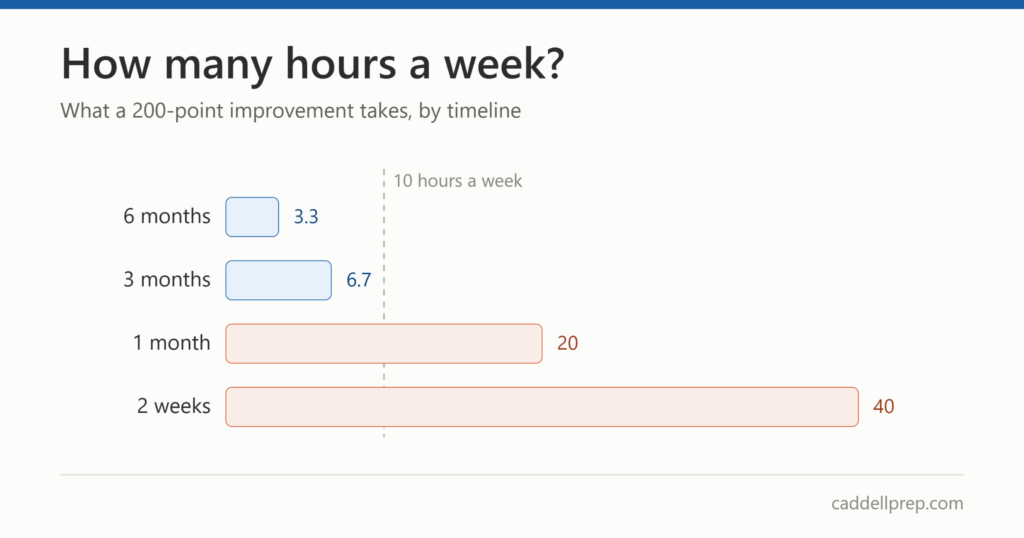
Most SAT study plans fail for a reason that has nothing to do with the student. They were never arithmetically possible in the first place.
A plan is decided by two numbers: how many points you need and how many weeks you have. Multiply and divide those correctly and you get a schedule that can actually be kept. Skip that step and you get a plan that falls apart in week three, which most students read as their own failure.
This page covers how to work out both numbers and what to do with them. The first one comes from your test date, and most students pick that backwards.
Table of Contents
- Why Should You Start From the Test Date?
- How Many Hours a Week Does Your Plan Need?
- What Goes Into a Study Week?
- How Often Should You Take a Practice Test?
- How Long Do You Have Before the Test?
Why Should You Start From the Test Date?
Students normally plan forward. They decide to start studying, and the plan runs from today toward whenever the test happens to be.
That’s the wrong end. The test date is fixed and the application deadline is fixed. Everything about the plan is determined at the far end, not the near one.
Which means choosing the test date is the real decision, and it’s normally made on convenience.
A junior deciding between the March test and the June test is choosing between about 8 weeks of preparation and about 21 weeks. That’s the difference between a schedule that takes over his spring and one that fits around it. Students pick based on which date feels less stressful, when the arithmetic would pick for them.
So start there. Look at the SAT test dates, pick the one you’re targeting, and count the weeks between now and then. That number decides everything else.
How Many Hours a Week Does Your Plan Need?
Based on the students we’ve worked with since 2008, a 70 to 130 point improvement takes approximately 40 hours of effective studying. A 130 to 250 point improvement takes approximately 80 hours.
Divide those by the weeks you counted, and you get the number that tells you whether your plan is real.
| Weeks until the test | For a 70 to 130 point gain | For a 130 to 250 point gain |
|---|---|---|
| 24 weeks | 1.7 hours a week | 3.3 hours a week |
| 16 weeks | 2.5 hours a week | 5 hours a week |
| 12 weeks | 3.3 hours a week | 6.7 hours a week |
| 8 weeks | 5 hours a week | 10 hours a week |
| 6 weeks | 6.7 hours a week | 13.3 hours a week |
| 4 weeks | 10 hours a week | 20 hours a week |
| 2 weeks | 20 hours a week | 40 hours a week |
Find your row. That’s what the plan requires, and it’s not negotiable in the way students assume it is.
Here’s the honest line about that table. Above approximately 10 hours a week, most juniors carrying a full course load and activities will not hold the schedule. They’ll hold it for two weeks and then they won’t, and the plan quietly becomes 4 hours a week without anyone deciding that.
So a student with four weeks and a 200-point target has three real options. Move the test date. Lower the target. Or accept that the plan needs 20 hours a week and be certain those hours exist.
What he shouldn’t do is start the four-week plan and find out in week three.
Keep in mind that these are hours of effective studying, which is not the same as hours spent with the material open. Watching a lesson doesn’t count. Attempting problems under test conditions and then working out what went wrong does. That distinction is covered in more detail in how to improve your SAT score.
Once you know how many hours a week you have, the question is what goes in them.
What Goes Into a Study Week?
Almost every source tells students to make a study schedule. Very few say what to put in it.
“Study five hours a week” is a quantity, not a plan. A student who blocks out five hours and then sits down with no idea what to do in them will spend most of it reviewing material he already knows, because that’s the comfortable thing to do.
A study week has four things in it, and the proportions change depending on how many hours you have.
Learning. Working through lessons on the topics your diagnostic flagged. This is the smallest part of the week for most students, and the part they overestimate.
Practice. Problem sets on those same topics, done under time pressure. This is where the improvement actually happens.
Review. Going back through what you got wrong and working out why. Not reading the explanation. Working out why.
Testing. A full practice section or a full test, on a regular cadence.
At four or five hours a week, that’s approximately one learning session, two practice sessions, and a practice section every other week. At ten or twelve hours a week, it’s the same shape with more of each and a full test weekly.
A twelve-hour week isn’t a four-hour week with more hours in it. There’s room for a full test plus a proper review, which is what makes the plan self-correcting rather than just longer.
That last point is worth its own section.
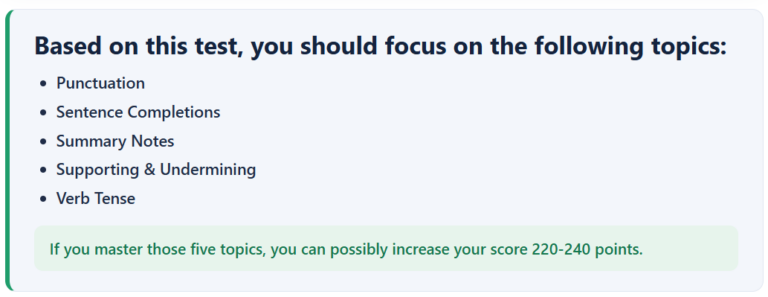
Want to Know What 5 Topics Will Improve Your SAT Score the Most?
Sample Feedback from our Diagnostic Test:
How Often Should You Take a Practice Test?
During an active study period, a practice test every two to three weeks is normally right.
The review matters more than the test. Plan for the review to take about as long as the test did, because a test you don’t review carefully has told you your score and nothing else.
Here’s why the cadence matters rather than just the count. A student’s weakest topics change as he improves. The list he built in June is wrong by August, because he closed three of the topics on it and other topics moved up.
So the practice test does two jobs. It shows whether the score is moving, which is the obvious one. And it rebuilds the topic list, which is the one students skip.
A student who takes a test, sees the score went up, and carries on with the same plan is studying yesterday’s weaknesses. Take the test, rebuild the list, work from the new one.
The right plan for any of this depends on how much time is left.
How Long Do You Have Before the Test?
The method doesn’t change with the timeline. What changes is the scope.
A student with six months can cover every topic, rebuild his list twice, and still have room to retake. A student with two weeks can cover three topics properly. Both are valid plans. They’re just not the same plan, and pretending otherwise is how students end up covering all 32 topics badly instead of three topics well.
Below are plans for the five most common timelines. They differ mainly in what they leave out.
Six Months or More
The only timeline with room for everything. Full topic coverage, two or three rebuild cycles, and enough margin to take the test, see the result, and prepare again before applications are due.
This is also the timeline where a 200-point gain is comfortable rather than demanding, because 80 hours across 24 weeks is about 3 hours a week.
See the 6-month SAT study plan.
Three Months
The most common window, and normally what a junior actually has once he’s decided to take the test seriously.
Twelve weeks supports a 100-point gain comfortably and a 200-point gain if the hours are genuinely there. It’s enough time for full coverage of the high-frequency topics and two practice test cycles.
See the 3-month SAT study plan.
One Month
This is where things start getting cut. Four weeks supports a 100-point gain at approximately 10 hours a week, and that’s a demanding schedule.
Full coverage isn’t available. The plan works down the highest-frequency topics the diagnostic flagged and stops when the time runs out. A 200-point target at this timeline isn’t realistic for most students.
See the 1-month SAT study plan.
Two Weeks
Two weeks is format familiarity and a handful of topics. It isn’t a score transformation and anyone telling you otherwise is selling something.
What it can do is real, though. A student who has never sat a full test learns the pacing. A student with three obvious gaps can close one or two. That’s normally worth 30 to 60 points, which occasionally matters.
See the 2-week SAT study plan.
Over the Summer
The only timeline defined by available hours rather than remaining weeks.
A student with no school has hours a term-time plan can’t assume. Ten hours a week in July is straightforward in a way ten hours a week in March is not. That changes what’s possible, not just how long it takes.
That’s why some high-achieving students who are busy during the school year do their preparation the summer before junior year. By then they’ve already taken the math classes the test covers, so the summer goes to preparing rather than to learning new material.
See the summer SAT study plan.
What If None of These Fit?
If you’ve read through those and none of the numbers work, you have three options and they’re all legitimate.
Move the test date. The most common answer and the one students resist most. A June test instead of a March one turns an impossible plan into a comfortable one.
Lower the target. A 100-point gain you actually achieve is worth more than a 200-point gain you plan and miss.
Add instruction hours. A tutor or a class doesn’t add hours to the week, but it makes the hours you have go further, because someone else is deciding what to work on and checking that you did it. That matters most when the timeline is short and there’s no room to spend a week on the wrong topic.
If you’re weighing the third one, see all SAT prep options, or start with a free diagnostic SAT so the plan is built around your actual topic list rather than a guess.

Glyn Caddell
Glyn Caddell holds a BS in Mechanical Engineering from NJIT and has been tutoring New York City students since 2008. He founded Caddell Prep in 2012 and is the author of Digital SAT Math Secrets: Lessons & Tricks to Quickly Improve to a Perfect 800 on the Math Test, which contains over 900 practice problems and is used in Caddell Prep’s SAT math classes. He is founding president of the Staten Island Technical High School alumni association and teaches every lesson on this site personally.
Finally, an SAT course that students actually understand
Every question has a video explanation. Not most — every one.
The on-demand Digital SAT course covers all 17 math topics and 15 reading and writing topics, with 5 full-length practice tests and a 100-point score increase guarantee. Keep access for the rest of high school. No subscription.
Want to Know What 5 Topics Will Improve Your SAT Score the Most?
Sample Feedback from our Diagnostic Test: