
Home » College SAT Score Ranges, Costs, and Programs by Major and State » Best Business Colleges » Business Colleges in Florida: SAT Scores, ACT Scores, Costs, and Programs
By Glyn Caddell, BSME · Author of Digital SAT Math Secrets · Tutoring since 2008 — Updated November 8, 2026
Seventeen Florida universities hold AACSB-accredited business schools, and this page lists the SAT and ACT scores of the students they admit, what each costs a New York student, and what the two flagships read after the admission letter.
Sixteen of the seventeen report both tests and every public one does, because Florida’s state universities require a score, so the table leads with the SAT and sorts by it.
At Florida a business freshman keeps his major by clearing a tracking GPA that rises from 2.5 to 3.0 over four semesters, and at Florida State he enters the College of Business at 52 hours on a 2.900, at $18,786 a year for a New Yorker.
Table of Contents
- Florida Business Colleges by SAT and ACT Score
- What Does a Florida Business Freshman Have to Do to Keep His Major?
- Which Florida Universities Have AACSB-Accredited Business Schools?
- What If Your Score Is Below the Range You Want?
Florida Business Colleges by SAT and ACT Score
Florida’s seventeen AACSB-accredited business schools sit at ten public universities that require a test score from every freshman and seven private universities, and the table below lists each with its SAT and ACT ranges, cost of attendance, enrollment and admit rate, from Miami’s and Florida’s 660 to 750 on Math down to Tampa, where no range is reported. The rows are sorted by the midpoint of the SAT Math range, with ties broken by the ACT composite midpoint and then by enrollment, so the order can be checked from the table itself.
| College | SAT Reading & Writing | SAT Math | ACT composite | Business school | Cost of attendance | Undergraduates | Admit rate |
|---|---|---|---|---|---|---|---|
| University of Miami | 660 to 730 | 660 to 750 | 30 to 33 | Miami Herbert Business School | $86,078 | 12,913 | 19% |
| University of Florida | 660 to 730 | 660 to 750 | 29 to 33 | Warrington College of Business | $22,523 | 35,629 | 24% |
| Florida State University | 640 to 710 | 630 to 700 | 29 to 32 | College of Business | $25,720 | 32,212 | 24% |
| University of Central Florida | 610 to 680 | 590 to 670 | 25 to 29 | College of Business | $23,133 | 59,146 | 40% |
| Rollins College | 600 to 690 | 560 to 680 | 25 to 30 | Crummer Graduate School of Business [VERIFY undergraduate unit] | $76,108 | 2,631 | 48% |
| Florida Southern College | 590 to 680 | 560 to 650 | 25 to 30 | Barney Barnett School of Business and Free Enterprise | $60,768 | 2,656 | 64% |
| University of South Florida | 580 to 660 | 550 to 660 | 24 to 29 | Muma College of Business | $22,859 | 37,207 | 43% |
| Nova Southeastern University | 530 to 650 | 500 to 650 | 19 to 28 | Huizenga College of Business and Entrepreneurship | $56,692 | 7,240 | 73% |
| Jacksonville University | 580 to 660 | 520 to 620 | 22 to 27 | Davis College of Business and Technology | $63,969 | 2,930 | 57% |
| Florida International University | 550 to 640 | 520 to 620 | 21 to 27 | College of Business | $21,462 | 39,508 | 55% |
| University of North Florida | 550 to 650 | 520 to 620 | 19 to 25 | Coggin College of Business | $20,983 | 13,359 | 53% |
| Stetson University | 540 to 660 | 520 to 610 | 21 to 28 | School of Business Administration | $72,533 | 2,297 | 72% |
| Florida Atlantic University | 530 to 610 | 510 to 590 | 21 to 26 | College of Business | $21,522 | 23,757 | 66% |
| University of West Florida | 520 to 630 | 500 to 600 | 20 to 27 | College of Business | $19,947 | 9,330 | 58% |
| Florida Gulf Coast University | 530 to 610 | 510 to 590 | 20 to 25 | Lutgert College of Business | $20,807 | 13,874 | 63% |
| Florida A&M University | 520 to 610 | 510 to 570 | 20 to 24 | School of Business and Industry | $23,970 | 7,582 | 21% |
| University of Tampa | Does not report SAT data | Does not report SAT data | Does not report ACT data | Sykes College of Business | $51,614 | 10,572 | 40% |
Each range covers the middle 50% of admitted students who submitted that test. A quarter scored below the lower number, and the top quarter scored at or above the upper one. Being under the lower number does not rule a student out, and being just above it is not as safe as it looks. Florida’s public universities require an SAT or ACT score from every first-year applicant, so every public row reports a range [VERIFY Board of Governors Regulation 6.002]. Business school names the AACSB-accredited college or school within the university that awards the business degree [VERIFY each name on the university’s site]. The cost of attendance shown for a public university is a resident’s.
Schools whose business accreditation comes from another body, or from none, are left off this list and named further down, and so are the University of Florida’s online arm, the state colleges and the for-profit institutions.
Three things about that table are worth pausing on.
Seventeen Florida universities hold AACSB business accreditation, ten of them in the State University System, and every one of the ten reports an SAT range, because Florida’s public universities require a score from every freshman applicant.
Florida State charges a New Yorker $18,786 in tuition on a 630 to 700 Math range, and Florida $28,659 on 660 to 750, the two lowest non-resident tuitions in this series at those ranges, while Miami charges $62,616 on the same range as Florida.
Florida and Florida State each admit 24% of applicants and then run a second test of their own: a tracking GPA that rises to 3.0 over four semesters at Gainesville, and a 2.900 at 52 hours at Tallahassee.
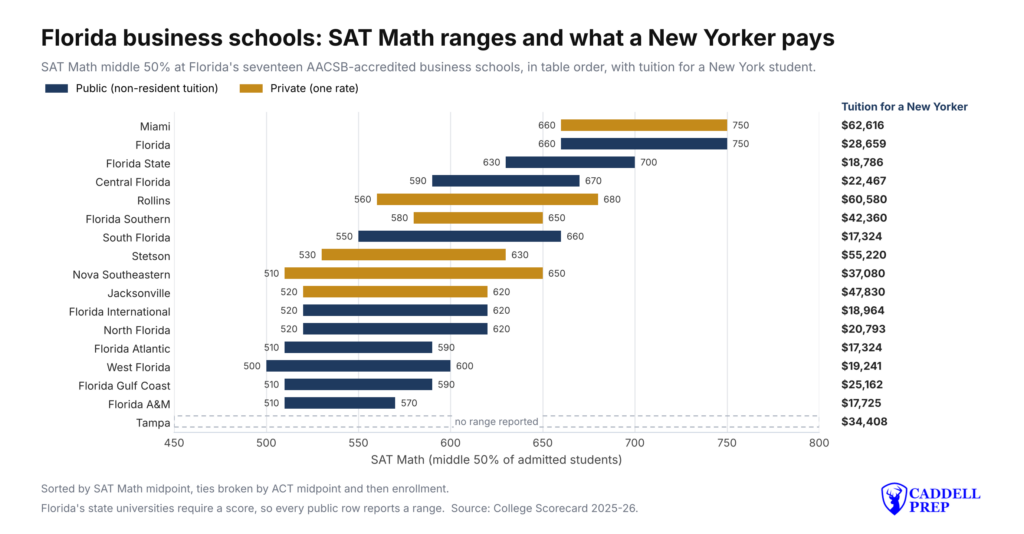
A student can see where his Math score sits on this ladder in the image above.
Want to Know What 5 Topics Will Improve Your SAT Score the Most?
Sample Feedback from our Diagnostic Test:

University of Miami
The University of Miami in Coral Gables awards its business degrees through the Miami Herbert Business School, and Miami reports the highest SAT range of the seventeen, shared with the University of Florida, and admits 19% of its applicants, the lowest rate on the page.
Reading & Writing 660 to 730, Math 660 to 750. ACT composite 30 to 33. The top quarter of admitted students scored at or above 750 on Math and 33 on the ACT. Cost of attendance $86,078, with tuition and fees at $62,616 for all students. 12,913 undergraduates, 19% admitted.
Miami’s 660 Math floor and 750 ceiling are the same as Florida’s, and the two sit one above the other in the table on the ACT midpoint, 31.5 to 31.0. Its $62,616 is $33,957 a year more than Florida charges a New Yorker for the same range, and its cost of attendance, $86,078, is the highest in the table. A New York student with a 650 on Math is 10 points under both schools’ floor.
University of Florida
The University of Florida in Gainesville awards its business degrees through the Warrington College of Business and its undergraduate Heavener School of Business, and Florida reports a Math range of 660 to 750 and charges a New Yorker $28,659, the lowest non-resident tuition in this series at that range.
Reading & Writing 660 to 730, Math 660 to 750. ACT composite 29 to 33. The top quarter of admitted students scored at or above 750 on Math and 33 on the ACT. Cost of attendance $22,523, with tuition and fees at $6,381 in-state and $28,659 out-of-state. 35,629 undergraduates, 24% admitted.
Florida admits 24% of applicants and then reads a business freshman four more times, after each of his first four semesters, the subject of the next section. The cost of attendance in the table is a resident’s. A non-resident’s comes to approximately $44,801 once the higher tuition is substituted, and the $28,659 that drives it is $5,513 below what the University of Alabama charges on a Math floor 80 points lower. Florida’s resident tuition, $6,381, is the lowest of any flagship in this series, so its non-resident premium, $22,278, is most of the bill. Some admitted freshmen are placed in PaCE, a start in UF Online, from which the only Heavener major is General Studies.
Florida State University
Florida State University in Tallahassee awards its business degrees through its College of Business, and Florida State charges a New Yorker $18,786 in tuition on a Math range of 630 to 700, the lowest price in this series at that range.
Reading & Writing 640 to 710, Math 630 to 700. ACT composite 29 to 32. The top quarter of admitted students scored at or above 700 on Math and 32 on the ACT. Cost of attendance $25,720, with tuition and fees at $5,656 in-state and $18,786 out-of-state. 32,212 undergraduates, 24% admitted.
Florida State admits 24% of applicants, the same share as Florida, and its College of Business is a limited access program that admits to a major at 52 hours on a 2.900. The cost of attendance in the table is a resident’s. A non-resident’s comes to approximately $38,850 with the higher tuition substituted, and the $18,786 that drives it is $15,386 below Alabama’s $34,172 on a Math floor 50 points higher and $26,132 below Boulder’s $44,918 on a floor 20 points higher.
University of Central Florida
The University of Central Florida in Orlando awards its business degrees through its College of Business, and Central Florida is the largest university on this page, with 59,146 undergraduates.
Reading & Writing 610 to 680, Math 590 to 670. ACT composite 25 to 29. The top quarter of admitted students scored at or above 670 on Math and 29 on the ACT. Cost of attendance $23,133, with tuition and fees at $6,368 in-state and $22,467 out-of-state. 59,146 undergraduates, 40% admitted.
Central Florida admits 40% of applicants on a Math range of 590 to 670, 40 points below Florida State’s at the floor, and charges a New Yorker $22,467, $3,681 more than Florida State. The cost of attendance in the table is a resident’s, and a non-resident’s comes to approximately $39,232 with the higher tuition substituted.
Rollins College
Rollins College in Winter Park awards its business degrees through its business program under the Crummer Graduate School of Business’s AACSB accreditation [VERIFY the undergraduate unit], and Rollins charges every student $60,580, the second highest tuition on the page after Miami’s.
Reading & Writing 600 to 690, Math 560 to 680. ACT composite 25 to 30. The top quarter of admitted students scored at or above 680 on Math and 30 on the ACT. Cost of attendance $76,108, with tuition and fees at $60,580 for all students. 2,631 undergraduates, 48% admitted.
Florida Southern College
Florida Southern College in Lakeland awards its business degrees through the Barney Barnett School of Business and Free Enterprise, and Florida Southern College admits 64% of its applicants.
Reading & Writing 590 to 680, Math 560 to 650. ACT composite 25 to 30. The top quarter of admitted students scored at or above 650 on Math and 30 on the ACT. Cost of attendance $60,768, with tuition and fees at $44,040 for all students. 2,656 undergraduates, 64% admitted.
University of South Florida
The University of South Florida in Tampa awards its business degrees through the Muma College of Business, and South Florida charges a New Yorker $17,324, tied with Florida Atlantic for the lowest non-resident tuition of the ten public rows.
Reading & Writing 580 to 660, Math 550 to 660. ACT composite 24 to 29. The top quarter of admitted students scored at or above 660 on Math and 29 on the ACT. Cost of attendance $22,859, with tuition and fees at $6,410 in-state and $17,324 out-of-state. 37,207 undergraduates, 43% admitted.
South Florida admits 43% of applicants on a Math range of 550 to 660 whose ceiling matches Central Florida’s within 10 points, and its $17,324 is $1,462 below Florida State’s and $11,335 below Florida’s. Its ACT range of 24 to 29 is the same as Central Florida’s, so the two sit apart in the table on the SAT Math midpoint alone, 630 to 605.
Nova Southeastern University
Nova Southeastern University in Fort Lauderdale awards its business degrees through the Huizenga College of Business and Entrepreneurship, AACSB-accredited since February 2023 and the newest accredited business school on the page, and Nova admits 73% of its applicants, the highest rate of the seventeen.
Reading & Writing 530 to 650, Math 500 to 650. ACT composite 19 to 28. The top quarter of admitted students scored at or above 650 on Math and 28 on the ACT. Cost of attendance $56,692, with tuition and fees at $38,700 for all students. 7,240 undergraduates, 73% admitted.
Jacksonville University
Jacksonville University in Jacksonville awards its business degrees through the Davis College of Business and Technology, and Jacksonville University admits 57% of its applicants.
Reading & Writing 580 to 660, Math 520 to 620. ACT composite 22 to 27. The top quarter of admitted students scored at or above 620 on Math and 27 on the ACT. Cost of attendance $63,969, with tuition and fees at $47,830 for all students. 2,930 undergraduates, 57% admitted.
Florida International University
Florida International University in Miami awards its business degrees through its College of Business, and Florida International is the second largest university on the page and charges a New Yorker $18,964.
Reading & Writing 550 to 640, Math 520 to 620. ACT composite 21 to 27. The top quarter of admitted students scored at or above 620 on Math and 27 on the ACT. Cost of attendance $21,462, with tuition and fees at $6,565 in-state and $18,964 out-of-state. 39,508 undergraduates, 55% admitted.
Florida International admits 55% of applicants on a Math range of 520 to 620 and charges $18,964, $178 above Florida State for a range 110 points lower at the floor. It sits above North Florida in the table, at the same 570 Math midpoint, on an ACT midpoint of 24.0 to 22.0, and below Jacksonville University at 24.5.
University of North Florida
University of North Florida in Jacksonville awards its business degrees through the Coggin College of Business, and University of North Florida admits 53% of its applicants.
Reading & Writing 550 to 650, Math 520 to 620. ACT composite 19 to 25. The top quarter of admitted students scored at or above 620 on Math and 25 on the ACT. Cost of attendance $20,983, with tuition and fees at $6,389 in-state and $20,793 out-of-state. 13,359 undergraduates, 53% admitted. University of North Florida charges a New Yorker $20,793, $13,379 below what the University of Alabama charges, with a non-resident premium of $14,404 over its resident tuition.
Stetson University
Stetson University in DeLand awards its business degrees through the School of Business Administration, and Stetson University admits 72% of its applicants.
Reading & Writing 540 to 660, Math 520 to 610. ACT composite 21 to 28. The top quarter of admitted students scored at or above 610 on Math and 28 on the ACT. Cost of attendance $72,533, with tuition and fees at $57,410 for all students. 2,297 undergraduates, 72% admitted.
Florida Atlantic University
Florida Atlantic University in Boca Raton awards its business degrees through the College of Business, and Florida Atlantic University admits 66% of its applicants.
Reading & Writing 530 to 610, Math 510 to 590. ACT composite 21 to 26. The top quarter of admitted students scored at or above 590 on Math and 26 on the ACT. Cost of attendance $21,522, with tuition and fees at $4,879 in-state and $17,324 out-of-state. 23,757 undergraduates, 66% admitted. Florida Atlantic University charges a New Yorker $17,324, $16,848 below what the University of Alabama charges, with a non-resident premium of $12,445 over its resident tuition.
University of West Florida
University of West Florida in Pensacola awards its business degrees through the College of Business, and University of West Florida admits 58% of its applicants.
Reading & Writing 520 to 630, Math 500 to 600. ACT composite 20 to 27. The top quarter of admitted students scored at or above 600 on Math and 27 on the ACT. Cost of attendance $19,947, with tuition and fees at $6,360 in-state and $19,241 out-of-state. 9,330 undergraduates, 58% admitted. University of West Florida charges a New Yorker $19,241, $14,931 below what the University of Alabama charges, with a non-resident premium of $12,881 over its resident tuition.
Florida Gulf Coast University
Florida Gulf Coast University in Fort Myers awards its business degrees through the Lutgert College of Business, and Florida Gulf Coast University admits 63% of its applicants.
Reading & Writing 530 to 610, Math 510 to 590. ACT composite 20 to 25. The top quarter of admitted students scored at or above 590 on Math and 25 on the ACT. Cost of attendance $20,807, with tuition and fees at $6,118 in-state and $25,162 out-of-state. 13,874 undergraduates, 63% admitted. Florida Gulf Coast University charges a New Yorker $25,162, $9,010 below what the University of Alabama charges, with a non-resident premium of $19,044 over its resident tuition.
Florida A&M University
Florida A&M University in Tallahassee awards its business degrees through its School of Business and Industry, and Florida A&M is a historically Black university that admits 21% of its applicants, the second lowest rate on the page after Miami’s.
Reading & Writing 520 to 610, Math 510 to 570. ACT composite 20 to 24. The top quarter of admitted students scored at or above 570 on Math and 24 on the ACT. Cost of attendance $23,970, with tuition and fees at $5,785 in-state and $17,725 out-of-state. 7,582 undergraduates, 21% admitted.
Florida A&M’s 21% admit rate comes with a Math range of 510 to 570, the narrowest of the ten public rows at 60 points, and a non-resident tuition of $17,725, the third lowest on the page. Its School of Business and Industry holds AACSB accreditation [VERIFY the current term].
University of Tampa
The University of Tampa awards its business degrees through the Sykes College of Business, and Tampa is the one university of the seventeen that reports no SAT or ACT range to the Scorecard.
University of Tampa reports no SAT or ACT range. Cost of attendance $51,614, with tuition and fees at $34,408 for all students. 10,572 undergraduates, 40% admitted.
Tampa charges $34,408 to every student and admits 40% of applicants, and its 10,572 undergraduates make it the second largest private university on the page after Miami. The absence of a range is a reporting choice, because Tampa is private and the state’s score requirement does not reach it.
Seventeen rows say who got into the university. The next section is about what the two flagships read after that, and how often.
What Does a Florida Business Freshman Have to Do to Keep His Major?
Lorem ipsum dolor sit amet, consectetur adipiscing elit. Ut elit tellus, luctus nec ullamcorper mattis, pulvinar dapibus leo.A freshman admitted to a business major at the University of Florida keeps it by clearing a critical-tracking GPA that rises from 2.5 after the first semester to 3.0 after the third and fourth, and a freshman at Florida State enters the College of Business at 52 completed hours on a 2.900.
Florida’s rule is a table, and the Heavener School of Business prints it in the catalog. After the first fall or spring semester a business student must have completed one tracking course with a 2.5 tracking GPA. After the second, two courses and a 2.75. After the third, two more including ACG 2021 and a 3.0. After the fourth, two more and a 3.0, with a 2.0 University of Florida GPA required at every step. Finance majors take two tracking courses every term, nine in all, and must earn a B in ACG 2021 and ACG 2071, and Finance, Management and Marketing each add an eighth tracking course with a minimum grade, FIN 3403 at a B, MAN 3025 at a C, MAR 3023 at a C, that does not enter the tracking GPA [VERIFY the table and the grade rules in the UF catalog’s Heavener section].
A UF student in another college comes into a business major with a 3.0 UF GPA and no tracking courses completed, or a 2.0 UF GPA with a 3.0 tracking GPA, and may not have passed 130 credits. A student admitted to another UF college at entry, or admitted as an upper-division transfer in a non-business major, is not eligible for the Heavener School at all. The far side of the table is written in one sentence: students must keep a 2.0 UF, core and major GPA, may be placed on probation for up to two semesters, and “Students who do not meet the terms of their probation will be prohibited from continuing in a business major.”
Warrington’s admissions page adds a route a New York family should know by name. The Office of Admissions places some admitted freshmen into PaCE, a start in UF Online, and a PaCE student in the Heavener School is limited to the Bachelor of Arts in Business Administration in General Studies, reached with 60 credits, of which up to 45 may be AP, IB or AICE credit, two online semesters with at least 15 UF credits, the seven tracking courses, and a prerequisite GPA of 3.5 or higher counting all attempts. A petition from PaCE into any other business major is, in the page’s words, “highly competitive” [VERIFY on the Warrington admissions page].
Florida State’s rule is one date and one number. Its College of Business describes itself as “a limited access program,” and admission to a major such as Marketing for fall 2026, spring 2027 and summer 2027 requires at least 52 completed semester hours, a C- or better in ACG 2021, ACG 2071, CGS 2100 or CGS 2518, ECO 2013, ECO 2023, MAC 2233 and STA 2023, and an overall GPA of 2.900 on all prior college work, a figure the major sheet says can change each academic year. The sheet’s own milestones ask a 2.7 after the first term, a 2.8 after the second and a 2.9 after the third and fourth, as guidance rather than cutoffs [VERIFY on the FSU major sheets, and confirm that Accounting, Finance and Management carry the same 2.900].
The shape is new to this series. On our page on business colleges in Alabama, the gate came once, at 61 hours. On our page on business colleges in Colorado, it came once and only for the student the first door refused. Florida’s flagship runs a gate after every semester for two years, and the number it reads goes up each time, while Florida State runs the single gate with a number it resets each year.
| School | When the business school reads you | What it reads | Number |
|---|---|---|---|
| Florida (Heavener) | After each of the first four semesters | Tracking courses completed, tracking GPA, UF GPA | 2.5, then 2.75, then 3.0, then 3.0, with a 2.0 UF GPA, and a B in ACG 2021 and 2071 for Finance |
| Florida (change of major) | Any time under 130 credits | UF GPA and tracking GPA | 3.0 with no tracking courses, or 2.0 with a 3.0 tracking GPA |
| Florida (PaCE) | At 60 credits after two online semesters | Seven tracking courses, prerequisite GPA | 3.5, General Studies only, with petitions elsewhere “highly competitive” |
| Florida State (limited access) | At 52 completed hours | Seven courses at C- or better, overall GPA | 2.900 for 2026-27, reset each year |
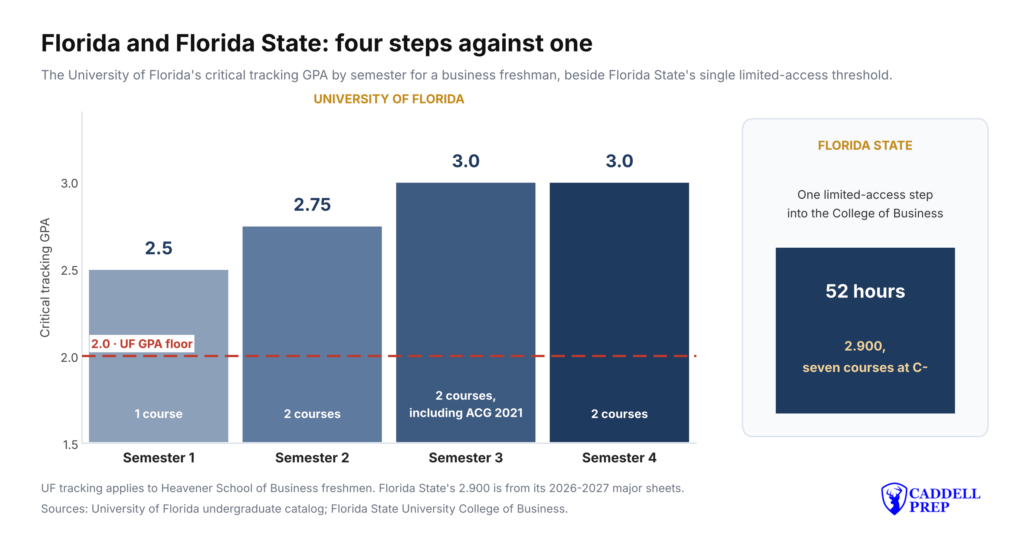
The image above shows the four tracking steps a Florida business freshman climbs and the one step at Florida State.
The tracking GPA is computed on the tracking courses only, with the UF GPA sitting beneath it at a 2.0 floor, so a student can carry a 3.4 overall and still fall off track on two accounting grades. The 2.900 at Florida State is this year’s number, and the sheet says so.
The price is the other half of the page, because Florida’s public business schools are the cheapest in this series for the ranges they post. Florida State charges a New Yorker $18,786 in tuition on a 630 to 700 Math range and a 24% admit rate, $15,386 less than the University of Alabama on a range 50 points higher at the floor and $26,132 less than Boulder on a range 20 points higher. Florida charges $28,659 on 660 to 750, the lowest non-resident tuition in this series at any school with a 660 Math floor, and its resident tuition of $6,381 is the lowest of any flagship on these pages, so its $22,278 premium is most of the bill. South Florida and Florida Atlantic charge $17,324, Florida A&M $17,725 and Florida International $18,964, and nine of the ten public rows sit under $26,000, with Florida Gulf Coast’s $25,162 the high among the nine. Miami charges $62,616 to every student on the same range as Florida, $33,957 more a year. Four years is $75,144 at Florida State, $114,636 at Florida, $69,296 at South Florida and $250,464 at Miami. Bright Futures, the state scholarship, is for Florida residents [VERIFY].
The one business degree Florida licenses is accounting. The Florida Board of Accountancy lets a candidate sit for the CPA exam with 120 semester hours including 24 upper-division accounting hours in taxation, auditing, financial and cost accounting and 24 upper-division general business hours with 3 in business law, and licenses on 150 hours with 30 upper-division accounting hours, 36 upper-division business hours including 3 in U.S. business law, all four parts of the exam passed inside a rolling 30-month window, and one year of experience of at least 2,000 hours verified by a licensed CPA [Florida Institute of CPAs page, VERIFY on the board’s page, including any ethics requirement]. Alabama asks 150 hours with 33 in accounting and 27 in business, Colorado 150 with 33 and 27 and 1,800 hours of experience, Delaware 2,000 hours. Florida’s 36 business hours is the largest business-hour count on these pages so far.
Take a New York student with a 1300 on the SAT, 650 on each section, and a 3.5 GPA. At Florida he is 10 points under the 660 Math floor and 10 under the 660 Reading & Writing floor, admitted at 24%. Admitted to Heavener, he holds the major by clearing 2.5, 2.75, 3.0 and 3.0 over four semesters, with a B in two accounting courses if he wants Finance. Placed in PaCE, he starts online and reaches General Studies at 60 credits and a 3.5 prerequisite GPA. At Florida State he is inside the 630 to 700 Math range and the 640 to 710 Reading & Writing range, admitted at 24%, and then 52 hours, seven courses at C- and a 2.900 put him in the College of Business, at $18,786 a year. At Central Florida he is inside 590 to 670, admitted at 40%, at $22,467. At Miami he is 10 under both floors, admitted at 19%, at $62,616. Four years of tuition is $75,144 at Tallahassee, $114,636 at Gainesville and $250,464 at Coral Gables. The score decided the first door at all four. Gainesville reads four more numbers over two years, and Tallahassee reads one at 52 hours.
The honest version is that Florida does not publish how many business freshmen fall off tracking or how many PaCE students reach a major other than General Studies. Florida State does not publish how many applicants clear the 2.900 or how often the figure moves. The other fifteen schools’ business-school rules were not read for this page and are not described here [VERIFY each catalog, since several State University System campuses also call business limited access]. The Board of Governors regulation is cited from the universities’ own statements and not read directly [VERIFY]. The page does not say which business school is better. It says what each costs a New Yorker, what the two flagships read after the letter, and how often.
Families reading the tracking table frequently ask what happens to a student who misses a step.
Does the University of Florida Drop Business Students Who Fall Below the Tracking GPA?
Yes, the University of Florida removes a business student who fails to meet the terms of his probation, and the Heavener School’s catalog section says it in one sentence: “Students who do not meet the terms of their probation will be prohibited from continuing in a business major.”
The tracking GPA counts the tracking courses only, and the UF GPA floor beneath it stays at 2.0 through all four semesters. A student who falls short is placed on probation for up to two semesters, and a student who is removed re-enters only under the change-of-major rule, a 3.0 UF GPA with no tracking courses completed or a 2.0 UF GPA with a 3.0 tracking GPA, and only under 130 credits [VERIFY]. The B in ACG 2021 and ACG 2071 for Finance is a grade rule, not a GPA rule, and a C in either closes Finance without closing the other majors.
Four steps, one sentence about probation. Which schools hold the accreditation is the next section.
Which Florida Universities Have AACSB-Accredited Business Schools?
Seventeen Florida universities hold business accreditation from AACSB International, ten in the State University System and seven private, and the list below names each with its city and the school that awards the business degree [VERIFY all seventeen on the AACSB directory before publishing, Rollins’s undergraduate unit first].
- University of Florida in Gainesville awards its business degrees through the AACSB-accredited Warrington College of Business.
- Florida State University in Tallahassee awards its business degrees through the AACSB-accredited College of Business.
- University of Central Florida in Orlando awards its business degrees through the AACSB-accredited College of Business.
- University of South Florida in Tampa awards its business degrees through the AACSB-accredited Muma College of Business.
- Florida International University in Miami awards its business degrees through the AACSB-accredited College of Business.
- University of North Florida in Jacksonville awards its business degrees through the AACSB-accredited Coggin College of Business.
- Florida Atlantic University in Boca Raton awards its business degrees through the AACSB-accredited College of Business.
- University of West Florida in Pensacola awards its business degrees through the AACSB-accredited College of Business.
- Florida Gulf Coast University in Fort Myers awards its business degrees through the AACSB-accredited Lutgert College of Business.
- Florida A&M University in Tallahassee awards its business degrees through the AACSB-accredited School of Business and Industry.
- University of Miami in Coral Gables awards its business degrees through the AACSB-accredited Miami Herbert Business School.
- Rollins College in Winter Park awards its business degrees through its AACSB-accredited business program [VERIFY the undergraduate unit].
- Florida Southern College in Lakeland awards its business degrees through the AACSB-accredited Barney Barnett School of Business and Free Enterprise.
- Nova Southeastern University in Fort Lauderdale awards its business degrees through the AACSB-accredited Huizenga College of Business and Entrepreneurship.
- Jacksonville University in Jacksonville awards its business degrees through the AACSB-accredited Davis College of Business and Technology.
- Stetson University in DeLand awards its business degrees through the AACSB-accredited School of Business Administration.
- University of Tampa in Tampa awards its business degrees through the AACSB-accredited Sykes College of Business.
Accreditation matters for a reason that is easy to miss at seventeen. Business itself is not a licensed profession, and the one business degree that leads to a license, accounting, leads to it through the state board rather than through the school. A CPA in Florida normally needs 150 semester hours with 30 in upper-division accounting and 36 in upper-division business, the four parts of the Uniform CPA Examination inside 30 months, and a year of experience, and may sit for the exam at 120 hours with 24 accounting and 24 business hours [VERIFY on the board’s page]. AACSB status matters on the way there because business schools use it to decide whose courses they will accept in transfer.
The Florida Institute of Technology’s Bisk College of Business holds business accreditation from the IACBE and Embry-Riddle Aeronautical University’s Daytona Beach campus from the ACBSP, and Saint Leo, Southeastern, Lynn, Barry, St. Thomas, Palm Beach Atlantic, Bethune-Cookman, Flagler, Florida Memorial, Edward Waters, Eckerd, Ave Maria, Webber and Warner award business bachelor’s degrees without AACSB accreditation [VERIFY each school’s accreditor]. Florida Polytechnic and New College award no business degree. The University of Florida’s online arm is a separate row in the Scorecard and the same university. The state colleges that award bachelor’s degrees in business are not AACSB-accredited, and Everglades, Keiser, Full Sail and the Ana G. Mendez campuses are online, for-profit or report no scores.
Nothing on this page ranks the seventeen. They are seventeen schools with the same accreditor, ten of them at prices no other state in this series has matched for the ranges they post, and the pages for business colleges in Georgia and business colleges in Alabama carry the neighbors a student looking at Florida is likely comparing.
What If Your Score Is Below the Range You Want?
In Florida the highest floors are Miami’s and Florida’s, 660 on Math, the highest in this series so far, with Florida State’s 630 and Central Florida’s 590 behind them, and Florida A&M’s 510 is the lowest public floor. A student under the floor he wants is not ruled out, because a quarter of admitted students were there too. He is in the quarter that needs the rest of the application to carry more, and in Florida he cannot leave the score out, because every public university requires one.
The first step is finding out where the score actually is, section by section. A free diagnostic SAT gives a Math score that can be set directly against Florida’s 660 floor and Florida State’s 630.
The Math section rewards the same handful of topics on every test date, and a student who knows which of them he is missing can close a gap of 50 to 100 points in weeks rather than months. The method is on our page on improving your SAT Math score, and in Florida the same algebra fills MAC 2233, the applied calculus course that stands among Florida State’s seven limited-access courses and Florida’s tracking list.
How to Read These Score Ranges
Each range in the table covers the middle 50% of admitted students who submitted that test, so a quarter of admitted students were below the lower number and a quarter were at or above the upper one.
At Florida’s public universities every admitted freshman submitted a score, because the state requires one, so those ten ranges describe the whole admitted class and not a self-selected part of it [VERIFY how the Scorecard treats required-score schools]. At the private schools a range describes the students who chose to submit. More on what SAT score you need for college and on test-optional colleges.
Should You Take the ACT Instead?
Florida’s public universities accept either test and require one of them, and sixteen of the seventeen schools on this page report both.
A New York student who holds an SAT should send it and leave the ACT alone unless a school outside the state asks for it. Nothing at Gainesville’s four tracking steps or Tallahassee’s 52-hour gate reads either test.
Business Programs in Nearby States
Florida borders Georgia and Alabama, and each has AACSB-accredited business schools of its own.
See business colleges in Georgia and business colleges in Alabama.
Business Colleges in Other States
We publish the same breakdown for business programs in every state.
See business colleges by state for the full list.

Glyn Caddell
Glyn Caddell holds a BS in Mechanical Engineering from NJIT and has been tutoring New York City students since 2008. He founded Caddell Prep in 2012 and is the author of Digital SAT Math Secrets: Lessons & Tricks to Quickly Improve to a Perfect 800 on the Math Test, which contains over 900 practice problems and is used in Caddell Prep’s SAT math classes. He is founding president of the Staten Island Technical High School alumni association and teaches every lesson on this site personally.
Finally, an SAT course that students actually understand
Every question has a video explanation. Not most — every one.
The on-demand Digital SAT course covers all 17 math topics and 15 reading and writing topics, with 5 full-length practice tests and a 100-point score increase guarantee. Keep access for the rest of high school. No subscription.
Want to Know What 5 Topics Will Improve Your SAT Score the Most?
Sample Feedback from our Diagnostic Test: