
Here are some examples of No Solution & Infinite Solutions questions from the Digital SAT.
- If the system has no solution, what is the value of
?
- In the given equation,
- One of the two equations in a system of linear equations is given. The system has infinitely many solutions. Which equation could be the second equation in this system?
If you think of the two equations as functions, they would be two functions that never intersect.
If they are both linear equations, they will have the same slope but different y-intercepts.
For example, if we had the system of equations 

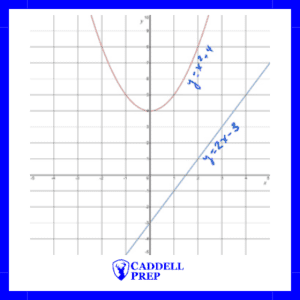
Here is an example of two linears equation that never intersect.


It isn’t easy to immediately notice, but both equations have the same slope. Solve for y in the second equation.
Divide both sides by 3 to get

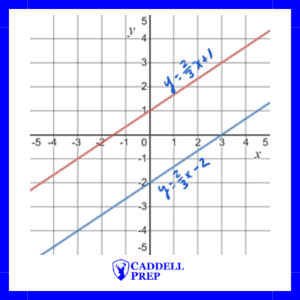
Both functions have a slope of

Here is a graph of both functions.
Put both equations into slope-intercept form:

If
(slope) is the same but
(
-intercept) is different → no solution
Equation 1:

Equation 2:
Both linear functions have a slope of 2. Same slope and different y-intercepts, so there’s no solution.
For example, the following system of equations has infinite solutions.


Solve for 
If both functions were graphed, they would be graphed right on top of each other, so there would be infinite solutions.

In the given equation, 
A) 0
B) 4
C) 9
D) 13
Answer: B) 4
For an equation to have infinitely many solutions, both sides must be identical for every value of 


Two common mistakes students make when answering No Solution & Infinite Solution questions are not using Desmos and reorganizing equations by solving for
A common mistake is reorganizing the equations to graph them in Desmos. This isn’t inherently a math mistake, but it’s a test-taking mistake for two reasons:
- It wastes time. The equations do not need to be solved for
- It introduces an opportunity for an error. When you try to reorganize an equation, you introduce a chance to make a mistake. There’s no reason to introduce a chance for a mistake when the equations can be graphed as-is.