
Home » College SAT Score Ranges, Costs, and Programs by Major and State » Best Pre-Med Colleges » Pre-Med Colleges in Vermont: SAT Scores, Costs, and Programs
By Glyn Caddell, BSME · Author of Digital SAT Math Secrets · Tutoring since 2008 — Updated October 17, 2026
Eight Vermont colleges with pre-med programs, what they cost, and the SAT scores of the students they admit.
Vermont has the highest median cost of attendance of any state in the country, and its state grant ignores grades entirely and can be used at colleges outside Vermont.
Scores are given by section rather than as a single total, because a student at 650 Reading & Writing and 540 Math is in a different position from a student at 540 and 650.
Two abbreviations come up later on this page. MD is the degree awarded by most medical schools in the United States. DO is the degree awarded by colleges of osteopathic medicine, and DO holders are licensed physicians with the same practice rights. Vermont has one of the first and none of the second.
Table of Contents
- Vermont Pre-Med Colleges by SAT Score
- Why Vermont Costs More Than Any Other State
- Vermont Does Not Give Students a College Entrance Exam
- What Does the Vermont Grant Require?
- Vermont’s Medical School Residency Rule Decides Price, Not Access
- Bennington’s Two Score Ranges Are 115 Points Apart
- Landmark College Enrolls Only Students Who Learn Differently
- What If Your Scores Are Below the Range You Want?
Vermont Pre-Med Colleges by SAT Score
The table below covers four-year public and non-profit institutions in Vermont awarding bachelor’s degrees or higher with at least 400 undergraduates. Eight institutions meet that description.
The threshold is 400 rather than the 500 this series normally uses, for one reason. Landmark College enrolls 455 undergraduates and is one of the only accredited colleges in the country designed exclusively for students who learn differently, and in a state with eight four-year institutions that is not an omission worth making. It has a section of its own below.
Colleges are sorted by the midpoint of the two section ranges, with ties broken on the Math 75th percentile. The two colleges reporting no scores go last, ordered by size. There is no ACT column because no Vermont institution reports an ACT composite without also reporting SAT sections, so the column would add nothing the table does not already carry.
| College | Reading & Writing | Math | Cost of attendance | Undergraduates | Admit rate |
|---|---|---|---|---|---|
| Middlebury College | 720 to 760 | 725 to 790 | $85,880 | 2,738 | 11% |
| University of Vermont | 660 to 730 | 630 to 710 | $35,649 | 11,743 | 65% |
| Bennington College | 703 to 750 | 588 to 653 | $87,284 | 780 | 45% |
| Champlain College | 620 to 700 | 600 to 680 | $65,009 | 2,752 | 83% |
| Saint Michael’s College | 570 to 660 | 550 to 620 | $69,079 | 1,092 | 85% |
| Norwich University | 540 to 650 | 520 to 670 | $67,357 | 2,428 | 74% |
| Vermont State University | Not reported | Not reported | $25,988 | 3,590 | 82% |
| Landmark College | Not reported | Not reported | $83,124 | 455 | 49% |
Each range covers the middle 50% of admitted students who submitted scores. A quarter scored below the lower number, and the top quarter scored at or above the upper one. Being under the lower number does not rule a student out, and being just above it is not as safe as it looks.
Two institutions sit outside the rule. Community College of Vermont enrolls 2,841 students and predominantly awards associate degrees, which puts it outside what this page compares, and it would otherwise be the third largest institution in the state. Sterling College enrolls 50 undergraduates, far below the size of anything else here.
Four things in that table are worth stopping on.
Vermont is the most expensive state in the country for college, and the next section works through the arithmetic. Six of these eight institutions cost more than $65,000 a year.
The most expensive is Bennington College at $87,284, ahead of Middlebury at $85,880 and Landmark at $83,124. A reader who expected Middlebury to top that column is in good company and is wrong by $1,404.
Middlebury admits 11% of applicants. The next most selective institution in the state is Bennington at 45%. That is a gap of 34 percentage points with nothing in between it, and no other state in this series has a selectivity distribution shaped like that.
Bennington’s Reading & Writing range sits 115 points above its Math range at the lower end of each. No other college here comes close, and that row gets its own section below.
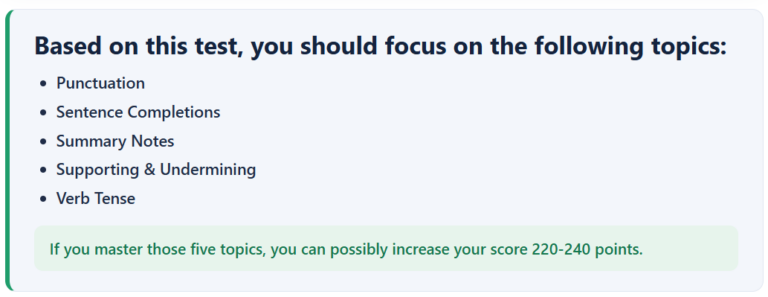
Want to Know What 5 Topics Will Improve Your SAT Score the Most?
Sample Feedback from our Diagnostic Test:
Middlebury College
Middlebury College is a private liberal arts college in Middlebury with 2,738 undergraduates, and it admits 11% of applicants, by far the lowest rate in Vermont. Admitted students scored 720 to 760 in Reading & Writing and 725 to 790 in Math, so the top quarter were at or above 760 and 790, against an ACT range of 33 to 35. Tuition and fees are $67,600 against a total cost of attendance of $85,880.
Middlebury is one of only two institutions on this page where Math sits above Reading & Writing, and the only one where it does so at both ends of the range.
University of Vermont
The University of Vermont is the state’s flagship in Burlington with 11,743 undergraduates, more than any other institution here, and it admits 65% of applicants. The admitted range runs 660 to 730 in Reading & Writing and 630 to 710 in Math, with the top quarter at or above 730 and 710, and an ACT range of 30 to 32. Residents pay $19,058 in tuition and fees and non-residents $45,502, a gap of $26,444, against a total cost of attendance of $35,649.
The Robert Larner, M.D., College of Medicine is on this campus, and its residency rule works differently from any other state’s in this series.
Bennington College
Bennington College is a private college in Bennington with 780 undergraduates, and it reports the highest cost of attendance in Vermont at $87,284. The middle half scored 703 to 750 in Reading & Writing and 588 to 653 in Math, putting the top quarter at or above 750 and 653, against an ACT range of 30 to 32. It charges $66,262 in tuition and fees and admits 45% of applicants.
Those two score ranges are 115 points apart at the lower end. That is the widest separation on this page by a long way, and it has its own section below.
Champlain College
Champlain College is a private college in Burlington with 2,752 undergraduates and an 83% admit rate. Its admitted range is 620 to 700 in Reading & Writing and 600 to 680 in Math, and the top quarter sat at or above 700 and 680, with an ACT range of 26 to 29. Tuition and fees come to $47,850, the lowest private figure in the state, against a total cost of attendance of $65,009.
Saint Michael's College
Saint Michael’s College is a private Catholic college in Colchester with 1,092 undergraduates, and it admits 85% of applicants, the highest rate on this page. Admitted students scored 570 to 660 in Reading & Writing and 550 to 620 in Math, so the top quarter were at or above 660 and 620, against an ACT range of 26 to 31. Tuition and fees are $51,450 and the total cost of attendance is $69,079.
Norwich University
Norwich University is a private military college in Northfield with 2,428 undergraduates, and it is the only institution on this page reporting SAT sections without an ACT range. The admitted range runs 540 to 650 in Reading & Writing and 520 to 670 in Math, with the top quarter at or above 650 and 670. Norwich charges $49,740 in tuition and fees against a total cost of attendance of $67,357, and admits 74% of applicants.
Vermont State University
Vermont State University is a five-campus public university, and one row in this table covers all of it. It launched on 1 July 2023, formed from Castleton University, Northern Vermont University and Vermont Technical College, with campuses in Castleton, Johnson, Lyndon, Randolph Center and Williston. Northern Vermont University was itself a 2016 merger of Johnson State College and Lyndon State College.
The enrollment figure needs a note. The Scorecard reports 3,590 undergraduates. Vermont State’s own published figures give 4,003 undergraduates and 4,775 total students, without naming an academic year. Either way, a reader should not picture a single campus of that size.
Vermont State reports no admitted score ranges and admits 82% of applicants. Residents pay $11,952 in tuition and fees and non-residents $22,296, against a total cost of attendance of $25,988, the lowest on this page by almost $10,000.
Landmark College
Landmark College is a private non-profit college in Putney with 455 undergraduates, the smallest institution on this page, and it admits 49% of applicants. It reports no admitted test scores. Tuition and fees are $66,540 against a total cost of attendance of $83,124, the third highest in Vermont.
Landmark describes itself as designed exclusively for students who learn differently, and it has its own section below.
Why Vermont Costs More Than Any Other State
Vermont has the highest median cost of attendance of any state in the country, at $68,218.
That figure was computed rather than quoted, and saying so matters because a reader has every reason to be skeptical of a superlative. Taking four-year public and non-profit institutions with at least 400 undergraduates awarding bachelor’s degrees or higher, in every state with at least five such institutions, Vermont comes first. The District of Columbia follows at $65,056 and Massachusetts at $63,740, then Rhode Island at $61,132 and Connecticut at $52,957. At the other end of the range sit Puerto Rico at $16,061, Wyoming at $16,891 and Utah at $19,416.
Inside Vermont the shape is lopsided. Six of the eight institutions cost more than $65,000 a year: Bennington at $87,284, Middlebury at $85,880, Landmark at $83,124, Saint Michael’s at $69,079, Norwich at $67,357 and Champlain at $65,009. Only the University of Vermont at $35,649 and Vermont State at $25,988 sit below, and the gap between Vermont State and the next cheapest institution is almost $10,000.
Median cost of attendance by state. No state asks more of a family than this one.
The public flagship is not the refuge it would be in most states. The University of Vermont charges residents $19,058 in tuition and fees, and Vermont State charges $11,952. So the cheapest resident tuition available at a four-year university in Vermont is $11,952. That is higher than what every public university charges residents in several states this series has already covered.
The comparison that makes that concrete is the state covered immediately before this one. Utah’s median cost of attendance is $19,416, third lowest in the country, and every public university in Utah charges residents under $10,000 with four charging under $7,000. Two neighboring pages in this series sit at opposite ends of the same national distribution.
Vermont Does Not Give Students a College Entrance Exam
Vermont’s statewide assessment system does not include the SAT or the ACT. The Vermont Comprehensive Assessment Program tests science in grade 11 alongside grades 5 and 8, and English language arts and mathematics in grades 3 through 9. Neither college entrance exam appears in the state assessment documentation.
A Vermont student who wants an SAT or ACT score registers for it and pays for it himself.
That is worth stating because three of the four states covered immediately before this one do the opposite. Utah provides the ACT free to every high school junior. South Dakota does the same beginning in spring 2026. Tennessee pays for two attempts, a junior test and a funded senior retake. Vermont provides neither test to anyone.
One limit on that claim. The assessment documentation describes what the state tests and does not address graduation requirements, so this page does not assert that Vermont requires no test to graduate. A student who needs certainty on that point should ask his school.
What Does the Vermont Grant Require?
The Vermont Grant requires financial need, and it does not require grades or test scores. The Vermont Student Assistance Corporation administers it and states plainly that grades do not factor into grant decisions. No test score appears anywhere in the criteria, and continuing eligibility asks only for satisfactory academic progress.
Eligibility runs as follows. A student must be a Vermont resident accepted or enrolled in an undergraduate degree, diploma or certificate program approved for federal Title IV aid, full time or part time, demonstrating financial need. He must not already hold a bachelor’s degree, and must not already have received the equivalent of ten full-time semesters of Vermont grants. The FAFSA is filed every school year listing Vermont as the state of legal residence.
The award range is wide. Recent awards ran from $1,000 to $15,350 for 2025-26, varying with a student’s financial situation, the cost of attendance at his institution, and when he applied. Grants are awarded first come, first served while funds last, so timing is part of what determines the amount. Those are annual figures rather than totals across a degree, and the $15,350 upper end is a ceiling rather than a typical award.
Vermont's Grant Is the Only One That Follows You Out of State
The Vermont Grant can be used at approved schools inside or outside Vermont. VSAC states that the grant is portable and that an eligible student can use it to study out of state.
No other state program covered in this series does that. Tennessee’s HOPE Scholarship requires enrollment at an eligible Tennessee institution. The Texas Grant requires an eligible Texas institution. South Dakota’s Opportunity Scholarship requires a participating South Dakota school. Utah’s Opportunity Scholarship requires an eligible Utah institution. In each of those four states, a student who enrolls elsewhere forfeits the award.
Why Vermont would design it that way is not hard to read, though the state does not say so directly. Vermont has eight four-year institutions and the highest costs in the country, so a grant that only worked at home would work for very few students.
The practical consequence reverses the advice on every other page in this series. A Vermont student weighing an out-of-state college against an in-state one is not giving up his state grant by leaving.
Vermont is the only one of the five that follows the student out of state.
And It Reaches Medical School
The Vermont Grant carries two exceptions to its ten-semester limit and its no-bachelor’s-degree requirement. One covers students enrolled in the Doctor of Medicine program at the UVM Larner College of Medicine. The other covers students in any accredited Doctor of Veterinary Medicine program.
A Vermont resident can therefore receive state grant money while in medical school at Larner. No other state in this series has state grant aid that reaches an MD program.
Two cautions go with that. The amount still depends on demonstrated need rather than on a published schedule, so there is no figure to plan around. And a provision this specific is the kind that gets amended, so a student counting on it should confirm the current terms with VSAC rather than with this page.
Vermont's Medical School Residency Rule Decides Price, Not Access
The University of Vermont’s published residency policy for the Larner College of Medicine governs tuition classification. It does not describe an admissions preference and it does not reserve seats for Vermont residents.
What the policy requires is specific. Establishing domicile in Vermont is necessary but not sufficient, and a student must reside in Vermont continuously for one full year before the semester for which in-state status is sought. A residence or domicile established for the purpose of attending UVM does not qualify. Applying or registering within one year of moving to Vermont creates a rebuttable presumption that the move was made for that purpose, and eligibility must be established by clear and convincing evidence. Limited exceptions allow time away to gain medical experience, capped at four academic semesters before matriculation. The policy notes that the Vermont Legislature established a lower tuition rate for Vermont residents.
Several groups may be charged the in-state rate regardless of residency, including armed forces, foreign service and intelligence community members and their qualifying family, veterans, and citizens of the Freely Associated States.
That is a different kind of rule from the seven states before this one, and the comparison is the point of the section. Texas caps non-residents at 10 percent of every public medical school class by statute. Utah publishes a seat table reserving 90 of 132 places for residents. North Carolina’s Brody School of Medicine bars applicants who are neither residents nor recent UNC System graduates. Tennessee’s University of Tennessee Health Science Center caps out-of-state admissions at approximately 10 percent of its class. Oregon’s OHSU writes four criteria into a numbered policy. South Dakota’s Sanford School of Medicine grants residents an interview and reviews tied non-residents for one. North Dakota’s UND ranks a state degree as one tie inside a preference order.
Every one of those rules decides who can get in. Vermont’s published policy sets a price.
One thing this page does not know and will not guess at. The in-state and out-of-state composition of Larner’s entering class could not be confirmed from UVM’s own materials. A residency policy that is silent on admissions is not the same thing as a medical school with no admissions preference, and treating the two as equivalent would be an error. A student who wants to know how residency affects his chances should ask the admissions office directly.
What is verified is useful on its own. The entering class is approximately 120 students a year. UVM’s application guidance says successful applicants generally present an MCAT score of 500 or greater and a grade point average higher than 3.0, and that Early Decision applicants must take the MCAT no later than mid-May of the application year.
Larner in Burlington is the only medical school in Vermont, and no college of osteopathic medicine operates in the state.
Bennington's Two Score Ranges Are 115 Points Apart
Bennington College reports a Reading & Writing range of 703 to 750 and a Math range of 588 to 653, a separation of 115 points at the lower end of each range and 97 at the upper.
No other college on this page approaches that. The University of Vermont is next at 30 and 20 points. Champlain sits at 20 and 20, Saint Michael’s at 20 and 40, and Norwich at 20 and negative 20. Middlebury runs the other way, with Math 5 points above Reading & Writing at the lower end and 30 points above at the upper.
The likely explanation is what Bennington is. It is an arts-centered college, and an applicant pool drawn to that is normally verbally strong in a way a Math range will reflect. That is a reading rather than a fact, and Bennington does not publish an explanation.
Each college’s two ranges, stacked. One college on this page admits a visibly different kind of applicant.
The practical point is the reason this section exists. A student whose own two section scores are far apart in the same direction is looking at a range that genuinely describes applicants like him, and that is rarely true of the ranges on a page like this one.
It also answers a question this series gets asked about every state page. Why report sections separately instead of giving a single total? Because a combined range of approximately 1,290 to 1,400 would describe Bennington’s admitted students accurately and tell a reader nothing whatsoever about them. Bennington is the clearest demonstration in this series of what the separate columns are for.
Landmark College Enrolls Only Students Who Learn Differently
Landmark College in Putney describes itself as one of the only accredited colleges in the United States designed exclusively for students who learn differently, and it names dyslexia, ADHD, autism and executive function challenges among the groups it serves.
It enrolls 455 undergraduates and admits 49% of applicants. Tuition and fees are $66,540 against a total cost of attendance of $83,124, the third highest figure in Vermont. It publishes no admitted test score ranges.
That last fact matters more here than it would elsewhere. A student cannot calibrate against a published range at Landmark, so the only way to learn what the college looks for is to ask its admissions office.
No other state covered in this series has an institution of this kind, and that is why the table threshold on this page is 400 undergraduates rather than 500. A student with a diagnosed learning difference who intends to take on a science-heavy degree has a genuine question about where to do that work, and the answer to it is not on a score table. It belongs to that student, his family and the advisers who know his situation.
What If Your Scores Are Below the Range You Want?
A Vermont student whose score sits below the range he wants should start by working out which part of this page his question actually belongs to, because most of it is not score-driven.
Six of the eight colleges here admit between 45% and 85% of applicants, and two publish no ranges at all. For most of this table a score is one input among several rather than the gate.
Two places on this page do turn on the number.
Middlebury is the first and it dominates. At 11% it is the only genuinely score-driven admission in Vermont, with an admitted range of 720 to 760 in Reading & Writing and 725 to 790 in Math, and the gap to the next most selective college is 34 percentage points. A student targeting Middlebury is in a different exercise from a student targeting anything else in the state.
Bennington is the second and in a more specific way. At 45% it is selective, and the asymmetry described above means a verbally strong student is reading a range that fits him while a mathematically strong one is reading a range that does not.
Then there is everything outside Vermont, which for a Vermont student is a larger category than it would be almost anywhere else. The state has eight four-year institutions and the state grant travels, so out-of-state applications are the normal case here rather than the exception.
Our students since 2008 have normally needed approximately 40 hours of focused work to move a score meaningfully and approximately 80 hours for a larger jump. An ACT point is worth approximately 25 to 30 SAT points, so those hours convert between the tests.
The honest close for Vermont is different from the one this page would write for most states. Vermont does not hand a student a free test, and it does not attach its state grant to a score or a grade. So the reason to prepare here is almost entirely about where a student applies rather than what the state will give him for the result. With the highest costs in the country and a grant that follows him across the state line, a Vermont student’s test score is mostly doing its work at colleges in other states. That is a smaller claim than the one a tutor would prefer to make, and it is the accurate one.
A student who wants to know where he stands before committing those hours should sit a full timed test first. Take a free diagnostic and work from a real score rather than an impression of one. Our guide on how to improve your SAT score sets out the method, and the conversion above makes it apply to the ACT.
Should a Vermont Student Take the SAT or the ACT?
A Vermont student can take either test, and the SAT is the sensible default.
Vermont provides neither exam, so the choice costs the same either way. That is not true in a state that administers one of them free. Six Vermont institutions report SAT sections and five report an ACT composite, and the five are a subset of the six, since Norwich reports the SAT alone. Every scoring institution on this page publishes SAT figures, and New England colleges have historically leaned that way.
The reasons to take the ACT instead are narrow. An application to a college in a state where the ACT dominates is the clearest one. A student who sits timed practice tests of both and finds the formats genuinely suit him differently is the other, which does happen because the SAT’s adaptive sections and the ACT’s tighter timing reward different habits.
One caution specific to this page. Two of the eight institutions publish no ranges at all, so for a quarter of the table there is nothing to aim at whichever test a student picks.
How to Read These Score Ranges
Every range on this page covers the middle 50% of admitted students who submitted that score. A quarter of admitted students scored below the lower figure, and the top quarter scored at or above the upper one.
Two things follow that students regularly get wrong. A score below the lower number does not rule a student out, because a quarter of the admitted class was there. And a score just above the lower number is weaker than it looks, because it sits at the bottom of the middle half rather than in the middle of it.
Three cautions apply to this page in particular.
Vermont State University and Landmark College publish no ranges, so for those two there is no published figure of any kind to compare against.
Bennington’s two ranges are 115 points apart, so a combined total would describe almost nobody, and the section above works through what that means for a student reading it.
Vermont State University’s enrollment is reported two ways. The Scorecard gives 3,590 undergraduates and the university’s own figures give 4,003, and one row in the table covers five campuses.
And every range here describes students who chose to submit a score. Where a college is test-optional, students with stronger scores tend to submit them and students with weaker ones often do not, so a published range describes the submitters rather than a standard the college applied to everyone. Our guides on what SAT score you need for college and test-optional colleges cover what that means for a particular application.
Pre-Med Programs in Nearby States
Vermont borders New Hampshire, Massachusetts and New York, and Quebec to the north.
The case for looking outward is stronger here than anywhere else in this series, and there is no reason for this page to pretend otherwise. Vermont has eight four-year institutions, the state grant is portable, and the highest costs in the country sit inside the state line. A Vermont student who only looks at Vermont has narrowed his options for no financial reason.
There is a counterpoint worth holding onto. The next highest median costs in the country after Vermont are the District of Columbia, Massachusetts and Rhode Island, so a student looking south is not automatically looking at lower prices. The comparison that matters is total cost of attendance after aid at each specific college, not a regional impression.
Our page for New York covers the colleges, costs and medical school rules there.
Pre-Med Colleges in Other States
Every state page in this series follows the same format, with admitted score ranges, costs, admit rates and the state’s own medical school and scholarship rules. Our pre-med colleges by state index lists all of them.

Glyn Caddell
Glyn Caddell holds a BS in Mechanical Engineering from NJIT and has been tutoring New York City students since 2008. He founded Caddell Prep in 2012 and is the author of Digital SAT Math Secrets: Lessons & Tricks to Quickly Improve to a Perfect 800 on the Math Test, which contains over 900 practice problems and is used in Caddell Prep’s SAT math classes. He is founding president of the Staten Island Technical High School alumni association and teaches every lesson on this site personally.
Finally, an SAT course that students actually understand
Every question has a video explanation. Not most — every one.
The on-demand Digital SAT course covers all 17 math topics and 15 reading and writing topics, with 5 full-length practice tests and a 100-point score increase guarantee. Keep access for the rest of high school. No subscription.
Want to Know What 5 Topics Will Improve Your SAT Score the Most?
Sample Feedback from our Diagnostic Test: