
Home » College SAT Score Ranges, Costs, and Programs by Major and State » Best Pre-Med Colleges » Pre-Med Colleges in Utah: SAT Scores, ACT Scores, Costs, and Programs
By Glyn Caddell, BSME · Author of Digital SAT Math Secrets · Tutoring since 2008 — Updated October 16, 2026
Eight Utah colleges with pre-med programs, what they cost, and the test scores of the students they admit.
Utah guarantees every high school student admission to its public system regardless of grade point average, and the state’s only MD program publishes exactly how its 132 seats a year are divided.
Scores are given by section for the SAT and as a composite for the ACT, because a student at 650 Reading & Writing and 540 Math is in a different position from a student at 540 and 650.
Two abbreviations matter later on this page. MD is the degree awarded by most medical schools in the United States. DO is the degree awarded by colleges of osteopathic medicine, and DO holders are licensed physicians with the same practice rights. Utah has one of the first and two of the second.
Table of Contents
- Utah Pre-Med Colleges by SAT Score
- Utah Guarantees Admission to Every High School Student
- Does Utah’s Scholarship Require a Test Score?
- Every Utah Junior Takes a Free ACT
- Utah Publishes Exactly How Many Medical School Seats Exist
- Utah Has Three Medical Schools
- What If Your Scores Are Below the Range You Want?
Utah Pre-Med Colleges by SAT Score
The table below covers four-year public and non-profit institutions in Utah that award graduate degrees and enroll at least 500 undergraduates. Nine institutions meet that description, one is excluded for a reason given below, and eight remain.
The table is grouped rather than simply sorted, because only half of these institutions publish admitted scores at all. Four report SAT sections and an ACT composite, and they come first, sorted by the midpoint of the two SAT ranges. One reports an admit rate without scores. Three are open admission and report neither scores nor an admit rate, and they come last by size. That grouping is not a gap in the data. It is what Utah’s system looks like.
An ACT column is included because Utah provides the ACT free to every high school junior, which makes the ACT composite the score a Utah student is most likely to already hold.
| College | SAT Reading & Writing | SAT Math | ACT composite | Cost of attendance | Undergraduates | Admit rate |
|---|---|---|---|---|---|---|
| Brigham Young University | 640 to 730 | 630 to 730 | 28 to 32 | $22,690 | 32,952 | 68% |
| University of Utah | 600 to 690 | 590 to 690 | 22 to 29 | $25,557 | 27,264 | 86% |
| Westminster University | 540 to 670 | 530 to 640 | 23 to 29 | $57,616 | 823 | 67% |
| Utah State University | 540 to 650 | 530 to 640 | 20 to 28 | $21,654 | 20,272 | 93% |
| Southern Utah University | Not reported | Not reported | Not reported | $19,416 | 9,289 | 82% |
| Utah Valley University | Open admission | Open admission | Open admission | $14,765 | 28,453 | Open admission |
| Weber State University | Open admission | Open admission | Open admission | $16,035 | 16,360 | Open admission |
| Utah Tech University | Open admission | Open admission | Open admission | $20,763 | 8,552 | Open admission |
Each range covers the middle 50% of admitted students who submitted scores. A quarter scored below the lower number, and the top quarter scored at or above the upper one. Being under the lower number does not rule a student out, and being just above it is not as safe as it looks. Where the table reads Open admission, the institution publishes no range because it admits applicants who meet its basic requirements.
Western Governors University is the institution left out, and it is worth naming because of its size. It enrolls 155,088 undergraduates, nearly five times Brigham Young University, and it is the second largest undergraduate population of any institution in the national dataset. It is excluded because it is fully online and competency-based with open admission, and a pre-med student needs laboratory science taught in person. The same rule excludes Salt Lake Community College and Snow College, which predominantly award associate degrees, Ensign College, which predominantly awards certificates, five technical colleges, and two for-profit institutions.
Four things in that table are worth stopping on.
The most selective institution in Utah is Westminster University, which admits 67% of applicants against Brigham Young’s 68%. The two are close, at 66.6% and 67.8%, and a private university of 823 students edges out a university of 32,952. Nobody predicts that.
Westminster is also the only institution in this table costing more than $26,000 a year. At $57,616 it sits more than twice as high as the University of Utah at $25,557, and almost four times Utah Valley at $14,765. Seven of the eight institutions sit between $14,765 and $25,557, so Westminster is the only one outside a band of under $11,000.
Every public university in Utah charges residents less than $10,000 in tuition and fees, and four of the six charge less than $7,000. Utah Tech is lowest at $6,306, followed by Utah Valley at $6,507, Weber State at $6,557 and Southern Utah at $6,962.
Three of Utah’s large public universities admit everyone who meets their basic requirements, and between them they enroll 53,365 undergraduates. That is more than the University of Utah and Utah State enroll together, at institutions where no admitted score range exists because there is no admissions contest to report.
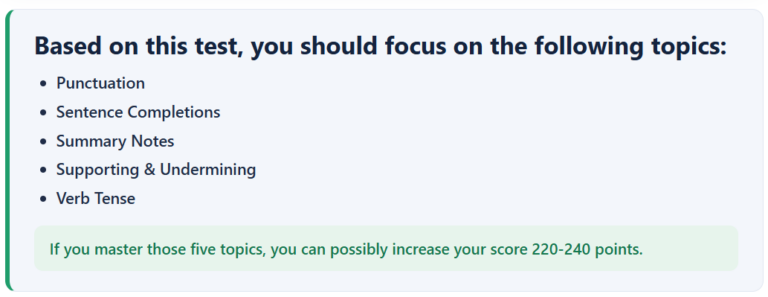
Want to Know What 5 Topics Will Improve Your SAT Score the Most?
Sample Feedback from our Diagnostic Test:
Brigham Young University
Brigham Young University is a private university in Provo owned by the Church of Jesus Christ of Latter-day Saints, with 32,952 undergraduates, and it reports the highest admitted scores in the state. Admitted students scored 640 to 730 in Reading & Writing and 630 to 730 in Math, so the top quarter were at or above 730 in both sections, against an ACT range of 28 to 32. Brigham Young admits 68% of applicants.
The tuition figure needs care, because the published number is not what every student pays. The Scorecard reports Brigham Young’s tuition and fees as $6,688 with no resident and non-resident distinction. The university’s own announcement for 2025-26 sets undergraduate tuition at $3,444 per semester for members of the Church of Jesus Christ of Latter-day Saints and $6,888 per semester for non-members. Across two semesters that is approximately $6,888 and $13,776. Spring and summer terms are priced separately, so those annual figures are estimates. The reported figure is the member rate, and a non-member pays approximately double it.
Put that against the publics and the comparison changes. At the member rate Brigham Young costs more than three Utah public universities charge residents. At the non-member rate it costs more than all six.
University of Utah
The University of Utah is the state’s flagship in Salt Lake City with 27,264 undergraduates, and it admits 86% of applicants. The admitted range runs 600 to 690 in Reading & Writing and 590 to 690 in Math, with the top quarter at or above 690 in both sections, and an ACT range of 22 to 29. Residents pay $9,620 in tuition and fees and non-residents $30,860, a gap of $21,240 that is the largest in the state, against a total cost of attendance of $25,557.
The Spencer Fox Eccles School of Medicine is on this campus, and its published seat allocation has its own section below.
Westminster University
Westminster University is a private university in Salt Lake City with 823 undergraduates, the smallest institution on this page, and it admits 67% of applicants, marginally the lowest rate in Utah. The middle half scored 540 to 670 in Reading & Writing and 530 to 640 in Math, putting the top quarter at or above 670 and 640, against an ACT range of 23 to 29. Tuition and fees are $43,528 and the total cost of attendance is $57,616, both the highest figures in the state by a wide margin.
Utah State University
Utah State University enrolls 20,272 undergraduates in Logan and admits 93% of applicants, the highest rate among the institutions here that report one. Its admitted range is 540 to 650 in Reading & Writing and 530 to 640 in Math, and the top quarter sat at or above 650 and 640, with an ACT range of 20 to 28. Resident tuition and fees come to $9,228 and non-resident tuition to $24,802, against a total cost of attendance of $21,654.
Southern Utah University
Southern Utah University is a public university in Cedar City with 9,289 undergraduates, and it admits 82% of applicants. It reports no admitted score ranges of any kind, and that is unusual for an institution publishing an admit rate, so a student who wants to know what scores Southern Utah actually admits should ask the admissions office directly rather than inferring it from this page. Residents pay $6,962 in tuition and fees and non-residents $21,192, with a total cost of attendance of $19,416.
Utah Valley University
Utah Valley University in Orem describes itself as an open-admissions university, and with 28,453 undergraduates it is the second largest institution in this table. It publishes no admitted score ranges and no admit rate because it admits applicants who meet its basic requirements, so there is no middle half of an admitted class to report. Tuition and fees are $6,507 for residents and $18,489 for non-residents, against a total cost of attendance of $14,765, the lowest on this page.
For a Utah student who wants a four-year university and is worried about getting in, this is the answer to that worry, at the lowest total cost in the state.
Weber State University
Weber State University in Ogden describes itself as an open-enrollment university and enrolls 16,360 undergraduates. It publishes neither admitted scores nor an admit rate. Resident tuition and fees are $6,557 and non-resident tuition is $17,545, with a total cost of attendance of $16,035.
Utah Tech University
Utah Tech University in St. George states plainly that it is an open enrollment institution and admits all applicants who meet the admission criteria, and it enrolls 8,552 undergraduates. Its own catalog lists no ACT or SAT requirement and no minimum grade point average for new freshmen, with those thresholds applying only to students still in high school taking concurrent or early enrollment courses. Utah Tech charges $6,306 in tuition and fees for residents, the lowest resident figure in the state, and $18,246 for non-residents, against a total cost of attendance of $20,763.
Utah Guarantees Admission to Every High School Student
Utah guarantees every high school student admission to at least one of its public colleges or universities, and it does so without reference to grades or test scores.
The Utah System of Higher Education announced the program, called Admit Utah, on 4 October 2024, describing it as the state’s first simplified and guaranteed admissions initiative. Its own statement of what students receive is the part worth quoting. Each student will receive a notification of their guaranteed admission to one or more of the 16 public colleges and universities in Utah, regardless of their GPA.
Regardless of grade point average. The announcement does not mention test scores anywhere in it. AdmitUtah.org serves as the central platform, and the program also covers guidance for undecided students, financial aid guidance, and admissions updates delivered to seniors during October.
Underneath that guarantee sits a second mechanism the table already showed. Utah Valley University, Weber State and Utah Tech admit applicants who meet their basic requirements, and together they enroll 53,365 undergraduates. A statewide guarantee of admission and open admission at three of the system’s largest universities are two different arrangements pointing the same direction.
Three bands of Utah admission. The admission question is settled before a Utah student sits a test.
Four States, and the Test Score Moving Further From the Decision
Four states covered in this series have each pushed the test score further from the admission decision, and Utah is where that line ends.
Oregon’s score did very little, and that page said so. Tennessee made the score one of three alternatives, where a weighted 3.0 grade point average reaches the HOPE Scholarship with no test score at all. Texas admits students to its public universities on class rank and treats the score as the fallback for anyone who did not complete the distinguished curriculum. Utah guarantees admission regardless of grade point average and asks for no score anywhere in the process.
A student working from the assumption that a test score is what gets him into a public university is using a model that does not describe any of those four states. That matters more than it sounds, because hours spent on the wrong lever are hours that bought nothing.
What a score still does in Utah is a real answer rather than a consolation, and it has its own section below.
Does Utah's Scholarship Require a Test Score?
Utah’s merit scholarship does not require a test score. The Opportunity Scholarship is merit-based, and the criteria the Utah System of Higher Education publishes include no ACT or SAT requirement.
What it does require is a 3.3 cumulative high school grade point average, three Advanced Placement, International Baccalaureate or Concurrent Enrollment courses completed in grades nine through twelve with one each in Math, Science and Language Arts, a completed FAFSA for the applicable year, graduation from a Utah high school, and admission as a degree-seeking student at an eligible institution with full-time enrollment in the fall after graduation.
The award has moved, and not upward. For the class of 2026 it pays up to $800 per semester for up to four semesters, or up to $3,200. For the classes of 2022 through 2025 it paid up to $1,000 per semester, up to $4,000. The maximum for the class of 2027 has not been set, and the system states that it is determined each year from available funding and the number of qualified applicants. Awards expire five years after high school graduation, and because the scholarship covers tuition and general fees after other state aid is applied, the actual semester amount varies.
Taken with the section above, the position in Utah is unusually clear. Neither admission to the state’s public system nor its merit scholarship turns on a test score.
So What Does a Test Score Still Do in Utah?
A test score still does four things in Utah, and the list is shorter than it would be in most states, and that is the honest way to present it.
The first is Brigham Young University. Its admitted ACT range of 28 to 32 begins approximately eight points above Utah’s average composite, and at 68% it is effectively tied with Westminster as the hardest admission in the state. For a student who wants Brigham Young, the score is the thing being measured.
The second is any application outside Utah. The state’s guarantee covers Utah’s 16 public institutions and nothing else, so a student applying to a college in another state is in an ordinary admissions process with ordinary requirements.
The third is institutional scholarship money, which each college sets for itself rather than the state setting it. At Westminster that matters against a cost of attendance of $57,616, where the state’s $3,200 maximum covers a small fraction of one year.
The fourth is indirect and worth being precise about. Medical school admission in Utah runs on undergraduate grades and the MCAT, not on an SAT or ACT score, so a high school test result does not carry into that decision. What carries is the work. A student who learns to prepare for a timed, content-heavy exam in high school is practicing the thing the MCAT will ask for four years later, and that is a real argument rather than a marketing one.
Every Utah Junior Takes a Free ACT
Utah provides the ACT free to every high school junior, administered at each high school on a set date in spring, and participation exceeds ninety percent of graduates.
One detail is reported inconsistently and this page will not resolve it. A Utah State University guidance page describes the state test as mandatory, while a report published on 15 October 2026 states that the ACT is not required for all Utah students while confirming that the state provides it free to every junior. A student who needs certainty about whether he must sit it should ask his district. What is not in dispute is that the test is provided and paid for.
The 2026 results are worth reporting because they are recent and because Utah does well on them. The state’s average composite rose to 20.1 from 19.9 in 2025, against a national average of 18.8, and Utah ranked first in average composite among states testing more than ninety percent of their graduates, ahead of Wisconsin and Montana at 19.4. Utah also led the nation in benchmark attainment.
Those benchmark figures deserve a closer look, because leading the nation and doing well are different claims. Among Utah public school graduates, 57% met the English benchmark, 45% met reading, 34% met math and 33% met science. Only English was met by a majority. The share meeting all three core benchmarks in English, math and reading rose two points to 27%.
One further figure from the same data is striking and needs a caveat attached in the same breath. Among students who retested, the average superscore was 25.8, against the state average composite of 20.1.
The caveat is not optional. Students who choose to retake the ACT are self-selected, and they were normally scoring above average already, so a 5.7-point difference is not a measurement of what retaking does for a typical student. Reported with that qualification it is a genuine data point about what the retaking population looks like in a state that tests everyone once for free. Reported without it, it would be exactly the sort of claim this page exists to avoid making.
Utah’s 2026 ACT figures. The students who choose to retake were already scoring higher, so the gap is not a retake effect.
South Dakota and Tennessee are the other two states in this series where a free state test and the superscore question sat at the center of the page, and they reached opposite arrangements from each other. Utah provides the test without attaching a scholarship threshold to it at all.
Utah Publishes Exactly How Many Medical School Seats Exist
The University of Utah publishes how its medical school seats are divided, and it is the only state in this series where a student can count them rather than infer them.
The Spencer Fox Eccles School of Medicine in Salt Lake City is the only MD program in Utah. Of 132 seats a year, 90 go to Utah residents, 10 to non-residents who attended a Utah school, 10 to Idaho residents under a partnership with the State of Idaho, and 22 to other non-residents including international applicants. Residency for seat allocation is set by the legal state of residence an applicant lists on his AMCAS application.
Those numbers are worth converting. The 90 resident seats are approximately 68% of the class, and the resident seats together with the Utah-school seats are approximately 76%.
No other state covered in this series publishes the counts. North Carolina gives a rule, Texas gives a statutory percentage, Tennessee gives an approximate share of one class. Utah prints the table, which means a Utah student can work out exactly how many seats he is competing for and against whom.
How Utah divides 132 seats. Ten seats are set aside for non-residents who studied in Utah.
The Idaho arrangement is a contract rather than a preference, and its terms are specific. Idaho pays the difference between in-state and out-of-state tuition for the duration of a student’s medical education, and Idaho applicants must complete Idaho State Certification to be considered for one of the ten seats. Once approved they are treated as Idaho residents for all four years and cannot petition for Utah residency afterwards. Under Idaho House Bill 718, applicants matriculating from fall 2023 onward must practice full time in Idaho for four years, beginning within one year of completing residency, fellowship or obtaining a license, and a student who does not comply must reimburse Idaho. Idaho students receiving state funds also pay a Rural Physician Incentive Program surcharge and complete their Family Medicine rotation in Idaho. Applicants to the combined MD and PhD program are treated as non-residents and do not complete the certification.
Montana and Wyoming students take a different route into the same school. They apply through the WICHE Professional Student Exchange Program, filing with their home state by 15 October of the year before matriculation. Students awarded that funding pay out-of-state tuition for all of medical school and cannot reclassify as Utah residents. Students who do not participate, or who apply and are not funded, may petition for Utah reclassification after the first year.
Seven States, and the Only One That Prints the Seat Count
Utah is the seventh consecutive state in this series where a medical school treats an applicant differently depending on where he lives or studied, and it is the only one that answers the question with a number.
Ten of the 132 seats are reserved for non-residents who attended a Utah school. A student in that position is competing for ten identified places, and he can know that before he chooses a college.
The other six states answer the same question less precisely. Texas sets a statutory cap of 10 percent non-residents at every public medical, dental, podiatric and veterinary school. North Carolina’s Brody School of Medicine runs a binary gate, where an applicant is a North Carolina resident or holds a UNC System degree earned within five years, and anyone who is neither may not apply. Tennessee’s University of Tennessee Health Science Center caps out-of-state admissions at approximately 10 percent of its class as institutional policy. Oregon’s OHSU writes four criteria into a numbered policy, any one of which qualifies. South Dakota’s Sanford School of Medicine grants residents an interview and reviews tied non-residents for one, with a 90-credit threshold. North Dakota’s UND treats a state degree as one tie among several in a preference order.
Every one of those is a rule a student has to interpret. Utah’s is a count. The instruction stays the same in all seven states. Read the published policy of the school in question, because none of these rules travel.
Utah Has Three Medical Schools
Utah has one MD-granting medical school and two colleges of osteopathic medicine, and both osteopathic colleges are private for-profit institutions.
The University of Utah Spencer Fox Eccles School of Medicine in Salt Lake City is the MD program, and its seat allocation is set out above. Its mission statement describes serving all people and communities of Utah and the Mountain West.
Noorda College of Osteopathic Medicine in Provo holds accreditation with monitoring from the Commission on Osteopathic College Accreditation, granted at the commission’s meeting of 16 to 18 April 2025, with the next accreditation visit scheduled for the 2028-29 academic year. Noorda’s own accreditation page states that the commission has granted it accreditation without naming the level, so the status given here comes from the commission’s published decision rather than from the college. Noorda enrolled 193 first-year students in 2024-25 against a total enrollment of 577, and it is listed as a private for-profit institution.
Rocky Vista University College of Osteopathic Medicine, Southern Utah, in Ivins, opened in 2017. Rocky Vista is a private for-profit institution that also operates campuses in Englewood, Colorado and Billings, Montana.
The for-profit status of both osteopathic colleges is worth stating rather than leaving for a student to discover, because it bears on cost, on how the institutions are governed, and on the questions a prospective student should ask before committing.
Utah has no BS/MD or early assurance program. There is no route in this state that settles medical school admission while a student is still in high school. That difference matters for anyone arriving from the Texas page, where the state funds the Joint Admission Medical Program, or the Tennessee page, where Middle Tennessee State runs an early acceptance route with Meharry.
The standard caution applies here as everywhere. A medical school on campus gives an undergraduate better access to shadowing, research positions and people who read applications for a living, and it does not improve his odds of admission there. Utah’s one exception is the ten Utah-school seats above, and that exception is unusually concrete.
Should a Utah Student Take the SAT at All?
A Utah student should normally plan around the ACT, and in this state the reason is close to decisive.
Utah provides the ACT free to every junior, so most Utah students have an ACT score before they have made any decision about testing. All four institutions on this page that report scores report both tests, so neither dominates the reporting, and the ACT appears in the table because it is the score a Utah student already holds rather than because more colleges publish it.
The reasons to add the SAT are narrow. An application out of state to an institution that prefers it is the clearest one. A student who sits timed practice tests of both and finds the formats genuinely suit him differently is another, which happens because the SAT’s adaptive sections and the ACT’s tighter timing reward different habits.
One caution about this page specifically. Four of the eight institutions publish no score ranges at all, so for half the table there is no target to aim at, whichever test a student picks.
What If Your Scores Are Below the Range You Want?
A Utah student whose score sits below the range he wants should start by checking whether the score is the obstacle, because in Utah it frequently is not.
Admission is not the constraint. Every Utah high school student is guaranteed admission to at least one of the state’s 16 public institutions regardless of grade point average, and three of the largest public universities admit applicants who meet their basic requirements. A student worried about getting in somewhere in Utah is worried about a problem the state has already solved for him.
Two things in Utah do move with the number.
Brigham Young University is the first and by far the largest. Its admitted ACT range is 28 to 32 against a state average composite of 20.1, so the bottom of its range sits approximately eight points above the state average. A student targeting Brigham Young is doing something the state’s guarantees do not help with at all.
Applications outside Utah are the second. None of the guarantees above apply across a state line, and a Utah student applying to a selective college elsewhere is read the way every other applicant is read.
Our students since 2008 have normally needed approximately 40 hours of focused work to move a score meaningfully and approximately 80 hours for a larger jump. An ACT point is worth approximately 25 to 30 SAT points, so those hours convert between the tests.
The honest close for Utah is narrower than the one this page would write for most states. The state hands every junior one free ACT, and its own data shows retesters averaging a 25.8 superscore against a 20.1 average, with the self-selection caveat from that section still attached. For most Utah students the real reasons to prepare are Brigham Young, an application out of state, or building the habit of preparing for a timed content exam before the MCAT asks for it. Those are three good reasons. Implying that a score opens doors Utah has already opened would not be a fourth.
A student who wants to know where he stands before committing those hours should sit a full timed test first. Take a free diagnostic and work from a real score rather than an impression of one. Our guide on how to improve your SAT score sets out the method, and the conversion above makes it apply to the ACT.
How to Read These Score Ranges
Every range on this page covers the middle 50% of admitted students who submitted that score. A quarter of admitted students scored below the lower figure, and the top quarter scored at or above the upper one.
Two things follow that students regularly get wrong. A score below the lower number does not rule a student out, because a quarter of the admitted class was there. And a score just above the lower number is weaker than it looks, because it sits at the bottom of the middle half rather than in the middle of it.
Three cautions apply to this page in particular.
Four of the eight institutions publish no ranges, and for two different reasons. Utah Valley, Weber State and Utah Tech admit applicants who meet their basic requirements, so there is no admitted middle half to describe. Southern Utah University publishes an admit rate of 82% without publishing score ranges, and that is a different situation and a less explicable one.
Brigham Young’s reported tuition is the church-member rate, so the cost column understates what a non-member pays by approximately double. The Brigham Young entry above gives both figures.
And every range here describes students who chose to submit a score. Where a college is test-optional, students with stronger scores tend to submit them and students with weaker ones often do not, so a published range describes the submitters rather than a standard the college applied to everyone. Our guides on what SAT score you need for college and test-optional colleges cover what that means for a particular application.
Pre-Med Programs in Nearby States
Utah borders six states. Idaho, Wyoming, Colorado, New Mexico, Arizona and Nevada all touch it, and for a student in St. George or Logan an out-of-state campus may be closer than most Utah ones.
Utah’s medical school is part of three neighboring states’ own pathways, and those arrangements are unusually concrete. Ten of the University of Utah’s 132 seats are contracted to Idaho residents, with the four-year Idaho practice requirement under House Bill 718 attached to them. Montana and Wyoming students apply through WICHE PSEP with an October deadline in their home state. For students in those three states the Utah medical school is not an out-of-state long shot but a route their own state has arranged and in Idaho’s case paid for.
Our pages for Idaho, Arizona and New Mexico cover the colleges, costs and medical school rules in each.
Pre-Med Colleges in Other States
Every state page in this series follows the same format, with admitted score ranges, costs, admit rates and the state’s own medical school and scholarship rules. Our pre-med colleges by state index lists all of them.

Glyn Caddell
Glyn Caddell holds a BS in Mechanical Engineering from NJIT and has been tutoring New York City students since 2008. He founded Caddell Prep in 2012 and is the author of Digital SAT Math Secrets: Lessons & Tricks to Quickly Improve to a Perfect 800 on the Math Test, which contains over 900 practice problems and is used in Caddell Prep’s SAT math classes. He is founding president of the Staten Island Technical High School alumni association and teaches every lesson on this site personally.
Finally, an SAT course that students actually understand
Every question has a video explanation. Not most — every one.
The on-demand Digital SAT course covers all 17 math topics and 15 reading and writing topics, with 5 full-length practice tests and a 100-point score increase guarantee. Keep access for the rest of high school. No subscription.
Want to Know What 5 Topics Will Improve Your SAT Score the Most?
Sample Feedback from our Diagnostic Test: