
Home » College SAT Score Ranges, Costs, and Programs by Major and State » Best Pre-Med Colleges » Pre-Med Colleges in Texas: SAT Scores, Costs, and Programs
By Glyn Caddell, BSME · Author of Digital SAT Math Secrets · Tutoring since 2008 — Updated October 16, 2026
Thirty-six Texas colleges with pre-med programs, what they cost, and the SAT scores of the students they admit.
Texas admits most students to its public universities on class rank rather than test scores, and Texas law reserves at least nine of every ten seats in a public medical school class for Texas residents.
Scores are given by section rather than as a single total, because a student at 650 Reading & Writing and 540 Math is in a different position from a student at 540 and 650.
Two abbreviations matter later on this page. MD is the degree awarded by most medical schools in the United States. DO is the degree awarded by colleges of osteopathic medicine, and DO holders are licensed physicians with the same practice rights. Texas has thirteen of the first and three of the second.
Table of Contents
- Texas Pre-Med Colleges by SAT Score
- Texas Admits Most Students on Class Rank, Not Test Scores
- Does Texas State Aid Require a Test Score?
- Texas Law Reserves Nine in Ten Medical School Seats for Texans
- JAMP Pays Texas Students to Become Doctors
- Texas Has Sixteen Medical Schools
- Why Texas SAT Ranges Sit Below Their ACT Equivalents
- What If Your Scores Are Below the Range You Want?
Texas Pre-Med Colleges by SAT Score
The table below covers four-year public and non-profit institutions in Texas that report admitted SAT scores and either enroll at least 4,000 undergraduates or admit fewer than half of their applicants. Thirty-six institutions meet that description.
That rule has two parts because Texas needs two. Sixty-four four-year public and non-profit institutions in Texas with at least 1,000 undergraduates report an admit rate or admitted scores, and no single size threshold produces a usable table from that many. Any cut high enough to be readable removes Trinity University, the second most selective institution in the state at 2,505 undergraduates, along with Southwestern, Austin College and Rice itself.
Colleges are sorted by the midpoint of the two section ranges, with ties broken on the Math 75th percentile. There is no ACT column because no Texas institution reports an ACT composite without also reporting SAT sections, so the column would add nothing the table does not already carry.
| College | Reading & Writing | Math | Cost of attendance | Undergraduates | Admit rate |
|---|---|---|---|---|---|
| Rice University | 740 to 770 | 770 to 800 | $79,788 | 4,776 | 8% |
| Trinity University | 680 to 750 | 660 to 750 | $68,224 | 2,505 | 26% |
| Southern Methodist University | 670 to 740 | 670 to 750 | $85,606 | 7,277 | 63% |
| The University of Texas at Austin | 630 to 740 | 620 to 770 | $31,247 | 42,855 | 27% |
| Baylor University | 610 to 700 | 590 to 700 | $74,226 | 14,785 | 51% |
| The University of Texas at Dallas | 580 to 690 | 580 to 720 | $29,807 | 21,751 | 65% |
| Texas A&M University-College Station | 580 to 690 | 570 to 710 | $32,696 | 59,615 | 57% |
| University of Houston | 590 to 670 | 570 to 670 | $26,185 | 38,380 | 74% |
| Texas Christian University | 580 to 680 | 560 to 670 | $76,604 | 11,026 | 44% |
| Southwestern University | 580 to 670 | 550 to 630 | $67,493 | 1,440 | 43% |
| Austin College | 550 to 660 | 550 to 650 | $61,607 | 1,165 | 48% |
| Texas Tech University | 550 to 640 | 540 to 640 | $27,443 | 32,394 | 73% |
| LeTourneau University | 500 to 660 | 490 to 670 | $51,124 | 1,468 | 38% |
| The University of Texas at Arlington | 510 to 620 | 500 to 620 | $25,261 | 32,294 | 80% |
| The University of Texas at San Antonio | 510 to 620 | 490 to 600 | $22,352 | 30,580 | 87% |
| University of North Texas | 500 to 630 | 480 to 600 | $26,243 | 34,341 | 72% |
| The University of Texas at Tyler | 510 to 610 | 500 to 590 | $24,505 | 7,440 | 94% |
| Texas State University | 500 to 610 | 480 to 590 | $28,073 | 36,177 | 89% |
| Texas A&M University-Corpus Christi | 500 to 610 | 470 to 583 | $25,210 | 8,034 | 89% |
| Stephen F. Austin State University | 500 to 600 | 470 to 570 | $25,791 | 8,728 | 94% |
| Tarleton State University | 500 to 590 | 480 to 570 | $24,100 | 12,673 | 90% |
| West Texas A&M University | 480 to 590 | 470 to 580 | $23,482 | 6,917 | 99% |
| University of Houston-Clear Lake | 490 to 580 | 480 to 570 | $24,622 | 6,078 | 91% |
| Texas A&M University-Kingsville | 510 to 550 | 480 to 560 | $24,060 | 4,748 | 91% |
| Lamar University | 480 to 580 | 450 to 560 | $22,254 | 8,150 | 86% |
| East Texas A&M University | 480 to 580 | 430 to 570 | $23,438 | 9,912 | 92% |
| Angelo State University | 470 to 590 | 440 to 560 | $23,441 | 5,643 | 83% |
| University of Houston-Downtown | 480 to 560 | 460 to 550 | $20,749 | 12,555 | 90% |
| Sam Houston State University | 480 to 570 | 450 to 550 | $25,505 | 17,743 | 90% |
| Texas A&M International University | 470 to 560 | 420 to 530 | $15,558 | 6,667 | 44% |
| The University of Texas Rio Grande Valley | 460 to 560 | 420 to 530 | $16,830 | 28,666 | 94% |
| Huston-Tillotson University | 430 to 590 | 370 to 570 | $25,384 | 1,005 | 39% |
| Prairie View A&M University | 450 to 550 | 410 to 530 | $26,362 | 8,877 | 79% |
| The University of Texas at El Paso | 450 to 550 | 410 to 530 | $19,836 | 21,005 | 100% |
| Texas A&M University-San Antonio | 430 to 540 | 410 to 530 | $21,655 | 6,599 | 93% |
| Texas Southern University | 420 to 520 | 380 to 480 | $27,052 | 6,844 | 97% |
Each range covers the middle 50% of admitted students who submitted scores. A quarter scored below the lower number, and the top quarter scored at or above the upper one. Being under the lower number does not rule a student out, and being just above it is not as safe as it looks.
Twelve Texas institutions with at least 1,000 undergraduates report no admitted SAT scores and are therefore outside the table. The three largest are Texas Woman’s University with 8,767 undergraduates at a cost of attendance of $22,234, the University of the Incarnate Word with 4,440 at $48,681, and Midwestern State with 4,087 at $22,652. Incarnate Word houses a college of osteopathic medicine and comes up again below. Two further institutions sit just outside the selectivity arm of the rule and may be worth a look anyway: the University of Dallas, with 1,403 undergraduates, a 53% admit rate and ranges of 580 to 700 and 540 to 670 at a cost of $68,583, and Abilene Christian, with 3,195 undergraduates and a 66% admit rate at $59,256.
Five things in that table are worth stopping on.
The most expensive college in Texas is Southern Methodist University at $85,606. Rice is second at $79,788 and TCU third at $76,604. A reader who expected Rice to top that column is in good company and is wrong.
Trinity University admits 26% of applicants and UT Austin 27%. They are one point apart, and the small liberal arts university in San Antonio is marginally the harder admission. Further down, LeTourneau at 38% and Huston-Tillotson at 39% are both more selective than Southwestern at 43% and TCU at 44%, which few readers would predict of a small Christian engineering university and a small historically Black university.
The three least expensive institutions on this page are all on or near the Mexican border. Texas A&M International in Laredo costs $15,558, UT Rio Grande Valley $16,830 and UT El Paso $19,836. Against SMU’s $85,606 that is a spread of five and a half to one, the widest in this series.
Texas A&M’s College Station campus enrolls 59,615 undergraduates and UT Austin 42,855. College Station is the largest single institution covered anywhere in this series, and eleven of the universities in this table enroll more than 20,000.
Out-of-state tuition behaves strangely in Texas, and the next section but one explains why. West Texas A&M charges non-residents $1,895 more than residents. UT Austin charges them $33,220 more. And seven institutions in this table share an identical out-of-state gap of exactly $9,840.
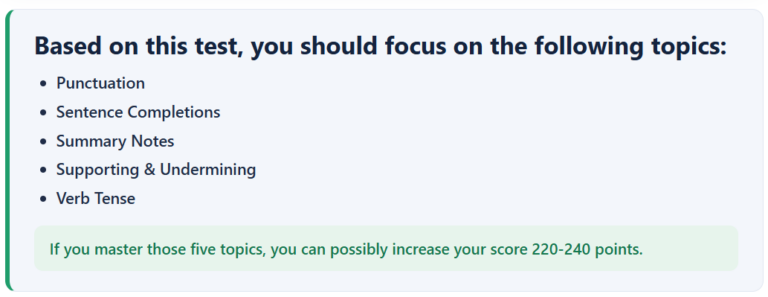
Want to Know What 5 Topics Will Improve Your SAT Score the Most?
Sample Feedback from our Diagnostic Test:
Rice University
Rice University is a private research university in Houston with 4,776 undergraduates, and it admits 8% of applicants, the lowest rate in Texas by a wide margin. Admitted students scored 740 to 770 in Reading & Writing and 770 to 800 in Math, so the top quarter were at or above 770 and 800, and those ranges are narrow because the distribution is pressed against the top of the scale rather than because the data is thin. Tuition and fees are $64,144 against a total cost of attendance of $79,788.
Trinity University
Trinity University is a private liberal arts university in San Antonio with 2,505 undergraduates, and at 26% it is the most selective institution in Texas after Rice. The admitted range runs 680 to 750 in Reading & Writing and 660 to 750 in Math, with the top quarter at or above 750 in both sections. It charges $53,676 in tuition and fees against a total cost of attendance of $68,224.
Southern Methodist University
Southern Methodist University is a private university in Dallas with 7,277 undergraduates, and it reports the highest cost of attendance in the state at $85,606. The middle half scored 670 to 740 in Reading & Writing and 670 to 750 in Math, putting the top quarter at or above 740 and 750. Tuition and fees are $67,040, and SMU admits 63% of applicants.
The University of Texas at Austin
The University of Texas at Austin enrolls 42,855 undergraduates and admits 27% of applicants, which makes it the most selective public university in the state. Its admitted range is 630 to 740 in Reading & Writing and 620 to 770 in Math, and the top quarter sat at or above 740 and 770. Residents pay $11,688 in tuition and fees and non-residents $44,908, a gap of $33,220 that is the largest in Texas, with a total cost of attendance of $31,247.
The Dell Medical School is on this campus, and UT Austin is also the only Texas public university that admits automatically on a threshold other than the top 10 percent. The next section covers both.
Baylor University
Baylor University is a private Baptist university in Waco with 14,785 undergraduates and a 51% admit rate. Admitted students landed between 610 and 700 in Reading & Writing and between 590 and 700 in Math, with the top quarter at or above 700 in both. Tuition and fees come to $58,100 against a total cost of attendance of $74,226.
Baylor College of Medicine in Houston is a separate institution and has been since 1969, which the medical school section below sets out, because the shared name misleads a great many pre-med students.
The University of Texas at Dallas
The University of Texas at Dallas enrolls 21,751 undergraduates in Richardson and admits 65% of applicants. The admitted range runs 580 to 690 in Reading & Writing and 580 to 720 in Math, with the top quarter at or above 690 and 720. In-state tuition and fees are $14,644, the highest resident figure among Texas publics, and out-of-state tuition is $40,144, against a total cost of attendance of $29,807.
Texas A&M University-College Station
Texas A&M University’s College Station campus enrolls 59,615 undergraduates, more than any other institution in this series, and admits 57% of applicants. The middle half scored 580 to 690 in Reading & Writing and 570 to 710 in Math, putting the top quarter at or above 690 and 710. Residents pay $13,154 in tuition and fees and non-residents $40,124, with a total cost of attendance of $32,696.
The Texas A&M Naresh K. Vashisht College of Medicine operates here and at several other sites across the state.
University of Houston
The University of Houston enrolls 38,380 undergraduates and admits 74% of applicants. Its admitted range is 590 to 670 in Reading & Writing and 570 to 670 in Math, and the top quarter sat at or above 670 in both sections. Tuition and fees run $9,717 for residents and $22,547 for non-residents, against a total cost of attendance of $26,185.
The Tilman J. Fertitta Family College of Medicine is on this campus.
Texas Christian University
Texas Christian University is a private university in Fort Worth with 11,026 undergraduates and a 44% admit rate. Admitted students scored 580 to 680 in Reading & Writing and 560 to 670 in Math, so the top quarter were at or above 680 and 670. It charges $61,740 in tuition and fees against a total cost of attendance of $76,604.
The Anne Burnett Marion School of Medicine at TCU received full accreditation in June 2023.
Southwestern University
Southwestern University is a private liberal arts university in Georgetown with 1,440 undergraduates, and it admits 43% of applicants. The admitted range runs 580 to 670 in Reading & Writing and 550 to 630 in Math, with the top quarter at or above 670 and 630. Tuition and fees are $53,813, and the total cost of attendance is $67,493.
Austin College
Austin College is a private liberal arts college in Sherman with 1,165 undergraduates and a 48% admit rate. The middle half scored 550 to 660 in Reading & Writing and 550 to 650 in Math, putting the top quarter at or above 660 and 650. It charges $48,680 in tuition and fees against a total cost of attendance of $61,607.
Texas Tech University
Texas Tech University enrolls 32,394 undergraduates in Lubbock and admits 73% of applicants. Its admitted range is 550 to 640 in Reading & Writing and 540 to 640 in Math, and the top quarter sat at or above 640 in both. Resident tuition and fees come to $11,852 and non-resident tuition to $24,451, against a total cost of attendance of $27,443.
The Texas Tech University Health Sciences Center School of Medicine is in Lubbock alongside it.
LeTourneau University
LeTourneau University is a private Christian university in Longview with 1,468 undergraduates, and it admits 38% of applicants, a lower share than TCU or Southwestern. Admitted students scored 500 to 660 in Reading & Writing and 490 to 670 in Math, so the top quarter were at or above 660 and 670. Tuition and fees are $37,160 against a total cost of attendance of $51,124.
The University of Texas at Arlington
The University of Texas at Arlington enrolls 32,294 undergraduates and admits 80% of applicants. The admitted range runs 510 to 620 in Reading & Writing and 500 to 620 in Math, with the top quarter at or above 620 in both sections. In-state tuition and fees are $11,950 and out-of-state tuition is $29,582, against a total cost of attendance of $25,261.
The University of Texas at San Antonio
The University of Texas at San Antonio enrolls 30,580 undergraduates and admits 87% of applicants. The middle half scored 510 to 620 in Reading & Writing and 490 to 600 in Math, putting the top quarter at or above 620 and 600. Residents pay $9,011 in tuition and fees and non-residents $22,051, with a total cost of attendance of $22,352.
University of North Texas
The University of North Texas enrolls 34,341 undergraduates in Denton and admits 72% of applicants. Its admitted range is 500 to 630 in Reading & Writing and 480 to 600 in Math, and the top quarter sat at or above 630 and 600. Tuition and fees run $11,309 for residents and $21,149 for non-residents, against a total cost of attendance of $26,243.
The University of Texas at Tyler
The University of Texas at Tyler enrolls 7,440 undergraduates and admits 94% of applicants. Admitted students scored 510 to 610 in Reading & Writing and 500 to 590 in Math, so the top quarter were at or above 610 and 590. In-state tuition and fees are $9,736 and out-of-state tuition is $25,494, with a total cost of attendance of $24,505.
The UT Tyler School of Medicine is on this campus.
Texas State University
Texas State University enrolls 36,177 undergraduates in San Marcos and admits 89% of applicants. The admitted range runs 500 to 610 in Reading & Writing and 480 to 590 in Math, with the top quarter at or above 610 and 590. Residents pay $11,450 in tuition and fees and non-residents $22,930, against a total cost of attendance of $28,073.
Texas A&M University-Corpus Christi
Texas A&M University’s Corpus Christi campus enrolls 8,034 undergraduates and admits 89% of applicants. The middle half scored 500 to 610 in Reading & Writing and 470 to 583 in Math, putting the top quarter at or above 610 and 583. In-state tuition and fees are $9,748 and out-of-state tuition is $20,794, with a total cost of attendance of $25,210.
Stephen F. Austin State University
Stephen F. Austin State University enrolls 8,728 undergraduates in Nacogdoches and admits 94% of applicants. Its admitted range is 500 to 600 in Reading & Writing and 470 to 570 in Math, and the top quarter sat at or above 600 and 570. The published rates are $11,128 for residents and $23,426 for non-residents, with a total cost of attendance of $25,791.
Tarleton State University
Tarleton State University enrolls 12,673 undergraduates in Stephenville and admits 90% of applicants. Admitted students scored 500 to 590 in Reading & Writing and 480 to 570 in Math, so the top quarter were at or above 590 and 570. Tuition and fees run $8,302 for residents and $18,142 for non-residents, with a total cost of attendance of $24,100.
West Texas A&M University
West Texas A&M University enrolls 6,917 undergraduates in Canyon and admits 99% of applicants. The admitted range runs 480 to 590 in Reading & Writing and 470 to 580 in Math, with the top quarter at or above 590 and 580. Residents pay $9,101 in tuition and fees and non-residents $10,996, a gap of $1,895 that is the smallest in Texas by a wide margin, against a total cost of attendance of $23,482.
West Texas A&M also publishes a reduced rate for students from Colorado, Kansas, New Mexico and Oklahoma. The university’s own figures for that rate do not reconcile cleanly, so a student from those states should ask the business office what he would actually pay.
University of Houston-Clear Lake
The University of Houston’s Clear Lake campus enrolls 6,078 undergraduates and admits 91% of applicants. The middle half scored 490 to 580 in Reading & Writing and 480 to 570 in Math, putting the top quarter at or above 580 and 570. In-state tuition and fees are $7,770, the second lowest resident figure on this page, and out-of-state tuition is $21,114, with a total cost of attendance of $24,622.
Texas A&M University-Kingsville
Texas A&M University’s Kingsville campus enrolls 4,748 undergraduates and admits 91% of applicants. Its reported range is 510 to 550 in Reading & Writing and 480 to 560 in Math, and the Reading & Writing span of 40 points is unusually narrow for a university of this size. That is worth a question to the admissions office rather than a conclusion. Residents pay $9,892 in tuition and fees and non-residents $25,746, against a total cost of attendance of $24,060.
Lamar University
Lamar University enrolls 8,150 undergraduates in Beaumont and admits 86% of applicants. Admitted students scored 480 to 580 in Reading & Writing and 450 to 560 in Math, so the top quarter were at or above 580 and 560. Tuition and fees run $8,905 for residents and $18,745 for non-residents, with a total cost of attendance of $22,254.
East Texas A&M University
East Texas A&M University enrolls 9,912 undergraduates in Commerce and admits 92% of applicants. The admitted range runs 480 to 580 in Reading & Writing and 430 to 570 in Math, with the top quarter at or above 580 and 570. In-state tuition and fees are $10,026 and out-of-state tuition is $22,326, against a total cost of attendance of $23,438.
Angelo State University
Angelo State University enrolls 5,643 undergraduates in San Angelo and admits 83% of applicants. The middle half scored 470 to 590 in Reading & Writing and 440 to 560 in Math, putting the top quarter at or above 590 and 560. Resident tuition and fees come to $8,460 and non-resident tuition to $18,300, against a total cost of attendance of $23,441.
University of Houston-Downtown
The University of Houston’s Downtown campus enrolls 12,555 undergraduates and admits 90% of applicants. Its admitted range is 480 to 560 in Reading & Writing and 460 to 550 in Math, and the top quarter sat at or above 560 and 550. Tuition and fees are $7,708 for residents, the lowest resident figure on this page, and $17,548 for non-residents, against a total cost of attendance of $20,749.
Sam Houston State University
Sam Houston State University enrolls 17,743 undergraduates in Huntsville and admits 90% of applicants. Admitted students scored 480 to 570 in Reading & Writing and 450 to 550 in Math, so the top quarter were at or above 570 and 550. The published rates are $9,228 for residents and $19,068 for non-residents, against a total cost of attendance of $25,505.
The Sam Houston State University College of Osteopathic Medicine is on this campus.
Texas A&M International University
Texas A&M International University enrolls 6,667 undergraduates in Laredo and reports the lowest cost of attendance on this page at $15,558. The admitted range runs 470 to 560 in Reading & Writing and 420 to 530 in Math, with the top quarter at or above 560 and 530. Residents pay $7,894 in tuition and fees and non-residents $19,454, and the university admits 44% of applicants, a lower share than any other Texas public except UT Austin.
The University of Texas Rio Grande Valley
The University of Texas Rio Grande Valley enrolls 28,666 undergraduates in Edinburg and admits 94% of applicants. The middle half scored 460 to 560 in Reading & Writing and 420 to 530 in Math, putting the top quarter at or above 560 and 530. In-state tuition and fees are $9,987 and out-of-state tuition is $19,827, against a total cost of attendance of $16,830, the second lowest in the table.
The UT Rio Grande Valley School of Medicine is on this campus.
Huston-Tillotson University
Huston-Tillotson University is a private historically Black university in Austin with 1,005 undergraduates, the smallest institution on this page, and it admits 39% of applicants. It reports an SAT range of 430 to 590 in Reading & Writing and 370 to 570 in Math alongside an ACT range of 16 to 28, and those two sets of figures do not agree with each other in a way the section on score columns below works through. Tuition and fees are $26,709 against a total cost of attendance of $25,384.
Prairie View A&M University
Prairie View A&M University is a public historically Black university with 8,877 undergraduates, and it admits 79% of applicants. Its admitted range is 450 to 550 in Reading & Writing and 410 to 530 in Math, and the top quarter sat at or above 550 and 530. Residents pay $11,299 in tuition and fees and non-residents $26,874, with a total cost of attendance of $26,362.
The University of Texas at El Paso
The University of Texas at El Paso enrolls 21,005 undergraduates and reports a 100% admit rate, the only institution on this page to do so. Admitted students scored 450 to 550 in Reading & Writing and 410 to 530 in Math, so the top quarter were at or above 550 and 530. In-state tuition and fees are $9,744 and out-of-state tuition is $25,502, against a total cost of attendance of $19,836.
Texas Tech’s Paul L. Foster School of Medicine is also in El Paso, and it belongs to Texas Tech’s health sciences center rather than to this university.
Texas A&M University-San Antonio
Texas A&M University’s San Antonio campus enrolls 6,599 undergraduates and admits 93% of applicants. The admitted range runs 430 to 540 in Reading & Writing and 410 to 530 in Math, with the top quarter at or above 540 and 530. Tuition and fees run $9,654 for residents and $23,255 for non-residents, against a total cost of attendance of $21,655.
Texas Southern University
Texas Southern University is a public historically Black university in Houston with 6,844 undergraduates, and it admits 97% of applicants. The middle half scored 420 to 520 in Reading & Writing and 380 to 480 in Math, putting the top quarter at or above 520 and 480. Resident tuition and fees come to $9,173 and non-resident tuition to $21,473, with a total cost of attendance of $27,052.
Texas Admits Most Students on Class Rank, Not Test Scores
Texas requires its public universities to admit students who finished in the top 10 percent of their high school class, and a student who qualifies that way needs no test score at all.
Texas Education Code 51.803 sets the rule. A general academic teaching institution must admit an applicant who graduated with a grade point average in the top 10 percent of his high school graduating class, in one of the two school years before the year he applies for, from an accredited Texas public or private high school or a United States Department of Defense high school.
The part normally left out of summaries is that the rank alone is not enough. A qualifying student must also satisfy one of two further conditions.
The first is the curriculum condition. A student completes the distinguished level of achievement under the foundation high school program, or an equivalent curriculum at a school where Section 28.025 does not apply.
The second is a test condition, and it exists precisely for students who did not complete that curriculum. The Uniform Admission Policy sets a designated college entrance examination score, given as at least 1,500 out of 2,400 on the SAT or the equivalent, and for the ACT as satisfying ACT’s College Readiness Benchmarks.
That SAT figure is published on the pre-2016 2400-point scale, and the policy document does not give a current 1600-scale number. Converting it here would be a guess dressed up as a fact, so a student who needs to rely on the test condition should confirm the current equivalent with the Texas Higher Education Coordinating Board before assuming he meets it.
The statute also contains a provision worth knowing about. Under 51.803(b), a student who could not complete the required curriculum because the courses were not offered at the right times, or for other reasons beyond his control, may still be treated as having met the requirement.
Two ways into a Texas public university. Class rank opens the door and the score is the spare key.
UT Austin Now Admits Only the Top 5 Percent Automatically
The University of Texas at Austin is the one Texas public university that does not use the top 10 percent threshold, and its figure has moved.
A Texas Education Agency correspondence letter dated 24 October 2024 states that UT Austin will automatically admit all eligible applicants who rank within the top 5 percent of their high school graduating classes, for summer and fall 2026 and spring 2027 freshman applicants. The letter asks school systems to pass that on to junior-level students and their parents.
The statutory basis is Senate Bill 175, passed by the 81st Texas Legislature and reflected in 51.803(a-1), under which UT Austin is not required to offer admission to automatically qualifying applicants beyond the number needed to fill 75 percent of its first-time resident undergraduate capacity. The 5 percent is the class-rank cutoff that results. The 75 percent is the share of resident capacity the statute lets the university fill this way. They are different numbers doing different jobs, and they are easy to confuse.
A related provision, 51.803(j), caps first-time non-resident admissions at 10 percent of capacity in any year an institution uses that exception.
For a student the practical effect is simple. Outside the top 5 percent, an application to the state’s flagship goes into the pool that is read holistically, where the test score is one of the things read. That pool now covers the large majority of Texas applicants to UT Austin. Every other public university in the table remains at the top 10 percent.
Does Texas State Aid Require a Test Score?
The TEXAS Grant does not require a test score. Texas’s main need-based state grant is awarded on financial need and enrollment criteria, and no entrance examination appears in its basic eligibility rules.
The core requirements are that a student be classified by his institution as a Texas resident, demonstrate financial need as the institution determines it, enroll at least three-quarter time in a baccalaureate program at an eligible institution, hold no baccalaureate degree already, be registered with Selective Service or exempt, and have no felony or controlled-substance conviction. The high school pathway requires enrolling before the end of the sixteenth month after graduating from a Texas public or private high school, with attempted credit not exceeding 30 semester hours, excluding dual credit and credit by examination. Homeschool graduates are not eligible on that pathway.
Priority consideration uses four areas, and a student needs at least one requirement in at least two of them:
- An advanced academic program, meaning 12 college credit hours, the Recommended or Advanced high school program, or the IB program
- TSI readiness or an exemption
- Class standing in the top third, or a grade point average of at least 3.0
- One mathematics course beyond Algebra II, or an approved advanced career and technical course
A college entrance examination score is not one of the four.
The published guidance does not state a dollar amount. It directs students to the financial aid office of the institution they attend or plan to attend, because funding is limited, not every eligible student receives an award, and funds may not be available at the start of a semester. Anyone quoting a figure for this grant without naming an institution and a year is guessing.
Put the last two sections together and the position is clear enough to state plainly. For a Texas student with the class rank, the curriculum and the financial need, neither admission to a public university in this state nor its principal need-based grant turns on a test score.
So What Does an SAT Score Still Do in Texas?
An SAT score still decides four things in Texas, and they are worth setting out concretely rather than asserting that the test matters.
The first is admission to the selective institutions, where class rank carries no weight at all. Rice at 8%, Trinity at 26%, UT Austin at 27%, LeTourneau at 38%, Huston-Tillotson at 39%, Southwestern at 43% and TCU at 44% are the only colleges in the table admitting fewer than half their applicants. The top 10 percent rule admits nobody to Rice.
The second is UT Austin’s holistic pool, which now begins just below the top 5 percent of a graduating class and therefore contains most Texas applicants to the university.
The third is the curriculum alternative inside the automatic admission rule. A top 10 percent student who did not complete the distinguished level of achievement needs the designated test score to qualify. For that student the score is not a supplement to his application, it is the mechanism that admits him.
The fourth is institutional merit aid at the private colleges, where cost of attendance runs to $85,606 at SMU, $79,788 at Rice and $76,604 at TCU, and where the TEXAS Grant does not apply at all. Those awards are set by each college and normally keyed to scores and grades together.
Why Does Out-of-State Tuition Vary So Much Across Texas?
Out-of-state tuition in Texas is built from two separate layers, and that is why the gaps in the table above look so inconsistent.
Statutory tuition is fixed in state law at Texas Education Code 54.051, and the resident undergraduate rate at a public university is $50 per semester credit hour, with non-residents paying a higher statutory rate set at the state level. Designated tuition is an additional charge that each institution’s governing board sets for its own operations, with no statutory ceiling, and it may differ between residents and non-residents. The Legislature deregulated designated tuition in 2003 under House Bill 3015.
That structure explains the pattern. Seven institutions in this table share an out-of-state gap of exactly $9,840. That is what results when a university applies the statewide statutory differential and charges residents and non-residents the same designated tuition. The seven are the University of North Texas, Tarleton State, Lamar, Angelo State, University of Houston-Downtown, Sam Houston State and UT Rio Grande Valley.
Universities that add non-resident designated tuition on top produce much larger gaps. UT Austin’s is $33,220, Texas A&M’s $26,970 and UT Dallas’s $25,500.
West Texas A&M runs the other way, charging non-residents $1,895 more than residents. For an out-of-state student who wants a Texas public university, that single figure is the most useful number on this page.
Texas Law Reserves Nine in Ten Medical School Seats for Texans
Texas law limits non-residents to no more than 10 percent of the entering class at a Texas public medical school, so at least 90 percent of every entering class is reserved for Texas residents.
Two sources state it. TMDSAS, the Texas Medical and Dental Schools Application Service, says that Texas state law limits non-Texas residents to no more than 10% of the entering classes at dental, medical, podiatric and veterinary schools. UT Southwestern’s own medical school catalog says that no more than 10 percent of an entering medical school class there may be composed of non-residents of Texas, in accordance with state law, and that only permanent United States residents or United States citizens are eligible for admission. Both cite state law without giving a section number.
The scope is what makes this the strongest residency rule this series has found. It is statutory rather than institutional, it covers every public medical school in the state, and it extends to dental, podiatric and veterinary schools as well.
Texas also runs its own application system, and that is practical news for a student who assumes there is only one. Texas uses TMDSAS as a centralized application service for health professions programs rather than AMCAS, so a Texas applicant files through TMDSAS for Texas schools and through AMCAS for most schools elsewhere.
TMDSAS determines residency for admission purposes, and each school reviews residency separately for tuition when a student enrolls. There are two routes. A student qualifies by graduating from a Texas high school or earning a Texas GED, having lived in Texas for the 36 months before graduation and continuously for the 12 months before the application deadline. Or he qualifies by domicile, having lived in Texas for the 12 consecutive months before the deadline and established domicile over the same period through Texas employment, ownership of Texas residential property, owning and operating a Texas business, or a year of marriage to someone who has established Texas domicile.
The 36-month route deserves a moment’s attention from any family thinking about moving. The residency that protects access to nine in ten Texas medical school seats is normally established during high school, not afterwards.
How each state treats non-resident applicants to its public medical schools. Nine of every ten seats are held for Texans by law.
Six States, Six Different Residency Rules
Texas is the sixth consecutive state in this series where a medical school’s treatment of an applicant depends on where he lives or studied, and the six rules are all different.
Texas is the hardest and the broadest. A statutory cap of 10 percent non-residents applies at every public medical, dental, podiatric and veterinary school in the state.
North Carolina’s Brody School of Medicine runs a binary gate, where an applicant is a North Carolina resident or holds a UNC System degree earned within five years, and an applicant who is neither may not apply at all.
Tennessee’s University of Tennessee Health Science Center caps out-of-state admissions at approximately 10 percent of its class and requires non-residents to possess superior qualifications.
Oregon’s OHSU writes four criteria into a numbered policy, any one of which qualifies, producing preference rather than eligibility.
South Dakota’s Sanford School of Medicine grants residents an interview and reviews tied non-residents for a possible invitation, with its undergraduate threshold set at 90 credits.
North Dakota’s UND treats a North Dakota degree as one tie among several inside a preference order.
Texas and Tennessee look identical at a glance and are not the same thing at all. Tennessee’s cap is one university’s admissions policy. Texas’s is law, applies to every public school, and reaches four professions. The instruction that follows is the one this series keeps arriving at. Read the published policy of the school a student actually cares about, because six states wrote six different rules.
JAMP Pays Texas Students to Become Doctors
The Joint Admission Medical Program is a Texas Legislature program that supports highly qualified, economically disadvantaged Texas students pursuing medical education, and no other state covered in this series has a legislated route of this kind.
What the program provides is unusually concrete. Participants receive scholarship money during their remaining undergraduate years, paid summer internships at a Texas medical school, mentoring toward medical school preparation, admission to a Texas medical school, and annual scholarship money during medical school.
The academic bar, as published by a participating institution, is a cumulative grade point average of at least 3.4 across all college-level coursework including summer courses and dual enrollment, together with a BCPM average of at least 3.25 across biology, chemistry, mathematics, physics and statistics. There are two tracks, an Early Admission Track for incoming fall freshmen and a Regular Admission Track.
One point needs stating carefully, because it is normally described loosely. The program offers admission to a Texas medical school if all program requirements are met. That is a conditional offer, not an unconditional guarantee, and a student planning his undergraduate years around it should understand which of the two he is relying on.
Three further details are not published on the institutional pages consulted for this article: the specific financial eligibility thresholds, the full list of participating medical schools, and whether an MCAT score is required and at what level. Those come from the program itself, and a student should get them from JAMP directly rather than from a summary.
JAMP and the 90 percent rule push in the same direction, and reading them together is more useful than reading either alone. The program moves Texas residents toward Texas medical schools whose seats are already overwhelmingly reserved for Texas residents.
Texas Has Sixteen Medical Schools
Texas has thirteen MD-granting medical schools and three colleges of osteopathic medicine. That is more than any other state covered in this series.
The MD programs are Baylor College of Medicine in Houston, the Dell Medical School at UT Austin, the Anne Burnett Marion School of Medicine at TCU in Fort Worth, Texas A&M’s Naresh K. Vashisht College of Medicine, the Texas Tech University Health Sciences Center School of Medicine in Lubbock, Texas Tech’s Paul L. Foster School of Medicine in El Paso, the University of Houston’s Tilman J. Fertitta Family College of Medicine, McGovern Medical School at UTHealth Houston, the Long School of Medicine at UT Health San Antonio, the UT Medical Branch at Galveston, the UT Rio Grande Valley School of Medicine, UT Southwestern Medical Center in Dallas, and the UT Tyler School of Medicine.
The osteopathic colleges are the Sam Houston State University College of Osteopathic Medicine in Huntsville, the Texas College of Osteopathic Medicine at UNT Health Science Center in Fort Worth, and the University of the Incarnate Word School of Osteopathic Medicine in San Antonio.
One pair of names needs separating. The Paul L. Foster School of Medicine belongs to Texas Tech’s health sciences center in El Paso, not to the University of Texas at El Paso, which appears in the table above as a separate institution in the same city.
Eight of the colleges in that table have a medical school on their own campus. UT Austin, TCU, Texas A&M College Station, Texas Tech, the University of Houston, UT Rio Grande Valley, UT Tyler and Sam Houston State. Incarnate Word, named earlier among the institutions reporting no scores, has a ninth.
Sixteen medical schools across twelve cities. Eight of the colleges in the table above have one on campus.
The standard caution holds in Texas as everywhere else. A medical school on campus gives an undergraduate better access to shadowing, research positions and people who read applications for a living, and it does not improve his odds of admission there, because applications are read against a pool rather than against the campus. Texas’s real exceptions are the two sections above, the 90 percent reservation and JAMP.
Baylor College of Medicine Is Not Part of Baylor University
Baylor College of Medicine and Baylor University are separate institutions, and have been since 1969.
The school was founded in 1900, formed an alliance with Baylor University in 1903, and separated from it in 1969 to become the independent Baylor College of Medicine in Houston. Talks about strengthening the relationship in 2009 and 2010 did not produce a merger.
One formal link does remain, and it is worth stating rather than simplifying away. Baylor University’s Board of Regents appoints 25 percent of the college’s board of trustees. The two institutions are separate with a residual governance tie. That is not the same as no relationship, and it is not remotely the same as a parent and a department.
For a pre-med student the practical consequence is the one sentence that matters. An undergraduate at Baylor University in Waco gets no admissions advantage at Baylor College of Medicine in Houston from the name on his diploma.
Why Texas SAT Ranges Sit Below Their ACT Equivalents
Texas colleges report SAT ranges that sit consistently below what their own ACT ranges would predict, and the direction of that gap turns out to be the most useful thing on this page about reading score data.
The arithmetic caveat comes first. This table reports each SAT section separately, and adding two section percentiles produces a figure higher than a college’s real composite range, normally by approximately 20 points at each end. Every comparison below subtracts that before drawing a conclusion.
With the correction applied, the SAT figures come in below their ACT equivalents at almost every college in the table that reports both tests. The gap at the 25th percentile is negative at thirty-two of the thirty-five. Fifteen fall within 50 points, twenty-two within 75 and thirty-one within 100. This is a direction rather than scatter.
Three states in this series now show three different versions of the same effect, and together they explain it.
South Dakota is an ACT state, where the state itself provides the ACT and almost nobody sits the SAT without a particular reason. Its SAT ranges sat above their ACT equivalents, by as much as 310 points at Dakota State.
Tennessee reports both tests in approximately equal numbers, and its two columns agreed, with twenty of twenty-three colleges within approximately 75 points.
Texas is an SAT state. Its smaller group of ACT takers is self-selected, so the ACT equivalents sit above the SAT ranges nearly everywhere.
The pattern across the three is worth stating as a rule, because it travels. The minority test reads higher, whichever test is the minority, since students who go out of their way to sit the less common exam in their state are not a cross-section of anything. The direction of the gap between a state’s two score columns tells a reader which test dominates there.
The same effect in three states with three different testing cultures. The minority test always reads higher.
One Texas college sits well outside even that pattern. Huston-Tillotson reports an ACT range of 16 to 28 against SAT sections summing to 800 and 1160, a gap of approximately 170 points after correction. An ACT 75th percentile of 28 beside an SAT Math 75th percentile of 570 cannot describe the same admitted class. Both figures stay on this page, neither is reconciled, and a student considering Huston-Tillotson should ask the admissions office which one describes the class he would join.
What If Your Scores Are Below the Range You Want?
A Texas student whose score sits below the range he wants should first work out whether the score is the thing standing in his way, because in this state it often is not.
For admission to most Texas public universities, class rank and curriculum do the work. A student in the top 10 percent of his class who completed the distinguished level of achievement is admitted without a test score, and no amount of preparation changes that outcome in either direction.
Four things in Texas do turn on the score, and the table above gives the distances.
The selective institutions are the first. Seven colleges here admit fewer than half their applicants, and their admitted ranges are a different world from the rest of the page. Rice’s middle half sits at 740 to 770 in Reading & Writing and 770 to 800 in Math. Trinity’s runs 680 to 750 and 660 to 750. UT Austin’s runs 630 to 740 and 620 to 770.
UT Austin’s holistic pool is the second, and it now starts just below the top 5 percent of a graduating class.
The automatic admission test condition is the third, and for a student without the distinguished curriculum it is the whole route in rather than a bonus.
Merit aid at the private colleges is the fourth, against costs reaching $85,606.
Our students since 2008 have normally needed approximately 40 hours of focused work to move a score meaningfully and approximately 80 hours for a larger jump. An ACT point is worth approximately 25 to 30 SAT points, so those hours convert between the tests.
The honest summary for Texas is narrower than it would be for most states, and it should be. Here a score buys options rather than deciding access. It moves a student between two admission systems at the flagship, it substitutes for a curriculum he may not have completed, and it buys money at the private colleges. It does not decide whether he can attend a public university in this state, and a page that implied otherwise would be selling something.
A student who wants to know where he stands before committing those hours should sit a full timed test first. Take a free diagnostic and work from a real score rather than an impression of one. Our guide on how to improve your SAT score sets out the method.
Should a Texas Student Take the SAT or the ACT?
A Texas student should normally plan around the SAT, and the reporting on this page is part of the reason.
Fifty-two Texas institutions report SAT sections against forty-eight reporting an ACT composite, and no Texas institution reports an ACT composite without also reporting the SAT. Every college in the table above publishes SAT figures. The automatic admission test condition is written in SAT terms, with an ACT benchmark alternative attached.
The reasons to add the ACT are narrow. A student applying out of state to institutions that prefer it has a case, and so does a student who sits timed practice tests of both and finds the formats suit him differently, which does happen because the SAT’s adaptive sections and the ACT’s tighter timing reward different habits.
One caution follows from the section above. The ACT ranges Texas colleges publish describe a small self-selected group of their applicants, so a Texas student should not read them as a parallel standard he could aim at instead.
How to Read These Score Ranges
Every range on this page covers the middle 50% of admitted students who submitted that score. A quarter of admitted students scored below the lower figure, and the top quarter scored at or above the upper one.
Two things follow that students regularly get wrong. A score below the lower number does not rule a student out, because a quarter of the admitted class was there. And a score just above the lower number is weaker than it looks, because it sits at the bottom of the middle half rather than in the middle of it.
Three cautions apply to this page in particular.
Twelve Texas institutions with at least 1,000 undergraduates report no admitted SAT scores and are not in the table, so for those there is no published figure of any kind to compare against.
Rice’s ranges are only 30 points wide at each end. That is a ceiling effect, because its admitted students are bunched against the top of the scale, and not a sign of thin data. Texas A&M-Kingsville’s Reading & Writing range of 40 points is narrow for a different and unexplained reason, and Huston-Tillotson’s two score sets disagree by more than the summing effect accounts for.
And every range here describes students who chose to submit a score. Where a college is test-optional, students with stronger scores tend to submit them and students with weaker ones often do not, so a published range describes the submitters rather than a standard the college applied to everyone. Our guides on what SAT score you need for college and test-optional colleges cover what that means for a particular application.
Pre-Med Programs in Nearby States
Texas borders four states and Mexico. New Mexico, Oklahoma, Arkansas and Louisiana all touch it, and for a student in El Paso, Texarkana or the Panhandle an out-of-state campus may be the closest option.
Leaving Texas costs more here than in any state covered so far, and the cost is not the grant. It is access to the seats. Texas reserves at least 90 percent of the entering class at every public medical school in the state for Texas residents, across thirteen MD programs and three osteopathic colleges. No state in this series holds a larger block of reserved medical school capacity for its own residents.
There is a counterpoint, and it needs stating carefully rather than as advice. The TMDSAS high school route turns on 36 months in Texas before graduation and 12 continuous months before the application deadline, so a student who grew up in Texas and leaves for college may still qualify as a Texas resident for application purposes. Whether he does depends on his particular facts, and TMDSAS is the only place to settle it.
Our pages for New Mexico and Oklahoma cover the colleges, costs and medical school rules in each.
Pre-Med Colleges in Other States
Every state page in this series follows the same format, with admitted score ranges, costs, admit rates and the state’s own medical school and scholarship rules. Our pre-med colleges by state index lists all of them.

Glyn Caddell
Glyn Caddell holds a BS in Mechanical Engineering from NJIT and has been tutoring New York City students since 2008. He founded Caddell Prep in 2012 and is the author of Digital SAT Math Secrets: Lessons & Tricks to Quickly Improve to a Perfect 800 on the Math Test, which contains over 900 practice problems and is used in Caddell Prep’s SAT math classes. He is founding president of the Staten Island Technical High School alumni association and teaches every lesson on this site personally.
Finally, an SAT course that students actually understand
Every question has a video explanation. Not most — every one.
The on-demand Digital SAT course covers all 17 math topics and 15 reading and writing topics, with 5 full-length practice tests and a 100-point score increase guarantee. Keep access for the rest of high school. No subscription.
Want to Know What 5 Topics Will Improve Your SAT Score the Most?
Sample Feedback from our Diagnostic Test: