
Home » College SAT Score Ranges, Costs, and Programs by Major and State » Best Business Colleges » Business Colleges in New Hampshire: SAT Scores, ACT Scores, Costs, and Programs
By Glyn Caddell, BSME · Author of Digital SAT Math Secrets · Tutoring since 2008 — Updated November 13, 2026
One New Hampshire university holds an AACSB-accredited business school that awards an undergraduate degree, the University of New Hampshire’s Paul College, and this page lists the SAT and ACT scores of the students the university admits, what it costs a New York student, and the three doors into Paul.
The one row reports both tests, so the table leads with the SAT.
Paul admits a freshman directly, admits a 3.2 student through a one-semester Path to Paul that ends at a 2.3, and admits a current UNH student on a 3.0 twice through a review it calls competitive, and New Hampshire’s CPA law has licensed on a bachelor’s degree and two years of experience since April 22, 2026.
Table of Contents
- New Hampshire Business Colleges by SAT and ACT Score
- What Are the Three Doors Into UNH’s Paul College?
- Which New Hampshire Universities Have AACSB-Accredited Business Schools?
- What If Your Score Is Below the Range You Want?
New Hampshire Business Colleges by SAT and ACT Score
New Hampshire’s one AACSB-accredited business school with an undergraduate degree is the Peter T. Paul College of Business and Economics at the University of New Hampshire in Durham, with a Math range of 540 to 660, and the table below lists it with its SAT and ACT ranges, cost of attendance, enrollment and admit rate, because Dartmouth awards no undergraduate business degree and the state’s other business programs hold other accreditors or none. The row is public, it reports both tests, and with one row there is nothing to sort.
| College | SAT Reading & Writing | SAT Math | ACT composite | Business school | Cost of attendance | Undergraduates | Admit rate |
|---|---|---|---|---|---|---|---|
| University of New Hampshire | 550 to 670 | 540 to 660 | 26 to 30 |
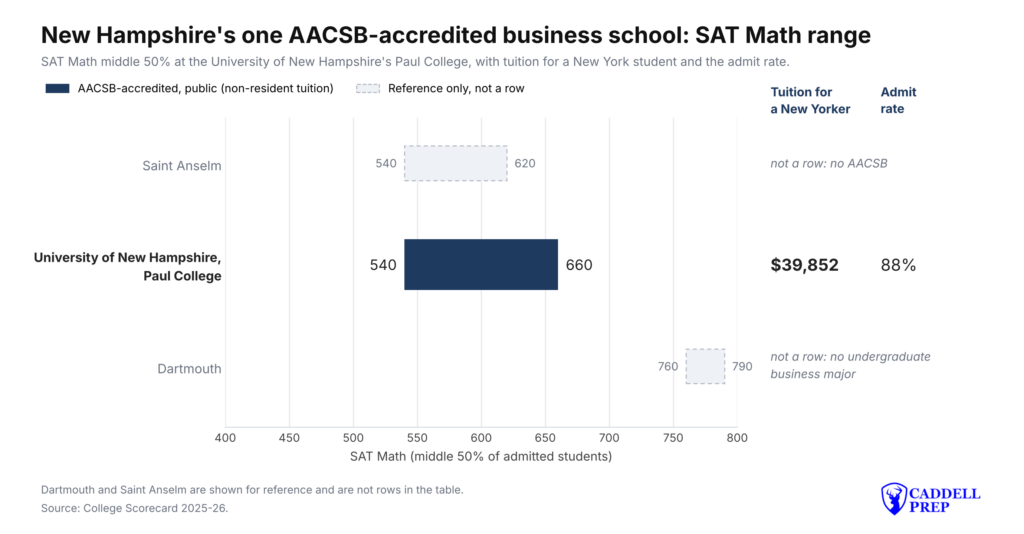
A student can see where his Math score sits against the one range on this page in the image above.
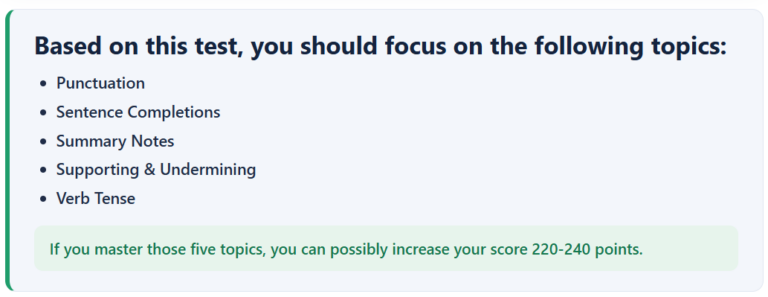
Want to Know What 5 Topics Will Improve Your SAT Score the Most?
Sample Feedback from our Diagnostic Test:
University of New Hampshire
The University of New Hampshire in Durham awards its business degrees through the Peter T. Paul College of Business and Economics, and UNH reports 540 to 660 on Math, admits 88%, and charges a New Yorker $39,852 against $19,202 for a New Hampshire resident.
Reading & Writing 550 to 670, Math 540 to 660. ACT composite 26 to 30. The top quarter of admitted students scored at or above 660 on Math and 30 on the ACT. Cost of attendance $35,537, with tuition and fees at $19,202 in-state and $39,852 out-of-state. 11,261 undergraduates, 88% admitted.
UNH’s 540 Math floor sits 120 under Amherst’s 660 and 140 under Ann Arbor’s 680, and its 660 ceiling is Amherst’s floor, so the New England public flagship a New Yorker compares it with starts where Durham’s middle half ends. The 88% is the university’s rate, and Paul College admits through three doors, the subject of the next section. The cost of attendance in the table is a resident’s. A non-resident’s comes to approximately $56,187 once the higher tuition is substituted, and the $39,852 that drives it is $597 under Amherst’s $40,449 and $1,490 above Minnesota’s $38,362, with a premium of $20,650 over a resident. Four years of tuition is $159,408 for a New Yorker and $76,808 for a resident.
One row says who got into the university. The next section is about the three ways into its business college, because the number changes with the door.
What Are the Three Doors Into UNH's Paul College?
A student enters the Peter T. Paul College of Business and Economics at the University of New Hampshire through one of three doors, direct admission from high school on preparation the university weighs with an emphasis in mathematics, the fall-only Path to Paul for a student with at least a 3.2 who finishes the semester with a 2.3 and five course results, or the inter-college transfer for a current UNH student with 12 credits, a 3.0 cumulative, a 3.0 in Paul courses, two Paul courses and a math course, through a process the university calls competitive.
The first door opens on the university application. A high school senior who applies to UNH with a Paul major is admitted to Paul directly or not, and the admissions office prints the standard in one line: “Strong academic preparation in high school, with emphasis in mathematics, is an important criteria.” It prints no GPA and no score for that door, and it writes of its restricted majors that “we can’t offer every admitted student direct admission into our restricted majors” [VERIFY both lines on the competitive-majors page].
The second door is the Path to Paul Pre-Business Program, a fall-only semester of 17 credits for a first-year applicant to Paul who is not directly admitted and holds at least a 3.2 high school GPA. Such an applicant is “automatically considered on a space available basis,” so the door is open when there is room. A student placed in it works with a professional advisor, with bootcamps in math and economics and guided study, and declares a Paul major at the end of the semester with a 2.3 cumulative GPA, a pass in MATH 417 or MATH 422, a C- or better in ECON 401 or ECON 402, a pass in PAUL 405, the course the college calls FIRE, and passes in two Discovery courses [VERIFY every item on the Path to Paul page].
The third door is the inter-college transfer. A current student in a four-year program at UNH Durham applies to change into Paul with at least 12 UNH Durham credits, a cumulative GPA of 3.0 or higher on the university’s GPA chart, at least two Paul College courses completed, a Paul College GPA of 3.0 or higher on all ECON and ADMN courses required for the intended major taken to date, MATH 420, 422, 424A/B or 425 (424A/B or 425 for Analytical Economics), and good conduct standing. The window is December 1 to 15 or May 1 to 15, decisions come by email in late January or mid-June, and the college “admits students twice annually through this process.” “The inter-college transfer process is competitive.” “Meeting the above requirements allows a student only to be eligible to apply.” A first-year, first-semester student needs two semesters to become eligible, an accepted student’s graduation timeline is not guaranteed and is re-mapped with an advisor, and the Paul tuition differential is charged at one rate to residents and non-residents alike [VERIFY every item on the inter-college transfer page].
Set against the earlier pages, Paul is the first business school in this grid with three doors and a different number at each. On our page on business colleges in Minnesota, Carlson asks a 3.0 once, of a student from another college. On our page on business colleges in Michigan, Ross prints a count at each of two doors. Paul prints no number at the first door, a 3.2 in and a 2.3 out at the second, and a 3.0 twice at the third, and the lowest of those numbers is available for one semester, in the first fall, when there is space.
| Door | Who | What Paul asks | When |
|---|---|---|---|
| Direct admission | A high school senior applying to UNH with Paul as the major | “Strong academic preparation in high school, with emphasis in mathematics,” with no GPA or score printed | With the UNH decision |
| Path to Paul | A Paul applicant not directly admitted, with at least a 3.2 high school GPA, considered automatically on space | One fall semester of 17 credits ending with a 2.3 cumulative GPA, a pass in MATH 417 or 422, a C- or better in ECON 401 or 402, a pass in PAUL 405 and passes in two Discovery courses | Fall only, declaring in December |
| Inter-college transfer | A current UNH Durham student in a four-year program | 12 UNH Durham credits, a 3.0 cumulative, two Paul courses, a 3.0 Paul GPA, MATH 420, 422, 424A/B or 425, good conduct standing, through a process the university calls competitive, with the requirements making a student eligible to apply | December 1 to 15 or May 1 to 15, with decisions in late January or mid-June |
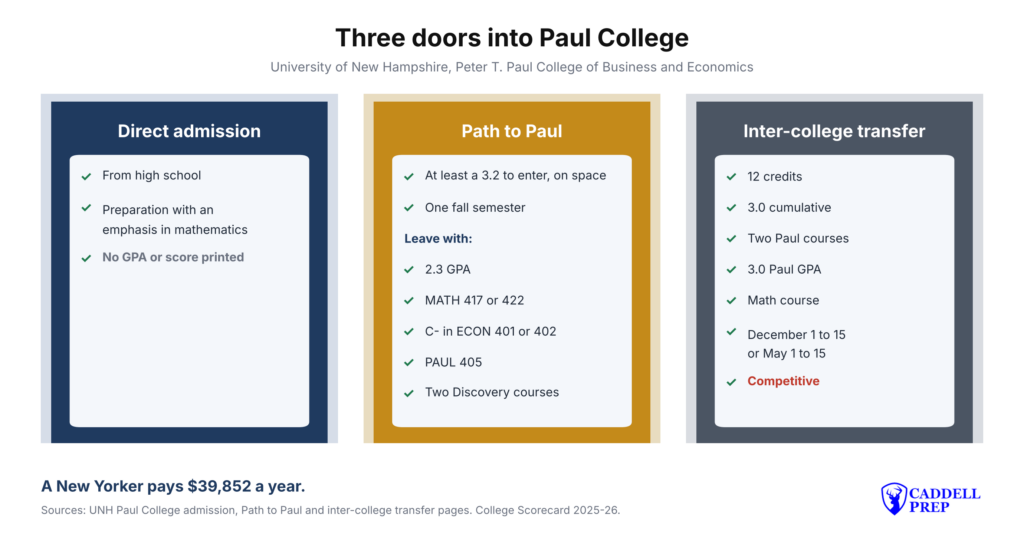
The image above shows the three doors and the number at each.
Does a 3.0 Get a UNH Student Into Paul College?
No, a 3.0 does not get a University of New Hampshire student into the Paul College of Business and Economics, because a 3.0 cumulative GPA and a 3.0 in Paul courses make a current student eligible to apply in the December or May window, and the university writes that the inter-college transfer process is competitive and that meeting the requirements allows a student only to be eligible to apply, so the 3.0 opens the application and the review decides.
The two Paul courses and the math course are the other lines, a first-year, first-semester student waits two semesters to be eligible at all, and an accepted student’s graduation timeline is re-mapped rather than promised. The lowest number on the page, the Path’s 2.3, is available in the first fall only, to a 3.2 applicant, when there is space, so a student who wants Paul should ask for it on the UNH application and read the Path letter as the second chance rather than the third.
Three doors, three numbers, one price. Which schools hold the accreditation is the next section.
Which New Hampshire Universities Have AACSB-Accredited Business Schools?
One New Hampshire university holds business accreditation from AACSB International for an undergraduate degree, the University of New Hampshire in Durham, through the Peter T. Paul College of Business and Economics, and Dartmouth College’s Tuck School of Business holds the same accreditation for graduate degrees alone [VERIFY both on the AACSB directory before publishing].
- University of New Hampshire in Durham awards its business degrees through the AACSB-accredited Peter T. Paul College of Business and Economics.
Accreditation matters for a reason that is easy to miss at seventeen. Business itself is not a licensed profession, and the one business degree that leads to a license, accounting, leads to it through the state board rather than through the school. A CPA in New Hampshire normally sits on a bachelor’s degree with 30 hours of accounting and 24 of business, as early as 120 days before the degree, and licenses on a bachelor’s and two years of experience, 150 hours and one year, or a master’s and one year, with no residency rule [VERIFY on the board’s page]. AACSB status matters on the way there because business schools use it to decide whose courses they will accept in transfer.
Dartmouth College in Hanover is the name a New Yorker expects first, and it is not a row because Dartmouth awards no undergraduate business degree: a Dartmouth student majors in economics or another field, and the Tuck School of Business awards the MBA and other graduate degrees. Dartmouth reports 760 to 790 on Math, admits 5% and charges every student $68,268. Southern New Hampshire University in Manchester is the largest university in the Scorecard, 163,164 undergraduates, almost all of them online, and it charges every student $17,200, admits 99.5%, reports no range and holds its business accreditation from the Accreditation Council for Business Schools and Programs as far as this page could confirm [VERIFY]. Plymouth State University (no range, 88% admitted, $14,626 resident and $25,566 non-resident, 3,153 undergraduates) and Keene State College (no range, 90%, $14,784 and $26,840, 2,699) are the two other public campuses, and neither holds AACSB accreditation [VERIFY both]. Saint Anselm College in Manchester reports 24 to 30 on the ACT and 540 to 620 on Math, admits 78% and charges every student $48,920, and Franklin Pierce University in Rindge (512 to 650 on Math, $46,442), Rivier University in Nashua (510 to 585, $39,488), New England College in Henniker ($41,938) and Colby-Sawyer College in New London ($19,125) award business degrees without an AACSB-accredited business school [VERIFY each]. None of them is a row.
Nothing on this page ranks the one. It is one public university with the accreditor, three doors into its business college, one price with no New England break for a New Yorker, and the pages for business colleges in Maine, business colleges in Vermont and business colleges in Massachusetts carry the schools a student looking at New Hampshire is likely comparing.
What If Your Scores Are Below the Range You Want?
In New Hampshire the one row’s floors are 540 on Math and 26 on the ACT, with Dartmouth’s 760 and Saint Anselm’s 540 the state’s other marks and neither a row. A student under the floor he wants is not ruled out, because a quarter of admitted students were there too. He is in the quarter that needs the rest of the application to carry more, and at Paul the admissions office has told him which part: preparation in mathematics.
The first step is finding out where the score actually is, section by section. A free diagnostic SAT gives a Math score that can be set directly against Durham’s 540 floor and 660 ceiling, and a total that can be set against the 1300 that clears both.
The Math section rewards the same handful of topics on every test date, and a student who knows which of them he is missing can close a gap of 50 to 100 points in weeks rather than months. The method is on our page on improving your SAT Math score, and at Durham the same algebra is the emphasis in mathematics the admissions office names for direct admission and then MATH 417 or 422 on the Path and MATH 420 or 422 at the transfer door.
How to Read These Score Ranges
Each range in the table covers the middle 50% of admitted students who submitted that test, so a quarter of admitted students were below the lower number and a quarter were at or above the upper one.
A range describes the students who chose to submit at all. Where a school is test-optional, the range describes the submitters, and the submitters are the students whose scores helped them. More on what SAT score you need for college and on test-optional colleges.
Should You Take the ACT Instead?
New Hampshire gives the SAT to its public school juniors as the state test [VERIFY current New Hampshire testing], and the one row reports both tests.
A New York student who holds an SAT should send it to Durham and leave the ACT alone unless a school elsewhere asks for it. UNH reports an SAT range from a large enough pool to read directly, and none of Paul’s three doors reads a test score after the university’s own decision.
Business Programs in Nearby States
New Hampshire borders three states by land, and each has its own page in this series.
See business colleges in Maine, business colleges in Vermont and business colleges in Massachusetts.
Business Colleges in Other States
We publish the same breakdown for business programs in every state.
See business colleges by state for the full list.

Glyn Caddell
Glyn Caddell holds a BS in Mechanical Engineering from NJIT and has been tutoring New York City students since 2008. He founded Caddell Prep in 2012 and is the author of Digital SAT Math Secrets: Lessons & Tricks to Quickly Improve to a Perfect 800 on the Math Test, which contains over 900 practice problems and is used in Caddell Prep’s SAT math classes. He is founding president of the Staten Island Technical High School alumni association and teaches every lesson on this site personally.
Finally, an SAT course that students actually understand
Every question has a video explanation. Not most — every one.
The on-demand Digital SAT course covers all 17 math topics and 15 reading and writing topics, with 5 full-length practice tests and a 100-point score increase guarantee. Keep access for the rest of high school. No subscription.
Want to Know What 5 Topics Will Improve Your SAT Score the Most?
Sample Feedback from our Diagnostic Test: