Give us a call (917) 722-0677

You can excel with Caddell!

By Glyn Caddell, BSME · Author of Digital SAT Math Secrets · Tutoring since 2008 — Updated August 18, 2026

Digital SAT Angles, Polygons & 3-D Shapes

The topic of Angles, Polygons, & 3-D shapes appears approximately 10.4% of the time on the Digital SAT. These questions fall under Geometry and Trigonometry according to the College Board. Angles, Polygons, & 3-D shapes questions include angles, triangles, quadrilaterals (specifically parallelograms), spheres, cylinders, cones, and rectangular prisms. Rarely, there can be a question about regular hexagons, but that is really a  question about equilateral triangles, since regular hexagons can be divided into six equilateral triangles. Questions can ask the measure of an angle, length of a side, height, volume, or density.

Angles, Polygons & 3-D Shapes Lesson

The lesson covers the types of Angles, Polygons & 3-D Shapes questions that show up on the Digital SAT and how to approach the questions. An entire section is dedicated to triangles because it’s the most popular type of polygon that appears on the test.

What Do Angles, Polygons, & 3-D Shapes Questions Look Like?

Here are some examples of Angles, Polygons, & 3-D Shapes questions from the Digital SAT.

  • In the figure, line m is parallel to line n, and line t intersects both lines. What is the value of x?
  • What is the measure of \angle A?
  • What is the area…
  • What is the volume…
  • What is the perimeter…

1. Angles

Types of Angles

  • Complementary: add up to 90^o.
  • Supplementary: add up to 180^o.
  • Vertical angles: opposite each other → always equal.
  • Angles on a line: add up to 180^o.
  • Angles around a point: add up to 360^o.

If you’re stuck, write an equation: sum of angles = 180 (line), 90 (complementary), or 360 (circle.)
Naming Angles

An angle can be named based simply by its vertex or by a point on each of its rays and its vertex, with the vertex in the middle.

4 line segments meeting at a single point

The angle above can be named ∠B, ∠ABC or ∠CBA.
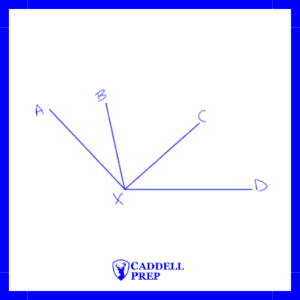
If multiple angles share a vertex, the angles should be named using the vertex and a point on each ray to avoid confusion.
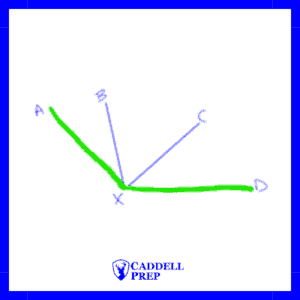
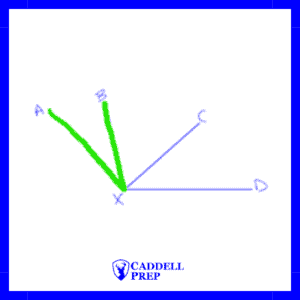
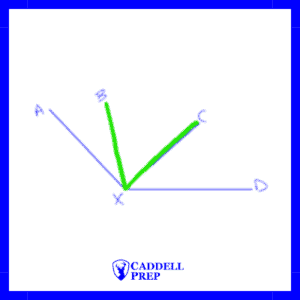
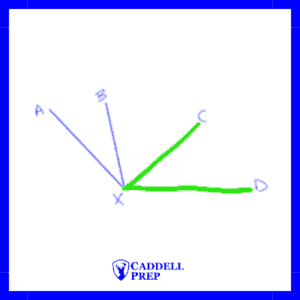
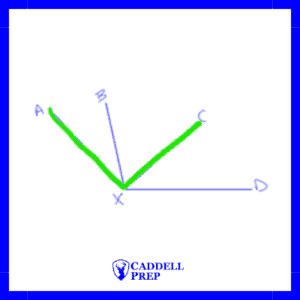
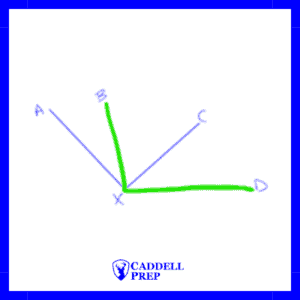
For example, in the diagram below, it would be unclear to refer to any of the angles as ∠X because many angles share X as a vertex.

Here are some of the angles that exist in the diagram above.

∠AXD

∠AXB

∠BXC

∠CXD

∠AXC

∠BXD

Supplementary Angles

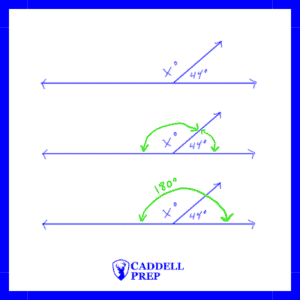
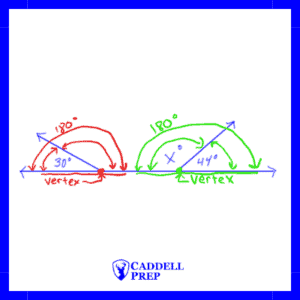
A pair or set of angles that can be combined to form a straight angle add up to 180^o. A pair of angles that add up to 180^o are called supplementary angles.
In the figure below, x^o and 44^o combine to equal 180^o.

Supplementary angles form a line

We can set up an equation to solve for x.

x+44=180

subtract 44 from both sides

x=136

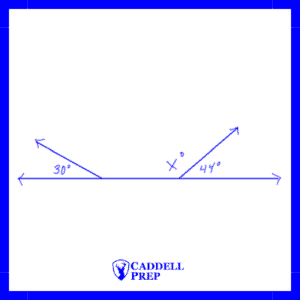
Below is a slightly modified diagram. Another angle with a measurement of 30^o is added. What is the value of x now?

Supplementary Angles on the Same Line

x is still 136. The angle to the left has no effect on the pair of angles on the right.

Angles combined at a vertex add up to 180^o if they form a straight angle.

Refer to the diagram below.

Supplementary angles along the same line

Complementary Angles

Complementary angles are angles that add up to 90^o.
Vertical Angles

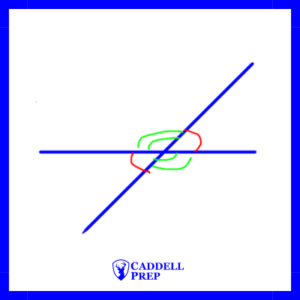
Vertical angles are formed when two lines intersect. Two pairs of angles are formed that are across from each other. The angles across from each other are called vertical angles, and they are congruent to each other.

Two pairs of congruent angles are formed when two lines intersect. 

Parallel Lines Cut By a Transversal

When two parallel lines are intersected by another line, a number of relationships are formed.

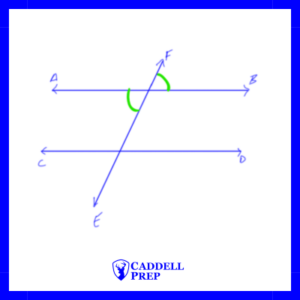
In the diagram below line AB is parallel to line CD. Both lines are intersected by line EF. 

Vertical angles are formed. A pair of vertical angles are shown in the diagram below.

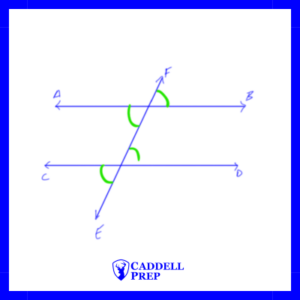
In fact, those vertical angles are congruent to the corresponding angles in the bottom part of the diagram.

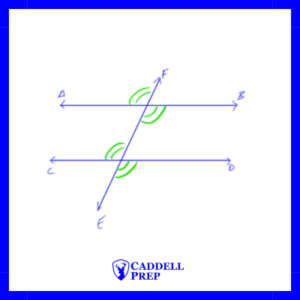
The other set of four angles are also congruent.

2. Polygons

A. Sum of Interior Angles

Sum = (n - 2) \times 180^o

where n = number of sides.

B. Measure of One Interior Angle (regular polygon)

Interior angle = \dfrac{(n - 2) \times 180^o}{n}

C. Exterior Angles

  • Exterior angles always add up to 360^o, no matter how many sides.
  • Each exterior angle of a regular polygon: \dfrac{360^o}{n}

Example:

A hexagon has n = 6.

  • Interior angle = \dfrac{(6 -2) \times 180}{6} = 120^o.
  • Exterior angle = 360 / 6 = 60^o.

Rectangles

Opposite sides are parallel and congruent.

All four angles are right angles.

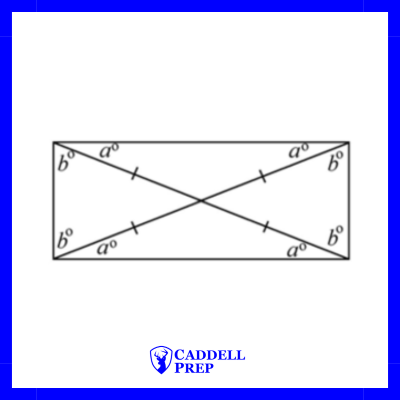
If two diagonals are drawn in a rectangle, two pairs of congruent isosceles triangles are formed.

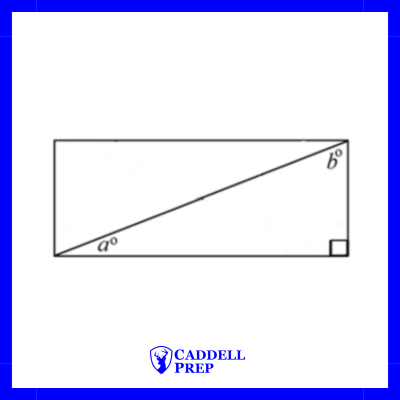
If one diagonal is drawn, two congruent right triangles are formed.

Squares

All sides are congruent.

Opposite sides are parallel.

All four angles are right angles.

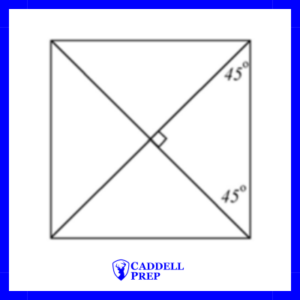
When both diagonals are drawn, four 45-45-90 right triangles are formed.

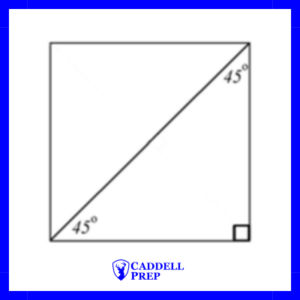
When one diagonal is drawn, two 45-45-90 right triangles are formed.

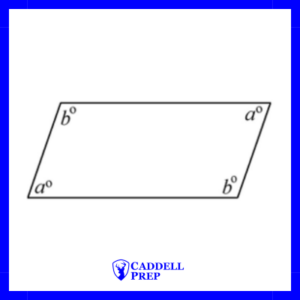
Parallelograms

Opposite sides are parallel and congruent.

Opposite angles are congruent.

Adjacent angles are supplementary.

In the diagram above, a+b=180.

3. 3-D Shapes (Solids)

A. Surface Area

Add up the areas of all faces.

  • Rectangular prism: 2lw + 2lh + 2wh
  • Cylinder: 2\pi r^2+2\pi rh (two circles + rectangle wrapped around)

B. Volume

Volume of a rectangular prism, cylinder, sphere, cone and pyramid are all provided on the Digital SAT math reference.

Volume of a Rectangular Prism
V=lwh
Volume of a Cylinder
V=\pi r^2h
Volume of a Sphere
V=\dfrac{4}{3}\pi r^3
Volume of a Cone
V=\dfrac{1}{3}\pi r^2 h
Volume of a Pyramid
V=\dfrac{1}{3}lwh

4. Triangles

The sum of the interior angles of a triangle is 180^o.

If two angles in a triangle are congruent, then the two sides opposite those angles are also congruent.

Area of a Triangle

A=\dfrac{1}{2}bh

Right Triangles

Pythagorean Theorem

Pythagorean theorem relates the lengths of all of the sides of a right triangle.

a^2+b^2=c^2

 a, b , and c are the lengths of the sides of the right triangle. c must be the length of the hypotenuse (the side opposite the right angle). 

Special Right Triangles

There are two special right triangles that show up on the SAT: 30-60-90 and 45-45-90.

Both special triangles have a ratio among their sides. The relationships are shown on the SAT math reference. Here are two videos explaining how to use them.

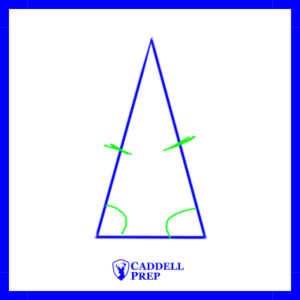
Isosceles Triangles

Isosceles triangles have a pair of congruent angles and the sides opposite the congruent angles are also congruent.

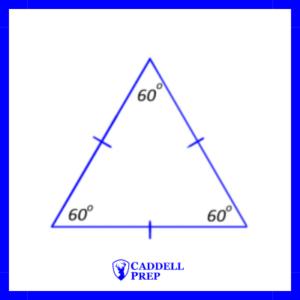
Equilateral Triangles

All sides of an equilateral triangle are congruent. All angles are congruent (60^o).

Area of an Equilateral Triangle
A=\dfrac{s^2\sqrt{3}}{4}

where s is the length of one of the sides.

Tips

  1. If asked about a cross-section, think of slicing the shape → usually gives a 2D figure.
  2. Memorize the big 3 volume: prism, cylinder, sphere. Others (cone, pyramid) are just “\dfrac{1}{3}” of a prism/cylinder.
  3. For polygons, check if it’s regular (all sides/angles equal) before dividing evenly.
  4. Angles in triangles: always 180^o. Angles in quadrilaterals: always 360^o.

Example

A right circular cone has a diameter of 16 centimeters and a slant height of 17 centimeters. What is the height, in centimeters, of the cone?

A) 8
B) 15
C) 24
D) 33

Video Explanation

Text Explanation

Correct Answer: B) 15

The diameter of the cone is 16 centimeters, so the radius is

\dfrac{16}{2}=8

The radius, height, and slant height form a right triangle inside the cone. The radius and height are the legs, and the slant height is the hypotenuse.

Use the Pythagorean theorem:

a^2+b^2=c^2,

8^2+h^2=17^2

64+h^2=289

h^2=225

h=15

So, the height of the cone is 15 centimeters.

Practice Problems with Video Explanations

Here is a set of practice Digital SAT Angles, Polygons, & 3-D Shapes practice problems. After selecting an answer, press “See Answer” to see the correct answer and a video explanation showing how to properly solve the questions. At the end of the set, after you press “Submit”, you’ll be able to see all of the questions, answers, and video explanations to review.

For more practice like this, enroll in our on-demand SAT prep course here: https://caddellprep.com/sat/prep/on-demand/

1.

Note: Figure is not drawn to scale.

What is the value of x in the figure above?

Question 1 of 3

2. A regular polygon has each interior angle measuring 144^o. How many sides does the polygon have?

Question 2 of 3

3. A right circular cone has a diameter of 20 centimeters and a slant height of 26 centimeters. What is the volume, in cubic centimeters, of the cone?

Question 3 of 3


Common Mistakes

Three common mistakes students make when answering Angles, Polygons & 3-D Shapes questions are misidentifying angles, not using the diagrams for hidden information about angles, and misidentifying the height and base when calculating area.

Misidentifying Angles

A common mistake is misidentifying angles. The middle letter of an angle’s name is the vertex of the angle. For example, angle ABC has its vertex at point B. To identify the angle, trace the three letters, A to B to C.

Not Using the Diagrams for Hidden Information About Angles

A common mistake is not using the provided diagrams to find missing angle measurements. In diagrams, only some measurements of the angles will be given. However, all or most of the angles can be determined from the diagram. Two common relationships that show up are vertical angles and supplementary angles. It’s important to familiarize yourself with those relationships. Another way information is hidden is with triangles. A diagram may include two parallel lines, so students assume the relationships only involve interior, exterior, and corresponding angles formed by a transversal. However, if there are two transversals, a triangle, trapezoid, or parallelogram may be formed as well. This leads to more relationships to find missing angles. All of these relationships come up in our on-demand course and practice problems.

Misidentifying the Height and Base When Calculating Area

A common mistake when calculating area of polygons, such as triangles and  parallelograms, is not correctly identifying the base and height. In a triangle, any side can be a base. Once you decide which side to use as the base, the height has to be drawn starting from the vertex opposite the base and down to form a right angle with the base, even if that means the height is outside of the triangle.

In a parallelogram, similarly, any side can be the base. The height will be drawn from the opposite side and straight down to form a right angle with the base.

Frequently Asked Questions

Here are three frequently asked questions that I get from students when reviewing Angles, Polygons, & 3-D Shapes.

Are Interior and Exterior Angles Supplementary?

An interior angle of any polygon is supplementary with its adjacent exterior angle. An exterior angle is formed by extending one of the sides of the polygon past the vertex. Since the extended side is a straight line, a straight angle is formed with a measurement of 180^o.

How Do I Find the Number of Sides of a Regular Polygon if an Angle Measure is Given?

To find the number of sides of a regular polygon using an angle measure, you will use the fact that the sum of all exterior angles of a convex polygon is 360^o. Use the interior angle to find the exterior angle by subtracting it from 180. Next, divide 360 by the exterior angle you just calculated to get the number of sides. It’s important to note that this only works for regular polygons in which all sides and all angles are congruent.

Do I Need to Memorize the Radian-to-Degree Conversion?

You do not need to memorize the radian-to-degree conversion. However, it is worth memorizing the relationship for speed on the test.

The reference table on the Digital SAT provides the relationship indirectly by stating:

The sum of the degrees of arc in a circle is 360.

The sum of radians in a circle is 2\pi.

From those two statements, you can conclude 360^o=2\pi.


Related Topics

Circles and Trigonometry are related to Angles, Polygons & 3-D Shapes.

Circles

A circle question on the SAT may include another shape in the figure. Sometimes a shape is inscribed in a circle, and sometimes a circle is inscribed in a shape. The trick to these questions is normally to identify how the radius or diameter of a circle relates to the length of a side in the other shape. Therefore, reviewing circle questions can help with other geometry questions.

Trigonometry

Trigonometry on the SAT is limited to its application in right triangles. Having a strong grasp of right triangles and their properties can help solve trigonometry questions.

All Math Topics

All of our math topics are available here: https://caddellprep.com/sat/math/ for you to review and improve on your SAT. There are lessons, practice problems, and video explanations for you. If you need more help, try our on-demand SAT course with video lessons, practice tests, and sets of questions for each topic: https://caddellprep.com/sat/prep/on-demand/

Glyn Caddell

Glyn Caddell holds a BS in Mechanical Engineering from NJIT and has been tutoring New York City students since 2008. He founded Caddell Prep in 2012 and is the author of Digital SAT Math Secrets: Lessons & Tricks to Quickly Improve to a Perfect 800 on the Math Test, which contains over 900 practice problems and is used in Caddell Prep’s SAT math classes. He is founding president of the Staten Island Technical High School alumni association and teaches every lesson on this site personally.