Give us a call (917) 722-0677

You can excel with Caddell!

By Glyn Caddell, BSME · Author of Digital SAT Math Secrets · Tutoring since 2008 — Updated August 18, 2026

Digital SAT Math Functions

Evaluating functions appears on approximately 8.9% of the Digital SAT. Evaluating functions falls under Algebra. Function questions typically ask students to evaluate a function using the equation, graph or table. Sometimes the question asks students to calculate the output, value of the function, and sometimes students are asked to calculate the input, normally the x-value or t-value.

Functions Lesson

The lesson covers the types of function questions that show up on the Digital SAT. This lesson will cover understanding functions, function notation, evaluating functions from a table, evaluating functions from a graph, and composition of functions.

A function is a rule that takes an input (x) and produces exactly one output (y)

We usually write it as:

y = f(x)

Think of it like a machine: put in x, apply the rule, get out y.

What Do Functions Questions Look Like?

Here are some examples of Functions questions from the Digital SAT.

  • What is the y-intercept of the graph shown?
  • What is the x-intercept of the graph shown?
  • Which of the following is the best interpretation of f(4)=1,176?
  • What is the value of f(0)?
  • For what value does f(x)=8?
  • What is the value of y when x=8?
  • Which table gives three values of x and their corresponding values of h(x) for the given function h?

1. Understanding Functions

An understanding of functions is necessary to do well on the SAT. Some questions will ask to evaluate functions. More complex questions will ask you to determine the independent value (normally the x-value) that results in the dependent value (normally the y-value)

Let’s start by looking at a simple function.

We can find points on the line by substituting in values for x and evaluating it to find the associated values of y.

For example, if we have the equation y=2x+1 we can substitute in some values for x and find the associated y-values.

When x=3, we would have y=2(3)+1=7. The value of the function would be 7 when x is 3.

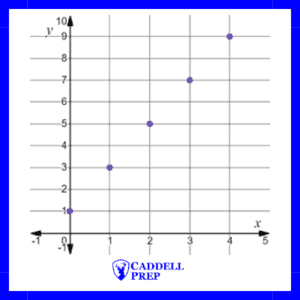
We can find many different values for y by substituting different values for x. Here is a table showing different x-values and different y-values (function values).

x2x+1y
02(0)+11
12(1)+13
22(2)+15
32(3)+17
42(4)+19

We can plot those points on a graph

There are more values to the function than just the ones we evaluated. Every y-value can be evaluated for this function from every x-value. Here are some more:

x2x+1y
2.12(2.1)+15.2
2.22(2.2)+15.4
2.32(2.3)+15.6
2.42(2.4)+15.8
2.52(2.5)+16.0
2.62(2.6)+16.2

Let’s include those points on the graph also.
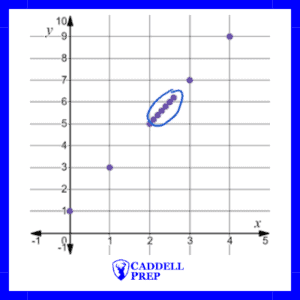
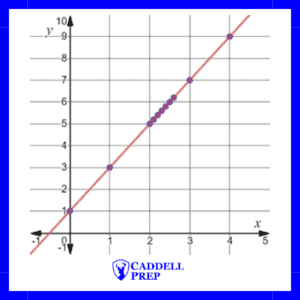
As you can see, the function is taking shape. We can see a straight line forming. Here is the graph of the function along with the plotted points. If all of the points were graphed for when x equals 2.00001, 2.00002, etc. and even smaller values of x, we would end up with a continuous function.
2. Function Notation: f(x), g(x), and h(x)

We looked at the simple function y=2x+1. It can be written as f(x)=2x+1, g(x)=2x+1, h(x)=2x+1, p(x)=2x+1, q(x)=2x+1, etc.

Don’t be confused when you see the notation f(x), it is similar to y.
f(x) is the notation used to refer to the function when it is in terms of x.
However, if we want to show the value of a function at a specific x-value, we would substitute the value in for x.
For example
f(x)=-2x-5,
f(3)=-2(3)-5,
f(3)=-11

3. How to Evaluate a Function From a Table

Sometimes you’ll be given a table of x-values and f(x)-values.  
x f(x)
2 5
3 7
4 9
  • If asked “What is f(3)?” → Look at x = 3,  the value of f(x) is 7, so answer is 7.
  • If asked “For what value of x is f(x) = 9?” → Look for where f(x) is 9 → f(x) = 9 is 9 when x is 4, so the answer is 4.

4. How to Evaluate a Function From a Graph

A graph of a function, f(x), will likely have the vertical axis labeled f(x) instead of y. The horizontal axis will be labeled x.

A graph of s(t) will likely have the vertical axis labeled s(t) instead of y and the horizontal axis labeled t instead of x.
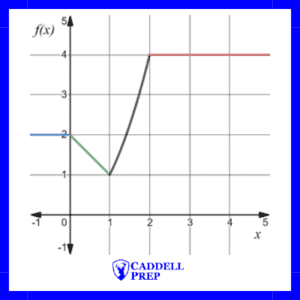
Here is an example.

We can see that the value of the graph changes at different spots on the graph.
The value of f(x) is 2 when x is -1.

f(2)=4,

f(2.2)=4,

f(3)=4,

and f(4)=4.

In fact, the value of the function is 4 when x is equal to or greater than 2 and less than or equal to 5.

Example

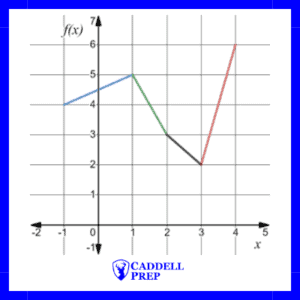
Based on the graph above, what is

a) f(2)?
b) The value of the function when x is 3?
c) The value of x when f(x) is 5?

Explanation

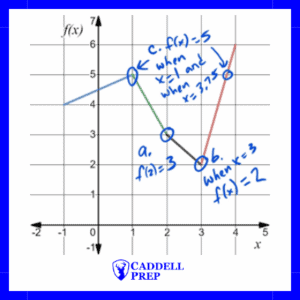
a) f(2) is the y-value when x=2. In the graph, when x is 2, y is 3.

b) The value of a function is the y-value, so the value of the function when x is 3 is the y-value when x is 3. In the graph, when x=3, y=2.

c) To find the value of x when f(x) is 5, we have to find the point (or points) on the graph where the y-value is 5. The y-value is 5 when x is 1 and when x is 3.75, so the answer could be 1 or 3.75.

5. Composition of Functions

A composition of functions is putting one function inside another. More specifically, the output of one function becomes the input of another function.

Here is an example of what a composition of functions looks like:

f(g(x))

In this case, we take the output of g(x) and input it into f(x). Work inside-out. Evaluate the function inside first, and that output becomes the input of the outer function.

Let’s look at an example involving numbers, because it is normally easier for students to understand that first.

Example of Composition of Functions (Using Numbers)

Given

f(x) = x^2+5x -3

and

g(x) = x-9

Evaluate f(g(6))

We need to determine g(6) first.

g(x) = x-9

therefore

g(6) = 6-9,

g(6) = -3

Now, we can return to f(g(6))

Since g(6) = -3, f(g(6)) can be written as f(-3)

Start by writing f(x)

f(x) = x^2+5x -3

then

f(-3) = (-3)^2+5(-3) -3

start evaluating

f(-3)=9-15-3

resulting in

f(-3)=-9

Example of Composition of Functions (Strictly Algebraic)

Given

f(x) = x^2+5x -3

and

g(x) = x-9

Evaluate f(g(x))

The output of g(x) will be the input of f(x).

Since g(x) = x-9, the output is simply x-9.

Therefore, f(g(x)) becomes f(x-9).

Treat (x-9) the same way as you would treat a number. Substitute (x-9) in for x in f(x).

Start by writing f(x)

f(x) = x^2+5x -3

then

f(x-9) = (x-9)^2+5(x-9) -3

start evaluating. Remember that (x-9)^2 means (x-9)(x-9).

f(x-9) = (x-9)(x-9)+5x-45 -3

FOIL

f(x-9) = x^2-9x-9x+81+5x-45 -3

Combine like terms to get

f(x-9)=x^2-13x+33

Therefore,

f(g(x))=x^2-13x+33

Tips

  1. For questions that ask you to identify which table gives the correct values for a function, test one of the x-values. Start with an x-value that results in different y-values in the tables. For example, if multiple tables have a y-value of 3 when x is 2, then don’t test that one. If all of the tables have a different y-value when x is 3, test x=3 in the function and you will definitively find your answer, since only one table will have the correct y-value.
  2. When evaluating a function from its graph, remember that the y-values represent the values of the function. For example, the point (3, 5) on a function graph means the value of the function is 5 when x is 3 or f(3)=5.

Example

The function h is defined by


h(x)=\dfrac{x-2}{3}


For what value of x does h(x)=5?


A) 7
B) 13
C) 15
D) 17

Video Explanation

Text Explanation

Answer: D


Set the function equal to 5 and solve for x.


\dfrac{x-2}{3}=5


Multiply both sides by 3.


x-2=15


Add 2 to both sides.


x=17


Therefore, h(x)=5 when x=17.

Practice Problems with Video Explanations

Here is a set of practice Digital SAT function practice problems. After selecting an answer, press “See Answer” to see the correct answer and a video explanation showing how to properly solve the questions. At the end of the set, after you press “Submit”, you’ll be able to see all of the questions, answers, and video explanations to review.

For more practice like this, enroll in our on-demand SAT prep course here: https://caddellprep.com/sat/prep/on-demand/

1. The function f is defined by f(x)=6x-5. For what value of x does f(x)=37?

Question 1 of 3

2. For which of the following tables are all the values of x and their corresponding values of y solutions to the given inequality?

y>2x+3

Question 2 of 3

3. The function f is defined by f(x)=a(3^x)+b where a and b are constants. If f(1)=11 and f(2)=35, what is the y-coordinate of the y-intercept of the graph of y=f(x) in the xy-plane?

Question 3 of 3


Common Mistakes

Two common mistakes on function questions are mixing up x and y in functions and not substituting the inputs into the function correctly.

Mixing up x and y in functions

A common mistake is mixing up x and y in functions.

f(x) represents y. Therefore, f(3) means the y-value when x=3.

Not substituting the input into the function correctly

Not substituting the input into the function correctly is a common mistake when evaluating functions.

For example, if you are given the function f(x)=3x-7 and you’re asked to evaluate f(5), then you have to substitute 5 in for x to get

f(5)=3(5)-7

then evaluate to get 

f(5)=8.

The mistake occurs often when the input is complex, such as x-5.

For example,

If you are given the function f(x)=3x-7 and you’re asked to evaluate f(x-5), then you have to substitute x-5 in for x to get

f(x-5)=3(x-5)-7

then simplify

f(x-5)=3x-15-7

and combine like terms to get 

f(x-5)=3x-22

Frequently Asked Questions

Here are two frequently asked questions that I get from students when reviewing functions.

What's the difference between f(x), h(x), and g(x)?

There’s no difference between f(x) and g(x) or f(x) and h(x). They all essentially mean the same thing. In math, there are times that multiple different functions need to be stated, so letters other than f are used. Any letter can be used to represent a function; however, you wouldn’t see x(x) used because that would cause confusion.

What does f(a)=5 mean?

f(a)=5 means when the x-value is a, the value of the function (y-value) is 5. This question will typically be accompanied by a table or a graph and ask students to identify the value of a. To answer it, look at the table or graph and see when the function equals 5, and identify the x-value associated with it. That x-value is the value of a.

Related Topics

Linear functions and quadratic functions are related to the math topic functions.

Linear Functions

Linear functions often appear as the functions that need to be evaluated in function questions. Understanding slope and the y-intercept can help answer function questions more quickly. Likewise, some linear function questions require students to evaluate the function at specific x-values.

Quadratic Functions

Quadratic functions also often appear as the functions that need to be evaluated in function questions. In some quadratic function questions, evaluating the quadratic functions at a specific x-value may be an intermediate step in finding the correct answer, even if the question doesn’t explicitly ask to evaluate the function.

All Math Topics

All of our math topics are available here: https://caddellprep.com/sat/math/ for you to review and improve on your SAT. There are lessons, practice problems, and video explanations for you. If you need more help, try our on-demand SAT course with video lessons, practice tests, and sets of questions for each topic: https://caddellprep.com/sat/prep/on-demand/

Glyn Caddell

Glyn Caddell holds a BS in Mechanical Engineering from NJIT and has been tutoring New York City students since 2008. He founded Caddell Prep in 2012 and is the author of Digital SAT Math Secrets: Lessons & Tricks to Quickly Improve to a Perfect 800 on the Math Test, which contains over 900 practice problems and is used in Caddell Prep’s SAT math classes. He is founding president of the Staten Island Technical High School alumni association and teaches every lesson on this site personally.