
Home » College SAT Score Ranges, Costs, and Programs by Major and State » Best Business Colleges » Business Colleges in Alaska: Admission Requirements, Costs, and Programs
By Glyn Caddell, BSME · Author of Digital SAT Math Secrets · Tutoring since 2008 — Updated November 7, 2026
Two Alaska universities hold AACSB-accredited business schools, the University of Alaska Anchorage and the University of Alaska Fairbanks, and this page lists what each asks of an applicant, what each costs a New York student, and when each admits a student to the business major.
Neither campus reports a score range or requires a test, so the table has no ACT or SAT column, and the question is what is read instead.
From January 1, 2026, Alaska licenses a CPA on a bachelor’s degree and two years of experience, with the 150-hour requirement repealed.
Table of Contents
- Alaska Business Colleges by Enrollment and Cost
- What Does It Take to Enter a Business Major in Alaska?
- Which Alaska Universities Have AACSB-Accredited Business Schools?
- What If You Have No Score to Send?
Alaska Business Colleges by Enrollment and Cost
The University of Alaska’s Anchorage and Fairbanks campuses hold the state’s two AACSB-accredited business schools, and the table below lists each with its cost of attendance, tuition, enrollment and test policy, because neither reports a score range. The rows are sorted by undergraduate enrollment, largest first, so the order can be checked from the table itself.
| College | Business school | Test policy | Cost of attendance | Tuition (resident / non-resident) | Undergraduates | Admit rate |
|---|---|---|---|---|---|---|
| University of Alaska Anchorage | College of Business and Public Policy | Not required | $24,096 | $7,738 / $21,322 | 7,212 | Not reported |
| University of Alaska Fairbanks | College of Business and Security Management | Not required | $22,407 | $8,736 / $22,320 | 4,207 | Not reported |
Neither campus reports a score range or an admit rate to the Scorecard, and neither requires an ACT or SAT score for admission, so no middle 50% exists for this table. Business school names the AACSB-accredited college within the university that awards the business degree [VERIFY both names on the universities’ sites]. The cost of attendance shown is a resident’s.
Schools whose business accreditation comes from another body, or from none, are left off this list and named further down. A for-profit college that reports no figures and a two-year tribal college are left off.
Three things about that table are worth pausing on.
Two Alaska universities hold AACSB business accreditation, both campuses of the University of Alaska, and neither reports an ACT range, an SAT range or an admit rate, so this is a page with no score to be inside.
A New Yorker pays $21,322 in tuition at Anchorage and $22,320 at Fairbanks, and both charge residents $13,584 less, the same premium at each campus.
Anchorage enrolls 7,212 undergraduates and Fairbanks 4,207, and the two together, 11,419, are smaller than the University of Alabama at Birmingham.
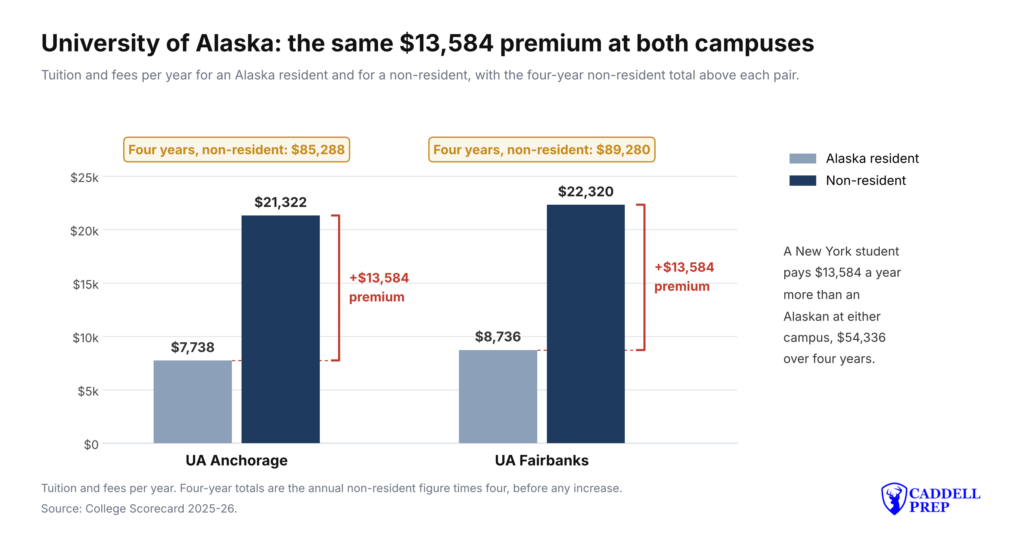
A New York student can see the two tuitions side by side in the image above.
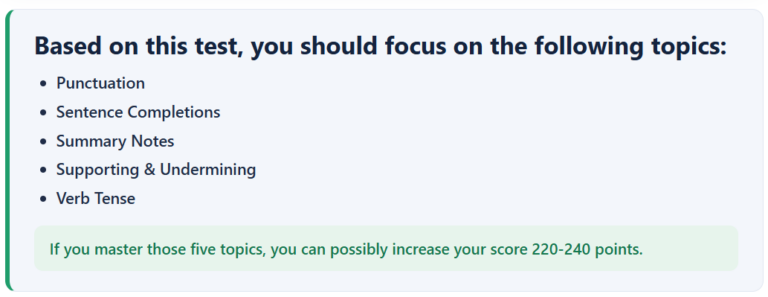
Want to Know What 5 Topics Will Improve Your SAT Score the Most?
Sample Feedback from our Diagnostic Test:
University of Alaska Anchorage
The University of Alaska Anchorage awards its business degrees through the College of Business and Public Policy, and Anchorage is the larger of the two campuses by 3,005 undergraduates.
Anchorage reports no score range. SAT and ACT scores are neither required nor recommended [VERIFY on UAA’s admissions page]. Cost of attendance $24,096, with tuition and fees at $7,738 in-state and $21,322 out-of-state. 7,212 undergraduates, admit rate not reported.
The College of Business and Public Policy had its AACSB accreditation extended in May 2025 and offers the Bachelor of Business Administration in accounting, finance, marketing, management, global logistics, economics, and business and data analytics, with a C or better required in each course of a 48-to-55-credit business core. The catalog states no admission requirement to the college beyond admission to the university [VERIFY with CBPP advising]. Anchorage’s non-resident tuition is $998 below Fairbanks’ and $1,240 below what UAB charges a New Yorker.
University of Alaska Fairbanks
The University of Alaska Fairbanks awards its business degrees through the College of Business and Security Management, and Fairbanks publishes the one admission floor on this page, a 2.5 GPA.
Fairbanks reports no score range. ACT and SAT scores have not been required for any undergraduate degree program since December 6, 2023. Cost of attendance $22,407, with tuition and fees at $8,736 in-state and $22,320 out-of-state. 4,207 undergraduates, admit rate not reported.
The College of Business and Security Management had its AACSB accreditation renewed for six years in 2025 and offers a 120-credit Bachelor of Business Administration with six concentrations, Finance and Economics, General Business, Human Resources, Leadership, Marketing and Sport Management, with a C- or better required in each course. Half of the accounting, business and economics credits and 24 of the last 30 credits must be earned at Fairbanks. Its cost of attendance, $22,407, is the lower of the two, and its non-resident tuition, $22,320, is the higher, because its resident tuition is also $998 higher than Anchorage’s.
Two rows say what each campus costs. The next section is about what gets a student in when no score is read.
What Does It Take to Enter a Business Major in Alaska?
Neither Alaska business school reads a test score and neither states a gate after admission, so a high school GPA of 2.5 admits a student to the University of Alaska Fairbanks and to its Bachelor of Business Administration at once.
Fairbanks publishes the rule in full. A freshman applying to a bachelor’s program needs a high school diploma, a cumulative GPA of 2.5, and a 2.5 in the 16-credit high school core curriculum. The admissions page says that as of December 6, 2023, UAF does not require ACT or SAT scores for any undergraduate degree program, and that scores do not factor into UAF scholarships. An applicant under 2.5 is told to contact an admissions counselor about starting as a pre-undeclared or non-degree student [VERIFY all of this on the UAF admissions page]. The BBA catalog page lists no further admission requirement. It lists 120 credits, a C- or better in each course, six concentrations, and the residency rules.
Anchorage publishes less. Its admissions profile lists scores as neither required nor recommended and asks for a high school GPA without naming a floor [VERIFY on UAA’s own admissions page, not a third party]. The College of Business and Public Policy catalog page lists the BBA core and a C minimum in each course and nothing a student must do to enter the college after the university admits him [VERIFY with CBPP advising at [email protected]].
The contrast with Alabama is the point. On our page on business colleges in Alabama, the University of Alabama reads a test score to admit a student to the university and a 2.5 college GPA on 61 hours to admit him to the business major. In Alaska a 2.5 high school GPA does both jobs at Fairbanks, and no second figure is published at either campus.
| Campus | What admits you | Test score read | Gate after admission |
|---|---|---|---|
| Anchorage | High school record [VERIFY any GPA floor] | No, neither required nor recommended | None stated, a C in each BBA core course |
| Fairbanks | Diploma, 2.5 cumulative GPA, 2.5 in the 16-credit core | No, not required since December 6, 2023 | None stated, a C- in each course |
The honest reading of a 2.5 floor is that it is a floor and not a description. A middle 50% tells a student where the admitted class sits. A floor tells him where the door is, and nothing on either campus’s pages says how far above it the class stands.
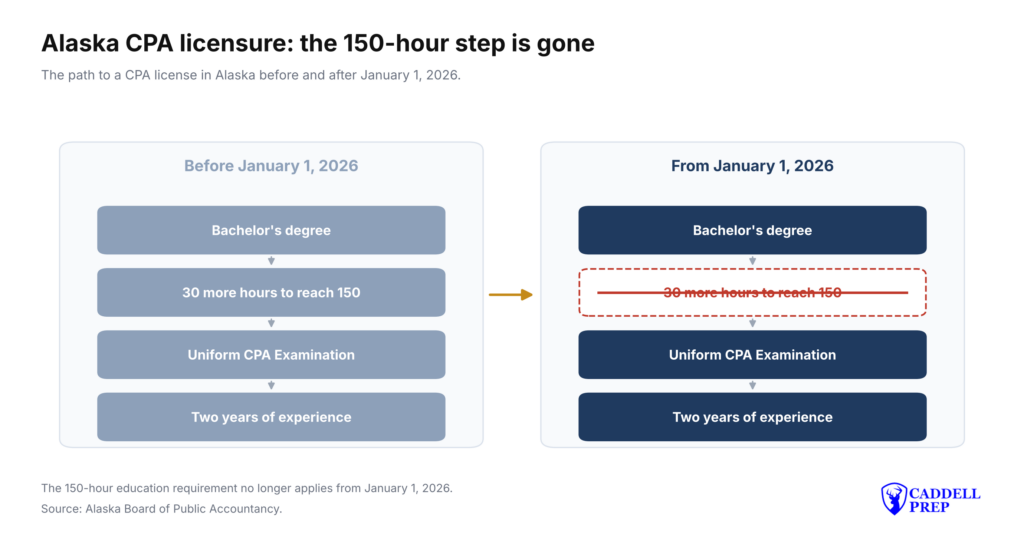
The image above shows the step House Bill 121 removed from Alaska’s CPA path.
Alaska repealed its 150-semester-hour requirement for CPA licensure. House Bill 121, sponsored by Representative Calvin Schrage of Anchorage, passed both chambers with no votes against it in the spring of 2025 and became law in July 2025 without the governor’s signature. The Alaska Board of Public Accountancy’s own flyer for 2026 says, “Alaska will no longer require 150 semester hours for licensure,” and the statute keeps a baccalaureate degree with an accounting concentration, “two years of accounting experience satisfactory to the board,” and the Uniform CPA Examination [VERIFY the flyer and the effective date]. A candidate may sit for the exam while within 18 semester hours of a bachelor’s degree once he holds 15 semester hours of accounting, and Alaska requires no Social Security number, citizenship or state residency to sit or to be licensed [VERIFY both on the board’s page]. Alabama asks 150 hours with 33 in upper-division accounting. Alaska, from 2026, asks a bachelor’s and two years.
A New Yorker pays $21,322 in tuition at Anchorage and $22,320 at Fairbanks, $85,288 and $89,280 over four years, against $136,688 at the University of Alabama. The Western Undergraduate Exchange rate both campuses offer does not reach him, because it applies to residents of the WICHE states and New York is not one [VERIFY on the University of Alaska WUE page and the WICHE member list]. Both campuses charge a resident $13,584 less than a non-resident, the same premium at each.
Take a New York student with a 1300 on the SAT, 650 on each section, and a 3.5 GPA. Alaska reads the 3.5 and not the 1300. At Fairbanks the 3.5 clears the 2.5 floor on the cumulative GPA and on the core, the SAT is not required and does not count for UAF scholarships, and he enters the BBA on admission. At Anchorage the SAT is neither required nor recommended and he enters the BBA on admission. Four years of tuition is $85,288 at one and $89,280 at the other. If he majors in accounting at either campus and stays in Alaska, a bachelor’s degree and two years of experience reach the CPA from 2026. If he comes home, New York’s own hour rule applies [VERIFY New York’s current rule].
The honest version is that neither campus reports a score range or an admit rate to the Scorecard, so this page has no middle 50% to describe. The College Board’s profile lists Anchorage at 59.58% admitted of 4,184 applicants for a year it does not name [VERIFY], and Fairbanks publishes a 2.5 floor and no rate. Neither business school publishes how many students who enter intending a BBA finish one. The CPA change is a licensure rule and not a hiring rule. The page does not say which campus is better. It says what each reads and what the state now asks of an accountant.
Families reading the CPA paragraph frequently ask whether the 150-hour rule is really gone.
Does Alaska Still Require 150 Credit Hours to Become a CPA?
No, Alaska no longer requires 150 semester hours to license a CPA, and from January 1, 2026, under House Bill 121, the state licenses on a bachelor’s degree with an accounting concentration, two years of accounting experience and the Uniform CPA Examination.
What remains is the exam, the experience, and an ethics course the board requires at licensing [VERIFY the ethics course on the board’s page]. The sitting rule is unchanged: a candidate may test while within 18 semester hours of a bachelor’s degree with 15 semester hours of accounting. The repeal is Alaska’s. A student who earns an Alaska accounting degree and practices in New York answers to New York’s board and New York’s hour rule [VERIFY].
One floor, one repeal. Which schools hold the accreditation is the next section.
Which Alaska Universities Have AACSB-Accredited Business Schools?
Two Alaska universities hold business accreditation from AACSB International, and both are campuses of the University of Alaska [VERIFY both on the AACSB directory before publishing].
- The University of Alaska Anchorage awards its business degrees through the AACSB-accredited College of Business and Public Policy.
- The University of Alaska Fairbanks awards its business degrees through the AACSB-accredited College of Business and Security Management.
Accreditation matters for a reason that is easy to miss at seventeen. Business itself is not a licensed profession, and the one business degree that leads to a license, accounting, leads to it through the state board rather than through the school. From 2026 a CPA in Alaska normally needs a bachelor’s degree with an accounting concentration, two years of accounting experience satisfactory to the board, and the Uniform CPA Examination, with the 150-hour requirement gone [VERIFY]. AACSB status matters on the way there because business schools use it to decide whose courses they will accept in transfer, and a student who moves between an Alaska campus and a school in another state will find that rule applied to him.
The University of Alaska Southeast in Juneau awards a Bachelor of Business Administration without AACSB accreditation, and Alaska Pacific University in Anchorage awards business degrees without it [VERIFY both on the AACSB directory]. Charter College is a for-profit college that reports no figures, and Ilisagvik College in Utqiagvik is a two-year tribal college.
Nothing on this page ranks the two. They are two campuses of one university with the same accreditor, the same non-resident premium and no published score, and the pages for business colleges in Washington and business colleges in Oregon carry the schools a student looking at Alaska is likely comparing [VERIFY the nearby-state convention from the engineering and pre-med Alaska pages].
What If You Have No Score to Send?
In Alaska the question runs the other way, because neither campus needs a score, and the question is what to do with one a student already holds.
The answer is to send it where it is read. UAF says scores do not factor into its scholarships. The Alaska Performance Scholarship does require a qualifying score, and it is for Alaska residents, so a New York student does not hold it [VERIFY the current Alaska Performance Scholarship rules]. A score that does nothing in Alaska still does its work at every school on the student’s list that reads one.
The first step is finding out where the score actually is, section by section. A free diagnostic SAT gives a Math score that can be set against the ranges on the other state pages in this series, and the method for closing a gap of 50 to 100 points is on our page on improving your SAT Math score. At either Alaska campus the same algebra fills the BBA’s required math and statistics courses [VERIFY which math course each BBA requires], so a student who arrives with it does not spend a semester on MATH 100-level work first.
How to Read a Page With No Score Ranges
A blank range in the Scorecard means the school did not report a middle 50% for that test, and at both Alaska campuses the reason is that no test is required [VERIFY the Scorecard’s rule for suppressing ranges with few submitters before stating one].
A blank range is not a low range. It is the absence of a description, and the student who wants one has to look at the floor the school publishes instead. More on what SAT score you need for college and on test-optional colleges.
Should You Take the ACT Instead?
Neither Alaska campus reads the ACT or the SAT, so a New York student gains nothing in Alaska by taking either.
The one Alaska use of a test score is the Alaska Performance Scholarship, and it is for residents, so a New Yorker cannot hold it [VERIFY]. A student who holds an SAT should send it to the schools on his list that read one and leave the ACT alone unless another school asks for it.
Business Programs in Nearby States
Alaska borders no other state, and the nearest AACSB-accredited business schools in the lower forty-eight are in Washington and Oregon [VERIFY the lists before linking].
See business colleges in Washington and business colleges in Oregon.
Business Colleges in Other States
We publish the same breakdown for business programs in every state.
See business colleges by state for the full list.

Glyn Caddell
Glyn Caddell holds a BS in Mechanical Engineering from NJIT and has been tutoring New York City students since 2008. He founded Caddell Prep in 2012 and is the author of Digital SAT Math Secrets: Lessons & Tricks to Quickly Improve to a Perfect 800 on the Math Test, which contains over 900 practice problems and is used in Caddell Prep’s SAT math classes. He is founding president of the Staten Island Technical High School alumni association and teaches every lesson on this site personally.
Finally, an SAT course that students actually understand
Every question has a video explanation. Not most — every one.
The on-demand Digital SAT course covers all 17 math topics and 15 reading and writing topics, with 5 full-length practice tests and a 100-point score increase guarantee. Keep access for the rest of high school. No subscription.
Want to Know What 5 Topics Will Improve Your SAT Score the Most?
Sample Feedback from our Diagnostic Test: