
Home » The Digital SAT: What’s Tested, How It’s Scored, and How to Improve Your Score » 330 SAT Vocabulary Words From Official Digital SAT Practice Tests
By Glyn Caddell, BSME · Author of Digital SAT Math Secrets · Tutoring since 2008 — Updated August 26, 2026
Most SAT word lists are collections of difficult words. This one isn’t.
We went through the ten full-length Digital SAT practice tests released by the College Board and pulled every vocabulary word that actually appeared. That’s the list below, with definitions, and it’s 330 words.
This page also has free flashcards and quizzes for every word, with no account required.
How Is Vocabulary Tested on the Digital SAT?
Vocabulary shows up as Words in Context questions, which are the first questions in each Reading & Writing module.
They’re approximately 16.5% of the Reading & Writing section, which makes them the single most common question type in that section. About one question in six.
They come in two forms. The first gives you a short passage with a blank and asks which word or phrase fits most logically. The second gives you a word that’s already in the passage and asks what it means as it’s used there.
Both are tested in context. You won’t see a word and be asked to pick its definition. That’s a change from older versions of the SAT, which tested vocabulary in isolation and used much harder words.
What Do SAT Vocabulary Questions Look Like?
Here’s the first form, where you choose the word that fits the blank.
While researching a topic, a student has taken the following notes. The archaeologist’s early findings were widely dismissed, but subsequent excavations ______ her conclusions.
A) undermined
B) corroborated
C) complicated
D) preceded
The word before the blank is doing the work. “But” signals a contrast with “dismissed,” so the correct answer has to be positive. Corroborated means confirmed or supported, which is the opposite of dismissed. The answer is B.
The second form works differently. Instead of a blank, the question quotes a word from the passage and asks what it means as used in the text. The same word can have several meanings, and the passage decides which one applies.
For both forms, knowing the word is only half of it. You also have to read the sentence around it closely enough to know which meaning the passage needs.
How We Built This List
We went through all ten full-length Digital SAT practice tests released by the College Board and recorded every vocabulary word that appeared, including the words in the questions, the answer choices, and the passages.
That produced 330 words.
Two things about this list are different from most SAT word lists.
These words came from the actual tests.
They aren’t words that seem like SAT words. They’re words that were on Digital SAT practice tests. Some of them are difficult and some of them aren’t, because that’s what the test looks like.
Some entries are phrases rather than single words.
You’ll see adhere to, antagonistic toward, and arguing about on the list rather than adhere, antagonistic, and arguing. That’s because the answer choices on the test include the preposition, and knowing the verb by itself doesn’t always tell you which preposition goes with it. Most SAT word lists strip these down to single words. The test doesn’t.
Words also repeat across tests. Obscure, indecipherable, and substantial each appeared at least three times.
Free SAT Vocabulary Flashcards and Quizzes
Every word on the list is covered by the flashcard sets below. Each set has a matching quiz.
There’s no account required and nothing to pay for. Work through a set of flashcards, then take the quiz to find out which words didn’t stick.
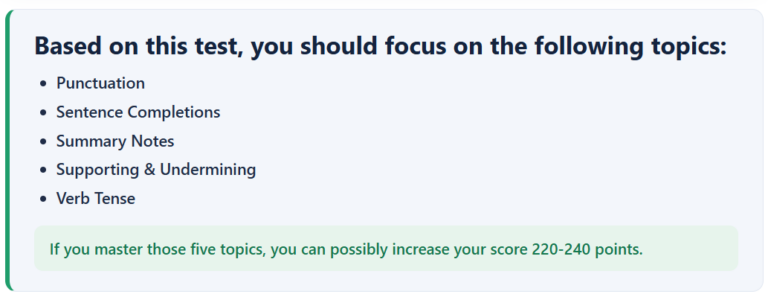
Want to Know What 5 Topics Will Improve Your SAT Score the Most?
Sample Feedback from our Diagnostic Test:
SAT Vocabulary List
Below is the full list of SAT vocabulary words that appeared on the ten Full-Length SAT Practice Tests provided by the College Board.
You can study these words with our free online flashcards and test your knowledge with the associated quizzes.
Abrupt – sudden or unexpected.
Acceptable – satisfactory or permissible; meeting minimum standards.
Accidental – happening by chance or unintentionally.
Acknowledged – recognized or admitted the truth or existence of something.
Acquired – gained or obtained through effort or experience.
Adhere to – to follow or stick firmly to rules, beliefs, or guidelines.
Adjusted – changed or modified for improvement or suitability.
Advertising – the activity of promoting products, services, or ideas to influence people.
Ameliorate – to make something bad or unpleasant better.
Amount – the quantity or total of something.
Amusing – entertaining or funny.
Annotate – to add notes or comments to explain or clarify.
Announced – made something known publicly or formally.
Antagonistic toward – showing hostility or opposition to something or someone.
Antecedent – something that came before or influenced something else.
Appropriate – suitable or proper for a particular situation or purpose.
Approximate – close to the actual amount or value, but not exact.
Arguing about – engaging in a dispute or debate regarding something.
Arriving at – reaching a conclusion, decision, or destination.
Asserting possession of – claiming ownership or control over something.
Attached – connected to something or emotionally connected to someone.
Attractive to – appealing or pleasing to someone.
Atypical – not representative of a type, group, or class; unusual.
Avoid – to keep away from or prevent something.
Beneficial – producing good results or advantages.
Beneficially – in a way that produces good or helpful results.
Beneficiary of – a person who gains or receives something as a result of an action or event.
Blemish – a flaw, mark, or imperfection.
Buttress – to support, strengthen, or reinforce.
Careful – taking pains to avoid mistakes or accidents; showing close attention.
Catastrophic – involving or causing sudden great damage or suffering.
Challenged – questioned or disputed the truth or validity of something.
Characterization – the way a writer reveals the personality of a character; a description of distinctive features.
Circumvent – to find a way around an obstacle or rule, often dishonestly or cleverly.
Coincidence – a situation where events happen at the same time by chance but seem related.
Collaboration – the action of working with others to produce or create something.
Collected – calm and composed; also means gathered together.
Commercialization – the process of managing or exploiting something to make a profit.
Committed – dedicated or loyal to a cause, activity, or person.
Common – occurring frequently; shared by two or more parties.
Comparable to – similar to something else in quality, amount, or nature.
Compelling – evoking interest or attention in a powerful or irresistible way.
Complementary – combining in such a way as to enhance or complete each other.
Complicated by – made more difficult by additional factors or circumstances.
Complemented by – enhanced or improved by something else that goes well with it.
Compose – to create or put together; also refers to calming oneself.
Compound – to intensify or add to something; also a mixture of substances.
Concealed – hidden or kept out of sight.
Concede – to admit or acknowledge something as true or valid, often reluctantly.
Conceptualize – to form a concept or idea of something in the mind.
Concern about – a feeling of worry or interest regarding someone or something.
Concerning – causing worry or anxiety; relating to a particular subject.
Condition – the state of something or a requirement for something to happen.
Confident – feeling or showing assurance in oneself or in a particular situation.
Confined to – limited to a certain space, area, or scope.
Conflated with – combined two or more ideas or things into one, often confusing them.
Confusing for – causing someone to feel uncertainty or difficulty in understanding.
Consistent – acting or done in the same way over time; reliable or uniform.
Conspicuous – easily seen or noticed; attracting attention.
Constant – happening all the time or staying the same.
Contentious – likely to cause disagreement or argument.
Contrived – deliberately created rather than arising naturally; artificial.
Controversial – causing disagreement or discussion, especially in public or political contexts.
Controversy – prolonged public disagreement or heated discussion.
Cordially – in a warm, friendly, and polite manner.
Corrected by – fixed or improved by someone or something.
Corroborate – to confirm or support a statement, theory, or finding.
Costly – involving great expense; having negative consequences.
Created – brought something into existence.
Creating – the act of bringing something into existence.
Critical – expressing disapproval or analysis; also important or crucial.
Dangerous – able or likely to cause harm or injury.
Deceptive – misleading or giving a false impression.
Deciding – choosing between alternatives; making a final judgment.
Defend – to protect from harm or to support with reasoning.
Delegate – to assign responsibility or authority to someone else; also refers to a person chosen to represent others.
Demands – strong requests or needs; also, authoritative orders.
Demarcated from – clearly separated or marked off from something else.
Denied – refused to give or acknowledge.
Derived from – originating from a source or base.
Describe – to give a detailed account of something using words.
Destroying – causing something to end or cease to exist, usually violently or completely.
Determined – having a firm decision or strong purpose to do something.
Disapproving of – expressing a negative opinion or lack of approval.
Disastrous – causing great damage or suffering; extremely unfortunate.
Discernible – able to be seen, recognized, or understood.
Disconcerting – causing discomfort, confusion, or unease.
Discounted – regarded something as unimportant or reduced its value.
Discussed – talked about something with others to share ideas or information.
Disengage – to release or detach from an attachment or connection.
Disorienting – making someone confused about direction or position.
Disparage – to belittle or speak negatively about someone or something.
Disseminate – to spread widely, especially information or ideas.
Distracted – unable to concentrate because one’s attention is diverted.
Distraction for – something that diverts attention away from the primary focus.
Diverge – to move or extend in different directions from a common point.
Diverse – showing a great deal of variety; very different.
Doubts – feelings of uncertainty or lack of conviction.
Dynamic – characterized by constant change, activity, or progress.
Earnest – showing deep sincerity or seriousness.
Eclipses – surpasses or overshadows something in importance or quality.
Elusive – difficult to find, catch, or understand.
Enduring – lasting over a period of time; long-lasting.
Ensured – made certain that something would happen.
Enthusiasm for – intense and eager enjoyment, interest, or approval of something.
Epitomizing – serving as a perfect example of something.
Establishes – sets up or creates something on a firm or permanent basis.
Esteem – respect and admiration, typically for a person.
Evaluate – to assess or determine the value, quality, or importance of something.
Evidence – information or facts that support a belief or conclusion.
Exacerbating – making a problem or situation worse.
Examples of – specific instances that illustrate a concept or category.
Exemplifies – shows or illustrates by example.
Exhaustive – thorough and complete; considering all aspects.
Expensive – costing a lot of money.
Experiment – a test or procedure carried out to discover or demonstrate something.
Exploited – used something or someone unfairly for personal gain.
Extensive – covering a large area or scope.
Fabricates – invents or makes up something, often false.
Featured – presented or highlighted as important.
Finishing – bringing something to an end or completion.
Followed – came after in sequence or time; adhered to.
Foretells – predicts or announces something before it happens.
Fragile – easily broken or damaged.
Gaining on – catching up to someone or something in pursuit.
Grapple with – to struggle to deal with or understand something difficult.
Guess – to form an opinion or answer without full information.
Handmade from – crafted manually using specific materials.
Healthy – in good physical or mental condition; beneficial to well-being.
Hibernation – a state of inactivity and metabolic depression in animals during winter.
Highlight – to emphasize or make something stand out.
Hoard – to accumulate and store items excessively.
Hypothesized – proposed a theory or explanation based on limited evidence.
Illustrate – to explain or decorate something with examples, pictures, or diagrams.
Imaginative – having or showing creativity or inventiveness.
Imagine – to form a mental image or concept of something.
Imitated by – copied or mimicked by someone or something.
Imminent – about to happen very soon.
Impartial – treating all sides or people equally; unbiased.
Impending – about to occur; looming.
Impenetrable – impossible to pass through or understand.
Imperceptible – too slight, subtle, or gradual to be perceived.
Implement – to put into effect or carry out a plan or system.
Important – having great meaning or influence.
Impractical – not sensible or realistic for use or action.
Improve on – to make something better than before.
Improvise – to create or perform without preparation.
Inadequate – not enough or not good enough.
Inadvertently – unintentionally; without meaning to.
Incident – an event or occurrence, often unexpected or unpleasant.
Inconclusive – not leading to a firm conclusion or result.
Inconsequential to – not important or relevant to something.
Indecipherable – impossible to read, understand, or interpret.
Independent of – not influenced or controlled by others.
Indicated by – shown or suggested by something.
Indications of – signs or evidence pointing to something.
Indifference to – lack of interest, concern, or sympathy toward something.
Infallible – incapable of making mistakes or being wrong.
Influenced – affected or shaped by external factors.
Infrequent – occurring rarely or not often.
Innocuous – harmless; not likely to offend or injure.
Insensible to – unaware of or indifferent to something.
Inspecting – examining something carefully and thoroughly.
Inspired by – motivated or influenced by something.
Interchangeable – capable of being exchanged or substituted.
Interjected – inserted suddenly into a conversation or discussion.
Interpret – to explain the meaning of information, words, or actions.
Interpretation – the act of explaining or understanding the meaning of something.
Intersect – to cross or meet at a point.
Intricate – very detailed or complex in design or structure.
Intriguing – arousing curiosity or interest; fascinating.
Invented – created something for the first time.
Involuntarily – done without will or conscious control.
Irrelevant to – not related or applicable to the subject.
Isolate – to set apart or separate from others.
Joining with – combining or cooperating with others.
Latent – present but not visible or active; hidden potential.
Legitimate – lawful, valid, or justifiable.
Localized – restricted to a particular area.
Lucrative – producing a great deal of profit.
Mandatory – required by law or rules; compulsory.
Manifest in – clearly shown or demonstrated in something.
Mimic – to imitate someone or something, often for humor or accuracy.
Misanthropic – having a dislike of or distrust in humankind.
Moderation – the avoidance of excess or extremes.
Neglect – to fail to care for properly.
Novel – new or original.
Nuanced – characterized by subtle differences in meaning or expression.
Obscure – not clearly expressed or easily understood; not well known.
Observable – able to be noticed or seen.
Observant – quick to notice or perceive things.
Obtain – to get or acquire something.
Obvious – easily perceived or understood; clear.
Occupy – to take up space or time; to reside or fill.
Oddity – something strange or unusual.
Offhand – casual or unprepared; done without planning or thought.
Operative – functioning or having effect; in operation.
Ordinary – with no special or distinctive features; normal.
Organized – arranged in a structured or systematic way.
Ornamental – decorative rather than functional.
Outstrip – to surpass or exceed.
Overcome – to succeed in dealing with a difficulty.
Overshadowed by – made less visible or important by comparison.
Overtly – openly and clearly, without hiding.
Paucity of – scarcity or lack of something.
Peripheral – on the edge or outer boundary; not central.
Permanent – lasting or intended to last indefinitely.
Perpetual – continuing without end.
Persistent – continuing firmly or obstinately despite difficulty or opposition.
Popularize – to make widely known or liked.
Postulate – to assume or suggest something as a basis for reasoning.
Pragmatic – dealing with things sensibly and realistically.
Praise – to express approval or admiration.
Precluding – preventing from happening or making impossible.
Predatory – seeking to exploit or harm others for personal gain.
Predetermined – decided or established in advance.
Predicted – said what would happen in the future.
Prediction – a forecast or prophecy.
Prescribed – recommended or ordered, especially by a doctor.
Presume – to suppose something is true without proof.
Prevail – to succeed or win; to be widespread.
Preventable – capable of being stopped or avoided.
Proclaims – announces officially or publicly.
Produced – created or brought into existence.
Profusion of – an abundance or large quantity of something.
Prolong – to extend the duration of something.
Prominent – important or well-known; standing out.
Proponent of – a person who supports or advocates for something.
Provide – to give or supply something.
Providing resistance to – opposing or withstanding something.
Prudently – acting with care and thought for the future.
Quarrel about – argue or fight about something.
Questionable – doubtful or uncertain in quality or validity.
Questioned – asked about or challenged.
Ranked – given a position in a hierarchy or scale.
Rationalize – to justify or explain something with logical reasons.
Recalcitrant – stubbornly resistant to authority or control.
Recants – withdraws a statement or belief publicly.
Receive – to be given or presented with something.
Reciprocate – to return a favor or feeling.
Recognizable – able to be identified from previous knowledge or experience.
Recommended – suggested as beneficial or suitable.
Reconstituted as – formed again into a new or original structure.
Rectify – to correct or make right.
Redefined – gave a new or clearer meaning to something.
Redressing – correcting or setting right a wrong or injustice.
Reduced – made smaller or less in amount, degree, or size.
Reflect – to show or represent something; to think deeply.
Refute – to prove a statement or claim to be false.
Regretted – felt sorrow or remorse about something done or not done.
Rejecting – refusing to accept, believe, or agree to something.
Renounce – to formally give up or reject something, especially a belief, claim, or behavior.
Replaced – took the place of something else.
Replicable – able to be duplicated or repeated, especially in experiments or processes.
Representative of – typical or characteristic of a group or class.
Represented by – shown or symbolized by something or someone.
Repressed by – held back or restrained, especially emotionally or politically.
Reprieve – a temporary relief or delay.
Repudiates – rejects or refuses to accept.
Require – to need or demand something.
Reserve – to set aside or keep for future use.
Resilient – able to recover quickly from difficulties.
Restored – brought back to a former condition or state.
Restricted – limited or controlled.
Retain – to keep or continue to hold.
Rival – a competitor or opponent.
Sanction – official permission or a penalty for disobedience.
Sanguine – optimistic or hopeful, especially in a difficult situation.
Satisfactory – meeting expectations or requirements.
Satisfying – giving a sense of pleasure or fulfillment.
Scheduled – arranged to happen at a specific time.
Scrutinized by – examined or inspected closely by someone.
Secretive – inclined to conceal feelings, intentions, or information.
Selecting – choosing from among options.
Significant – important or meaningful.
Similar to – resembling or alike in appearance, nature, or function.
Similarities with – features or aspects that are alike when compared to something else.
Simple – easy to understand or not complicated.
Sincerity – the quality of being honest, genuine, and free from pretense.
Skeptical – having doubts or reservations; not easily convinced.
Sketch – a rough or unfinished drawing or outline.
Smoothly – in a way that is even, uninterrupted, or without difficulty.
Sophisticated – advanced, refined, or complex in design or understanding.
Source – the origin or starting point of something.
Speculates – forms a theory or guess about something without firm evidence.
Straightforward – easy to understand; honest and direct.
Strenuously – in a way that requires great effort or exertion.
Stretching toward – reaching in the direction of something physically or figuratively.
Struggling – making a strenuous effort; having difficulty.
Stymie – to block, hinder, or thwart progress.
Substantial – of considerable importance, size, or worth.
Successful – having achieved a desired outcome or goal.
Succumb – to yield or give in to pressure, temptation, or illness.
Summarize – to give a brief statement of the main points.
Superficial – concerned only with surface aspects; lacking depth.
Supplement to – something added to improve or complete another thing.
Surmised – guessed or inferred without conclusive evidence.
Surpassed by – exceeded or overtaken in quality or performance.
Surprise at – a feeling of astonishment caused by something unexpected.
Surprising – causing wonder or amazement due to being unexpected.
Synchronization – the coordinated timing of events to operate in unison.
Tedious – too long, slow, or boring; tiresome.
Tentative – not certain or fixed; done without confidence.
Tenuous – weak or insubstantial; lacking a strong basis.
Theory – a system of ideas intended to explain something.
Thoughtfulness – consideration for the needs of others; careful thinking.
Tranquil – peaceful, calm, and quiet.
Transparent – easy to see through or understand; open and honest.
Unbiased – fair and impartial; not influenced by personal feelings.
Unbothered by – not troubled, disturbed, or concerned by something.
Uncertain about – not sure or lacking confidence in something.
Undeniable – clearly true or unable to be disputed.
Underestimated – judged as being less capable or important than is the case.
Understandable – able to be comprehended or grasped.
Unimportant – lacking significance or value.
Unintended – not planned or meant.
Universal – applicable or common to all; widespread.
Unknown – not known, identified, or recognized.
Unobtrusive – not attracting attention; inconspicuous.
Unoriginal – lacking new ideas; derived from something else.
Unpredictable – not able to be foreseen or expected.
Useful – able to be used for a practical purpose; helpful.
Validated – confirmed as true, accurate, or legitimate.
Verisimilitude in – the appearance of being true or real in something.
Waive – to voluntarily give up a right or claim.
Warranted – justified or deserved.
Waste – to use something inefficiently or carelessly.
Weaken – to reduce in strength, power, or effectiveness.
Widespread – happening or found over a large area or among many people.
Worried – anxious or concerned about actual or potential problems.
Finally, an SAT course that students actually understand
Every question has a video explanation. Not most — every one.
The on-demand Digital SAT course covers all 17 math topics and 15 reading and writing topics, with 5 full-length practice tests and a 100-point score increase guarantee. Keep access for the rest of high school. No subscription.
How to Study SAT Vocabulary
Three things matter more than how many words you get through.
1. Start Early
Vocabulary is the one part of SAT prep that doesn’t respond to cramming. It’s cumulative, which means a small amount of review spread over many weeks works far better than a large amount in one week.
If you’re building a study plan, vocabulary starts on day one even though it pays off last.
2. Learn Words in Context, Not as Definitions
The test never asks you for a definition. It asks you which word fits a specific sentence, or what a word means in a specific passage.
That means recognizing a word isn’t enough. You have to know it well enough to tell whether it fits the tone and logic of the sentence in front of you.
3. Use the Quizzes to Find the Gaps
Going through flashcards feels productive, and it’s easy to convince yourself you know a word when you’ve just seen it a moment ago.
The quizzes tell you what actually stuck. Take one a few days after working through a set, not immediately, and go back to whichever set gave you trouble.
Frequently Asked Questions
Students studying SAT vocabulary frequently ask how many words are on the test and whether they need to memorize a word list at all.
How many vocabulary words are on the SAT?
Words in Context questions are approximately 16.5% of the Reading & Writing section, which is about one question in six. The words themselves vary from test to test, but they repeat more than most students expect. This list has the 330 words that appeared across the ten official Digital SAT practice tests.
Do I need to memorize vocabulary for the Digital SAT?
You need to know vocabulary, but memorizing definitions from a list isn’t the most efficient way to get there. The Digital SAT tests words in context, so learning what a word means and how it’s used matters more than being able to recite a definition.
What are the most common SAT vocabulary words?
Words repeat across official tests. Obscure, indecipherable, and substantial each appeared at least three times on the ten practice tests. The full list on this page is ordered alphabetically rather than by frequency.
Are SAT vocabulary words harder on the Digital SAT than on the old SAT?
No. Older versions of the SAT tested vocabulary in isolation, which meant you had to know obscure words with very little context to help you. The Digital SAT tests words within a passage, and the words themselves are generally more common.
Is this list free?
Yes. The word list, all 18 flashcard sets, and all 18 quizzes are free and don’t require an account.
Ready to Study?
Start with Set 1 above, or take a free diagnostic SAT to find out whether vocabulary is actually where your points are.
If you want the full Reading & Writing section covered, our on-demand Digital SAT course includes all 15 Reading & Writing topics with a video explanation for every practice question.

Glyn Caddell
Glyn Caddell holds a BS in Mechanical Engineering from NJIT and has been tutoring New York City students since 2008. He founded Caddell Prep in 2012 and is the author of Digital SAT Math Secrets: Lessons & Tricks to Quickly Improve to a Perfect 800 on the Math Test, which contains over 900 practice problems and is used in Caddell Prep’s SAT math classes. He is founding president of the Staten Island Technical High School alumni association and teaches every lesson on this site personally.
Need Help Preparing for the SAT?
Use the only SAT prep course built with an engineer’s approach and taught in a way that students actually understand.
100-point score increase guarantee
Take a Free Diagnostic SAT
Discover the 5 Topics That Could Make the Biggest Difference in Your Score.
Take our free diagnostic and receive a personalized assessment showing exactly what to study next.