Give us a call (917) 722-0677

You can excel with Caddell!

By Glyn Caddell, BSME · Author of Digital SAT Math Secrets · Tutoring since 2008 — Updated August 18, 2026

Digital SAT Transforming Functions

Transforming functions questions ask students to draw mathematical conclusions about the values of a function after a transformation, such as a horizontal translation, vertical translation, dilation, and/or reflection. Transforming Functions questions appear on approximately 2.6% of the Digital SAT. Transforming Functions falls under Advanced math according to the College Board. 

Transforming Functions Lesson

The lesson covers the types of transforming functions questions that show up on the Digital SAT. This lesson will cover vertical shift, horizontal shift, reflection, dilation, and combining transformations.

What Do Transforming Functions Questions Look Like?

Here are some examples of Transforming Functions questions from the Digital SAT.

  • The graph of _______ is translated down 4 units in the xy-plane. What is the x-coordinate of the x-intercept of the resulting graph?
  • Which of the following is the graph of y=f(x)+5?
  • The function f is given. Which table of values represents y=f(x)-3?

1. Vertical Shift (Up/Down)

If you add or subtract outside the function:

f(x)+k
  • If k>0, the graph moves up
  • If k<0, the graph moves down

Example:
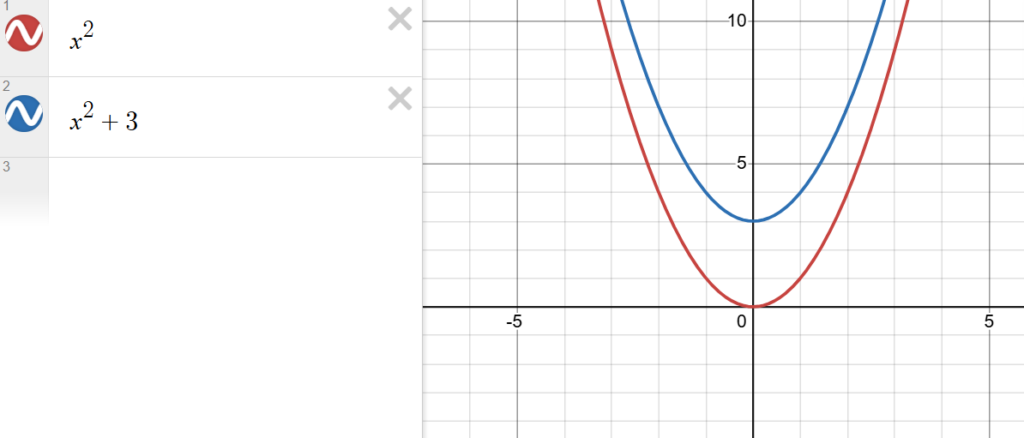
If f(x)=x^2, then f(x)+3=x^2+3 is 3 units higher.

2. Horizontal Shift (Left/Right)

If you add or subtract inside the function:

f(x+h)
  • if h>0, then the graph moves left
  • if h<0, then the graph moves right

Example:

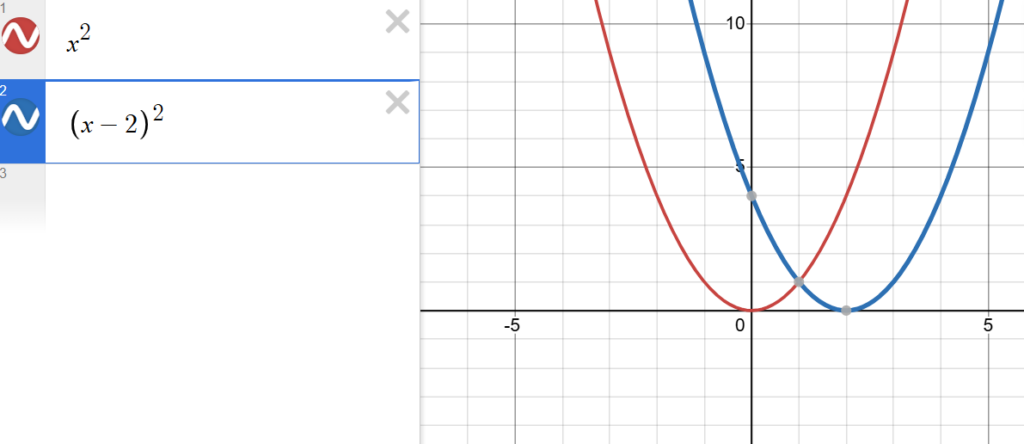
If f(x)=x^2, then f(x-2)=(x-2)^2 is horizontal shift 2 units right.

Tip: Horizontal shifts feel backward.

  • f(x+2) is a shift 2 left
  • f(x-2) is a shift 2 right

3. Reflection (Flipping)

Negating the function or the x reflects a function.

  • Negating the entire function, -f(x), reflects the function over the x-axis
  • Negating the x, f(-x), reflects the function over the y-axis.

Example:

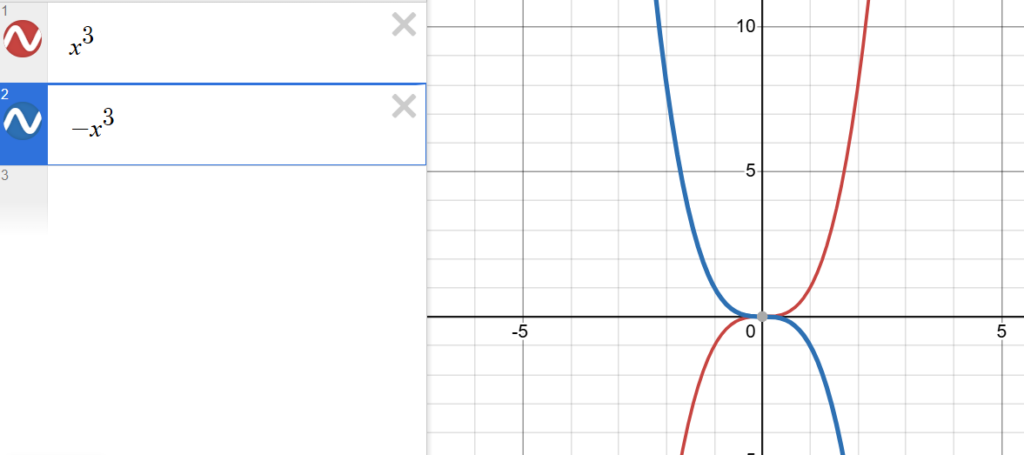
If f(x)=x^3, then -f(x)=-x^3 is a flip over the x-axis.

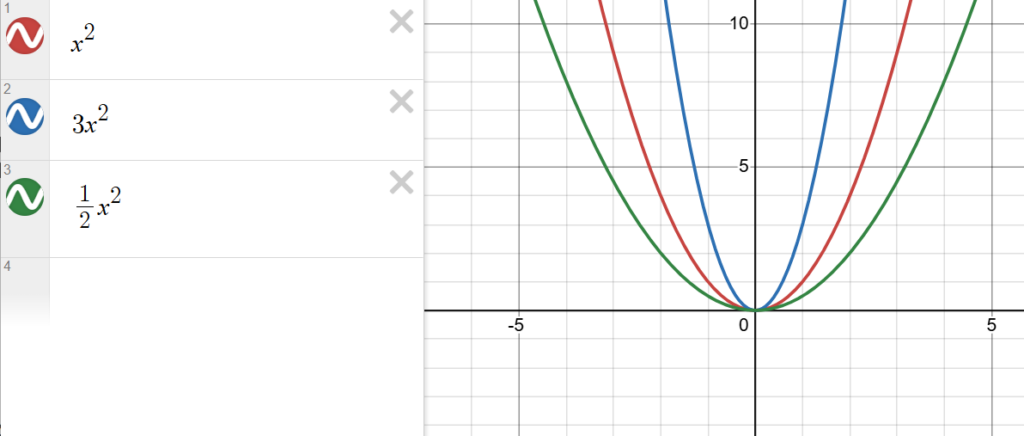
4. Dilation (Stretching/Compressing)

A dilation is when the entire function is multiplied by a constant (other than 1 or 0).

a f(x)
  • If |a|>1, then it is a vertical stretch and will look skinnier
  • If 0<|a|<1, then it is a vertical compression and will look wider

Example:

If f(x)=x^2, then

  • 3f(x)=3x^2 results in a vertical stretch and it will look skinnier
  • \dfrac{1}{2}f(x)=\dfrac{1}{2}x^2 results in a vertical compression and it will look wider
5. Combining Transformations

It’s possible for a function to undergo multiple transformations. 

Common transformations include a horizontal and a vertical shift.

For example, f(x-8)-7 is a transformation of f(x) that includes a horizontal translation 8 units and a vertical translation down 7 units.

If your transformation includes a dilation or reflection, those should be done before translating the function horizontally or vertically.

Tips

  1. You don’t have to graph everything — just understand the effect.

  2. If they give you the graph of f(x) and ask for f(x-2)+1, apply the shifts step-by-step.

  3. Use Desmos! You can type in functions and quickly see how the transformations affect them.

  4. Translations that affect the function will affect the minimum and maximum points in the function. For example, if the function is translated up 5 units, then the minimum or maximum is translated up 5 units as well. 

Example

The function f is defined by f(x)=3x-8. The function g is defined by g(x)=f(x)+5. Which equation defines g?

A) g(x)=3x-13
B) g(x)=3x-3
C) g(x)=8x-8
D) g(x)=3x+5

Video Explanation

Text Explanation

Answer: B

Since g(x)=f(x)+5, substitute 3x-8 for f(x).

g(x)=3x-8+5,
g(x)=3x-3

Therefore, the correct answer is B.

Practice Problems with Video Explanations

Here is a set of practice Digital SAT Transforming Functions practice problems. After selecting an answer, press “See Answer” to see the correct answer and a video explanation showing how to properly solve the questions. At the end of the set, after you press “Submit”, you’ll be able to see all of the questions, answers, and video explanations to review.

For more practice like this, enroll in our on-demand SAT prep course here: https://caddellprep.com/sat/prep/on-demand/

1. The function f is defined by f(x)=4x+11. The function g is defined by g(x)=f(x)-7.

Which equation defines g?

Question 1 of 3

2. The graph of the quadratic function f has a vertex at (-3,8). The function g is defined by g(x)=f(x+5)-6

What are the coordinates of the vertex of the graph of y=g(x)?

Question 2 of 3

3.

The graph of y=f(x) is translated 4 units to the right and 3 units down to produce the graph of y=g(x). The table shows several values of g.

xg(x)
1-5
47
710
92

What is the value of f(5)?

Question 3 of 3


Common Mistakes

Two common mistakes on transformation questions are mixing up the direction of a horizontal translation and mixing up the graph of a translated function with the original function.

Mixing Up the Direction of a Horizontal Translation

A common mistake on transformation questions is to mix up the direction of a horizontal translation because it translates opposite of most students’ intuition. Subtracting a number from x translates the function to the right, adding a number to x translates the function to the left.

Mixing Up a Graph of a Translated Function with the Original Function

A common mistake students make is mixing up a graph of a translated function with the original function. Sometimes, on hard math questions, the problem will provide a graph of a translated function such as f(x)+3, and ask a question about the original function. Since the graph is of the translated function, students have to reverse the translation to find values of the original function. A mistake is to treat the provided graph as a graph of the original function, f(x), and translate it again.

Frequently Asked Questions

Here are three frequently asked questions that I get from students when reviewing transforming functions.

What does f(x)+5 mean?

f(x)+5 means that the entire function, f(x), will be translated up 5 units.

What does f(x-5) mean?

f(x-5) means that the entire function, f(x), will be translated right 5 units.

What does -f(x) mean?

-f(x) means that the entire function, f(x), will be reflected over the x-axis. Remember, that the values of f(x) are y-values, so if you negate the function, all of the y-values get negated. All of the points above the x-axis are reflected below the x-axis.

Related Topics

Quadratic functions and circles are topics related to transforming functions.

Quadratic Functions

Transforming functions is closely related to quadratic functions. Many SAT questions ask students to recognize how a quadratic function changes when it is shifted up, down, left, or right. For example, when a quadratic function is written in vertex form, students can use the values in the equation to identify the vertex and understand how the graph was transformed. Therefore, reviewing our quadratic functions lesson and questions can help students improve on transforming functions questions.

Circles

Circle questions can also involve transformations. On the coordinate plane, a circle may be shifted left, right, up, or down from the origin. Students need to understand how the center and radius of a circle are shown in its equation. Therefore, reviewing our circle lesson and  questions can help students recognize transformations involving circles on the coordinate plane.

All Math Topics

All of our math topics are available here: https://caddellprep.com/sat/math/  for you to review and improve on your SAT. There are lessons, practice problems, and video explanations for you. If you need more help, try our on-demand SAT course with video lessons, practice tests, and sets of questions for each topic: https://caddellprep.com/sat/prep/on-demand/

Glyn Caddell

Glyn Caddell holds a BS in Mechanical Engineering from NJIT and has been tutoring New York City students since 2008. He founded Caddell Prep in 2012 and is the author of Digital SAT Math Secrets: Lessons & Tricks to Quickly Improve to a Perfect 800 on the Math Test, which contains over 900 practice problems and is used in Caddell Prep’s SAT math classes. He is founding president of the Staten Island Technical High School alumni association and teaches every lesson on this site personally.