
Home » The Digital SAT: What’s Tested, How It’s Scored, and How to Improve Your Score » The 17 Digital SAT Math Topics: How Often Each Is Tested and What to Study First » SAT Percent: Lesson, Practice Problems & Video Explanations
By Glyn Caddell, BSME · Author of Digital SAT Math Secrets · Tutoring since 2008 — Updated August 18, 2026
Percent questions test students’ understanding of percentages by asking students to solve for the percent, part, or whole, given the other values. Complex percent questions include finding the original value before a percent increase or decrease. Percent questions appear on approximately 3.1% of the Digital SAT. Percent falls under Problem-Solving and Data Analysis according to the College Board.
Percent Lesson
The lesson covers the types of percent questions that show up on the Digital SAT. The lesson covers the percent formula, percent increase & decrease, how to calculate the percent change, and successive percent changes.
What Do Percent Questions Look Like?
Here are some examples of Percent questions from the Digital SAT.
- The number
is 110% greater than the number
. The number
is 90% less than 47. What is the value of
?
- What was the store’s cost, in dollars, for the shirt?
- What percentage of 300 is 75?
- 210 is
greater than 30. What is the value of
?
- What is the amount, in dollars, of the tip Hanna gave?
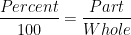
1. Percent Formula
For example, what is 30% of 60?
Substitute the values into the equation.
The part is typically associated with “is” in the sentence, and the whole is typically associated with “of” in the sentence.
Cross-multiply to get
Divide both sides by 100
Solve by Writing an Equation
In math “of” means multiply and “is” means “equals”.
We can look at the same question and write an equation.
What is 30% of 60?
,
Finding the Part
If you know the whole and the percent,
Use the proportion:
or
Example:
What is 30% of 200?
Finding the Whole
If you know the part and percent,
Use the proportion:
or
Example:
If 40 is 20% of a number, what is the number?
Finding the Percent
If you know the part and the whole,
Use the proportion:
or
Example:
What percent of 80 is 20?
2. Tax, Mark-Up, & Discount (Increase and Decrease)
Word problems on the Digital SAT may include a percent increase, such as tax or mark-up, or a percent decrease, such as discount. On difficult questions, successive percent changes may occur or students could be asked to find an original value before the percent change.
Increase by a Percent (Including Tax and Mark-Up)
Tax and mark-up increase the cost of a purchase.
For example, if a pair of shoes is $80 and there is 8% tax, we would have to add the tax on to the total cost.
We would have to calculate the tax and then add it on to the original cost.
8% of $80 is found by multiplying $80 and 0.08.
Now, we have to add the tax on to the price of the shoes,

Solving for the new value in a percent increase in one step (useful for algebraic questions)
Another way to look at it is that 100% of the price of the shoes is $80.
If it increases by 8% because of tax, the cost is now 108% of $80.
We can solve for the new total after tax in one step
.
The same concept applies to all increases.
If something increases by 40%, it will be 140% of what it previously was.
If something increases by 7.5%, it will be 107.5% of what it previously was.
If something increases by 100%, it will be 200% of what it previously was.
This is useful in algebra.
If increases by 30%, then there will be 130% of
, which can be written as
How to Find the Original Value After a Percent Increase
Sometimes a question will ask to find the original value. This is when it is especially important.
Example:
The price of an object is $500 after a 10 percent increase. What was the original price?
Let represent the original price.
Solve for the original price, by dividing both sides by 1.10.
Round the answer to the nearest cent.
The original price was $454.55.
Decrease by a Percent (Including Discount)
Discount decreases the cost of a purchase.
For example, if a pair of shoes is $80 and there is 30% discount, we would have to subtract the discount from the total cost.
We have to calculate the discount and subtract it from the original cost.
30% of $80 is found by multiplying $80 and 0.30.
.
Now, we have to subtract the discount from the original cost.
.
Solving for the new value after a percent decrease in one step (useful for algebraic questions)
Another way to look at it is that 100% of the price of the shoes is $80.
If it decreases by 30% because of a discount, the cost is now 70% of $80.
We can solve for the new price after the discount in one step
.
The same concept applies to all decreases.
If something decreases by 40%, it will be 60% of what it previously was.
If something decreases by 7.5%, it will be 92.5% of what it previously was.
If something decreases by 24%, it will be 76% of what it previously was.
This is useful in algebra.
If decreases by 30%, then there will be 70% of
, which can be written as
How to Find the Original Value After a Percent Decrease
Sometimes a question will ask to find the original value. This is when it is especially important.
Example:
The price of an object is $500 after a 20 percent decrease. What was the original price?
Let represent the original price.
Solve for the original price, by dividing both sides by 0.80.
3. How to Calculate the Percent Change (Increase or Decrease)
The formula for percent change, whether increase or decrease, can be found with a simple equation.
Percent Change
For example, if a stock increased from $80 to $100, the change is $20 and the original value was $80. Let’s use the formula to find the percent change.
Percent Change
Percent Change
The percent change from $80 to $100 is 25%.
If the stock decreased from $100 to $80, the change is still $20, but this time the original value is $100. Let’s use the formula to find the percent change in this scenario.
Percent Change
Percent Change
The percent change from $100 to $80 is 20%
4. Successive Percent Changes
Be careful: two percent changes don’t just add together.
Example:
A shirt costs $100. It’s reduced by 20%, then reduced by another 10%.
- First change:
.
- Second change:
.
Final price = $72.
This can also be done using single factors.
Using either method, the final price is $72.
The total percent decrease is:
(not 30%)
Tips
- Always ask: Is the percent based on the original value or the new value?
- For word problems, underline which number is the “whole” (what the percent is based on).
- Watch out for percent increase/decrease questions—they always use the original value in the denominator.
Example
A jacket originally costs $90. The price of the jacket is decreased by 20%. What is the new price, in dollars?
A) 18
B) 70
C) 72
D) 108
Video Explanation
Text Explanation
Answer: C) 72
A 20% decrease means the jacket will cost 80% of its original price.
80% of 90 is:
0.80(90) = 72
Therefore, the new price is $72.
Practice Problems with Video Explanations
Here is a set of practice Digital SAT percent practice problems. After selecting an answer, press “See Answer” to see the correct answer and a video explanation showing how to properly solve the questions. At the end of the set, after you press “Submit”, you’ll be able to see all of the questions, answers, and video explanations to review.
For more practice like this, enroll in our on-demand SAT prep course here: https://caddellprep.com/sat/prep/on-demand/
Please wait…![]()
Common Mistakes
Two common mistakes students make when answering percent questions are assuming the same percent used to increase a value can be used as the percent decrease to find the original value and not dividing by the original value when calculating the percent change.
Assuming the percent used to increase from one value to another is the same as the percent to decrease back to the original number
A common mistake on percent questions is assuming the percent used to increase from one value to another is the same as the percent to decrease back to the original number. For example, the percent increase from 80 to 100 is 25%, but the percent decrease from 100 to 80 is 20%.
This problem comes up in word problems.
Example:
The price of a purse increased by 25% and the new price is $200. What was the original price?
The mistake would be to find 25% of $200, and then subtract that number from $200.
then
$150 is the wrong answer.
To demonstrate, if 150 was the original price, a 25% increase would be
but
, not 200.
The correct method is to define the original price as a variable such as .
A 25% increase means the new price, $200, is 125% of the original price.
The equation is
.
Divide both sides by 1.25 to get
The original price was $160.
For percent change questions, not dividing by the original value
A common mistake for percent change questions, such as finding the percent increase or percent decrease, is not dividing by the original value. The way to find the percent change is to divide the change in the values by the original value.
Frequently Asked Questions
Here are two frequently asked questions that I get from students when reviewing percents.
How do I write a percent as its decimal equivalent?
To convert any percent to a decimal, simply divide by 100 or move the decimal two spots to the left.
For example,
,
,
and
How is tax applied to a price to get a final cost?
Tax is added onto a price, so it is treated like a percent increase.
If there is 8% tax, find out what 8% of the price is and add it onto the price to get the total cost.
Since it is a percent increase, you can also find the total cost by calculating 108% of the price by multiplying the price by 1.08.
Related Topics
Exponential growth/decay and data & probability are topics related to percents.
Exponential Growth/Decay
Percent questions are closely related to exponential growth and decay questions. In exponential growth questions, students often need to convert a percent increase into a growth factor. In exponential decay questions, students often need to convert a percent decrease into a decay factor. Therefore, mastering percent questions can help students answer exponential growth and decay questions more confidently.
Data & Probability
Data and probability questions often use percentages. For example, data may be shown in a table, graph, or survey, and students may need to find the percent of a group that has a certain characteristic. Probability can also be written as a percent, fraction, or decimal. Therefore, practicing data and probability questions can help students understand how percentages are used in SAT word problems.
All Math Topics
All of our math topics are available here: https://caddellprep.com/sat/math/ for you to review and improve on your SAT. There are lessons, practice problems, and video explanations for you. If you need more help, try our on-demand SAT course with video lessons, practice tests, and sets of questions for each topic: https://caddellprep.com/sat/prep/on-demand/
Glyn Caddell
Glyn Caddell holds a BS in Mechanical Engineering from NJIT and has been tutoring New York City students since 2008. He founded Caddell Prep in 2012 and is the author of Digital SAT Math Secrets: Lessons & Tricks to Quickly Improve to a Perfect 800 on the Math Test, which contains over 900 practice problems and is used in Caddell Prep’s SAT math classes. He is founding president of the Staten Island Technical High School alumni association and teaches every lesson on this site personally.