
Home » The Digital SAT: What’s Tested, How It’s Scored, and How to Improve Your Score
By Glyn Caddell, BSME · Author of Digital SAT Math Secrets · Tutoring since 2008 — Updated August 30, 2026
The Digital SAT is a college admissions test with four modules and 98 questions, taken on a computer through the College Board’s Bluebook app. It has two sections, Reading & Writing and Math, and it’s adaptive from module to module, which means a student’s performance on the first module determines the difficulty of the second. This page covers what’s tested, how the scoring works, when to take the test, and how to prepare for it.
It's Possible to Improve 100+ Points on the SAT by Only Studying 7 Topics
Most students study everything on the SAT evenly. That’s not the fastest way to raise a score.
There are 32 topics on the Digital SAT, and no student is weak in all of them. A student who finds out which topics he’s actually losing points on can improve 100 or more points by studying seven of them. The other 25 topics don’t need the same attention.
The way to find those seven topics is a diagnostic test with an assessment. Below is a real example of the feedback from a student’s diagnostic test.
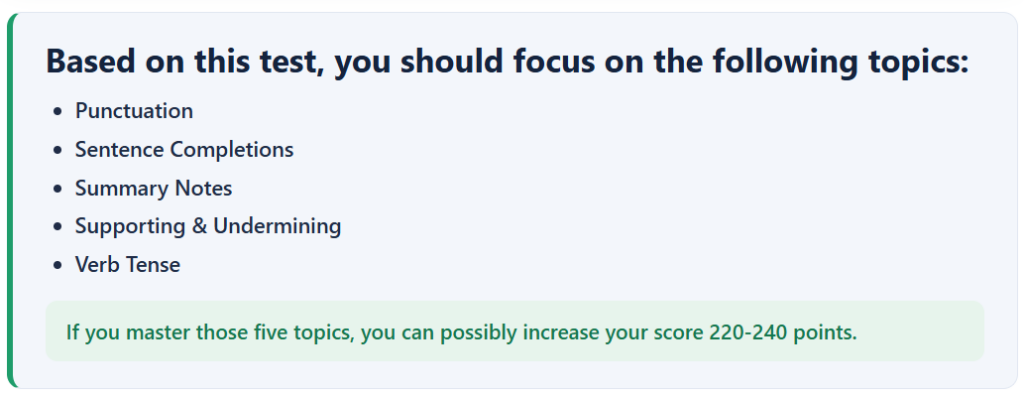
The assessment shows exactly which topics to study first. You can take a free diagnostic SAT online or in person at our Staten Island office.
What Is Tested on the Digital SAT?
The Digital SAT has two sections, Reading & Writing and Math. Each section has two modules, so there are four modules in total.
The College Board breaks each section into four broad content domains. For Reading & Writing, those are Craft and Structure, Information and Ideas, Standard English Conventions, and Expression of Ideas. For Math, they’re Algebra, Advanced Math, Problem-Solving and Data Analysis, and Geometry and Trigonometry.
Those domains describe the test, but they’re too broad to study from. A student who is told he is weak in Algebra still doesn’t know what to work on. Algebra covers linear functions, systems of equations, solving for a variable, and more, and a student can be strong in one and weak in another.
That’s why we categorize the Digital SAT into 32 specific topics instead of eight broad domains: 17 in math and 15 in Reading & Writing. We built the categories by going through every question on the practice tests released by the College Board and grouping them by what students actually have to know to answer them.
The categories still line up with the College Board’s. Adding up our topic percentages within each College Board domain lands within about 3.5 percentage points of what the College Board publishes, on both sections. The categories aren’t different from the College Board’s. They’re just finer, which is what makes them useful for deciding what to study.
Digital SAT Math Topics
There are 17 math topics tested across 44 questions in the two math modules. Linear functions is the most common at 15% of the questions, followed by combining like terms & solving equations at 11.7%.
See the full breakdown of the 17 Digital SAT math topics, including how often each one is tested, with a lesson and practice problems for every topic.
Digital SAT Reading & Writing Topics
There are 15 Reading & Writing topics tested across 54 questions in the two Reading & Writing modules. Words in context is the most common at 16.5% of the questions, followed by punctuation at 13.6%.
The Reading & Writing topics also appear in a predictable order. Each module starts with words in context questions and ends with summary notes. See the full breakdown of the 15 Digital SAT Reading & Writing topics, including the order they appear in and how often each one is tested.
How Is the Digital SAT Scored?
The Digital SAT is scored on a scale of 400 to 1600. Each section is scored from 200 to 800, and the two section scores are added together for the total score.
There is no penalty for a wrong answer, so students should answer every question. There’s also no partial credit on the math section.
The most important thing to understand about Digital SAT scoring is that it’s adaptive.
How Adaptive Scoring Works on the Digital SAT
The Digital SAT is adaptive. It is not adaptive from question to question. Instead, it is adaptive from module to module.
A student’s performance on the first module of each section determines the difficulty of the second module. Every student gets the same difficulty level on the first math module. If a student gets approximately two-thirds of the questions or more correct, he will get the more difficult second module. If he gets less than approximately two-thirds correct, he will get the easier second module.
The two-thirds figure is an estimate based on the students we’ve worked with and the scores they received. The College Board has not published the exact threshold.
Students need to reach the more difficult second module to maximize their scores. That’s because the easier second module has a score ceiling. A student who does well on an easy second module still can’t reach the top of the range.
This changes how students should think about the first module. Accuracy on the first module matters more than how many questions a student gets through, because the first module sets the ceiling for the whole section.
How Is the Digital SAT Structured and Timed?
Each of the four modules on the Digital SAT is timed separately. Students get a 10-minute break after the second Reading & Writing module, before the first math module.
| Module | Number of Questions | Time |
|---|---|---|
| Reading & Writing Module 1 | 27 | 32 mins |
| Reading & Writing Module 2 | 27 | 32 mins |
| Math Module 1 | 22 | 35 mins |
| Math Module 2 | 22 | 35 mins |
| Total | 98 | 134 mins |
The test is administered digitally on a computer or device at a designated test center. Students are encouraged to bring their own devices with the Bluebook app already installed. However, if students do not have their own device, one will be provided to them.
Types of Questions on the Digital SAT
The overwhelming majority of the test is made up of multiple choice questions. In fact, all of the Reading & Writing questions are multiple choice. Only the math section has some questions that require the student to enter an answer.
When Should Students Take the SAT?
The majority of students take the SAT for the first time in spring of junior year, but they can take the SAT earlier or later if they want.
Students should take the SAT when they have time to prepare for it. For example, if a student has many AP tests in May, he will likely not have a lot of time to prepare for the SAT while studying for AP exams, so taking the SAT earlier in March or later in June or August is better.
Earlier is always better because it allows time for the student to study and prepare for a retake if necessary.
When Is the Latest Students Can Take the SAT?
In most cases, the last attempt for taking the SAT is December of senior year. However, if a student is applying for early decision or early action, the last time will be October or November of senior year, depending on when the application is due.
How Many Times Can a Student Take the SAT?
Students can take the SAT as many times as they like.
For almost all college applications, students can choose which scores to send. Those colleges will only know about the SATs that a student chooses to share. Some colleges also superscore, which means they take the highest section scores across multiple test dates and combine them.
How to Register for the SAT
To register for the SAT, create an account on the College Board website. It is possible to register by mail, but we recommend registering online.
Registration for the entire school year normally opens in late May or early June. Registering early improves a student’s chances of getting his preferred test center before the seats fill up. Here’s more on how to register for the SAT.
How Should Students Prepare for the Digital SAT?
Knowing the format and the topics isn’t a study plan. It doesn’t tell a student which of the 32 topics are costing him points, and that’s the piece that decides what to study first.
The SAT is not the end-all-be-all of applying to colleges. But for a lot of students it’s the easiest part of the application to improve, and it’s a significant part of the application. How much preparation is necessary depends on the student’s current score and his target score.
Start With a Diagnostic SAT
Starting with a diagnostic SAT is the most important step for three reasons. First, it will introduce you to the format of the test. Second, it will give you your baseline score, so you know how much you need to improve to reach your target. Third, a good diagnostic test will inform you about which topics you need the most help with.
Our free diagnostic SAT gives students an accurate score based on College Board scoring, plus an assessment showing which topics to study first.
SAT Prep Options
After the diagnostic, students need a plan based on their assessment and their target score. Caddell Prep offers several ways to prepare, both in-person and online. See all of our SAT prep options to compare them.
SAT Prep Classes
A 4-week course with 8 three-hour lessons and 4 practice tests, meeting three times per week. SAT prep classes are limited to 8 students, so every student gets some one-on-one attention from the instructor.
SAT Tutoring
SAT tutoring is 1-on-1, online or in person, with flexible scheduling. Tutoring lets a student spend the time on exactly the topics he needs instead of reviewing material he already knows.
On-Demand SAT Course
Our on-demand SAT course includes interactive video lessons, 4 practice tests, and a video explanation for every practice question. Students study at their own pace.
Digital SAT Math Secrets
Digital SAT Math Secrets covers every math topic with over 900 practice problems and 3 practice tests. It’s written by the same person who teaches every lesson on this site and is available on Amazon.

Glyn Caddell
Glyn Caddell holds a BS in Mechanical Engineering from NJIT and has been tutoring New York City students since 2008. He founded Caddell Prep in 2012 and is the author of Digital SAT Math Secrets: Lessons & Tricks to Quickly Improve to a Perfect 800 on the Math Test, which contains over 900 practice problems and is used in Caddell Prep’s SAT math classes. He is founding president of the Staten Island Technical High School alumni association and teaches every lesson on this site personally.
Need Help Preparing for the SAT?
Use the only SAT prep course built with an engineer’s approach and taught in a way that students actually understand.
100-point score increase guarantee
Take a Free Diagnostic SAT
Discover the 5 Topics That Could Make the Biggest Difference in Your Score.
Take our free diagnostic and receive a personalized assessment showing exactly what to study next.