
Home » The Digital SAT: What’s Tested, How It’s Scored, and How to Improve Your Score » The 15 Digital SAT Reading & Writing Topics: How Often Each Is Tested and the Order They Appear » SAT Words in Context: Lesson, Practice Problems & Video Explanations
By Glyn Caddell, BSME · Author of Digital SAT Math Secrets · Tutoring since 2008 — Updated August 18, 2026
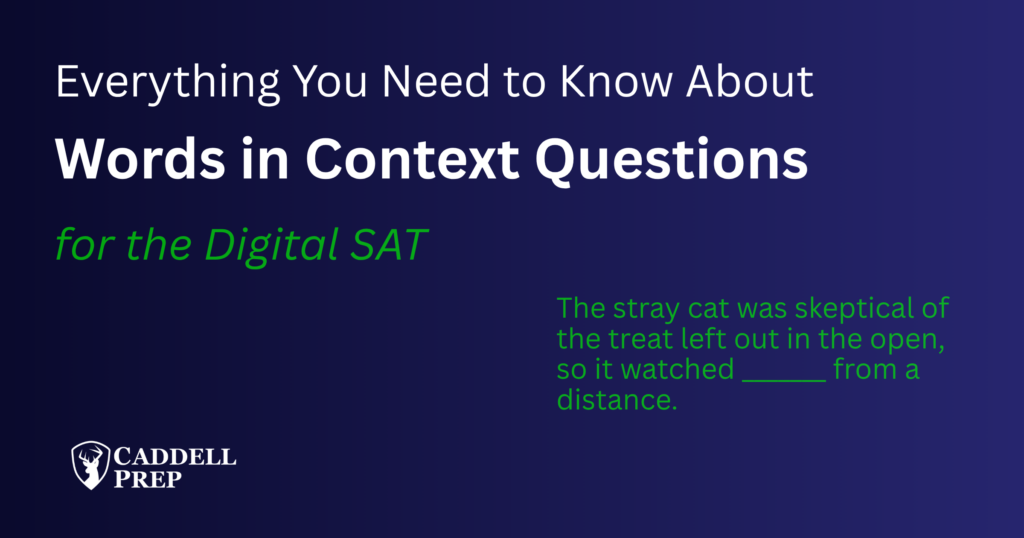
Words in context (sentence completion) questions on the Digital SAT ask students to choose the best word for a blank based on context. Occasionally a question with no blanks will be provided, and students are asked to define a specific word in a text based on context. Words in context questions appear on approximately 16.5% of the Digital SAT Reading & Writing section. These are typically the first questions in each Reading & Writing module. Sentence Completion questions fall under Craft & Structure according to the College Board.
Words in Context Lesson
The lesson covers the types of Words in Context questions that show up on the Digital SAT. This lesson includes what sentence completion questions look like, how to answer sentence completions, and some tips for answering them.
What Do Words in Context Questions Look Like?
These are typically the first questions on the Reading and Writing section.
- They have a blank in the middle of the text and the question asks for the best word to put in the blank.
- Another type of question could include a text and ask for the best meaning of a specific word in the text.
Here are some examples of Word in Context questions from the Digital SAT.
- Which choice completes the text with the most logical and precise word or phrase?
- As used in the text, what does the word “_______ ” most nearly mean?
How Do I Answer Words in Context Questions?
- Read the entire passage. Identify clues (words and phrases).
- Normally the previous or following sentence contains the clue for the blank.
- Think of your own word to fill into the blank. If you can’t define the word that belongs in the blank, DO NOT try the answer choices. First, try step four.
- Determine if the word that belongs in the blank is a positive or negative word. If you can determine that the answer should be positive, eliminate the negative and neutral answers. After eliminating answers, try the remaining answer choices in the blank to see which one fits the best.
What are Some Tips for Answering Words in Context Questions?
Use Context Clues to predict meanings.
Clues for continuation:
These clues show a continuation of an idea.
- Also
- And
- As well as
- Furthermore
- In addition
- Just as
- Likewise
- Moreover
- Not only (first statement) but also…
- Similarly
Clues for cause-and-effect:
These clues show a cause-and-effect relationship:
- As a result
- Because
- Consequently
- In that
- Therefore
- Thus
Clues for contrast: These clues show a contrasting relationship:
- Although
- But
- Despite
- For all (same meaning as despite)
- However
- In contrast
- In spite of
- Meanwhile
- Nevertheless
- On the other hand
- Regardless
- Though
- Unlike
- Whereas
- While
Do I Need to Study Vocabulary for Words in Context Questions?
Yes, you need to study vocabulary for words in context questions. You’ll have to pick the best word to fit in the blank or the best definition of a given word, so you’ll need to know the definitions of the answer choices.
The good news is that the SAT no longer uses archaic vocabulary. The vocabulary is limited to words students would come across in their typical education.
How Do I Study Vocabulary for the Digital SAT?
Study vocabulary for the Digital SAT by using Caddell Prep’s free digital SAT flashcards and practice questions. Our list is made from scouring College Board SATs for vocabulary words that appear.
SAT Words in Context Example
The scientist did not dispute that the preliminary results were encouraging. However, because the experiment had been conducted under unusually controlled conditions and involved only a small sample size, she warned that the findings might not be easily ______ in more complex real-world environments.
A) replicated
B) questioned
C) illustrated
D) implemented
Video Explanation
Text Explanation
Answer: A) replicated
The contextual clues are “unusually controlled conditions” and “small sample size,” both of which suggest concern about whether the same results could be reproduced elsewhere. “Replicated” is therefore the most precise answer.
- B) questioned is tempting because the scientist is cautious, but the issue is specifically whether the results can be repeated.
- C) illustrated does not fit the context logically.
- D) implemented concerns putting something into practice, not reproducing experimental findings.
Practice Problems with Video Explanations
Here is a set of practice Digital SAT Words in Context practice problems. After selecting an answer, press “See Answer” to see the correct answer and a video explanation showing how to properly solve the questions. At the end of the set, after you press “Submit”, you’ll be able to see all of the questions, answers, and video explanations to review.
For more practice like this, enroll in our on-demand SAT prep course here: https://caddellprep.com/sat/prep/on-demand/
Please wait…
Common Mistakes
Two common mistakes students make when answering words in context (sentence completion) questions are not reading the whole text and choosing a word that doesn’t fit well.
Not Reading the Whole Text
A common mistake is not reading the whole text. Often, the clue to a blank is in the preceding or following sentence. You have to read the entire text to get the context clues for the blank.
Choosing a Word That Doesn't Fit Well Because You Don't Know the Other Words
Students often select an answer that they know doesn’t fit well, but they don’t know the definitions of the other answer choices. If you know a word doesn’t fit well because you know the definition of that word, then you should cross it out.
Related Topics
Inference and Transitions are topics related to Words in Context.
Inference
Words in context questions are related to inference questions because both require students to use clues from the text. In words in context questions, students need to determine which word best fits the meaning of the sentence. In inference questions, students need to determine what must be true based on the information provided. Therefore, practicing inference questions can help students improve their ability to use context clues in words in context questions.
Transitions
Words in context questions are related to transition questions because both require students to understand how ideas connect. In some words in context questions, the blank depends on the relationship between two ideas, such as contrast, cause and effect, or continuation. Transition questions directly test those relationships by asking students to choose the best word or phrase to connect ideas. Therefore, practicing transition questions can help students better understand the logic needed for words in context questions.
All Reading & Writing Topics
All of our reading & writing topics are available here: https://caddellprep.com/sat/reading-writing/ for you to review and improve on your SAT. There are lessons, practice problems, and video explanations for you. If you need more help, try our on-demand SAT course with video lessons, practice tests, and sets of questions for each topic: https://caddellprep.com/sat/prep/on-demand/

Glyn Caddell
Glyn Caddell holds a BS in Mechanical Engineering from NJIT and has been tutoring New York City students since 2008. He founded Caddell Prep in 2012 and is the author of Digital SAT Math Secrets: Lessons & Tricks to Quickly Improve to a Perfect 800 on the Math Test, which contains over 900 practice problems and is used in Caddell Prep’s SAT math classes. He is founding president of the Staten Island Technical High School alumni association and teaches every lesson on this site personally.
Need Help Preparing for the SAT?
Use the only SAT prep course built with an engineer’s approach and taught in a way that students actually understand.
100-point score increase guarantee
Take a Free Diagnostic SAT
Discover the 5 Topics That Could Make the Biggest Difference in Your Score.
Take our free diagnostic and receive a personalized assessment showing exactly what to study next.