Give us a call (917) 722-0677

You can excel with Caddell!

By Glyn Caddell, BSME · Author of Digital SAT Math Secrets · Tutoring since 2008 — Updated August 6, 2026

Circles questions on the SAT test students’ knowledge of the equation of a circle, (x-h)^2+(y-k)^2=r^2; the area of a circle, A=\pi r^2; circumference of a circle, C=2 \pi r; and relationships between angles in a circle and corresponding sector or arc lengths. Circle questions appear on approximately 3.5% of the Digital SAT. Circle questions fall under Geometry and Trigonometry according to the College Board. 

Circles Lesson

The lesson covers the types of Circles questions that show up on the Digital SAT. This lesson covers circle formulas, proportions in a circle, angles in circles, the equation of a circle, and completing the square to get the circle equation in standard form.

1. What Circle Formulas are Provided on the Digital SAT?

A couple of basic formulas are given on the SAT for circles: area and circumference.

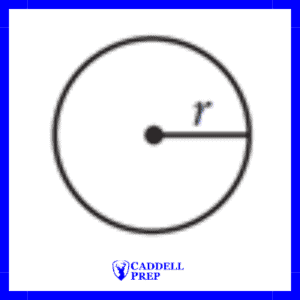
Radius in a Circle

A=\pi r^2
C=2\pi r

Also, remember that diameter is the width of a circle. It is a chord drawn from one point on the circle to another, passing through the center. It is twice the length of the radius, and the radius is half the length of the diameter.

With the two formulas, you will be able to find circumference if you are given the area and vice-versa, because you can find the radius if you are given one.

Example

The circumference of a circle is 8\pi. What is the area of the circle?

Explanation & Solution

The formula for area of a circle is A=\pi r^2, so we need to find the radius to find the area. 

We are given that the circumference is 8\pi, so we should use the formula for circumference to find the radius.

C=2\pi r,

8\pi = 2\pi r

Divide both sides by \pi, to get

8=2r

Divide both sides by 2 to get

4=r

Now that we know the radius, we can calculate the area.

A=\pi r^2,

A=\pi(4)^2,

A= 16\pi

Video Explaining the Circle Formulas with an Example

Videos are available for all of the provided Digital SAT Math Formulas.

2. Proportions in Circles

There are two proportions that exist in a circle that are tested on the Digital SAT: one involves the central angle and the intercepted arc length, and the other involves the central angle and sector area.

Central Angle & Arc Length

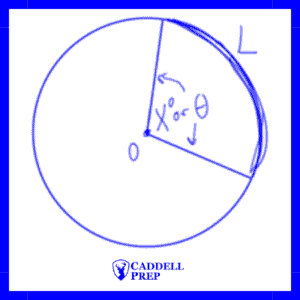
The ratio between the central angle and a full circle (360^o or 2\pi radians) is equal to the ratio between the arc length and the full circumference.

Diagram of Central Angle and Arc Length
\dfrac{X}{360}=\dfrac{L}{C}

X is the central angle in degrees, L represents the arc length, and C is the circumference

\dfrac{\theta}{2\pi}=\dfrac{L}{C}

\theta is the central angle in radians, L represents the arc length, and C is the circumference

Central Angle & Sector Area

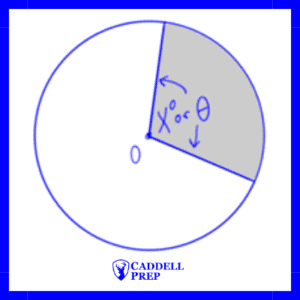
Also, the ratio between the central angle and a full circle (360^o or 2\pi radians) is equal to the ratio between the sector area and the full area.

Central Angle and Sector Area Diagram
\dfrac{X}{360}=\dfrac{S}{A}

X is the central angle in degrees, S represents the sector area, and A is the area

\dfrac{\theta}{2\pi}=\dfrac{S}{A}

\theta is the central angle in radians, S represents the sector area, and A is the area

Example
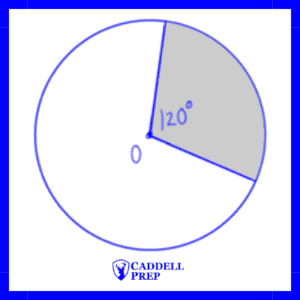
Central Angle 120

Circle O, shown above, has a radius of 6 inches. What is the area of the shaded portion of the circle?

Explanation & Solution
\dfrac{X}{360}=\dfrac{S}{A}

We have to solve for S. However, we need to find the area first, so we can substitute it in for A.

A=\pi r^2A=\pi (6)^2A=36\pi

Now, we can substitute the values into the proportion.

\dfrac{X}{360}=\dfrac{S}{A},

\dfrac{120}{360}=\dfrac{S}{36\pi},

cross-multiply to get

4,320\pi = 360S

divide both sides by 360 to get

12\pi=S

We could have also seen that 120 is one third of the full 360, so the area will be one third of the full area.

Video Explaining the Relationship Between Radians and Degrees, Plus an Example of the Conversion

3. Angles and Intercepted Arcs

  • Central angle = arc measure. Central angles have a vertex at the center of the circle. The arc that the angle intercepts has a measure equal to the measure of the central angle.
  • Inscribed angle = half the arc measure. An inscribed angle has its vertex on the circle. The arc that it intercepts is double the measure of the inscribed angle.
    • A common inscribed angle is one that intercepts a semicircle. Since a semicircle is half of the circle, it has a measure of 180^o. The inscribed angle is half of that, 90^o, so it’s a right angle.
  • Tangent lines. A tangent line touches the circle at exactly one point and is perpendicular to the radius drawn to that point. Because a diameter contains a radius, a diameter and a tangent also meet at 90°. This perpendicularity often creates a right triangle you can solve with the Pythagorean theorem.

Example: An inscribed angle intercepts a 100^o arc. The angle = \dfrac{100}{2} = 50^o

4. What is the Equation of a Circle? (Center-Radius Form)

(x-h)^2+(y-k)^2=r^2
where the center of the circle is (h,k) and the radius is r

For example, if the center of a circle is (2,-5) and the radius is 8, the equation would be (x-2)^2+(y+5)^2=64.

If the equation of a circle is (x+3)^2+(y-5)^2=8, then the center of the circle is (-3,5) and the radius is \sqrt{8}, which could be reduced to 2\sqrt{2}.

How Do I Complete the Square to Get a Circle in Center-Radius Form?

Sometimes we cannot immediately determine the center and radius of a circle from the equation because it’s not in center-radius form.

For example, if we were given the equation of circle x^2+y^2-6x+2y=4, the center and radius aren’t readily identifiable.

To get the equation in center-radius form, we need to complete the square twice.

x^2+y^2-6x+2y=4

First we have to organize the x-terms together and y-terms together.

x^2-6x + y^2+2y=4

Now, we have to complete the square, by first halving and squaring the coefficients in front of the variables raised to the first power (the coefficients of x and y)

x^2-6x + y^2+2y=4,

(\dfrac{-6}{2})^2=9

and

(\dfrac{2}{2})^2 = 1

9 will complete the square for the x-terms and 1 will complete the square for the y-terms. We have to add the numbers into the equation, but make sure to add them on the right side of the equation also.

x^2-6x +9 + y^2+2y+1=4+9+1,

x^2-6x +9 + y^2+2y+1=14

We can now factor x^2-6x+9 and y^2+2y+1. We will end up with the circle equation in center-radius form.

x^2-6x +9 + y^2+2y+1=14

factors to 

(x-3)(x-3)+(y+1)(y+1)=14

Notice that we have repeated factors. That is the result of completing the square.

The equation can be rewritten as

(x-3)^2+(y+1)^2=14

Now, we can identify the center as (3, -1) and the radius as \sqrt{14}.

Tips

  1. The formulas for circumference and area are provided on the test, but they are worth memorizing for speed.
  2. It is easier to remember the proportions in a circle if you understand the concept behind the proportions that exist between the central angle and the area/arc length.
  3. If a question asks about finding a specific point on a circle, it is usually easiest to find the point from the graph of the circle in Desmos.
  4. Triangles drawn inside a circle with two sides that are radii are isosceles triangles since the two sides that are radii are congruent.

Example

A circle has a diameter of 18. What is the circumference of the circle?

A) 9\pi
B) 18\pi
C) 36\pi
D) 81\pi

Video Explanation

Text Explanation

Answer: B) 18\pi

The circumference of a circle is given by the formula C=\pi d, where d is the diameter. Since the diameter is 18, the circumference is

C=\pi(18)=18\pi

Therefore, the circumference of the circle is 18\pi.

Practice Problems with Video Explanations

Here is a set of practice Digital SAT Circles practice problems. After selecting an answer, press “See Answer” to see the correct answer and a video explanation showing how to properly solve the questions. At the end of the set, after you press “Submit”, you’ll be able to see all of the questions, answers, and video explanations to review.

For more practice like this, enroll in our on-demand SAT prep course here: https://caddellprep.com/sat/prep/on-demand/

1. In the xy-plane, the equation of a circle is (x+3)^2+(y-5)^2=64. What is the diameter of the circle?

Question 1 of 3

2. A circle with center O has radius 5. Point P lies outside the circle, and segment \overline{PT} is tangent to the circle at point T. If \overline{OP}=13, what is the length of \overline{PT}?

Question 2 of 3

3. In the xy-plane, a circle has equation x^2+y^2-10x+4y+c=0 where c is a constant. If the circle is tangent to the x-axis, what is the value of c?

Question 3 of 3


Common Mistakes

Three common mistakes students make when answering circles questions are trying to find the radius of a circle from the equation while it is not in standard form, messing up negatives when identifying the center of the circle, and making a mistake converting radians to degrees.

Trying to find the radius of a circle from the equation of a circle not in standard form

A common mistake is to try to find the radius of a circle from the equation of a circle not in standard form. For example, a given equation may be x^2+4x+y^2-8y=16. It would be incorrect to treat 16 as r^2 and calculate the radius to be 4. The formula isn’t in standard notation, (x-h)^2+(y-k)^2=r^2.

The equation in standard form is (x+2)^2+(y-4)^2=36. Therefore, r^2 is 36 and the radius is 6.

Messing up the negatives when identifying the center of the circle from the equation of the circle in standard form

A common mistake is to mess up the negatives when identifying the center of the circle from the equation of the circle in standard form. 

The standard form of the equation of a circle is

(x-h)^2+(y-k)^2=r^2

Notice that there are minus signs in front of the coordinate h and k. Therefore, if the equation has a minus sign in front of the coordinate, the coordinate is positive. Similarly, if the equation has a plus sign in front of the coordinate, the coordinate is negative.

For example, the center of the circle with the equation (x-5)^2+(y+2)^2=7 has a center at (5, -2).

There’s a minus sign in front of the 5, so the 5 is positive, and there’s a plus sign in front of the 2, so the 2 is negative.

Making a mistake in the conversion from radians to degrees, or vice-versa

A common mistake is to mix up the conversion from radians to degrees. On the reference table, you can see that 360^o equals 2\pi rad.

That has to be your starting ratio in any proportion you are setting up. 

For example, \dfrac{degrees}{radians}=\dfrac{360}{2\pi}

Frequently Asked Questions

Here are two frequently asked questions that I get from students when reviewing circles.

How can I find the radius of a circle if I have the equation, but it's not in standard form, and I don't know how to complete the square?

You can find the radius of a circle if you have the equation, even if it’s not in standard form and you don’t know how to complete the square. The simplest way is to graph the equation as-is in Desmos. Desmos will make a graph of your circle. Then, you have to click the bottom of the circle and top of the circle. Write down what the y coordinates are for both points, then subtract the smaller number from the larger number. This will give you the diameter. The radius is just half of the diameter, so cut the diameter in half.

How can I find the center of a circle from its graph on Desmos?

Finding the center of a circle from its graph on Desmos is similar to finding its radius. Graph the equation as-is in Desmos. Desmos will make a graph of your circle. Then, you have to click the bottom of the circle and top of the circle. Write down what the coordinates are for both points. The two points should have the same x-coordinates and different y-coordinates. The x-coordinate is the x-coordinate of the center of the circle. The y-coordinate of the center of the circle is the average of the top and bottom y-coordinates.

For example, if the top and bottom coordinates are (-3, -5) and (-3, 17), then the x-coordinate of the center is -3. The y-coordinate of the center is the average of -5 and 17, which is 6. Therefore, the coordinates of the center of the circle are (-3, 6).

Related Topics

Angles, Polygons, & 3-D Shapes and Ratios & Proportions are topics related to Circles.

Angles, Polygons, & 3-D Shapes

Circle questions on the SAT sometimes include angles, polygons, or other shapes. For example, a question may show a triangle, square, or rectangle inside or around a circle. In these questions, students often need to use properties of the shape first before using circle formulas. Therefore, practicing angles, polygons, and 3-D shapes can help students solve more difficult circle questions.

Ratios & Proportions

Ratio and proportion concepts can appear in circle questions. For example, students may need to compare the radii, diameters, circumferences, or areas of two circles. Since the radius, diameter, and circumference are all directly related, proportional reasoning can help students solve these questions more quickly. Therefore, reviewing ratio and proportion questions can help students improve on circle questions.

All Math Topics

All of our math topics are available here: https://caddellprep.com/sat/prep/how-to/mathematics/ for you to review and improve on your SAT. There are lessons, practice problems, and video explanations for you. If you need more help, try our on-demand SAT course with video lessons, practice tests, and sets of questions for each topic: https://caddellprep.com/sat/prep/on-demand/

Glyn Caddell

Glyn Caddell holds a BS in Mechanical Engineering from NJIT and has been tutoring New York City students since 2008. He founded Caddell Prep in 2012 and is the author of Digital SAT Math Secrets: Lessons & Tricks to Quickly Improve to a Perfect 800 on the Math Test, which contains over 900 practice problems and is used in Caddell Prep’s SAT math classes. He is founding president of the Staten Island Technical High School alumni association and teaches every lesson on this site personally.