
Home » The Digital SAT: What’s Tested, How It’s Scored, and How to Improve Your Score » SAT Prep Options: How Many Hours You Need, What Each One Costs » How to Choose SAT Prep: Classes, Tutoring, Self-Study, and Free Options » Can You Study for the SAT on Your Own? The Two Things It Takes
By Glyn Caddell, BSME · Author of Digital SAT Math Secrets · Tutoring since 2008 — Published September 24, 2026
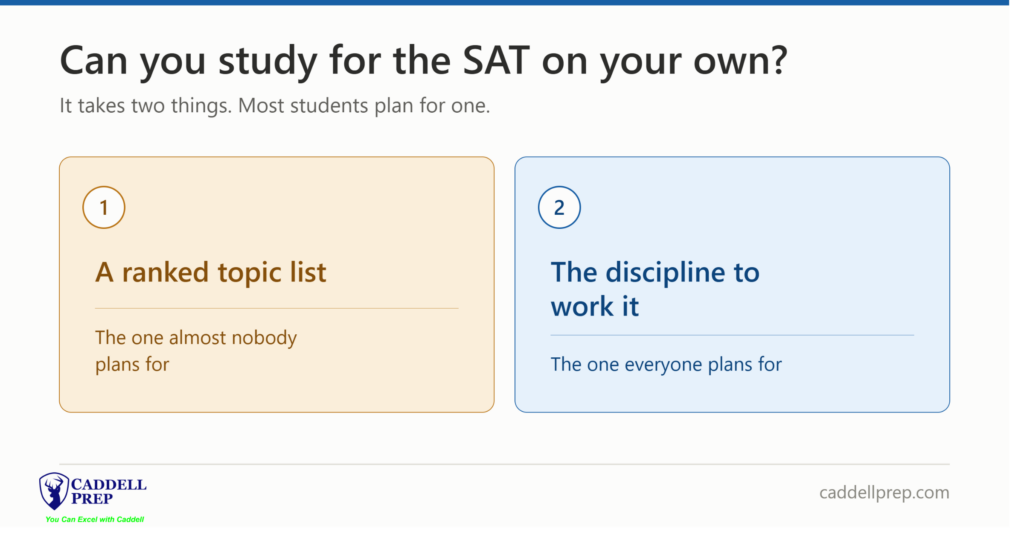
Self-study works for more students than test prep companies admit, and for fewer than students believe.
It takes two things. Most students plan for one of them and find out about the other from a practice test that didn’t move.
This page covers both, how to tell which one you’re missing, and what it looks like when self-study is quietly failing.
A note about who’s telling you this. Caddell Prep sells SAT courses, classes, and tutoring. This page explains how to prepare without buying any of it.
Everything you need is here, including where to get a ranked topic list for free. Nothing is held back to make a point.
Table of Contents
- What Does Self-Study Actually Require?
- Which of the Two Are You Missing?
- Where Do You Get a Topic List for Free?
- How Do You Stay on Schedule Without a Class?
- When Does Self-Study Stop Working?
- What Should You Do If It Isn’t Working?
What Does Self-Study Actually Require?
Two things, and they’re not the two you’d expect.
The discipline to do the work. This is the one everyone plans for. Sitting down on a Tuesday night without anyone telling you to.
A correct topic list. This is the one almost nobody plans for, and it’s the one that quietly wastes months.
Here’s what happens when the second one is missing. A student studies hard for eight weeks. He works through material, does practice problems, and puts in real hours. Then he takes a practice test and the score has barely moved.
The effort was real. It went to topics that weren’t costing him points.
There are 32 topics on the Digital SAT and they aren’t tested equally. Linear functions is 15% of the math section. Exponents is 1.3%. A student who spends three weeks on exponents because it felt hardest has spent three weeks on approximately one question.
The important thing about these two requirements is that they come apart. A student can have either one without the other, and the fix is completely different depending on which is missing.
Which of the Two Are You Missing?
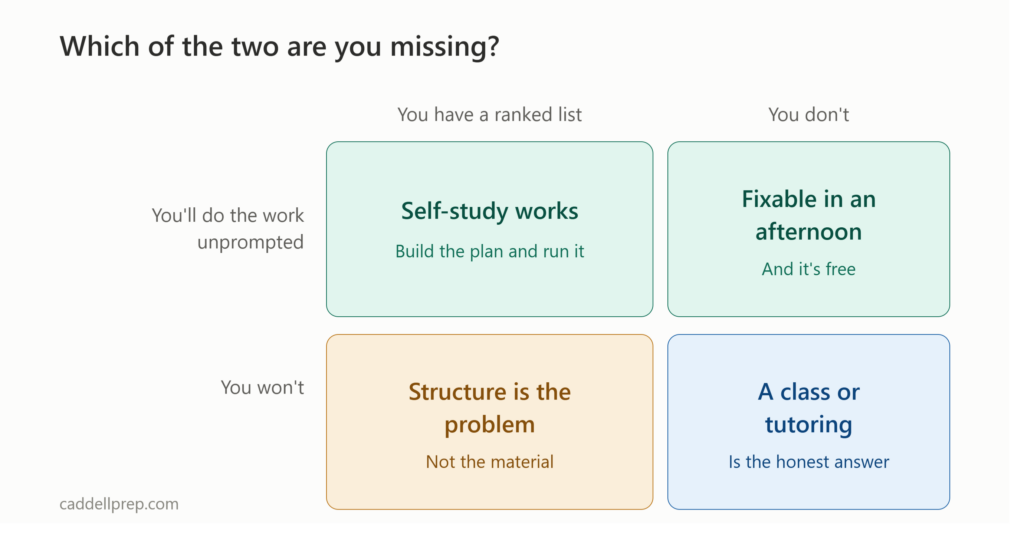
| You have a ranked topic list | You don’t have a ranked topic list | |
|---|---|---|
| You’ll do the work unprompted | Self-study works. This page is your plan. | Fixable in an afternoon, and it’s free. |
| You won’t do the work unprompted | The material isn’t the problem. Structure is. | A class or tutoring is the honest answer. |
Work out which of the two you’re missing before deciding anything else, because three of those four boxes don’t call for spending money.
Top left. Self-study works for you. Build the plan and run it.
Top right. You have the harder half already. A ranked list costs nothing and takes an afternoon to get, and the next section covers where.
Bottom left. You know what to study and it isn’t happening. Material won’t fix this, and buying a better course won’t either. What’s missing is a reason to start on a given evening, and there are ways to build one without paying.
Bottom right. Both missing. This is where a class or tutoring genuinely helps, and it’s a fact about your situation rather than about your ability.
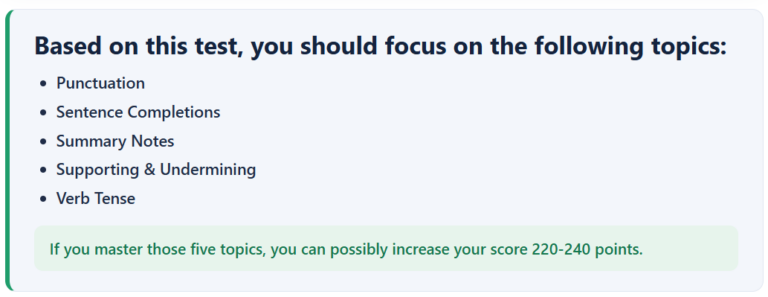
Want to Know What 5 Topics Will Improve Your SAT Score the Most?
Sample Feedback from our Diagnostic Test:
Where Do You Get a Topic List for Free?
Two ways, and both cost nothing.
Take a diagnostic with a topic assessment. A free diagnostic SAT gives an accurate score based on College Board scoring, plus a ranked list of which of the 32 topics are costing you the most points. That list is the plan. Other free tools do something similar, and Khan Academy’s skill tracking points you in a direction after a Bluebook practice test.
Or build one from the frequency data. We published how often each topic appears on released tests, and it’s free to read. A student with no diagnostic at all can start at the top of that list and be working on the right things.
The shortcut, if you want to start today: the three most common math topics are linear functions, combining like terms and solving equations, and angles, polygons and 3-D shapes. The three most common Reading & Writing topics are words in context, punctuation, and summary notes. Those six cover approximately 39% of the test.
That’s not as good as knowing your own weak spots. It’s much better than guessing, and it’s better than what most students study.
See the 17 Digital SAT math topics and the 15 Digital SAT Reading & Writing topics for the full data.
That’s the fixable requirement handled. The other one is harder.
How Do You Stay on Schedule Without a Class?
Think about what a class actually sells. Twenty-four hours of instruction, yes. But also a fixed time, a room, and an instructor who notices when you aren’t there.
A student working alone can build substitutes for most of that, and almost nobody tries.
Put a time on the calendar, not an hours target. “Six hours a week” becomes Friday, then next week. “Tuesday and Thursday, 7 to 9” becomes a habit. This is the single highest-return change a self-studying student can make.
Book a practice test in advance. A date on a calendar is a deadline, and a deadline is what makes the two weeks before it real. Book the next one before you finish reviewing the last one.
Ask a parent to check the score report, not the studying. “Did you study?” produces a yes. “Can I see the last practice test?” produces the actual information, and it takes the enforcement off the student.
Find someone sitting the same test date. Comparing practice test scores with a friend does more for consistency than any app.
What doesn’t work: intending to study more, collecting resources, and subscribing to things. All three feel like progress and none of them put you in a chair.
Even with all of that in place, self-study fails in a predictable way and on a predictable schedule.
When Does Self-Study Stop Working?
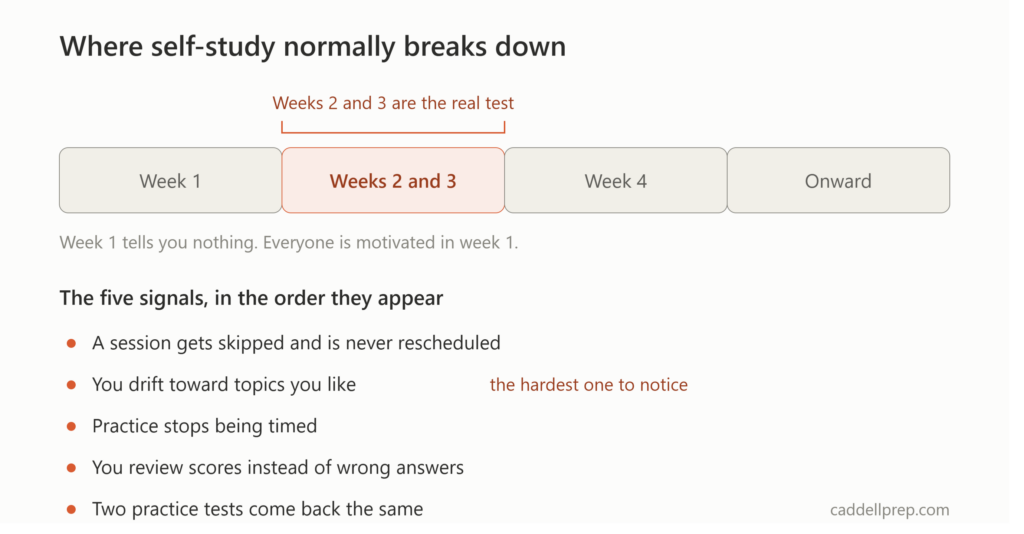
Week 1 tells you nothing. Everyone is motivated in week 1 and every plan looks like it’s working.
Weeks 2 and 3 are the real test. This is where self-study either turns into a habit or quietly stops, and knowing that’s coming makes it more likely you’ll get through it.
Here are the five signals, in the order they normally appear.
- A session gets skipped and isn’t rescheduled. One skipped session is nothing. One skipped session that never gets made up is the start.
- You drift toward topics you like. Covered below, and it’s the worst one.
- Practice stops being timed. Untimed practice is a different skill from the test.
- You review scores instead of wrong answers. Looking at a score tells you where you are. Looking at what you got wrong is what moves it.
- Two practice tests in a row come back the same. This is the clearest signal and also the latest one.
The second one deserves more attention than it gets.
Drifting toward comfortable topics is the most dangerous thing on that list because it doesn’t feel like anything is wrong. You’re studying. You’re doing problems. You’re getting most of them right, which feels good, and that’s exactly the problem. You’re practicing what you can already do.
It’s invisible to the student doing it. The only defence is a ranked list that tells you what you’re supposed to be working on, which is why the two requirements at the top of this page are connected rather than separate.
If you recognize any of these, the question is what to change.
What Should You Do If It Isn't Working?
Stalling is information, not failure. It tells you which of the two requirements is missing, and that decides what to change.
The cheapest fix comes first, because for a lot of students it’s the only one needed.
Fix the Topic List First
If you’ve been studying without a ranked list, don’t conclude that self-study failed. You haven’t tested it yet.
Get the list, work the top of it for three weeks, and take a practice test. If the score moves, the approach was fine and the direction was wrong.
A free diagnostic SAT gives you the list and the baseline in one sitting.
Add Structure Without Adding Cost
If the list was right and the sessions weren’t happening, go back to the substitutes above. A fixed time, a booked practice test, and a parent who asks to see the score report will fix more cases than a new course would.
Give that two or three weeks before deciding it hasn’t worked. The change to measure is whether the sessions happened, not whether the score moved yet.
How to Choose SAT Prep
If both requirements are missing, self-study isn’t the right question. The format question is, and there are four answers rather than two.
See how to choose SAT prep, which covers free resources, self-paced courses, classes, and tutoring, and the three questions that decide between them.
Caddell Prep vs Khan Academy
This page is about whether you can self-study. That one is about what to self-study with.
If you’ve decided to work on your own and you’re choosing between free and paid material, see Caddell Prep vs Khan Academy.
How Long Does Self-Study Take?
The same hours as any other format, spread over more calendar time.
A 70 to 130 point improvement takes approximately 40 hours of effective studying, based on the students we’ve worked with since 2008. A 130 to 250 point improvement takes approximately 80.
Self-study normally takes longer in elapsed weeks than the same hours in a class, and the reason isn’t effort. It’s that unscheduled hours are harder to protect, so a student doing six hours a week on paper often does four.
Plan for that rather than being surprised by it. More on SAT study plans and how many hours a week each timeline needs.

Glyn Caddell
Glyn Caddell holds a BS in Mechanical Engineering from NJIT and has been tutoring New York City students since 2008. He founded Caddell Prep in 2012 and is the author of Digital SAT Math Secrets: Lessons & Tricks to Quickly Improve to a Perfect 800 on the Math Test, which contains over 900 practice problems and is used in Caddell Prep’s SAT math classes. He is founding president of the Staten Island Technical High School alumni association and teaches every lesson on this site personally.
Finally, an SAT course that students actually understand
Every question has a video explanation. Not most — every one.
The on-demand Digital SAT course covers all 17 math topics and 15 reading and writing topics, with 5 full-length practice tests and a 100-point score increase guarantee. Keep access for the rest of high school. No subscription.
Want to Know What 5 Topics Will Improve Your SAT Score the Most?
Sample Feedback from our Diagnostic Test: